
The Unseen Realm
Demonology
What Scripture actually says about the unseen adversary — named, bounded, and already defeated.
Summary
What Scripture actually says about the unseen adversary: named, bounded, and already defeated. The page keeps to the text and says where tradition goes further.
- The Gospels treat the demonic as a front line, not a backdrop.
- Christ's authority is total; the cross sealed the defeat.
- Scripture names them without giving them a mythology.
- The believer's standing is Christ's victory, not technique.
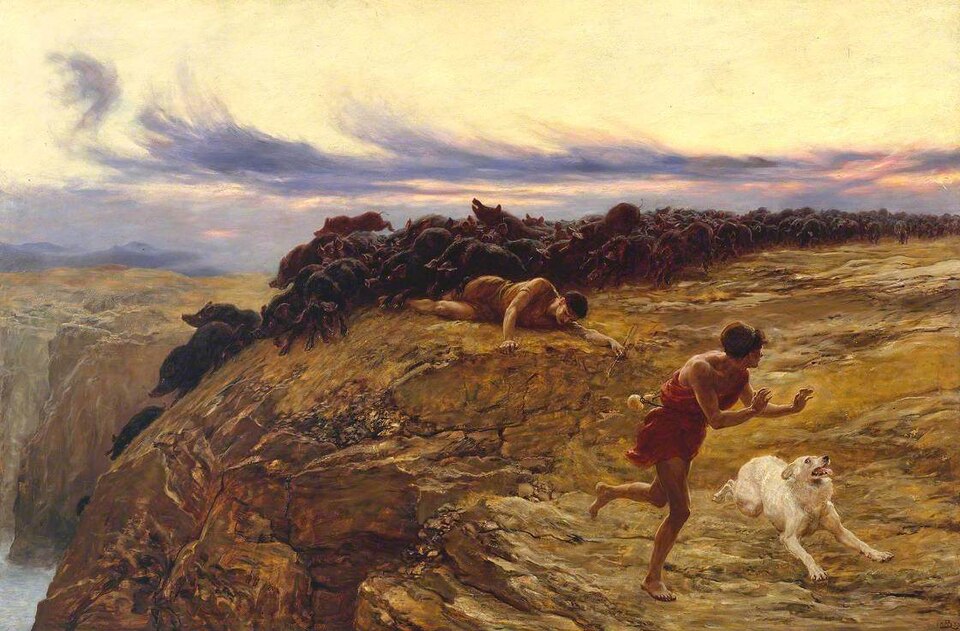
The Miracle of the Gadarene Swine — Briton Rivière
Briton Rivière, The Miracle of the Gadarene Swine (1883) — Public domain, via Wikimedia Commons
The Unseen Realm
What Scripture calls them
The Bible speaks of the demonic in plain lexical terms, not myth. In the Old Testament, Israel is charged with sacrificing to shedim, "demons," not-God, gods their fathers never knew (Deut 32:17; Ps 106:37), and with worshiping se'irim, the "goat-demons" of the high places (Lev 17:7; 2 Chr 11:15). The New Testament tightens the vocabulary: daimonion (G1140) appears more than sixty times, and the paired phrase pneuma akatharton, "unclean spirit," fixes the essential trait, these are impure, and they defile.
The Gospels give the sharpest anatomy. Demons are disembodied: an unclean spirit, cast out, "passeth through waterless places, seeking rest" and craves a body to inhabit (Matt 12:43-45). They are territorial and self-aware, Legion names itself, negotiates, and above all dreads abyssos, the abyss (Luke 8:31). And they are not deaf idols: they speak, they recognize Christ as "the Holy One of God" (Mark 1:24), and they obey when commanded out. This is the reason the Gospels resist every attempt to read "demon" as mere ancient idiom for illness.
A fever does not confess Christ's identity; these do. Scripture's demonology is therefore neither sensational nor embarrassed. It states the reality flatly, and then bounds it just as flatly, every clause anchored to a verse, nothing invented.
"And there was in their synagogue a man with an unclean spirit — literally, 'in an unclean spirit' — that is, so entirely under demoniacal power that his personality was sunk for the time in that of the spirit. The frequency with which this character of 'impurity' is ascribed to evil spirits — some twenty times in the Gospels — is not to be overlooked." — Jamieson, Fausset & Brown, Commentary Critical and Explanatory on the Whole Bible (1871), on Mark 1:23
The Unseen Realm
Where did they come from?
Scripture states that demons are, that they are unclean, and that Christ rules them, but it never hands down a single sentence on their origin. Three readings compete, and each deserves a fair hearing.
The fallen-angels view holds that demons are angels who fell with Satan, reading Revelation 12:4, 9 ("the third part of the stars") alongside Isaiah 14 and Ezekiel 28. It is the simplest account and dominant since Augustine, but it leaves unexplained why demons hunger so specifically for bodies.
The Watchers view, the spirits of the Nephilim, is this site's flag. On this reading, demons are the disembodied spirits of the Nephilim, the offspring of the Genesis 6 union between the "sons of God" and the daughters of men, who perished in the Flood and now roam bodiless. This reading explains two of the oddest features of the Gospel data: why demons crave embodiment (Matt 12:43-45) and why they beg not to be sent to the abyss (Luke 8:31).
It is rooted in 1 Enoch 15:8-12, a labeled Second Temple study resource, not Scripture, and never treated as Scripture here. Chuck Missler's Return of the Nephilim lecture series argues the same case at length from 1 Enoch, Jubilees, and patristic sources, and pushes it further, that the same fallen-angel agency stands behind the modern "alien" phenomenon (Alien Encounters, with Mark Eastman, 1997).
The fuller treatment of the "sons of God," the Flood, and the post-Flood giant clans lives at Watchers and the Nephilim.
Other readings include pre-Adamite spirits (a gap-theory variant) and a merged view that folds the Watchers into the general angelic fall. Demythologizing readings, "demon" as idiom for sickness, founder on the Gospel narratives themselves, where the spirits speak and are commanded (Mark 1:24-25). The site labels its posture as a posture; the texts are given whole so the reader can weigh them.
The Unseen Realm
Christ's authority and the believer's standing
In the Gospels the demonic is a front line, not a backdrop. Christ's public ministry opens with an exorcism in the Capernaum synagogue, where the crowd marvels that "with authority he commandeth even the unclean spirits, and they obey him" (Mark 1:27). At Gerasa, Legion, a host strong enough to break chains, can only beg (Luke 8:26-33). Charged with casting out demons by Beelzebul, Jesus answers that no one plunders a strong man's house until the strong man is bound (Matt 12:28-29): the exorcisms are the binding, visible.
The believer's standing flows directly from this. When the seventy return elated that "even the demons are subject unto us" (Luke 10:17), Christ redirects the joy: "rejoice not, that the spirits are subject unto you; but rejoice that your names are written in heaven" (Luke 10:20, ASV). Authority is real but derivative; the enrolled name is the ground. Paul frames the ongoing conflict as a wrestle "not against flesh and blood" and issues armor for it (Eph 6:10-18), while insisting the decisive battle is already won: at the Cross, Christ "despoiled the principalities and the powers" and "made a show of them openly" (Col 2:15).
That authority did not lapse with the apostles. In this site's tradition, deliverance is continuing, ordinary pastoral ministry, not a first-century relic, see Does deliverance ministry continue today? for the case and the honest counter-argument it answers.
So the posture is neither fear nor fascination. "The demons also believe, and shudder" (Jas 2:19), belief without submission. The believer's belief submits, and therefore stands: "resist the devil, and he will flee from you" (Jas 4:7), because "greater is he that is in you than he that is in the world" (1 John 4:4).
"They either were, or at least would be thought to be, a legion, formidable as an army with banners; and now, at least, to be, what the twentieth legion of the Roman army, which was long quartered at Chester, was styled, legio victrix — a victorious legion." — Matthew Henry, Commentary on the Whole Bible (1710), on Luke 8:27
Follow a thread
- Does deliverance ministry continue today?
- The Gospels bind the strong man once. MannaFest's house position is that the binding is still being applied.
Concepts · the unseen adversary
The anatomy of the unclean spirit
Scripture never mythologizes the demonic and never sensationalizes it. It names it, bounds it, and defeats it. Dissected, the biblical picture holds five parts, and every one of them ends under authority.
Unclean spirit
πνεῦμα ἀκάθαρτον
- Domain
- the air · tombs · the parched places
- Craving
- embodiment (Matt 12:43-45)
- Dread
- the abyss (Luke 8:31)
Its limits
- Under God
- acts by permission (Job 1:12)
- Under Christ
- cast out by a word (Mark 1:27)
- Under the Cross
- disarmed (Col 2:15)
The vocabulary
Four words Scripture uses
The Bible speaks of the demonic in plain lexical terms across both testaments, from the idols Israel sacrificed to, to the spirits that dread the pit.
Gospel activity
Christ's campaign against the powers
In the Gospels the demonic is not a background theme, it is a front line. The spirits know Christ, name Him "the Holy One of God," and obey when commanded (Mark 1:24-27). Each encounter narrows their ground.
The believer's standing
Where the joy actually rests
Nevertheless, do not rejoice that the spirits submit to you, but rejoice that your names are written in heaven.”Authority over demons is real, but it is never the ground of joy. The enrolled name is.
The fall
How the tradition has pictured it

Contested
Where did they come from?
Scripture states that demons are, that they are unclean, and that Christ rules them. It does not hand down a single sentence on their origin. Three readings compete, presented at full strength here; the site's posture is labeled as the site's posture.
◈The three origin readingscontested · Contested, Scripture underdetermines
Demons are angels who fell with Satan (Rev 12:4, 9, "the third part of the stars"), read alongside Isa 14 and Ezek 28. Dominant since Augustine; simplest, but leaves the demons' hunger for bodies unexplained.
Revelation 12 · KJV
Demons are the disembodied spirits of the Nephilim, offspring of the Genesis 6 union, who perished in the Flood and now roam bodiless. This alone explains why demons crave embodiment (Matt 12:43-45) and beg not to be sent to the abyss (Luke 8:31). Rooted in 1 Enoch 15:8-12 — a labeled Second Temple study resource, not Scripture. This is the site's flag.
1 Enoch 15Second Temple study resource
Pre-Adamite spirits (a gap-theory variant); a merged reading that folds the Watchers into the general angelic fall; and demythologizing readings that treat "demon" as ancient idiom for illness, which the Gospels resist, since the spirits speak, know Christ, and are commanded out (Mark 1:24-25).
Two confessions
What the demons say, and the answer
The demons tremble
Belief without submission
"You believe that God is one. Good for you! Even the demons believe that—and shudder."
James 2:19 · BSB
Legion knew exactly who Jesus was, "Son of the Most High God", and it changed nothing but their fear (Mark 5:7).
The believer resists
Belief that stands
"Submit yourselves, then, to God. Resist the devil, and he will flee from you."
James 4:7 · BSB
"Greater is he that is in you, than he that is in the world" (1 John 4:4), the ground the demons never stand on.
Go deeper
Four doorways
Origin
The sons of God (Genesis 6)The passage under the site's origin flag, read the Watchers text whole.Word study
daimonion · G1140The word the Gospels use 60-plus times, trace every occurrence.Narrative
Legion and the swine (Luke 8)The clearest window into what a demon is, wants, and fears.Standing
The whole armor (Ephesians 6)The believer's standing set out piece by piece, the wrestle named.Search every occurrence of demon, spirit, and the abyss across the 66 books.
Keep Studying
On this page
People and groups1