
Place
Patmos
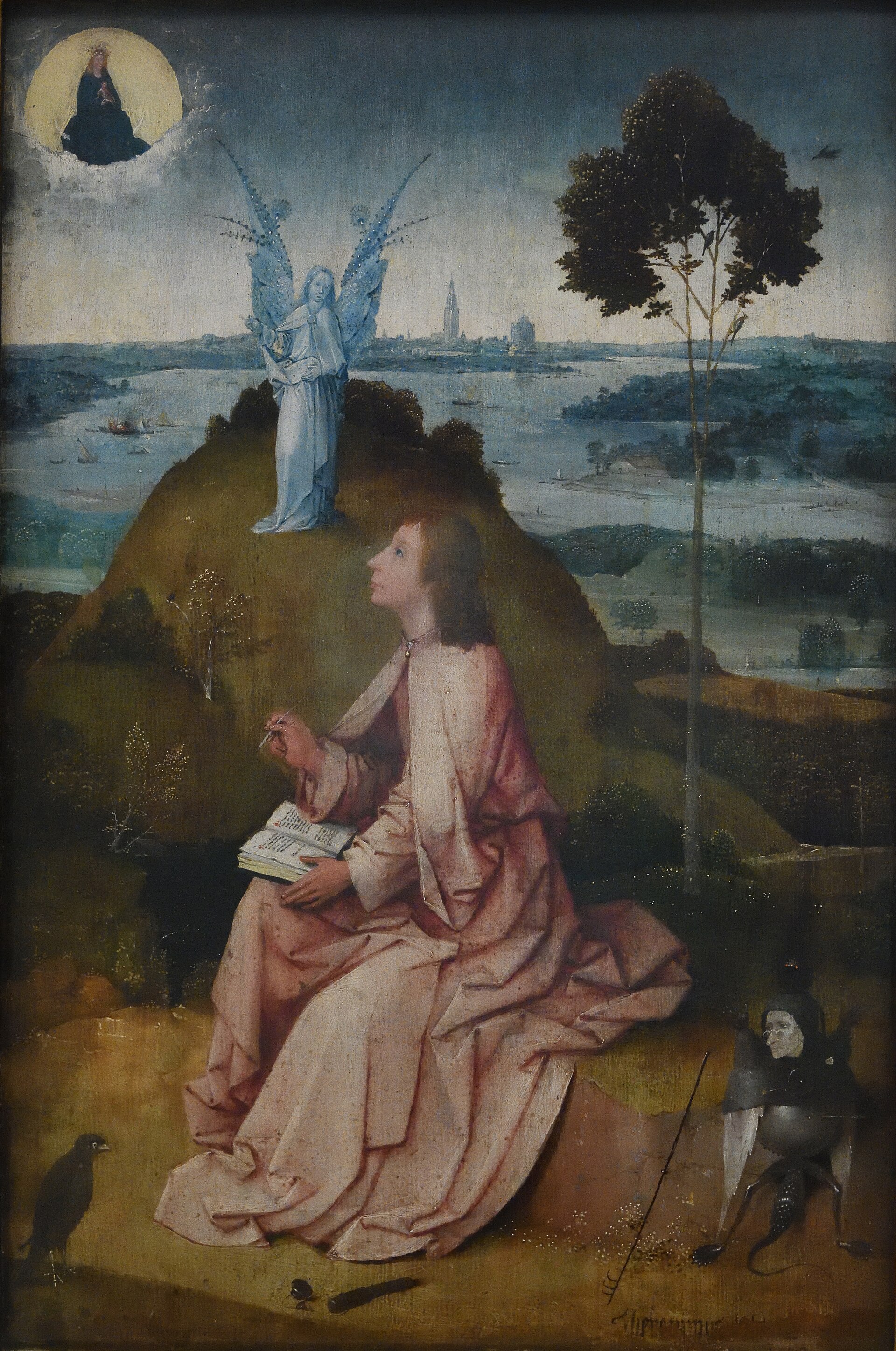
Hieronymus Bosch, Saint John the Evangelist on Patmos, about 1500. Gemäldegalerie, Berlin. Photograph CC BY-SA 4.0.
Summary
Small rocky island of the Aegean where John was exiled "for the word of God and the testimony of Jesus" and received the Revelation on the Lord's day.
- Patmos is named once in the whole Bible, at Revelation 1:9, and that one verse is the address the last book of Scripture was written from.
- John was on the island under a Roman sentence of banishment, and he calls his own situation tribulation in the sentence that names the place.
- On the Lord's day he heard a voice behind him and turned to see the risen Christ standing among seven golden lampstands.
- The vision is told in the words of Daniel 7 and 10 and Ezekiel 1. All three men were outside the land and under a foreign power when they were shown the throne.
- Which emperor sent him, and whether he was put to work in mines, are genuinely disputed. This page names the positions and settles neither.
On this page
In Scripture
- Verses
- 1
- Books
- 1
Near Patmos
Straight-line distances, computed from the gazetteer coordinates.
Where it is
the country around it
- Coordinates
- 37.3075° N, 26.5483° Efind it on the Atlas →
- Region
- Aegean Sea
- Kind of place
- Region
1 place the record names with Patmos, the farthest 102 km away
- Placed: the point stands for an area, or is rounded
- A dashed line ends at a place the gazetteer does not fix
Why Patmos matters
What has been found
the evidence, and where it is disputed
The vision of the Son of Man
Revelation 1:9 to 1:20, in the order it happens
Read Revelation 1:9 to 1:20, in the order it happens
- The man, the place, and the reasonRevelation 1:9I, John, your brother and partner in the tribulation and kingdom and perseverance that are in Jesus, was on the island of Patmos because of the word of God and my testimony about Jesus.
- The day, the Spirit, and a voice behind himRevelation 1:10On the Lord’s day I was in the Spirit, and I heard behind me a loud voice like a trumpet,
- The commission, and the seven cities namedRevelation 1:11saying, “Write on a scroll what you see and send it to the seven churches: to Ephesus, Smyrna, Pergamum, Thyatira, Sardis, Philadelphia, and Laodicea.”
- He turns, and sees seven golden lampstandsRevelation 1:12Then I turned to see the voice that was speaking with me. And having turned, I saw seven golden lampstands,
- One like the Son of Man among themRevelation 1:13and among the lampstands was One like the Son of Man, dressed in a long robe, with a golden sash around His chest.
- White hair, blazing eyes, a voice like many watersRevelation 1:14-15The hair of His head was white like wool, as white as snow, and His eyes were like a blazing fire. His feet were like polished bronze refined in a furnace, and His voice was like the roar of many waters.
- Seven stars, a sword, and a face like the sunRevelation 1:16He held in His right hand seven stars, and a sharp double-edged sword came from His mouth. His face was like the sun shining at its brightest.
- He falls as a dead man, and a hand is laid on himRevelation 1:17When I saw Him, I fell at His feet like a dead man. But He placed His right hand on me and said, “Do not be afraid. I am the First and the Last,
- The keys of Death and of HadesRevelation 1:18the Living One. I was dead, and behold, now I am alive forever and ever! And I hold the keys of Death and of Hades.
- Write, and what the two symbols meanRevelation 1:19-20Therefore write down the things you have seen, and the things that are, and the things that will happen after this. This is the mystery of the seven stars you saw in My right hand and of the seven golden lampstands: The seven stars are the angels of the seven churches, and the seven lampstands are the seven churches.
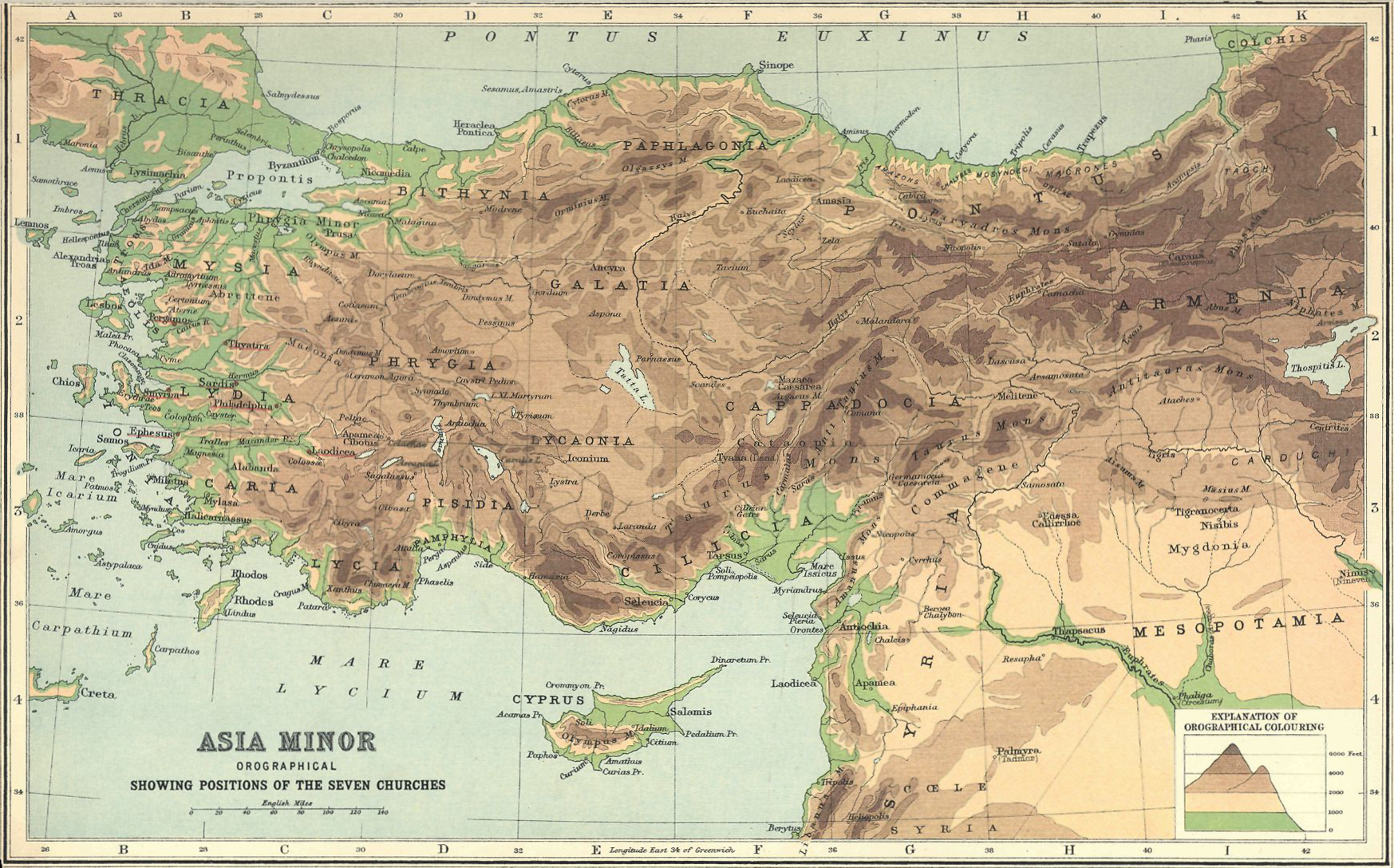
The seven cities dictated at verse 11 form a circuit on the mainland: Ephesus on the coast, north to Smyrna and Pergamum, then inland and southeast through Thyatira, Sardis, Philadelphia and Laodicea. William Ramsay argued in The Letters to the Seven Churches of Asia (1904) that this is the order a courier would ride, which is why the letters stand in that order rather than by size or importance.
John on Patmos: Revelation 1, the full studyWhat happened here, in order
in the order the canon tells it
- An exile by the Kebar sees visions of GodEzekiel 1:1In the thirtieth year, on the fifth day of the fourth month, while I was among the exiles by the River Kebar, the heavens opened and I saw visions of God.
- One like the Son of Man comes to the Ancient of DaysDaniel 7:13In my vision in the night I continued to watch, and I saw One like the Son of Man coming with the clouds of heaven. He approached the Ancient of Days and was led into His presence.
- The man dressed in linen, with a belt of fine goldDaniel 10:5I lifted up my eyes, and behold, there was a certain man dressed in linen, with a belt of fine gold from Uphaz around his waist.
- John on the island of PatmosRevelation 1:9I, John, your brother and partner in the tribulation and kingdom and perseverance that are in Jesus, was on the island of Patmos because of the word of God and my testimony about Jesus.
- On the Lord's day, in the SpiritRevelation 1:10On the Lord’s day I was in the Spirit, and I heard behind me a loud voice like a trumpet,
- Write to the seven churchesRevelation 1:11saying, “Write on a scroll what you see and send it to the seven churches: to Ephesus, Smyrna, Pergamum, Thyatira, Sardis, Philadelphia, and Laodicea.”
- The Son of Man among the lampstandsRevelation 1:13and among the lampstands was One like the Son of Man, dressed in a long robe, with a golden sash around His chest.
- Do not be afraidRevelation 1:17When I saw Him, I fell at His feet like a dead man. But He placed His right hand on me and said, “Do not be afraid. I am the First and the Last,
- The outline of the whole book in one sentenceRevelation 1:19Therefore write down the things you have seen, and the things that are, and the things that will happen after this.
- Antipas killed at Pergamum, under the same pressureRevelation 2:13I know where you live, where the throne of Satan sits. Yet you have held fast to My name and have not denied your faith in Me, even in the day when My faithful witness Antipas was killed among you, where Satan dwells.
- The open door, and the setting leaves the islandRevelation 4:1After this I looked and saw a door standing open in heaven. And the voice I had previously heard speak to me like a trumpet was saying, “Come up here, and I will show you what must happen after these things.”
- The last prayer in the Bible, prayed on PatmosRevelation 22:20He who testifies to these things says, “Yes, I am coming soon.” Amen. Come, Lord Jesus!
Where it points
The voices
each quoted from the work named
Was in the island, etc. The story is known, that John was banished to this island by Caesar Domitian because of the gospel, to whom it was fittingly given to penetrate the secrets of heaven when he was forbidden to exceed certain earthly spaces.
In the affliction, and kingdom and patience of Jesus - The kingdom stands in the midst. It is chiefly under various afflictions that faith obtains its part in the kingdom; and whosoever is a partaker of this kingdom is not afraid to suffer for Jesus, 2 Tim. ii, 12.
I was in the Spirit - That is, I received the Spirit of prophecy, and was under its influence when the first vision was exhibited. The Lord’s day - The first day of the week, observed as the Christian Sabbath, because on it Jesus Christ rose from the dead; therefore it was called the Lord’s day, and has taken place of the Jewish Sabbath throughout the Christian world. And heard behind me a great voice - This voice came unexpectedly and suddenly. He felt himself under the Divine afflatus; but did not know what scenes were to be represented.
3 more teachers on these versesCharles Spurgeon · Victorinus of Pettau · Jerome
The gray old saint in Patmos had been familiar with his Master more years than most of us have known Him. He had laid his head upon the Savior's bosom—a privilege accorded to none beside himself. He had stood at the Cross and seen the blood and water flow from that dear heart that loved him so well and yet, though he was "that disciple whom Jesus loved," when he had a sight of his glorified Master, he fell at His feet as dead!
He says this, because when John said these things he was in the island of Patmos, condemned to the labour of the mines by Caesar Domitian. There, therefore, he saw the Apocalypse; and when grown old, he thought that he should at length receive his quittance by suffering, Domitian being killed, all his judgments were discharged. And John being dismissed from the mines, thus subsequently delivered the same Apocalypse which he had received from God.
In the fourteenth year then after Nero Domitian having raised a second persecution he was banished to the island of Patmos, and wrote the Apocalypse, on which Justin Martyr and Irenæus afterwards wrote commentaries.
Patmos in Scripture
1 verse names it, in 1 book
Open a book to read its mentions here. Text: Berean Standard Bible.
The account
Read the account as one telling
People lived on Patmos long before John. The hill above the harbour at Skala, called Kastelli, carries the walls of an ancient acropolis, built in large blocks and enclosing a small fortified settlement. It is the main visible ancient site on the island. Greek inscriptions from Patmos record a sanctuary of Artemis, worshipped here as Artemis Patmia.
Thucydides mentions the island once, in the History of the Peloponnesian War 3.33, where the Spartan commander Alcidas puts in there while being pursued. That is about five hundred years before John, and it shows what the place was: a stopping point on a working sea lane.
Pliny the Elder lists Patmos among the Aegean islands in his Natural History 4.69 and gives its circuit as thirty Roman miles, about forty-four kilometres. He names it and moves on. He does not call it a prison, a penal colony or a quarry, and this page reports what he says and stops there.
Revelation 1:9 puts John on the island and gives the reason, and it names no emperor and no year. Christian writers of the following centuries supply what the verse leaves out. Irenaeus, about AD 180, says the vision was seen towards the end of Domitian's reign. Clement of Alexandria, about AD 200, has John returning from Patmos to Ephesus after the tyrant was dead, and does not name the tyrant. Eusebius, about AD 325, places the banishment in Domitian's fifteenth year and reports the release and return to Ephesus under Nerva. Jerome repeats the Domitianic account in 392. The date is disputed, and the positions and their holders are set out further down this page.
- fifth century
The rest of the island's Christian story begins much later. The Acts of John by Prochorus, an apocryphal work of the fifth century, tells of John's exile with a disciple named Prochorus and of the Apocalypse dictated to him. It is not Scripture and it is not history. Most of the island's local tradition traces back to it, including the scribe who stands beside John in later paintings.
The Cave of the Apocalypse is a grotto on the slope between Skala and Chora, enclosed in a monastery and venerated as the place where John received the vision. The identification of that particular cave is not attested in the earliest sources. It has been a place of prayer for many centuries, and no excavated object ties it to John.
In 1088 the monk Christodoulos founded the Monastery of Saint John the Theologian on the height above Chora, under a chrysobull of the emperor Alexios I Komnenos granting him the island. The monastery is fortified, and it has been in use ever since. That foundation is the firmest date on the island.
Its library has grown from the foundation onward into one of the important surviving monastic libraries of the Greek world, with hundreds of manuscripts and an archive reaching back to 1088, including leaves of a sixth-century purple Gospel codex.
Common questions
Where is Patmos, and how big is it?
Patmos is a small island of the Dodecanese in the southeastern Aegean, off the coast of what the New Testament calls the province of Asia. It covers about thirteen square miles, roughly thirty-four square kilometres, and it lies about forty miles from the nearest point of the mainland and about sixty miles from Ephesus. Pliny the Elder listed it among the Aegean islands in the first century and gave its circuit as thirty Roman miles. It was close enough that a letter written there reached the seven cities in days.
Why was John on Patmos?
He says so himself. He was there because of the word of God and his testimony about Jesus. He names no emperor, no court and no sentence. Everything else a reader has heard about the exile comes from Christian writers of the following centuries, and this page names each of them with their dates.
Which emperor banished John, and when?
Readers differ; the positions are named
The oldest surviving answer is Irenaeus, writing about AD 180, who says the vision was seen towards the end of Domitian's reign, which would put it about AD 95. Clement of Alexandria, Victorinus, Eusebius and Jerome all follow that line, and it is the majority reading today.
A minority argues for the reign of Nero, about AD 65 to 68, from Revelation 11:1 to 11:2, which seems to assume a temple still standing, and from the count of kings at Revelation 17:9 to 17:10. John A. T. Robinson and Kenneth Gentry are the modern names attached to that case, and the Syriac heading of Revelation names Nero. An older tradition naming Claudius survives in Epiphanius and Apringius and has almost no support now. The evidence for both is set out further up this page.
Was Patmos a prison colony? Was John sent to the mines?
Readers differ; the positions are named
Roman law had two forms of island banishment, and the lighter one, relegatio, left a man at liberty on the island with his citizenship intact. No surviving Roman source names Patmos as an exile island, and none describes mines there.
The claim that John was condemned to the mines comes from Victorinus of Pettau, writing about AD 300, and it is repeated after him. William Ramsay argued in 1904 that it is Victorinus's own inference rather than a record. What the text says is that John was on the island because of the word of God, and he calls his own situation tribulation in the same sentence.
What does it mean that John was in the Spirit on the Lord's day?
The Lord's day is the first day of the week, and Revelation 1:10 is the earliest surviving Christian use of the phrase. Being in the Spirit is not a mood. John uses the same words at three later turns of the book, and each time he is carried somewhere: into heaven, into a wilderness, and onto a high mountain.
On Patmos it means he was brought by the Spirit of God into a state in which he heard and saw what was shown to him. Adam Clarke's note adds the detail that matters most: the voice came suddenly, and John did not know what was coming.
Is the cave you can visit on Patmos the place where John saw the vision?
The Bible says nothing about a cave. It says John was on the island. The grotto now called the Cave of the Apocalypse has been venerated for centuries and is enclosed in a monastery, and much of the local tradition around it traces back to the Acts of John by Prochorus, an apocryphal work of the fifth century that tells of John dictating the book to a disciple.
The identification of that particular cave is not attested in the earliest sources. It is a place of prayer with a long history, and no excavated object ties it to John.
Why does the vision sound so much like Daniel and Ezekiel?
Because John is quoting them. The white hair like wool comes from Daniel 7:9, the title Son of Man from Daniel 7:13, and the linen robe, the golden sash, the blazing eyes and the feet like polished bronze from Daniel 10:5 to 10:6. The voice like the roar of many waters and the collapse to the ground come from Ezekiel 1.
All three men were outside the land and under a foreign power when they were shown the throne. John writes in a vocabulary his readers already had, and he applies every line of it to Jesus.
Notable art
3 verified pieces depicting Patmos
Sources cited
- OpenBible.info Bible Geocoding: Patmosread 2026-08-20The coordinates on this page. Used under CC-BY with attribution to OpenBible.info.
- Pliny the Elder, Natural History, Book 4, on the Aegean islandsNames Patmos and gives its circuit as thirty Roman miles. Public domain.
- Thucydides, History of the Peloponnesian War 3.33Alcidas puts in at Patmos while being pursued. Public domain.
- Irenaeus, Against Heresies 5.30.3, about AD 180The earliest statement of the Domitianic date.
- Clement of Alexandria, Who Is the Rich Man That Shall Be Saved? 42, about AD 200The return from Patmos to Ephesus after the tyrant was dead.
- Tertullian, The Prescription Against Heretics 36, about AD 200The banishment to an island, with no emperor and no island named.
- Victorinus of Pettau, Commentary on the Apocalypse of the Blessed John, about AD 300The earliest source for the mines. Quoted on this page from the site's own pool.
- Eusebius of Caesarea, Ecclesiastical History 3.18 to 3.20 and 3.23, about AD 325The exile, the release under Nerva, the return to Ephesus.
- Jerome, De Viris Illustribus 9, AD 392The Domitianic account. Quoted on this page from the site's own pool.
- Epiphanius of Salamis, Panarion 51Cited for the ancient variant that places the exile under Claudius.
- Acts of John by Prochorus, fifth centuryApocryphal. Cited as the source of the island's later local traditions, and labelled as such on the page.
- Digest of Justinian, title 48.22, on relegatio and deportatio in insulamThe Roman law of island banishment.
- William M. Ramsay, The Letters to the Seven Churches of Asia (London: Hodder and Stoughton, 1904)The courier circuit behind the order of the seven, and the argument that the sentence was relegatio. Public domain.
- Ian Boxall, Patmos in the Reception History of the Apocalypse (Oxford University Press, 2013)In copyright. Cited for the dating of the island's Christian sites, not quoted.
- Otto F. A. Meinardus, St. John of Patmos and the Seven Churches of the Apocalypse (1974)In copyright. Cited for the topography and the ancient remains, not quoted.
- John A. T. Robinson, Redating the New Testament (SCM Press, 1976)In copyright. Cited for the Neronian position, not quoted.
- Kenneth L. Gentry Jr., Before Jerusalem Fell: Dating the Book of Revelation (1989)In copyright. Cited for the Neronian position, not quoted.
- UNESCO World Heritage List, item 942, inscribed 1999The inscription of Chora with the monastery and the cave.
- Charles H. Spurgeon, The Metropolitan Tabernacle Pulpit, Sermon No. 2689Public domain, CCEL edition.
- John Wesley, Explanatory Notes upon the New Testament (1755)Public domain.
- Adam Clarke, Commentary on the Bible (1832)Public domain.
- Bede, Commentary on Revelation (735)Quoted on this page from the site's own ingested translation.
- Hieronymus Bosch, Saint John the Evangelist on Patmos, about 1500, Gemäldegalerie BerlinThe hero image. Photograph CC BY-SA 4.0.
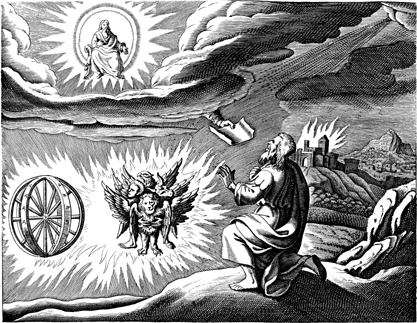
- Raphael, Ezekiel's VisionPublic domain.
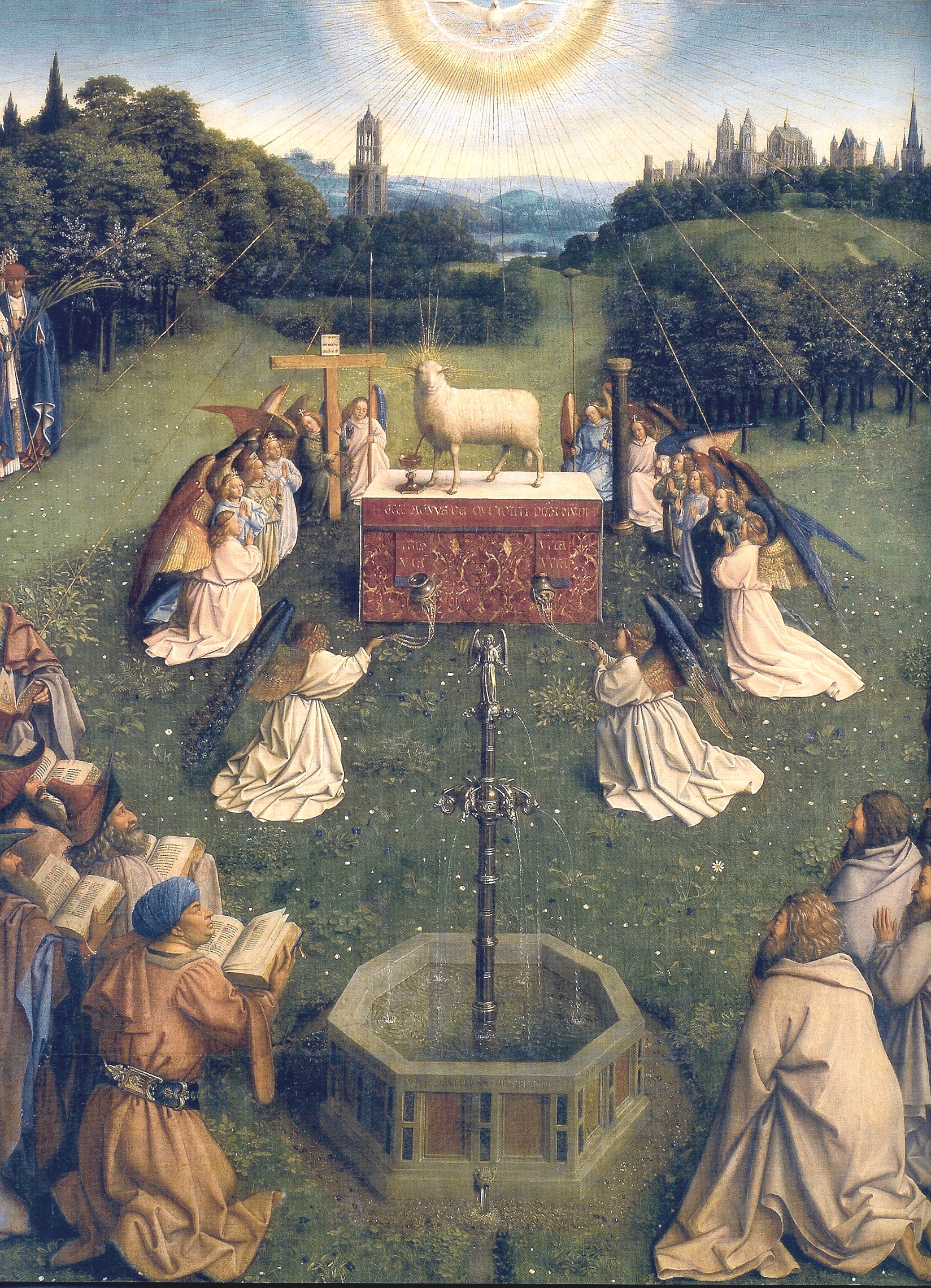
- Jan van Eyck, The Adoration of the Lamb, Ghent AltarpiecePublic domain.
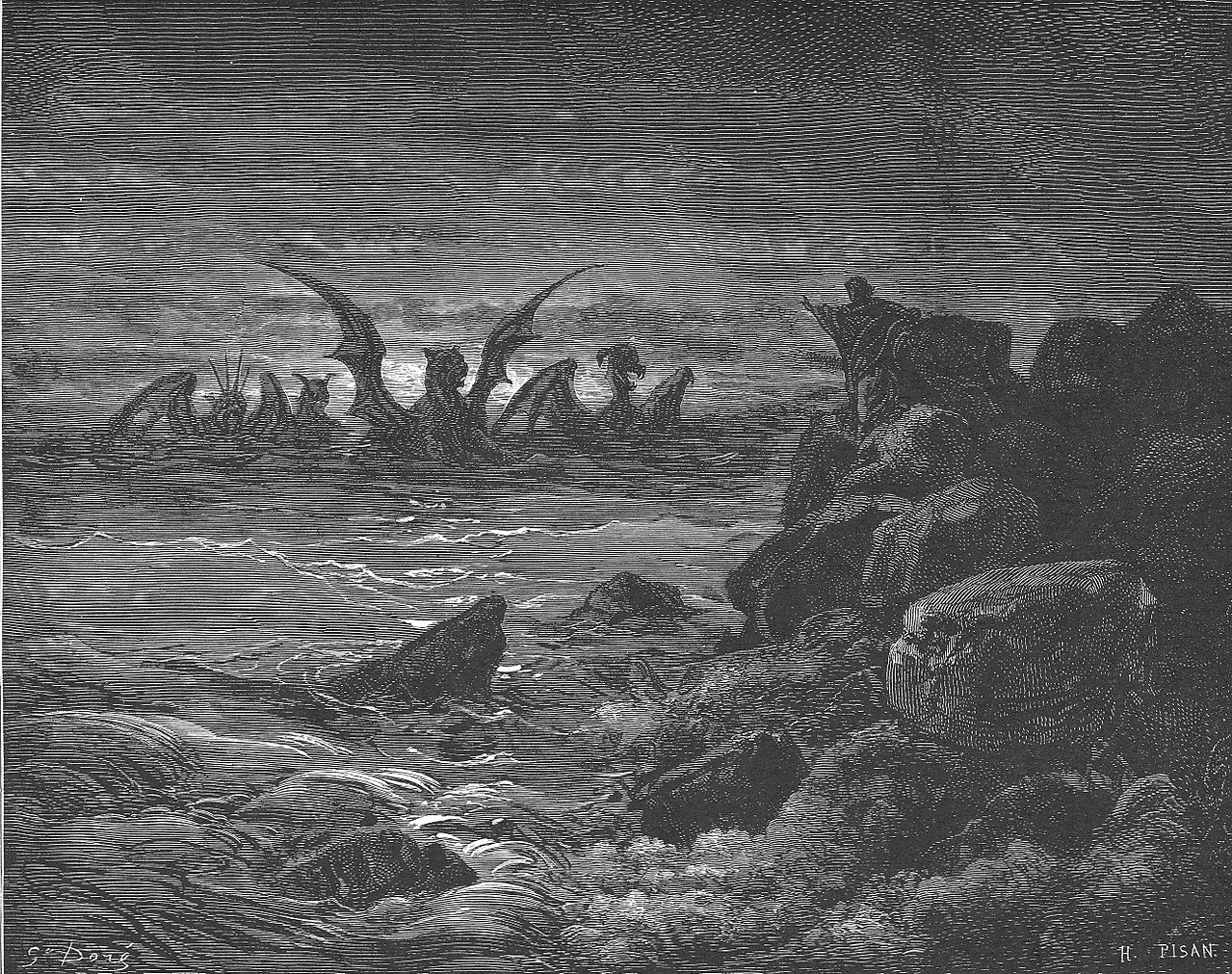
- Gustave Doré, La Sainte Bible (Tours: Alfred Mame et fils, 1866), plate 132Public domain.
Keep studying
On this page
Studies8
Lives that run through it1
Doorway2
Keep this page