

Genesis 30:35 · Symbol · Featured Study
White
A symbol study of the colour, with the Hebrew and Greek words and two readings in dispute.
Laban's name is the Hebrew word for white, and Jacob peeled branches down to the white inner wood to win flocks from him.
- The word
- לָבָן (laban), H3836
- First appears
- Genesis 30:35 “…goat—every one that had any white on it—and…”
Fra Angelico, The Transfiguration, 1437 to 1446. Public domain.
Summary
Scripture uses white for what is clean and for what is glorious.
- The Hebrew adjective laban stands 29 times in the Old Testament, and the Greek leukos 25 times in the New.
- Isaiah 1:18 promises that sins like scarlet will be as white as snow.
- At the transfiguration the clothes of Jesus became as white as the light.
- Revelation 7:14 says the great multitude washed their robes and made them white in the blood of the Lamb.
White in Genesis
Genesis 30:37 and Genesis 49:12, the peeled branches and the blessing of Judah.
Genesis uses the word laban of goats with white on them, of the inner wood under the bark and of Judah's teeth. Adam Clarke, in his Commentary on the Bible, notes that the poplar of Genesis 30:37, libneh, is generally taken to be the white poplar.
Jacob, however, took fresh branches of poplar, almond, and plane trees, and peeled the bark, exposing the white inner wood of the branches.The branches stand at the centre of Jacob's dealings with Laban over the flocks.
His eyes are darker than wine, and his teeth are whiter than milk.The blessing of Judah uses colour to picture a land of plenty.
White as the Light
Fra Angelico's Transfiguration in San Marco, read part by part with the verse each part answers to.
Fra Angelico painted Matthew 17:1 to 6 on the wall of a friar's cell in San Marco.
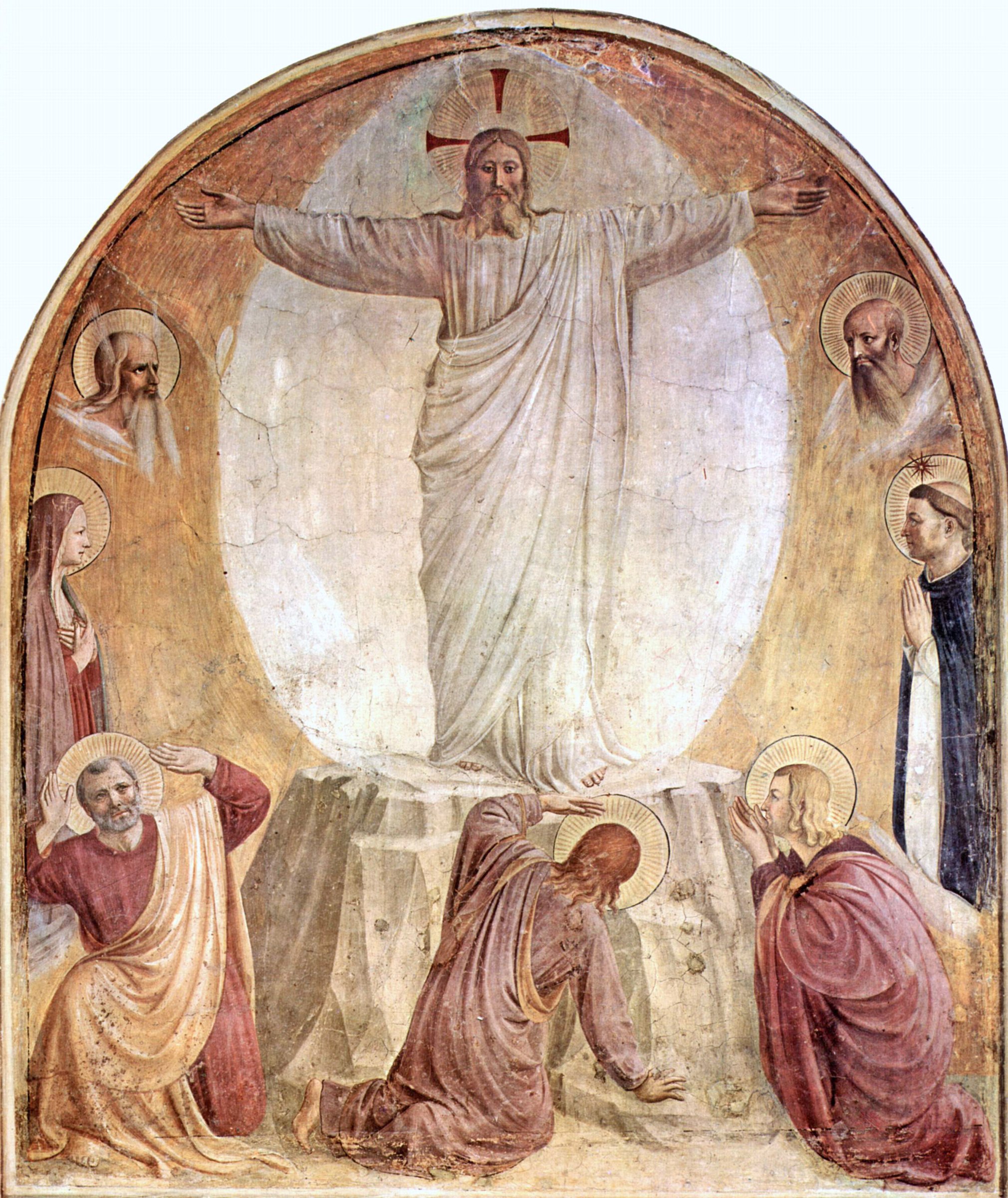
- The white robeChrist's robe is painted white against a pale oval of light.Matthew 17:2
- Moses and ElijahTwo heads appear in the gold on either side of the light.Matthew 17:3
- The mountainChrist stands on a bare rock that rises from the ground.Matthew 17:1
- The three disciplesPeter, James and John fall back on the ground, shielding their eyes.Matthew 17:6
Fra Angelico, The Transfiguration, 1437 to 1446. Public domain.
Fresco, about 1437 to 1446, cell 6 of the Convent of San Marco, Florence.
White Through Scripture
Fourteen places in canon order, from Laban's flocks to the great white throne.
Five of the fourteen stops stand in the five books of Moses.
- Genesis 30The white inner wood, Genesis 30:37
- Genesis 49Teeth whiter than milk, Genesis 49:12
- ExodusManna white like coriander seed, Exodus 16:31
- LeviticusHair turned white in a sore, Leviticus 13:3
- NumbersMiriam white as snow, Numbers 12:10
- PsalmsWhiter than snow, Psalm 51:7
- EcclesiastesGarments always white, Ecclesiastes 9:8
- IsaiahScarlet made white as snow, Isaiah 1:18
- DanielThe Ancient of Days, Daniel 7:9
- Matthew 17Clothes as white as the light, Matthew 17:2
- Matthew 28The angel at the tomb, Matthew 28:3
- Revelation 1Hair white like wool, Revelation 1:14
- Revelation 7Robes made white, Revelation 7:14
- Revelation 20A great white throne, Revelation 20:11
Each stop opens its verse in the reader.
White as snow, three waysNumbers 12:10, Isaiah 1:18 and Daniel 7:9
The same comparison marks a disease, a forgiveness and the clothing of God.
| Verse | Who or what is white | What the white marks |
|---|---|---|
| Numbers 12:10 | Miriam's skin | The LORD's judgment on her words against Moses |
| Isaiah 1:18 | Sins like scarlet | Cleansing offered by the LORD |
| Daniel 7:9 | The Ancient of Days' clothing | The holiness of the One who takes His seat to judge |
Said Outright, and Heard by Readers
Three verses that say what white means where they stand, and two readings often heard.
SINS MADE WHITE
The verse puts the colour in a promise from the LORD's own mouth.
WHITER THAN SNOW
David's prayer asks for a cleansing that no washing of his own could give.
WHITE GARMENTS TO WEAR
The risen Christ offers Laodicea white clothing to cover its shame.
Two readings of white, set beside the textLeviticus 13:3 and Daniel 7:9
Two common readings of white meet verses that read otherwise.
| Verse | The reading | What the text says |
|---|---|---|
| Leviticus 13:3 | White always stands for purity in Scripture. | Hair turned white in a sore is a sign of skin disease, and the priest pronounces the person unclean. |
| Daniel 7:9 | The white hair of the Ancient of Days pictures age alone. | Revelation 1:14 gives the same white hair, like wool and snow, to the risen Christ in His glory. |
White Garments
Clothing bleached by the launderer, and the white robes of the early church.
Mark 9:3 measures the transfiguration by the launderer's trade, since the clothes became brighter than any launderer on earth could bleach them. Ecclesiastes 9:7 to 8 tells its reader to eat his bread with joy and to let his garments always be white.
The early church dressed the newly baptized in white.
“After this white robes were given to you as a sign that you were putting off the covering of sins and putting on the chaste veil of innocence, of which the prophet said, ‘Purge me with hyssop, and I shall be cleansed; wash me, and I shall be made whiter than snow.’”
Ambrose of Milan · On the Mysteries 7:34 · on Psalm 51:7Patristic
Laban and Leukos
The Hebrew adjective and verb for white and the Greek adjective, with their counts.
The Greek adjective is used in the Gospels of the transfigured clothes and of the angels at the tomb, and in Revelation of the white stone, the robes and the throne.
laban
white
laben
to be white; to make bricks
leukos
white
The lexicon in full1 table or figure
Hebrew has a verb for becoming white beside the adjective for the colour.
| Word | Meaning | Uses |
|---|---|---|
| laban, H3836 | white | 29 |
| laben, H3835 | to be white; to make bricks | 8 |
| leukos, G3022 | white | 25 |
What Scripture Does Not Say
Three things about white and the mountain that the text leaves open.
No verse gives white one meaning for every place it stands. Revelation 2:17 promises a white stone with a new name on it and never explains the stone. Matthew 17:1 says Jesus led the three disciples up a high mountain, and it does not name the mountain.
Made White in the Blood
The promise of Isaiah and the robes of the great multitude.
“Come now, let us reason together,” says the LORD. “Though your sins are like scarlet, they will be as white as snow; though they are as red as crimson, they will become like wool.The prophet sets the offer in the middle of the LORD's charge against Judah.
“Sir,” I answered, “you know.” So he replied, “These are the ones who have come out of the great tribulation; they have washed their robes and made them white in the blood of the Lamb.The elder answers John's question about the multitude standing before the throne.
The Treasury of Scripture Knowledge links the two verses, and the second turns the first around, since in Revelation it is blood that makes the robes white.
Voices on White
Three teachers on the shining of the transfigured Christ.
died 253 · Origen of Alexandria
Origen of Alexandria, in his Commentary on Matthew, reads the shining face of the transfigured Christ as His showing Himself to the children of light, as the sun of righteousness.
died 430 · Augustine of Hippo
Augustine of Hippo, in his Sermons on New Testament Lessons, on Mark 9:3, writes that what the sun is to the eyes of the flesh, the Lord is to the eyes of the heart.
1703 to 1791 · John Wesley
John Wesley, in his Explanatory Notes upon the New Testament, on Matthew 17:2, writes that the glory of His body shone through His clothes and made them white and glittering as the very light.
Where Careful Readers Differ
Two questions about white in Revelation that readers answer in different ways.
The white stone of Revelation 2:17Victorinus of Pettau and Bede
Victorinus of Pettau, in his Commentary on the Apocalypse, reads the white stone as adoption to be a son of God and the new name on it as Christian. The objection is that the verse makes the new name known only to the one who receives it, and the name Christian is known to all.
Bede, in his Commentary on Revelation, reads the white stone as the body made white by baptism, which will then shine with the glory of incorruption. The objection is that Revelation 2:17 says nothing of baptism or of the body.
Who wears the white robes of Revelation 7John Wesley, Bede and Adam Clarke
John Wesley, in his Explanatory Notes upon the New Testament, holds that the multitude is all the souls of the righteous from the beginning of the world. He judges them too many to be the martyrs alone. The objection is that Revelation 7:14 says they have come out of the great tribulation.
Bede, in his Commentary on Revelation, reads the great tribulation as the persecution of the Antichrist, the worst of all. Adam Clarke, in his Commentary on the Bible, reads it as persecutions of every kind. The objection to both is that Revelation 7:9 calls the multitude too large to count, from every nation, and names no one time of trouble.
Books to Read Next
Two public domain works, each with a free copy to read.
Commentary on Matthew, Book 12
Origen of Alexandria · third century
He reads the launderers of the transfiguration account as the rhetoricians of the world, whose polish cannot match the Word.
Read at New AdventCommentary on the Bible
Adam Clarke · 1832
His note on Isaiah 1:18 explains the scarlet of the verse as cloth dyed twice.
Read at CCELDressed in White
The Christ whose clothes shone on the mountain promises white clothing to those who overcome.
Blessed are those who wash their robes, so that they may have the right to the tree of life and may enter the city by its gates.The text asks the reader to come and reason with the LORD, as Isaiah 1:18 invites.
Sources
Scripture is the Berean Standard Bible.
- James Strong, Exhaustive Concordance of the Bible, 1890, entries H3836, H3835, H3837 and G3022.
- The Treasury of Scripture Knowledge, on Isaiah 1:18 and Revelation 7:14.
- Adam Clarke, Commentary on the Bible, 1832, on Genesis 30:37; on Revelation 7:14; on Isaiah 1:18.
- Ambrose of Milan, On the Mysteries 7:34, on Psalm 51:7.
- Augustine of Hippo, Sermons on New Testament Lessons 28, on Mark 9:3.
- John Wesley, Explanatory Notes upon the New Testament, 1755, on Matthew 17:2; on Revelation 7:14.
- Origen of Alexandria, Commentary on Matthew 12.37 and 12.39, on Mark 9:3.
- Victorinus of Pettau, Commentary on the Apocalypse, on Revelation 2:17.
- Bede, Commentary on Revelation, on Revelation 2:17; on Revelation 7:14.
Keep Studying
Studies1
People and groups5
Symbols5
Doctrines7