
The Unseen Realm
Heaven
A house of many storeys — the three heavens, the throne room, the true tabernacle, and the new earth where God comes down to dwell.
Summary
Heaven in Scripture is a house of many storeys: the three heavens, the throne room, the true tabernacle, and finally the new earth where God comes down to dwell.
- Paul's third heaven implies the first two: sky and stars.
- The throne room is the seen center of the unseen world.
- The earthly tabernacle copied a heavenly original.
- The story ends with heaven descending, not the earth abandoned.
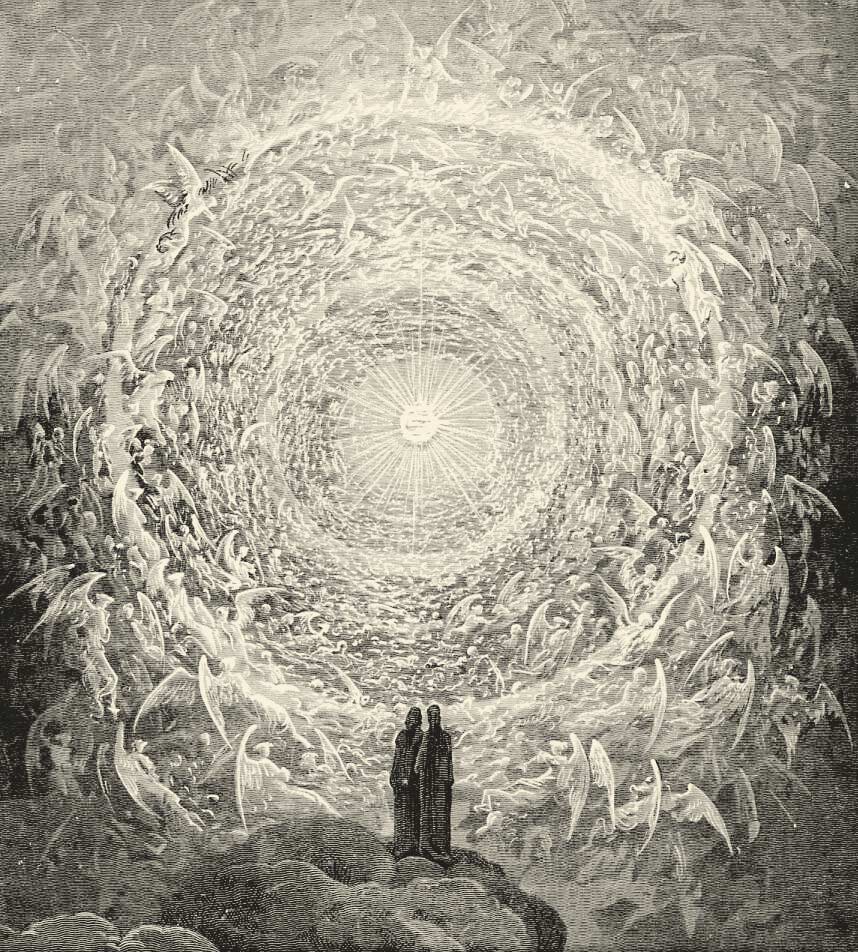
The Celestial Rose, Paradiso Canto XXXI — Gustave Doré
Gustave Doré, The Celestial Rose, Paradiso Canto XXXI (1868) — Public domain, via Wikimedia Commons
The Unseen Realm
The three heavens
The Bible does not treat "heaven" as one flat place. The Hebrew word shamayim (H8064) is plural, and Scripture stacks it into layers. The first heaven is the atmosphere, the firmament where birds fly and clouds gather (Gen 1:8, 20). The second is the celestial heaven, the expanse into which God made "the greater light to rule the day, and the lesser light to rule the night: he made the stars also" (Gen 1:14–16). Above both is a third heaven: the dwelling of God himself.
Paul is the witness to that top storey. He describes a man "caught up even to the third heaven," and in the same breath names it "Paradise," where he "heard unspeakable words, which it is not lawful for a man to utter" (2 Cor 12:2–4). The layering is confirmed elsewhere by the phrase "heaven and the heaven of heavens" (Deut 10:14; 1 Kings 8:27), a superlative that lifts God's abode above the visible sky. This is the site's reading: a threefold heaven, plainly built into the vocabulary, with the highest reserved for God.
Later Jewish writings would multiply the count to seven (2 Enoch, Testament of Levi); those are labeled study resources, not read back into the canonical text, which speaks of three without fixing a formal number.
The Unseen Realm
The throne room
When the veil of the third heaven lifts, the same room keeps appearing. Isaiah, standing in the temple, "saw the Lord sitting upon a throne, high and lifted up; and his train filled the temple" (Isa 6:1). Seraphim call to one another, Holy, holy, holy; the thresholds shake; the house fills with smoke. Seven centuries later John is shown "a throne set in heaven, and one sitting upon the throne" (Rev 4:2). Four living creatures cry the same threefold Holy; twenty-four elders cast their crowns before the throne; and the Lamb takes the sealed scroll (Rev 4–5).
Ezekiel adds a third angle, the throne-chariot borne above the firmament, "the likeness of a throne, as the appearance of a sapphire stone" (Ezek 1:26). Three prophets, three eras, one architecture: a central throne, a seated glory too bright to detail, attendant creatures, and unceasing praise. The correspondence is not coincidence but pattern, the throne room of heaven is a stable reality that breaks into human sight when God chooses to open it. Isaiah calls it the temple; John calls it heaven; both are describing the place from which the whole created order is governed.
The Unseen Realm
The heavenly temple
Hebrews makes a startling claim: Israel's tabernacle was a scale model. Moses did not design it, he copied it, building "after their pattern, which hath been showed thee in the mount" (Ex 25:40, quoted at Heb 8:5). The earthly tent was "a copy and shadow of the heavenly things," while the original is "the true tabernacle, which the Lord pitched, not man" (Heb 8:2, 5).
That original is where the argument lands. Christ, the high priest, did not enter a room in Jerusalem; he passed "into heaven itself, now to appear before the face of God for us" (Heb 9:24). He went in "through his own blood," entering "once for all into the holy place" and obtaining "eternal redemption" (Heb 9:12). Every furnishing of the old tent, altar, laver, lampstand, mercy seat, was pointing upward to this. (Full priesthood argument: the Hebrews hub.)
Whether "the true tabernacle" is an actual heavenly structure or a figure for God's unmediated presence is contested; Edersheim and others stress that the point is the pattern, the shadow-and-substance relationship, not the masonry. And Scripture closes the loop: in the new Jerusalem there is no sanctuary building at all, "for the Lord God the Almighty, and the Lamb, are the temple thereof" (Rev 21:22). The model is retired once the reality fills everything.
A shadow that was never empty
"The old tabernacle was not the empty inventions of man, but the effigy of the heavenly tabernacle."
— John Calvin, Commentaries (1554), on Hebrews 8:2
Calvin's line sharpens the contested question above: even readers who take "the true tabernacle" as a figure for God's presence, not a structure, agree the earthly copy was no human invention, it was cut to a real, disclosed pattern (Ex 25:40), whatever the pattern's ultimate nature.
The Unseen Realm
The destination: heaven comes down
Popular imagination sends the redeemed up, souls rising to a distant cloud forever. The Bible's last scene runs the other direction. John "saw the holy city, new Jerusalem, coming down out of heaven from God" (Rev 21:2). Heaven relocates to a renewed creation: "the tabernacle of God is with men, and he shall dwell with them... and he shall wipe away every tear from their eyes; and death shall be no more" (Rev 21:3–4).
This is the traditional, majority Christian reading. The final hope is not disembodied sky but bodily resurrection into "a new heaven and a new earth" (Rev 21:1), the tree of life restored, the river flowing from the throne, the nations walking in its light (Rev 22:1–5). The present experience of the believing dead, "with Christ" now (Phil 1:23), is real and conscious but not the end; it is the waiting room, not the destination. Creation is not scrapped and abandoned; it is redeemed and glorified, and God moves in permanently.
The story that began with God walking in a garden (Gen 3:8) ends with God dwelling among his people in a garden-city, the two heavens, celestial and earthly, married at last rather than exchanged. (The renewed-creation side of this argument, in full: New Heavens and New Earth; the vision's own sequence: the Revelation hub.)
Contemporary near-death-experience literature (John Burke, Imagine Heaven, 2015) treats convergent testimony among NDE accounts as suggestive corroboration of a conscious intermediate state, evidence the site weighs as substantive confirmation of Scripture, never as its ground; Scripture remains the controlling witness on what waits between death and the new earth.
"Not interrupted, as on earth"
"The presence of God with his church is the glory of the church... The presence of God with his people in heaven will not be interrupted as it is on earth, but he will dwell with them continually."
— Matthew Henry, Commentary on the Whole Bible (1710), on Revelation 21:3
The three heavens
A house of many storeys
Scripture speaks of heaven in layers. The Hebrew shamayim is a plural word, and the Bible stacks it: the sky where birds fly, the expanse where the stars burn, and above both the dwelling of God that Paul reached and called paradise(2 Cor 12:2–4). Walk up.
heaven 1 of 3
The firmament: sky and air
heaven 2 of 3
The celestial heaven: sun, moon, and stars
heaven 3 of 3
The third heaven: paradise, the throne of God
Caught up
The man who reached the third floor
I know a man in Christ, fourteen years ago (whether in the body, I don’t know, or whether out of the body, I don’t know; God knows), such a one caught up into the third heaven... how he was caught up into Paradise, and heard unspeakable words, which it is not lawful for a man to utter.Paul equates the third heaven with paradise: the top storey is God’s own dwelling.
The throne room
Two prophets, one throne
When the veil lifts, the same room appears: a throne, a seated One, fire, and endless praise. Isaiah saw it in the temple; John saw it opened in heaven. The details rhyme across seven centuries.
Isaiah 6
In the temple
“I saw the Lord sitting on a throne, high and lifted up; and his train filled the temple.” Seraphim cry Holy, holy, holy; the thresholds shake; the house fills with smoke. Isaiah 6:1–4
Revelation 4–5
In heaven
“A throne was set in heaven, and one sat on the throne.” Four living creatures cry Holy, holy, holy; twenty-four elders cast down their crowns; the Lamb takes the scroll. Revelation 4:2–5:14

The heavenly temple
The tent that Moses copied
Hebrews reads the whole tabernacle as a scale model. Moses built to a blueprint he was shown “in the mount” (Ex 25:40); the original stands in heaven, and Christ entered it: not with the blood of animals, but his own.
The true sanctuary
σκηνή
- The earthly copy
- The tabernacle, built to “the pattern shewed in the mount” (Ex 25:40; Heb 8:5).
- The true tent
- “The true tabernacle, which the Lord pitched, not man” (Heb 8:2).
- The greater sanctuary
- Christ entered “heaven itself, now to appear before God for us” (Heb 9:24).
- The better blood
- Not of goats and calves, but his own, once for all (Heb 9:12).
- The temple ends
- In the new Jerusalem: “I saw no temple therein”, God and the Lamb are its temple (Rev 21:22).
The destination
Heaven comes down
The Bible’s last scene is not souls flying up to a cloud but the holy city descending: God’s dwelling relocated to a renewed creation. The hope is bodily resurrection on a new earth, not endless disembodied sky.
Behold, God’s dwelling is with people, and he will dwell with them, and they will be his people, and God himself will be with them as their God. He will wipe away every tear from their eyes. Death will be no more; neither will there be mourning, nor crying, nor pain any more. The first things have passed away.The consummation moves heaven to earth: the two are married, not exchanged.
◈How many heavens? Where do the dead go now?contested · Contested: presented at full strength
Seven heavens.Some Second Temple writings (2 Enoch, the Testament of Levi) count seven heavens. These are labeled study resources, not Scripture; the canon speaks of a “third heaven” and the “heaven of heavens” (Deut 10:14) without fixing a number. The site does not read the sevenfold scheme back into the text.
Literal sanctuary or presence?Hebrews’ “true tabernacle” (8:2) is read by some as an actual heavenly structure of which Moses’ tent was a copy, and by others as the unmediated presence of God that no building could hold (1 Kings 8:27). The text’s weight falls on Christ’s real entry (Heb 9:24), not on the architecture.
Intermediate state.The believing dead are “with Christ” now (Phil 1:23): real, conscious, but not the end. The site’s posture: the final hope is resurrection into the new earth (Rev 21), of which present heaven is the waiting room, not the destination.
Keep walking
Doors from here
Keep Studying
On this page
People and groups1
Places1