
Laodicea
Summary
The wealthy neighbor of Colossae that received a letter from Paul now lost and the rebuke of Revelation 3 for lukewarm faith, its tepid piped water the living picture.
- Laodicea was the wealthiest of the seven churches of Revelation, and the only one with no word of praise.
- The risen Christ rebukes it as lukewarm, neither cold nor hot, and threatens to spit it out.
- Its counsel to buy gold, white garments and eye salve answers the city's own banking wealth, wool trade and medical school point for point.
- Paul wrote a letter to the Laodiceans that has not survived, and asked the Colossians to trade letters with them.
- Laodicea sat between Hierapolis's hot springs and Colossae's cold mountain water, a detail two scholars read two different ways.
On this page
In Scripture
- Verses
- 6
- Books
- 2
Near Laodicea
Straight-line distances, computed from the gazetteer coordinates.
Where it is
the country around it
- Coordinates
- 37.7699° N, 29.0645° Efind it on the Atlas →
- Region
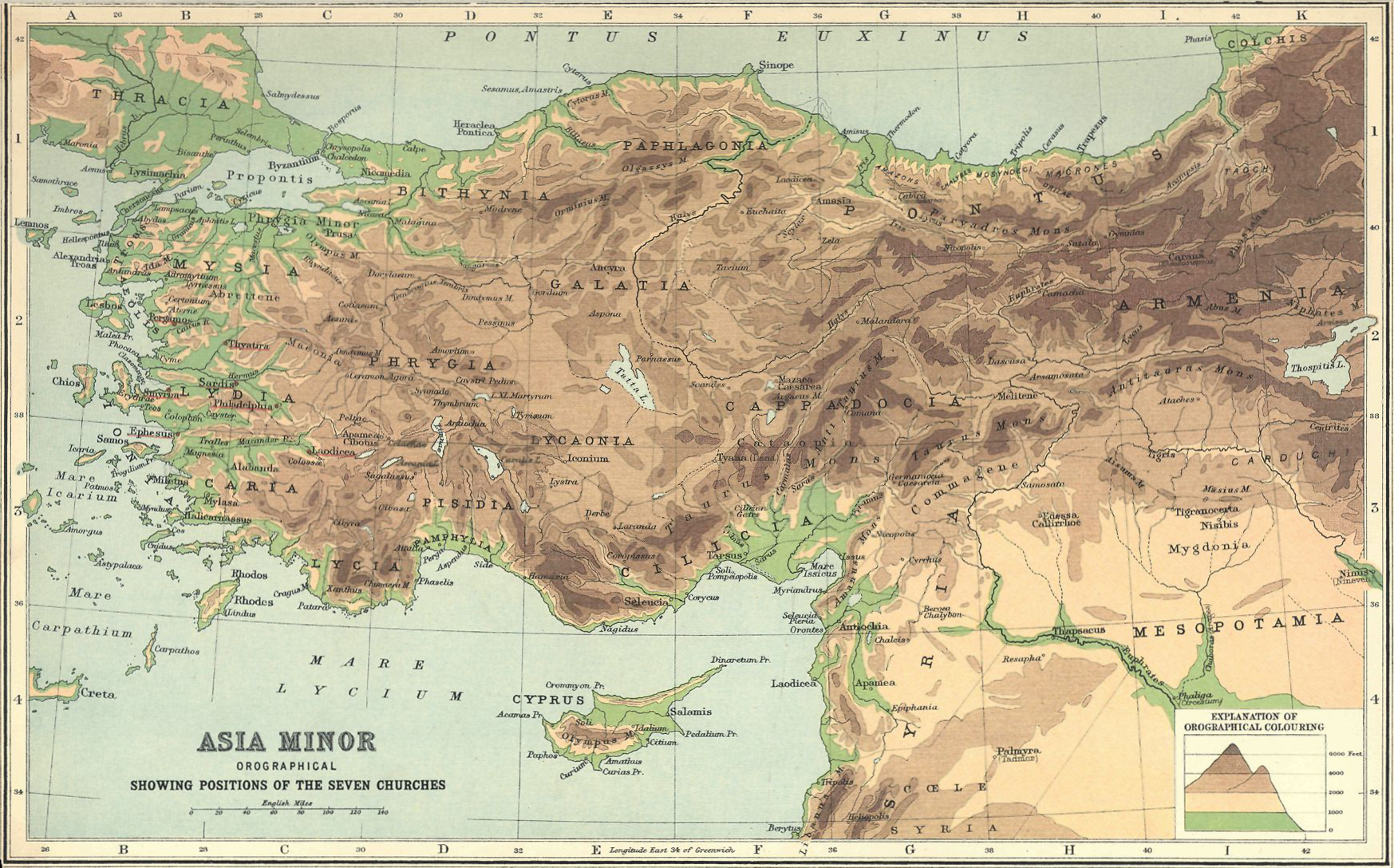
- Lycus Valley, Phrygia
- Kind of place
- City
1 place the record names with Laodicea, the farthest 18 km away
- Located: the gazetteer fixes one site
- A dashed line ends at a place the gazetteer does not fix
Why Laodicea matters
The letter to Laodicea
Revelation 3:14 to 3:22, in the order it happens
Read Revelation 3:14 to 3:22, in the order it happens
- The Amen, the faithful and true WitnessRevelation 3:14To the angel of the church in Laodicea write: These are the words of the Amen, the faithful and true Witness, the Originator of God’s creation.
- Neither cold nor hotRevelation 3:15I know your deeds; you are neither cold nor hot. How I wish you were one or the other!
- About to be spit outRevelation 3:16So because you are lukewarm—neither hot nor cold—I am about to vomit you out of My mouth!
- Rich, and wretchedRevelation 3:17You say, ‘I am rich; I have grown wealthy and need nothing.’ But you do not realize that you are wretched, pitiful, poor, blind, and naked.
- Gold, garments and salveRevelation 3:18I counsel you to buy from Me gold refined by fire so that you may become rich, white garments so that you may be clothed and your shameful nakedness not exposed, and salve to anoint your eyes so that you may see.
- Rebuke and discipline, because of loveRevelation 3:19Those I love, I rebuke and discipline. Therefore be earnest and repent.
- Standing at the door and knockingRevelation 3:20Behold, I stand at the door and knock. If anyone hears My voice and opens the door, I will come in and dine with him, and he with Me.
- The promise to the one who overcomesRevelation 3:21-22To the one who overcomes, I will grant the right to sit with Me on My throne, just as I overcame and sat down with My Father on His throne. He who has an ear, let him hear what the Spirit says to the churches.
Laodicea is the seventh and last of the seven letters (Rev 2:1 to 3:22), and the only one of the seven with no word of commendation before the correction.
Revelation: the full studyWhat happened here, in order
in the order the canon tells it
- Paul names his struggle for Laodicea, a church he had not metColossians 2:1For I want you to know how much I am struggling for you and for those at Laodicea, and for all who have not met me face to face,
- Epaphras labors in prayer for Laodicea and Hierapolis alikeColossians 4:13For I testify about him that he goes to great pains for you and for those at Laodicea and Hierapolis.
- Greetings sent to the church in the house of NymphaColossians 4:15Greet the brothers in Laodicea, as well as Nympha and the church that meets at her house.
- Paul asks the two churches to trade lettersColossians 4:16After this letter has been read among you, make sure that it is also read in the church of the Laodiceans, and that you in turn read the letter from Laodicea.
- The letter to Laodicea opensRevelation 3:14To the angel of the church in Laodicea write: These are the words of the Amen, the faithful and true Witness, the Originator of God’s creation.
- I am rich and need nothing, answeredRevelation 3:17You say, ‘I am rich; I have grown wealthy and need nothing.’ But you do not realize that you are wretched, pitiful, poor, blind, and naked.
- The counsel: gold, garments, salveRevelation 3:18I counsel you to buy from Me gold refined by fire so that you may become rich, white garments so that you may be clothed and your shameful nakedness not exposed, and salve to anoint your eyes so that you may see.
- Christ still stands at the door and knocksRevelation 3:20Behold, I stand at the door and knock. If anyone hears My voice and opens the door, I will come in and dine with him, and he with Me.
Laodicea in Scripture
6 verses name it, in 2 books
Open a book to read its mentions here. Text: Berean Standard Bible.
Old TestamentNew Testamentsegment width = share of mentions
New Testament2 books · 6 mentions
Colossians4 mentions
- Colossians 2:1For I want you to know how much I am struggling for you and for those at Laodicea, and for all who have not met me face to face,
- Colossians 4:13For I testify about him that he goes to great pains for you and for those at Laodicea and Hierapolis.
- Colossians 4:15Greet the brothers in Laodicea, as well as Nympha and the church that meets at her house.
- Colossians 4:16After this letter has been read among you, make sure that it is also read in the church of the Laodiceans, and that you in turn read the letter from Laodicea.
Revelation2 mentions
- Revelation 1:11saying, “Write on a scroll what you see and send it to the seven churches: to Ephesus, Smyrna, Pergamum, Thyatira, Sardis, Philadelphia, and Laodicea.”
- Revelation 3:14To the angel of the church in Laodicea write: These are the words of the Amen, the faithful and true Witness, the Originator of God’s creation.
Common questions
What does "neither cold nor hot" mean?
Readers differ; the positions are named
Two positions are argued from Laodicea's own water supply, and Scripture itself does not choose between them. One reading, from Rudwick and Green and carried forward by Colin Hemer's standard study, ties the words to Laodicea's piped water, which arrived lukewarm and useless between Hierapolis's hot springs and Colossae's cold mountain water. Mark Wilson, working from excavation done since 2003, argues Laodicea's water was not meaningfully different from its neighbors' and reads the temperature language as a plain picture of indifference. Both stand.
Why does Laodicea get no word of praise at all?
Of the seven churches addressed in Revelation 2 and 3, Laodicea is the one letter that opens straight into rebuke, with nothing commended before the correction begins.
What does the counsel to buy gold, garments and salve answer?
Each item answers a specific source of Laodicea's own pride. Gold refined by fire answers the city's banking wealth. White garments answer its renowned black wool trade. Salve to anoint the eyes answers its medical school's own famous eye remedy. The cure is built from the city's own boasts.
Did Paul write a letter to the Laodiceans?
Colossians 4:16 names a letter from Paul that the church at Colossae was to pass on to Laodicea, and asks the Colossians to read the letter that came from Laodicea in turn. That letter has not survived, and this page does not identify it with any other document carrying a similar title.
How close was Laodicea to Colossae and Hierapolis?
All three towns sat in the Lycus Valley within a day's walk of one another. Epaphras, who founded the church at Colossae, is said to labor in prayer for both Laodicea and Hierapolis at the same time.
Sources cited
- OpenBible.info Bible Geocoding: Laodicearead 2026-08-20The coordinates on this page. Used under CC-BY with attribution to OpenBible.info.
- Berean Standard BibleAll Scripture text on this page, from the site's own verse store. Public domain since 2023.
- Tacitus, Annals 14.27The ancient source behind the traditional AD 60 date for the earthquake that struck Laodicea; a minority reading (Eusebius, Orosius) places it after AD 64. Cited by name; not directly quoted.
Keep studying
On this page
Books that name it2
Doorway2
Keep this page