
Ephesus
Summary
Great harbor city of Asia, home of the Artemis temple; Paul's three-year base where the word grew mightily; addressed in Ephesians and first of the seven churches of Revelation.
- Ephesus was the leading city of Roman Asia, and Paul's two years teaching daily in the hall of Tyrannus was the longest single stay of his ministry.
- Seven sons of a Jewish chief priest tried to use Jesus' name like a magic formula and were overpowered by the very spirit they tried to command.
- Fear of the Lord spread through the city, and converts publicly burned magic books worth fifty thousand pieces of silver.
- A silversmith named Demetrius started a riot over the threat Paul's preaching posed to the trade in silver shrines of Artemis, and the city clerk had to dismiss the crowd.
- Ephesus received Paul's letter, held Timothy's charge against false teaching, and stands first among the seven churches addressed in Revelation.
On this page
In Scripture
- Verses
- 17
- Books
- 6
Near Ephesus
Straight-line distances, computed from the gazetteer coordinates.
Where it is
the country around it
- Coordinates
- 37.9533° N, 27.3678° Efind it on the Atlas →
- Region
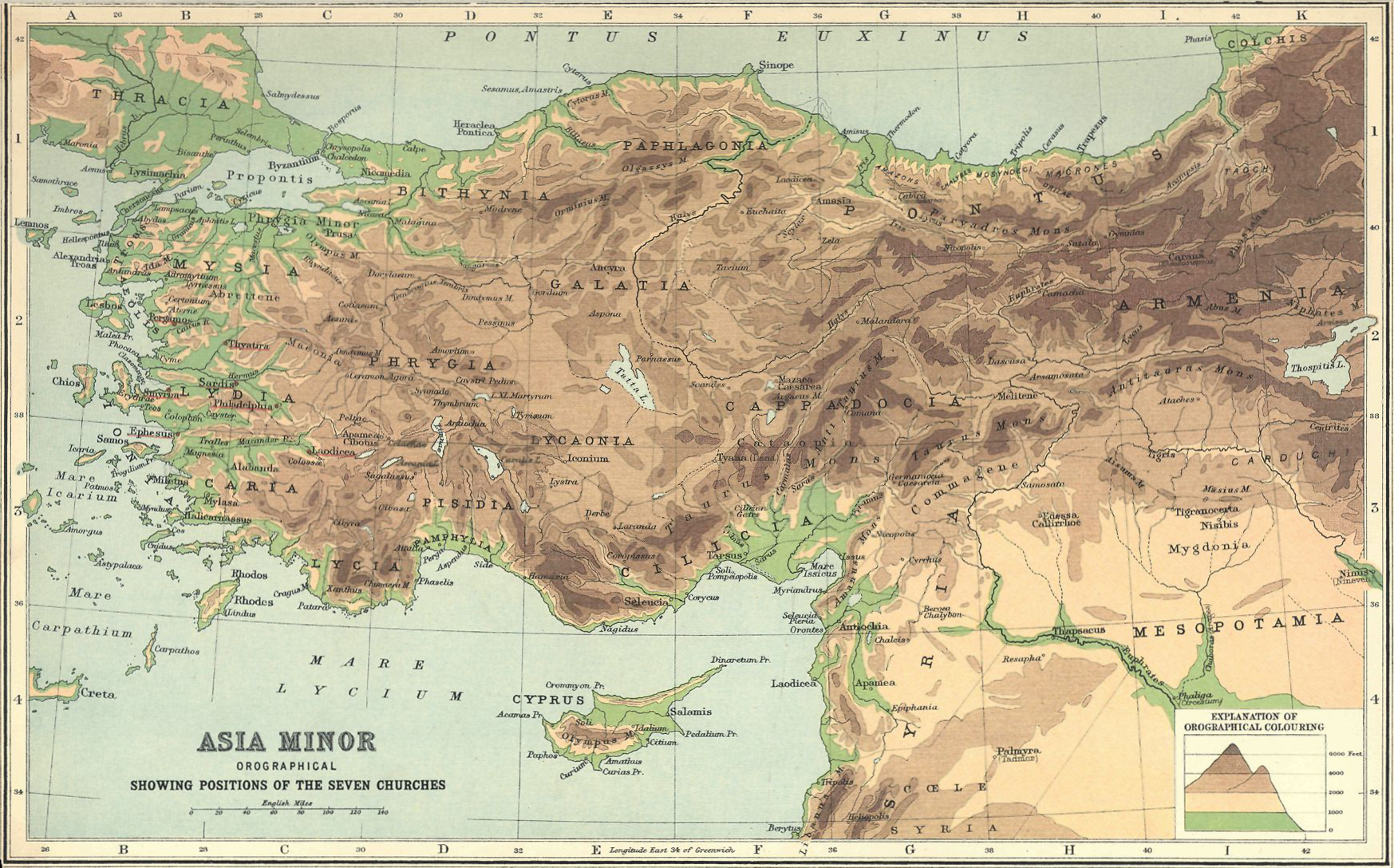
- Asia Minor
- Kind of place
- City
1 place the record names with Ephesus, the farthest 51 km away
- Located: the gazetteer fixes one site
- A dashed line ends at a place the gazetteer does not fix
Not located: The Temple. The gazetteer records no location for it, so it is not marked.
Why Ephesus matters
Paul at Ephesus
Acts 19, in the order it happens
Read Acts 19, in the order it happens
- Twelve disciples who knew only John's baptismActs 19:2and asked them, “Did you receive the Holy Spirit when you became believers?” “No,” they answered, “we have not even heard that there is a Holy Spirit.”
- The Holy Spirit comes on themActs 19:6And when Paul laid his hands on them, the Holy Spirit came upon them, and they spoke in tongues and prophesied.
- Paul moves to the hall of TyrannusActs 19:9But when some of them stubbornly refused to believe and publicly maligned the Way, Paul took his disciples and left the synagogue to conduct daily discussions in the lecture hall of Tyrannus.
- Two years, and all Asia hears the wordActs 19:10This continued for two years, so that everyone who lived in the province of Asia, Jews and Greeks alike, heard the word of the Lord.
- The sons of Sceva and the spirit that would not obey themActs 19:15Eventually, one of the evil spirits answered them, “Jesus I know, and I know about Paul, but who are you?”
- The magic books are burned in publicActs 19:19And a number of those who had practiced magic arts brought their books and burned them in front of everyone. When the value of the books was calculated, the total came to fifty thousand drachmas.
- Great is Artemis of the EphesiansActs 19:34But when they realized that he was a Jew, they all shouted in unison for about two hours: “Great is Artemis of the Ephesians!”
- The city clerk dismisses the assemblyActs 19:41After he had said this, he dismissed the assembly.
What happened here, in order
in the order the canon tells it
- Paul first reasons in the synagogue at EphesusActs 18:19When they reached Ephesus, Paul parted ways with Priscilla and Aquila. He himself went into the synagogue there and reasoned with the Jews.
- Apollos, eloquent and versed in Scripture, comes to EphesusActs 18:24Meanwhile a Jew named Apollos, a native of Alexandria, came to Ephesus. He was an eloquent man, well versed in the Scriptures.
- Priscilla and Aquila explain the way of God more accuratelyActs 18:26And he began to speak boldly in the synagogue. When Priscilla and Aquila heard him, they took him in and explained to him the way of God more accurately.
- The word of the Lord grows in power and prevailsActs 19:20So the word of the Lord powerfully continued to spread and prevail.
- The city clerk calms the crowdActs 19:35Finally the city clerk quieted the crowd and declared, “Men of Ephesus, doesn’t everyone know that the city of Ephesus is guardian of the temple of the great Artemis and of her image, which fell from heaven?
- Paul sends from Miletus for the Ephesian eldersActs 20:17From Miletus, Paul sent to Ephesus for the elders of the church.
- Overseers charged to shepherd the church God purchased with His bloodActs 20:28Keep watch over yourselves and the entire flock of which the Holy Spirit has made you overseers. Be shepherds of the church of God, which He purchased with His own blood.
- Paul recalls three years of warning them with tearsActs 20:31Therefore be alert and remember that for three years I never stopped warning each of you night and day with tears.
- Paul's letter addressed to the saints in EphesusEphesians 1:1Paul, an apostle of Christ Jesus by the will of God, To the saints in Ephesus, the faithful in Christ Jesus:
- Timothy charged to stay and stop false teaching1 Timothy 1:3As I urged you on my departure to Macedonia, you should stay on at Ephesus to instruct certain men not to teach false doctrines
- Paul recalls Onesiphorus's service to him at Ephesus2 Timothy 1:18May the Lord grant Onesiphorus His mercy on that day. You know very well how much he ministered to me in Ephesus.
- Tychicus sent to Ephesus2 Timothy 4:12Tychicus, however, I have sent to Ephesus.
- Ephesus named first of the seven churchesRevelation 1:11saying, “Write on a scroll what you see and send it to the seven churches: to Ephesus, Smyrna, Pergamum, Thyatira, Sardis, Philadelphia, and Laodicea.”
- Christ's rebuke: you have left your first loveRevelation 2:4But I have this against you: You have abandoned your first love.
The voices
each quoted from the work named
"And many of them that practised curious arts, brought their books together, and burnt them in the presence of all men" - having seen that there was no more use of them now that the demons themselves do these things - "and reckoned up the price of them, and found the amount fifty thousand pieces of silver. So mightily grew the word of God and prevailed."
Curious arts - Arts or practices requiring skill, address, cunning. The word used here (περίεργα perierga) denotes properly “those things that require care or skill,” and was thus applied to the arts of “magic, jugglery, and sleight of hand” that were practiced so extensively in Eastern countries. That such arts were practiced at Ephesus is well known. The Ephesian letters, by which incantations and charms were supposed to be produced, were much celebrated.
The sin that Christ charged this church with was their decay and declension in holy love and zeal: Thou hast left thy first love; not left and forsaken the object of it, but lost the fervent degree of it that at first appeared. Observe, (1.) The first affections of men towards Christ, and holiness, and heaven, are usually lively and warm.
1 more teacher on these versesBede
In which the Holy Spirit has made you overseers. For above he had called the elders called from Ephesus to Miletus, whom he now names bishops, that is, overseers. For indeed one city could not have many bishops, but he signifies those same elders, as
Ephesus in Scripture
17 verses name it, in 6 books
Open a book to read its mentions here. Text: Berean Standard Bible.
Old TestamentNew Testamentsegment width = share of mentions
New Testament6 books · 17 mentions
Acts9 mentions
- Acts 18:19When they reached Ephesus, Paul parted ways with Priscilla and Aquila. He himself went into the synagogue there and reasoned with the Jews.
- Acts 18:21But as he left, he said, “I will come back to you if God is willing.” And he set sail from Ephesus.
- Acts 18:24Meanwhile a Jew named Apollos, a native of Alexandria, came to Ephesus. He was an eloquent man, well versed in the Scriptures.
- Acts 19:1While Apollos was at Corinth, Paul passed through the interior and came to Ephesus. There he found some disciples
- Acts 19:17This became known to all the Jews and Greeks living in Ephesus, and fear came over all of them. So the name of the Lord Jesus was held in high honor.
- Acts 19:26And you can see and hear that not only in Ephesus, but in nearly the whole province of Asia, Paul has persuaded a great number of people to turn away. He says that man-made gods are no gods at all.
- Acts 19:35Finally the city clerk quieted the crowd and declared, “Men of Ephesus, doesn’t everyone know that the city of Ephesus is guardian of the temple of the great Artemis and of her image, which fell from heaven?
- Acts 20:16Paul had decided to sail past Ephesus to avoid spending time in the province of Asia, because he was in a hurry to reach Jerusalem, if possible, by the day of Pentecost.
1 further mention in Acts, read them in the book.
1 Corinthians2 mentions
Ephesians1 mention
1 Timothy1 mention
2 Timothy2 mentions
Revelation2 mentions
- Revelation 1:11saying, “Write on a scroll what you see and send it to the seven churches: to Ephesus, Smyrna, Pergamum, Thyatira, Sardis, Philadelphia, and Laodicea.”
- Revelation 2:1“To the angel of the church in Ephesus write: These are the words of Him who holds the seven stars in His right hand and walks among the seven golden lampstands.
Common questions
Why did Paul stay at Ephesus longer than almost anywhere else in his ministry?
Ephesus was the leading city of the province of Asia, and reaching it meant reaching everyone who passed through it. Paul reasoned in the synagogue three months, then, when opposition grew, moved to the lecture hall of Tyrannus and taught there daily for two years.
Luke sums up the result plainly: everyone who lived in the province, Jews and Greeks alike, heard the word of the Lord. Two years of daily teaching in one hall, reaching an entire province, was Paul's longest continuous stay recorded anywhere in Acts.
Who were the sons of Sceva, and what does their failure show?
Seven sons of a man named Sceva, described as a Jewish chief priest, tried to cast out a demon by invoking the name of Jesus the way Paul did, as though the name itself were a formula with power apart from the person behind it.
The spirit's answer exposed them: it knew Jesus and knew about Paul, but did not know them, and the possessed man overpowered all seven and sent them running. The whole city took note, and many who had practiced magic burned their own books in response.
What was the temple of Artemis, and why did a sermon threaten it?
The temple of Artemis at Ephesus was one of the wonders of the ancient world, and the city called itself the temple's guardian, a title the city clerk himself uses in Acts 19:35. The cult image, according to the text, was believed to have fallen from the sky, which is exactly the claim the town clerk leans on to calm the crowd.
Demetrius the silversmith framed the threat as economic, since his trade in silver shrines depended on the temple's continued honor. But the deeper issue Luke points to is doctrinal: Paul had been teaching that gods made by human hands are no gods at all, a claim that could not coexist with Ephesus's whole civic identity.
Is the letter to the Ephesians really addressed to the church at Ephesus?
Readers differ; the positions are named
The Berean Standard Bible's text of Ephesians 1:1 reads "to the saints in Ephesus," following the traditional title most manuscripts carry. Textual critics note that a few of the earliest witnesses lack the words "in Ephesus" at that point, which has led some to read the letter as a circular letter meant for several churches in the province rather than Ephesus alone. The witnesses that lack the phrase are Papyrus 46 and the original hands of Codex Sinaiticus and Codex Vaticanus, three of the oldest manuscripts of the letter; a later corrector added the words into both Sinaiticus and Vaticanus.
This page presents the manuscript question as a textual note rather than a settled dispute with named holders on each side in the site's own sourcing, since the point is a detail of transmission rather than a difference in the letter's teaching.
Why does Revelation's letter to Ephesus praise its doctrine but rebuke its love?
Christ commends the Ephesian church for its labor, its perseverance, and its refusal to tolerate false apostles and the practices of the Nicolaitans. Doctrinally the church had stood firm.
But He tells them plainly that they have left the love they had at first, and calls them to remember, repent, and return to the works they did in the beginning, or their lampstand will be removed. Guarding the truth and keeping the first devotion to Christ are both required, and the letter shows a church that had kept one without the other.
Sources cited
- OpenBible.info Bible Geocoding: Ephesusread 2026-08-20The coordinates on this page. Used under CC-BY with attribution to OpenBible.info.
- Berean Standard Bible (2023)Every verse quoted on this page, from the site's own verse store. Public domain.
- John Chrysostom, Homily on Acts, Homilies 40, 41, 42, 44 (c. 400)Acts 19:19, the burned books; Acts 20:28, the elders as overseers. Public domain.
- Albert Barnes, Notes, Explanatory and Practical, on the Old and New Testaments (1832-1869)Acts 19:19, the curious arts and Ephesian letters. Public domain.
- Matthew Henry, Commentary on the Whole Bible (1710)Revelation 2:4, the first love. Public domain.
- Bede, Commentary on Acts (c. 709)Acts 20:28, elders and overseers as one office under two names. Public domain.
- Adam Clarke, Commentary on the Bible (1832)The description of the Ephesian Artemis image, referenced in why_it_matters. Public domain.
- "Who Were the Recipients of the Epistle to the Ephesians?", Through Our Time TestimonyNames Papyrus 46, Sinaiticus and Vaticanus as the earliest witnesses lacking "in Ephesus" at 1:1, used in the common_questions entry on the manuscript question.
- Stock, Pint, Horejs, Ladstatter and Bruckner, "Demise of a harbor: a geochemical chronicle from Ephesus", Quaternary International (2014)The Cayster River's silt filling the harbor and the resulting malarial marshland, used in why_it_matters.
Keep studying
On this page
Studies8
Books that name it4
Lives that run through it2
Doorway2
Keep this page