
Leviticus 17:11 · Featured Study · The Blood of the Covenant
BSBThe Blood
One ruling, stated once in Leviticus and never revoked: “the life of the flesh is in the blood.”From that axiom a single substance runs the length of the canon: marking doorposts in Egypt, sealing a covenant at Sinai, entering the Most Holy Place once a year, drawing a prophet’s indictment of hollow ritual, filling a cup at a Passover table, and finally overcoming an accuser at the throne. The Bible does not treat blood as a symbol reached for when convenient. It treats it as the one thing that can actually pay for a life.
Summary
This page traces Leviticus 17:11's ruling on blood and life through nine texts, from Passover's doorposts to Revelation's throne, then explains Isaiah's critique of hollow ritual and why the sacrifice never has to repeat.
- A nine-link chain running from Exodus 12:13's doorposts to Revelation 12:11's overcoming blood
- Isaiah 1:11's hard words about sacrifice read in their own context, not as an attack on the altar
- Why Hebrews argues the old sacrifices had to repeat but Christ's blood did not
- Derek Prince's covenantal reading of Revelation 12:11 against the accuser
- A word study on the Hebrew and Greek nouns the whole thread rests on
The Ruling
Leviticus 17:11: the axiom the whole thread stands on
“For the life of the flesh is in the blood; and I have given it to you upon the altar to make atonement for your souls: for it is the blood that maketh atonement by reason of the life.”
Two Hebrew nouns carry the whole verse: dam, blood, and nephesh, life or soul. God does not say blood represents life: he says it is the life of the flesh, and for that reason, and only for that reason, he assigns it to the altar. Every text on this page is a variation on that one ruling.
“Because it is the blood that makes atonement for the soul; and therefore it was appointed to make atonement with, because the life of the flesh is the blood.”
Matthew Henry, Commentary on the Whole Bible (1710), on Leviticus 17:11 — public domain
“God, as the sovereign author and proprietor of nature, reserved the blood to Himself and allowed men only one use of it — in the way of sacrifices.”
Jamieson, Fausset & Brown, Commentary Critical and Explanatory (1871), on Leviticus 17:11 — public domain
“The blood maketh atonement — Typically, and in respect of the blood of Christ which it represented, by which the atonement is really made.”
John Wesley, Explanatory Notes upon the Bible (1765), on Leviticus 17:11 — public domain
The Chain
eight more texts, one substance, from a Hebrew doorpost to the throne
- IIExodus 12:13the token on the doorposts
“The blood on the houses where you are staying will distinguish them; when I see the blood, I will pass over you. No plague will fall on you to destroy you when I strike the land of Egypt.”
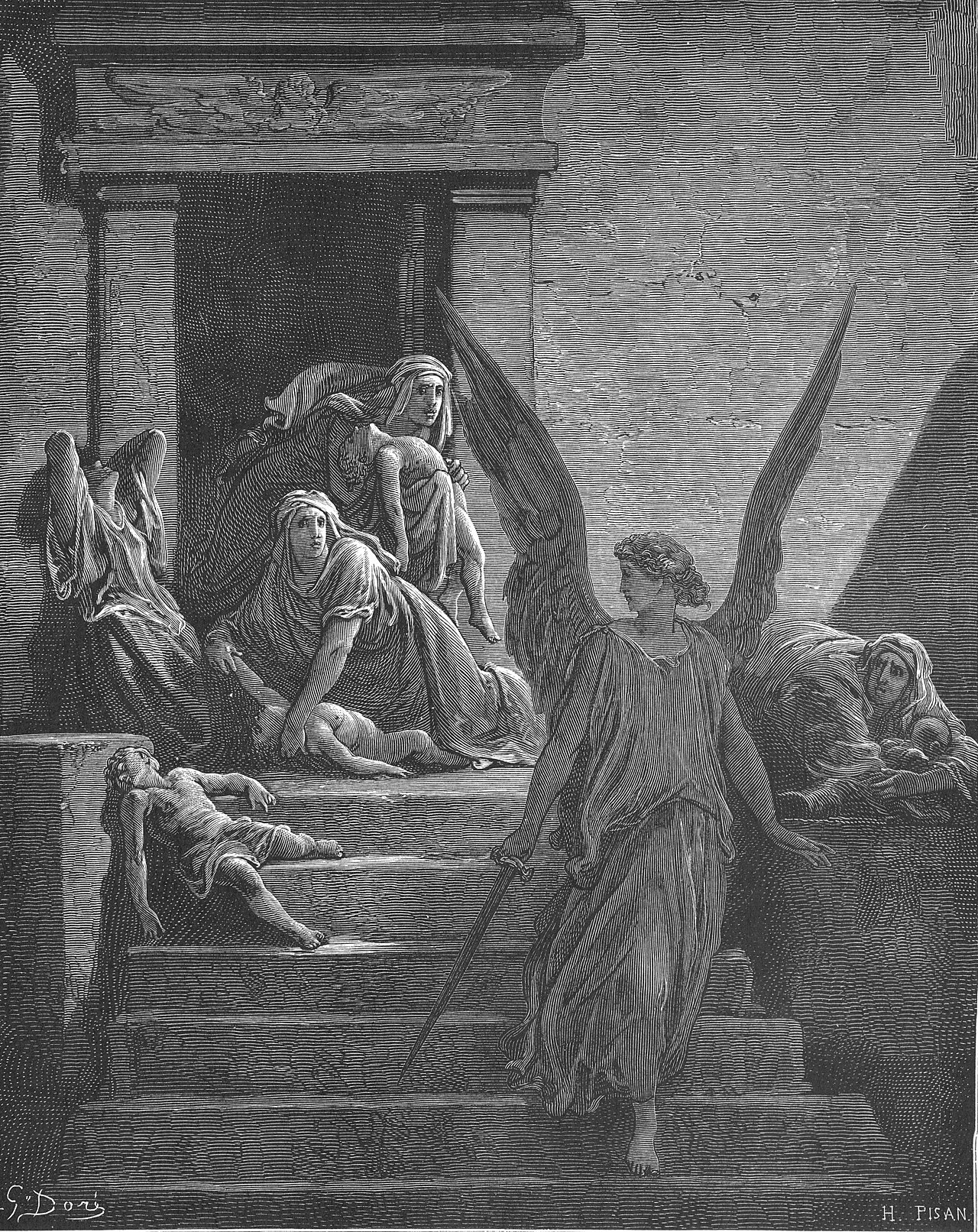
The first blood-mark in the canon that saves rather than merely atones: sprinkled where it can be seen, not trodden underfoot, and doing its work not because Israel deserved sparing but because the destroying angel had, in Matthew Henry's phrase, “nothing to do where the blood was.”
- IIIExodus 24:8the covenant ratified
“So Moses took the blood, sprinkled it on the people, and said, “This is the blood of the covenant that the LORD has made with you in accordance with all these words.””
No covenant in Scripture is cut without blood: this is the phrase Jesus himself will reach back for at the Last Supper. Moses does not merely announce the covenant; he sprinkles its terms onto the people who just swore to keep them, sealing law and promise together in one act.
- IVLeviticus 16:30Yom Kippur: the yearly reckoning
“because on this day atonement will be made for you to cleanse you, and you will be clean from all your sins before the LORD.”
The one day a year the high priest entered the Most Holy Place with blood not his own, for sins not his own. Its very repetition, every single year, is itself the tell: a sacrifice that actually removed sin would not need doing again (Hebrews will make this argument explicit at 10:1–4).
- VIsaiah 1:11the prophets' critique: rightly framed
““What good to Me is your multitude of sacrifices?” says the LORD. “I am full from the burnt offerings of rams and the fat of well-fed cattle; I take no delight in the blood of bulls and lambs and goats.”
Read alone this sounds like blood itself under indictment. Read with the verses that follow, “wash you, make you clean… learn to do well; seek justice” (1:16–17), it is ritual performed by hands that “are full of blood” another way (1:15) that God refuses, not the altar he himself commanded. See the framing box below.
- VIMatthew 26:28the cup
“This is My blood of the covenant, which is poured out for many for the forgiveness of sins.”
Jesus takes Exodus 24:8's own phrase, “the blood of the covenant”, and applies it to the cup in his hand, at the very meal that remembers the Passover lamb. Two threads the chain has already laid, Sinai and the doorposts, are tied into one knot at a Passover table in Jerusalem.
- VIIHebrews 9:22the axiom, stated in full
“According to the law, in fact, nearly everything must be purified with blood, and without the shedding of blood there is no forgiveness.”
The New Testament's own commentary on Leviticus 17:11: not a new doctrine but the floor-grade cross-reference the apostles themselves drew. Everything before this verse in the chain has been building toward it; everything after depends on it.
- VIII1 Peter 1:18–19the ransom price
“knowing that ye were redeemed, not with corruptible things, with silver or gold, from your vain manner of life handed down from your fathers; but with precious blood, as of a lamb without blemish and without spot, even the blood of Christ.”
Peter names the currency of redemption by naming what it is not: not silver, not gold, not anything corruptible: a lamb “without blemish and without spot,” the very phrase the Passover lamb had to meet (Exodus 12:5), now fulfilled in a person.
- IXRevelation 12:11the thread's far end
“They have conquered him by the blood of the Lamb and by the word of their testimony. And they did not love their lives so as to shy away from death.”
The canon's last word on the blood is a victory shout. The accuser is answered not by the saints' own record but by a blood already shed: Jamieson, Fausset & Brown's phrase is exact: that blood “meets every charge.” The thread that opened at a Hebrew altar closes at the throne.
Ritual Without Obedience
Isaiah 1:11: the prophets' critique, rightly framed
Taken alone, Isaiah 1:11 reads like blood sacrifice itself standing under indictment. Taken with its own context it is nothing of the kind. Two verses earlier God names the real charge: hands that shed blood another way (Isaiah 1:15, “your hands are full of blood”) while the altar runs at full capacity. And three verses later comes the remedy, and it is not the abolition of sacrifice:
“Wash and cleanse yourselves. Remove your evil deeds from My sight. Stop doing evil! Learn to do right; seek justice and correct the oppressor. Defend the fatherless and plead the case of the widow.””
Isaiah 1:16–17 (BSB)
The multitude of sacrifices God is “had enough of” are sacrifices offered as a substitute for justice and mercy, not sacrifices offered in obedience to Leviticus 17:11. Isaiah is not the ritual’s enemy; he is Leviticus 17:11’s enforcer, insisting the blood mean what it was given to mean rather than paper over a life that contradicts it.
“A foreshadowing of the gospel, when the One real sacrifice was to supersede all the shadowy ones, and ‘bring in everlasting righteousness’ (Ps 40:6, 7)…”
Jamieson, Fausset & Brown, Commentary Critical and Explanatory (1871), on Isaiah 1:11 — public domain
Once, Not Again
why the axiom does not mean the sacrifices had to repeat forever
The repeated blood
“Day after day every priest stands to minister and to offer again and again the same sacrifices, which can never take away sins.”
Hebrews 10:11 (BSB)
The blood that need not repeat
“But when this Priest had offered for all time one sacrifice for sins, He sat down at the right hand of God.”
Hebrews 10:12 (BSB)
“For it is impossible that the blood of bulls and goats should take away sins” (Hebrews 10:4) is Hebrews reading its own logic back onto the Day of Atonement’s yearly repetition (Lev 16:30): a sacrifice that has to be redone every year has, by its own repetition, announced that it never finished the job. Leviticus 17:11’s axiom does not change between the two covenants, blood is still the price of life either way, but the blood itself changes, from an animal’s that must be offered again to one offered, in Peter’s own phrase, “without blemish and without spot” and never repeated.
The Accuser Answered
Revelation 12:11: the thread's last word, and a covenantal reading of what it overturns
“Had that blood not been shed, Satan’s accusations would have been unanswerable; as it is, that blood meets every charge.”
Jamieson, Fausset & Brown, Commentary Critical and Explanatory (1871), on Revelation 12:11 — public domain
Derek Prince’s covenantal-deliverance framework, developed at length in Blessing or Curse: You Can Choose(1990), reads the believer’s standing before the accuser in exactly this legal register: a curse or claim against a life is real and must be answered on legal grounds, not merely wished away, and the cross supplies the specific legal ground the claim is answered on. Revelation 12:11’s own pairing: the blood of the Lamb and the word of their testimony: fits that pattern: a legal fact appropriated by a spoken confession, not a legal fact alone.
The Words the Blood Rests On
two Hebrew nouns, two Greek: the substance and the testimony that overcomes with it
Notable art
— click a piece to enlargeKeep studying
On this page
Places1
Go further1
Doctrines12
- The Scarlet Thread: fifteen scenes, one unbroken line
- The Sacrificial System: the five offerings in full
- The Day of Atonement: Yom Kippur in full
- Passover: the feast in full
- Once for All: why the sacrifice never repeats
- Forgiven, and Forgiving
- The Lamb: Revelation's Christology
- The Lord's Supper
- The Mercy Seat
- The Veil
- The Covenants
- Demonology