
Athens
Summary
The city full of idols where Paul reasoned in the marketplace daily and then addressed the Areopagus on the unknown God, the appointed day, and the man God had ordained.
- Paul waited alone in Athens for Silas and Timothy, and the city full of idols disturbed him deeply (Acts 17:15-16).
- He reasoned daily in the synagogue and the marketplace before Epicurean and Stoic philosophers brought him to the Areopagus (Acts 17:17-19).
- He preached from an altar inscribed to an unknown god, naming the true God as the one who made the world and does not live in temples (Acts 17:23-25).
- The address ends on the resurrection, and the city split: some mocked, some wanted to hear more, and a few believed, including Dionysius the Areopagite and a woman named Damaris (Acts 17:32-34).
- Paul was still in Athens when he sent Timothy back to Thessalonica, which is how the city enters Paul's own letters (1 Thessalonians 3:1-2).
On this page
In Scripture
- Verses
- 5
- Books
- 2
Near Athens
Straight-line distances, computed from the gazetteer coordinates.
Where it is
the country around it
- Coordinates
- 37.9833° N, 23.7333° Efind it on the Atlas →
- Region
- Achaia
- Kind of place
- City
- Located: the gazetteer fixes one site
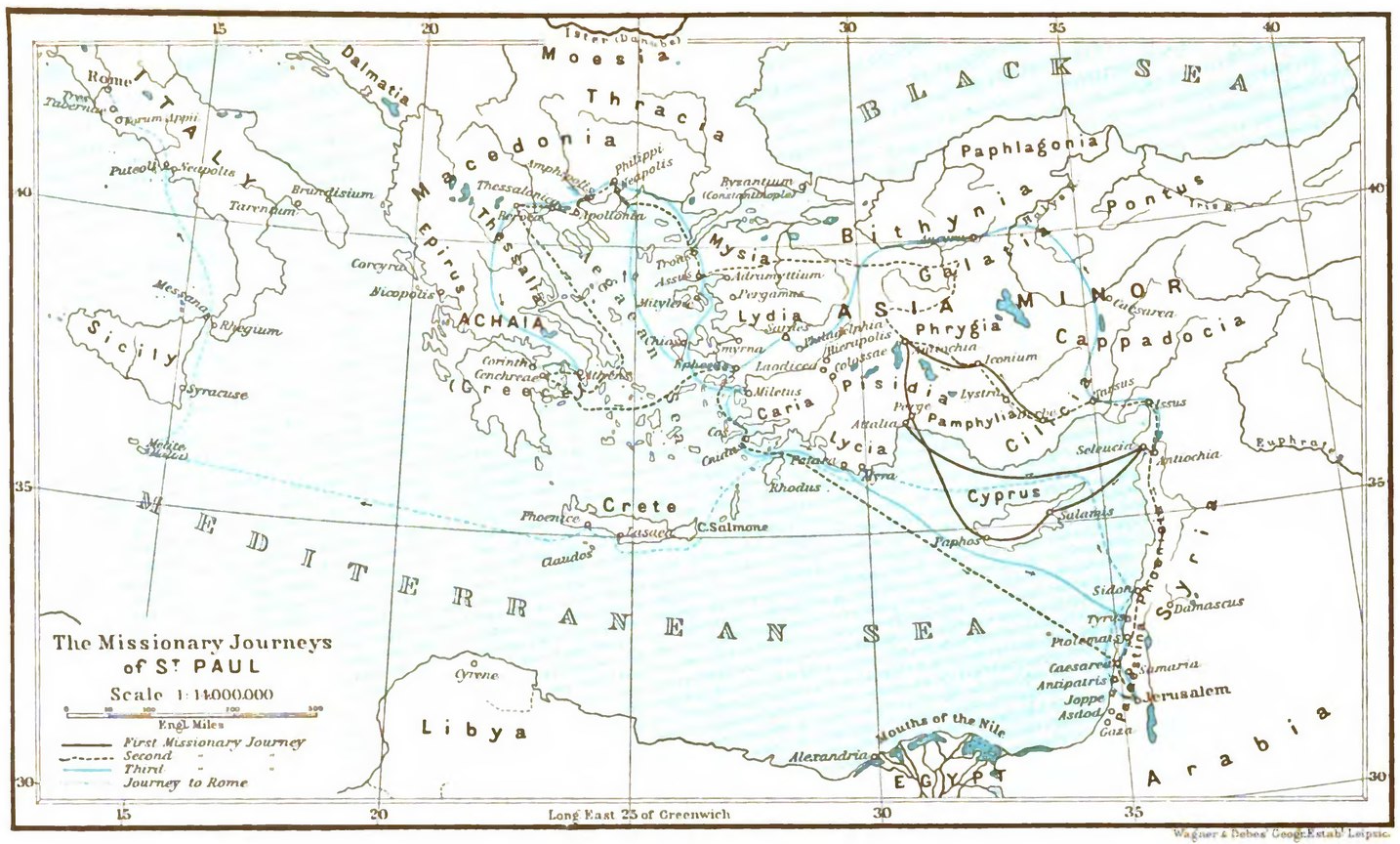
Why Athens matters
The Areopagus Address
A city full of idols, an altar to an unknown God, and a sermon that ends on the resurrection
Read A city full of idols, an altar to an unknown God, and a sermon that ends on the resurrection
- Paul waits alone, disturbed by the city's idolsActs 17:16While Paul was waiting for them in Athens, he was deeply disturbed in his spirit to see that the city was full of idols.
- He reasons daily in the synagogue and the marketplaceActs 17:17So he reasoned in the synagogue with the Jews and God-fearing Gentiles, and in the marketplace with those he met each day.
- Philosophers debate him and call him a babblerActs 17:18Some Epicurean and Stoic philosophers also began to debate with him. Some of them asked, “What is this babbler trying to say?” Others said, “He seems to be advocating foreign gods.” They said this because Paul was proclaiming the good news of Jesus and the resurrection.
- He is brought to the AreopagusActs 17:19So they took Paul and brought him to the Areopagus, where they asked him, “May we know what this new teaching is that you are presenting?
- He names the altar to an unknown godActs 17:23For as I walked around and examined your objects of worship, I even found an altar with this inscription: TO AN UNKNOWN GOD. Therefore what you worship as something unknown, I now proclaim to you.
- He quotes the Athenians' own poetsActs 17:28‘For in Him we live and move and have our being.’ As some of your own poets have said, ‘We are His offspring.’
- He names the appointed day and the raised manActs 17:31For He has set a day when He will judge the world with justice by the Man He has appointed. He has given proof of this to everyone by raising Him from the dead.
- The city splits, and some believeActs 17:34But some joined him and believed, including Dionysius the Areopagite, a woman named Damaris, and others who were with them.
What happened here, in order
in the order the canon tells it
- Paul is brought to Athens ahead of Silas and TimothyActs 17:15Those who escorted Paul brought him to Athens and then returned with instructions for Silas and Timothy to join him as soon as possible.
- He is disturbed by the city's idolsActs 17:16While Paul was waiting for them in Athens, he was deeply disturbed in his spirit to see that the city was full of idols.
- He reasons in the synagogue and marketplaceActs 17:17So he reasoned in the synagogue with the Jews and God-fearing Gentiles, and in the marketplace with those he met each day.
- Epicureans and Stoics debate himActs 17:18Some Epicurean and Stoic philosophers also began to debate with him. Some of them asked, “What is this babbler trying to say?” Others said, “He seems to be advocating foreign gods.” They said this because Paul was proclaiming the good news of Jesus and the resurrection.
- He is brought to the AreopagusActs 17:19So they took Paul and brought him to the Areopagus, where they asked him, “May we know what this new teaching is that you are presenting?
- Paul opens: you are very religiousActs 17:22Then Paul stood up in the meeting of the Areopagus and said, “Men of Athens, I see that in every way you are very religious.
- The altar to an unknown godActs 17:23For as I walked around and examined your objects of worship, I even found an altar with this inscription: TO AN UNKNOWN GOD. Therefore what you worship as something unknown, I now proclaim to you.
- The God who made the worldActs 17:24The God who made the world and everything in it is the Lord of heaven and earth and does not live in temples made by human hands.
- From one man, every nationActs 17:26From one man He made every nation of men, that they should inhabit the whole earth; and He determined their appointed times and the boundaries of their lands.
- Quoting the Athenians' own poetsActs 17:28‘For in Him we live and move and have our being.’ As some of your own poets have said, ‘We are His offspring.’
- God now commands all people to repentActs 17:30Although God overlooked the ignorance of earlier times, He now commands all people everywhere to repent.
- The appointed day and the raised manActs 17:31For He has set a day when He will judge the world with justice by the Man He has appointed. He has given proof of this to everyone by raising Him from the dead.
- Some mock, some want to hear moreActs 17:32When they heard about the resurrection of the dead, some began to mock him, but others said, “We want to hear you again on this topic.”
- Dionysius and Damaris believeActs 17:34But some joined him and believed, including Dionysius the Areopagite, a woman named Damaris, and others who were with them.
- Paul names Athens in his letter to Thessalonica1 Thessalonians 3:1So when we could bear it no longer, we were willing to be left on our own in Athens.
The voices
each quoted from the work named
The Areopagus, or hill of Mars, (dedicated to Mars, the heathen God of war,) was the place where the Athenians held their supreme court of judicature. But it does not appear he was carried thither as a criminal. The original number of its Judges was twelve; but afterward it increased to three hundred.
Paul stood in the midst of Mars’ hill - That is, in the midst of the judges, who sat in the Areopagus.
Because he hath appointed a day in the which he will judge the world--Such language beyond doubt teaches that the judgment will, in its essence, be a solemn judicial assize held upon all mankind at once. "Aptly is this uttered on the Areopagus, the seat of judgment" [BENGEL].
1 more teacher on these versesJohn Wesley
Among whom was even Dionysius the Areopagite - One of the Judges of that court: on whom some spurious writings have been fathered in later ages, by those who are fond of high sounding nonsense.
Athens in Scripture
5 verses name it, in 2 books
Open a book to read its mentions here. Text: Berean Standard Bible.
Old TestamentNew Testamentsegment width = share of mentions
New Testament2 books · 5 mentions
Acts4 mentions
- Acts 17:15Those who escorted Paul brought him to Athens and then returned with instructions for Silas and Timothy to join him as soon as possible.
- Acts 17:16While Paul was waiting for them in Athens, he was deeply disturbed in his spirit to see that the city was full of idols.
- Acts 17:22Then Paul stood up in the meeting of the Areopagus and said, “Men of Athens, I see that in every way you are very religious.
- Acts 18:1After this, Paul left Athens and went to Corinth.
Common questions
What was the altar to an unknown god?
Acts 17:23 says Paul found an altar in Athens inscribed To An Unknown God, and he took the inscription as his opening line. Jamieson, Fausset and Brown read Paul's phrase whom therefore ye ignorantly worship as a direct allusion to that same inscription. Paul does not explain why such an altar existed. He uses it to announce the God the city did not yet know. Ancient writers outside the New Testament confirm such altars stood in and around Athens: Pausanias records altars to unknown gods near the city at Phalerum (Description of Greece 1.1.4), and Philostratus says altars were set up at Athens even to unknown gods (Life of Apollonius of Tyana 6.3), while Diogenes Laertius records a tradition of nameless altars there, tied to a purification performed by Epimenides (Lives of Eminent Philosophers 1.110).
Who was Dionysius the Areopagite?
Acts 17:34 names him as a member of the Areopagus court who believed after hearing Paul. Scripture says nothing further about him. John Wesley's Explanatory Notes warn that centuries later, mystical writings unrelated to this man were wrongly published under his name, so this page states only what Acts itself records.
Why did some mock Paul when he mentioned the resurrection?
Acts 17:32 records the division without explaining it further: some mocked, and others wanted to hear Paul again on the subject. The text does not say what each side found strange about it, and this page does not add a reason Scripture does not give.
How does Athens connect to Paul's letters?
Paul was in Athens when he grew concerned for the believers he had left in Thessalonica and sent Timothy back to strengthen them. His own letter to that church names Athens directly as the place he was willing to be left alone in for their sake.
Was Paul's approach at Athens a departure from his usual preaching?
Readers differ; the positions are named
Readers differ. Some set 1 Corinthians 2:1-5, written for the next city, against the Areopagus address and read it as a course correction after Athens produced few converts. Others read the address itself as full gospel preaching adapted to a philosophical audience, since it still ends on God's coming judgment and the raising of Christ from the dead. Scripture does not say which reading Paul himself would have given, and this page names both.
Sources cited
- OpenBible.info Bible Geocoding: Athensread 2026-08-20The coordinates on this page. Used under CC-BY with attribution to OpenBible.info.
- Berean Standard BibleAll Scripture text on this page, from the site's own verse store. Public domain since 2023.
- John Wesley, Explanatory Notes upon the New Testament (1755)Public domain, CCEL edition.
- Adam Clarke, Commentary on the BiblePublic domain, CCEL edition.
- Jamieson, Fausset & Brown, Commentary Critical and Explanatory on the Whole Bible (1871)Public domain, CCEL edition.
- Pausanias, Description of Greece, Book 1, ch. 1 (tr. W.H.S. Jones, Loeb Classical Library)Confirms altars named to unknown gods near Athens. Added in the 2026-09-02 session 7 re-verification pass.
- Philostratus, Life of Apollonius of Tyana, Book 6, ch. 3 (tr. F. C. Conybeare, Loeb Classical Library)Confirms altars set up at Athens to unknown gods. Added in the 2026-09-02 session 7 re-verification pass.
- Diogenes Laertius, Lives of Eminent Philosophers, Book 1, sec. 110 (tr. R. D. Hicks, Loeb Classical Library)Records the tradition of nameless altars at Athens tied to Epimenides. Added in the 2026-09-02 session 7 re-verification pass.
Keep studying
On this page
Keep this page