
Cyprus
Summary
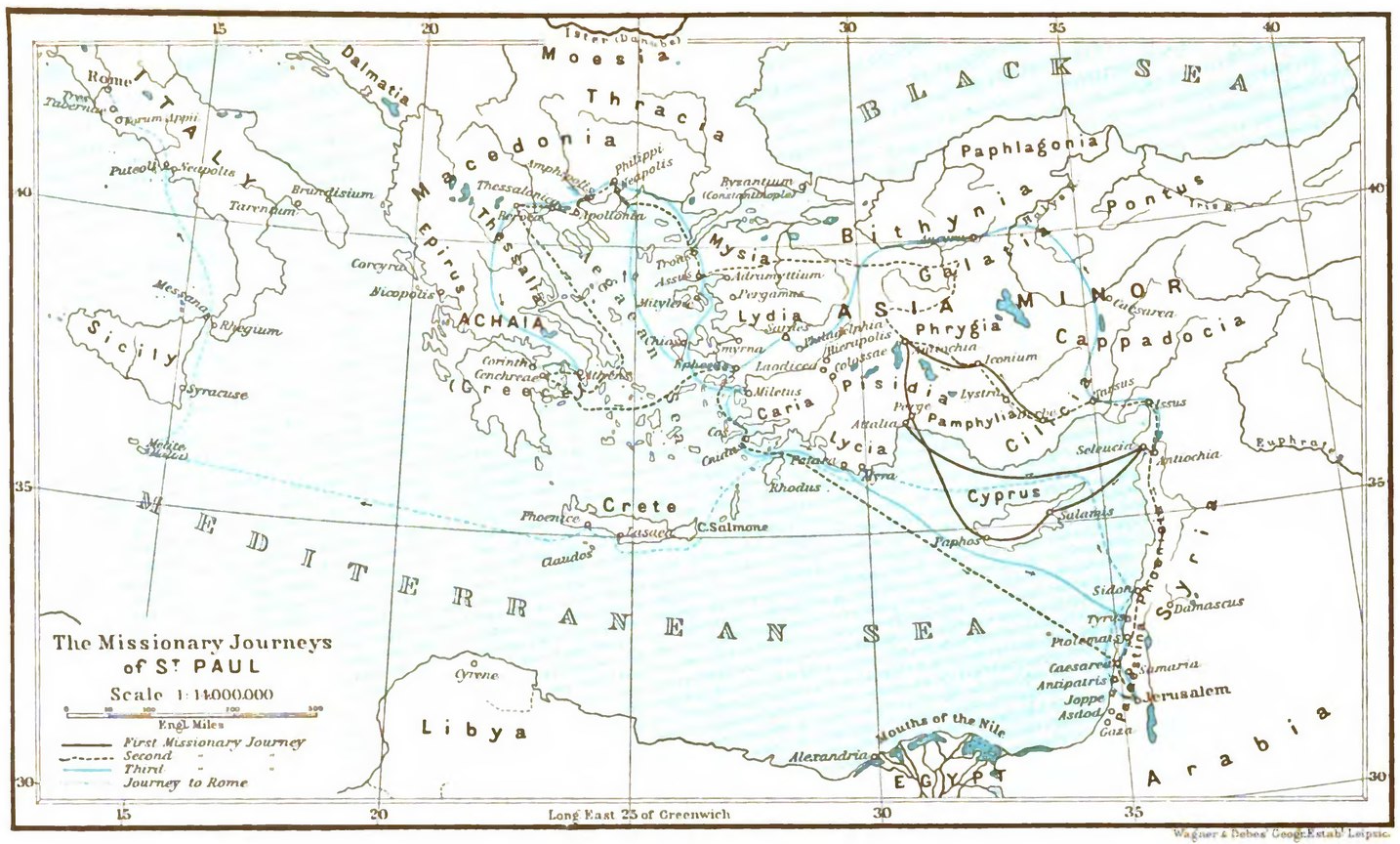
Barnabas's home island and the first stop of the first missionary journey, from Salamis to Paphos, where the proconsul Sergius Paulus believed and the sorcerer Elymas was struck blind.
- Barnabas, one of the earliest apostles, was himself a Levite from Cyprus.
- Cyprus was the first stop of the first missionary journey, from Salamis to Paphos.
- At Paphos the sorcerer Elymas opposed the message and was struck blind, and the Roman proconsul Sergius Paulus believed.
- It is at this meeting that Acts first calls Saul by his other name, Paul.
- Barnabas returned to his home island with Mark after the two men parted ways, and Paul's later voyages twice pass in sight of it.
On this page
In Scripture
- Verses
- 12
- Books
- 5
Where it is
the country around it
- Coordinates
- 35.0183° N, 33.2077° Efind it on the Atlas →
- Region
- Mediterranean
- Kind of place
- Region
- Placed: the point stands for an area, or is rounded
Why Cyprus matters
Paphos: Bar-Jesus opposed, Sergius Paulus believes
Acts 13:4-12, in the order it happens
Read Acts 13:4-12, in the order it happens
- Sent by the Holy Spirit, they sail to CyprusActs 13:4So Barnabas and Saul, sent forth by the Holy Spirit, went down to Seleucia and sailed from there to Cyprus.
- They preach in the synagogues of SalamisActs 13:5When they arrived at Salamis, they proclaimed the word of God in the Jewish synagogues. And John was with them as their helper.
- They reach Paphos and find Bar-JesusActs 13:6They traveled through the whole island as far as Paphos, where they found a Jewish sorcerer and false prophet named Bar-Jesus,
- The proconsul Sergius Paulus wants to hear the wordActs 13:7an attendant of the proconsul, Sergius Paulus. The proconsul, a man of intelligence, summoned Barnabas and Saul because he wanted to hear the word of God.
- Elymas opposes themActs 13:8But Elymas the sorcerer (for that is what his name means) opposed them and tried to turn the proconsul from the faith.
- Saul, now called Paul, confronts himActs 13:9Then Saul, who was also called Paul, filled with the Holy Spirit, looked directly at Elymas
- The pronouncement of blindnessActs 13:11Now look, the hand of the Lord is against you, and for a time you will be blind and unable to see the light of the sun.” Immediately mist and darkness came over him, and he groped about, seeking someone to lead him by the hand.
- The proconsul believesActs 13:12When the proconsul saw what had happened, he believed, for he was astonished at the teaching about the Lord.
What happened here, in order
in the order the canon tells it
- Cyprus named among the sons of JavanGenesis 10:4And the sons of Javan: Elishah, Tarshish, the Kittites, and the Rodanites.
- Word of Tyre's fall reaches CyprusIsaiah 23:1This is the burden against Tyre: Wail, O ships of Tarshish, for Tyre is laid waste, without house or harbor. Word has reached them from the land of Cyprus.
- Barnabas, a Levite from Cyprus, introducedActs 4:36Joseph, a Levite from Cyprus, whom the apostles called Barnabas (meaning Son of Encouragement),
- Scattered believers carry the message as far as CyprusActs 11:19Meanwhile those scattered by the persecution that began with Stephen traveled as far as Phoenicia, Cyprus, and Antioch, speaking the message only to Jews.
- Cypriot believers preach to Greeks at AntiochActs 11:20But some of them, men from Cyprus and Cyrene, went to Antioch and began speaking to the Greeks as well, proclaiming the good news about the Lord Jesus.
- Barnabas and Saul sail from Seleucia to CyprusActs 13:4So Barnabas and Saul, sent forth by the Holy Spirit, went down to Seleucia and sailed from there to Cyprus.
- Saul is first called PaulActs 13:9Then Saul, who was also called Paul, filled with the Holy Spirit, looked directly at Elymas
- Sergius Paulus believesActs 13:12When the proconsul saw what had happened, he believed, for he was astonished at the teaching about the Lord.
- Barnabas and Mark sail for CyprusActs 15:39Their disagreement was so sharp that they parted company. Barnabas took Mark and sailed for Cyprus,
- Paul's ship sights Cyprus on the way to JerusalemActs 21:3After sighting Cyprus and passing south of it, we sailed on to Syria and landed at Tyre, where the ship was to unload its cargo.
- Mnason the Cypriot hosts Paul's partyActs 21:16Some of the disciples from Caesarea accompanied us, and they took us to stay at the home of Mnason the Cypriot, an early disciple.
- Paul's prisoner ship sails to the lee of CyprusActs 27:4After putting out from there, we sailed to the lee of Cyprus because the winds were against us.
Cyprus in Scripture
12 verses name it, in 5 books
Open a book to read its mentions here. Text: Berean Standard Bible.
Old TestamentNew Testamentsegment width = share of mentions
Old Testament4 books · 5 mentions
Numbers1 mention
Isaiah2 mentions
- Isaiah 23:1This is the burden against Tyre: Wail, O ships of Tarshish, for Tyre is laid waste, without house or harbor. Word has reached them from the land of Cyprus.
- Isaiah 23:12He said, “You shall rejoice no more, O oppressed Virgin Daughter of Sidon. Get up and cross over to Cyprus—even there you will find no rest.”
Jeremiah1 mention
New Testament1 book · 7 mentions
Acts7 mentions
- Acts 4:36Joseph, a Levite from Cyprus, whom the apostles called Barnabas (meaning Son of Encouragement),
- Acts 11:19Meanwhile those scattered by the persecution that began with Stephen traveled as far as Phoenicia, Cyprus, and Antioch, speaking the message only to Jews.
- Acts 11:20But some of them, men from Cyprus and Cyrene, went to Antioch and began speaking to the Greeks as well, proclaiming the good news about the Lord Jesus.
- Acts 13:4So Barnabas and Saul, sent forth by the Holy Spirit, went down to Seleucia and sailed from there to Cyprus.
- Acts 15:39Their disagreement was so sharp that they parted company. Barnabas took Mark and sailed for Cyprus,
- Acts 21:3After sighting Cyprus and passing south of it, we sailed on to Syria and landed at Tyre, where the ship was to unload its cargo.
- Acts 27:4After putting out from there, we sailed to the lee of Cyprus because the winds were against us.
Common questions
Why does Acts start calling Saul "Paul" at this exact point?
Readers differ; the positions are named
Acts simply notes in passing, "Saul, who was also called Paul," right at the encounter with the Roman proconsul Sergius Paulus. Both names were likely his from birth, one Hebrew and one Roman, which was ordinary for a Jew who also held Roman citizenship. Scripture gives no stated reason for the timing; it lands at the first recorded meeting with a Gentile official on Gentile ground.
Who was Bar-Jesus, and why was he struck blind?
He is named a Jewish sorcerer and false prophet in the household of Sergius Paulus, actively trying to keep the governor from the faith. Paul pronounced a judgment of blindness on him for that specific opposition, and it was temporary, for a time, the same word used of Paul's own blindness at his conversion.
Why was the Roman proconsul living at Paphos?
New Paphos became a city around 312 BC under Nikokles, the last king of the local Paphian kingdom, and it grew into the administrative capital of the Roman province of Cyprus, a status it held until Salamis was refounded as the island's capital in AD 346. That is why Luke's account finds the governor, Sergius Paulus, at Paphos rather than at Salamis, where Barnabas and Saul had begun their preaching.
Why was Cyprus the first stop of the first missionary journey?
What does the Bible mean by "Kittim," and is it the same as Cyprus?
The standard Hebrew lexicons identify Kittim with Kition, a city on Cyprus, and by extension the island itself. This page uses the identification only as far as those lexicons support it, without extending it to later, broader uses of the same name in other books.
Why did Barnabas and Paul part ways over Cyprus?
Readers differ; the positions are named
Acts names the disagreement plainly: Barnabas wanted to bring John Mark on a second journey, and Paul did not, because Mark had left them partway through the first one. Barnabas took Mark and sailed for his own island; Paul chose Silas and went another way. Scripture reports the sharp parting without assigning blame to either man by name.
Sources cited
- OpenBible.info Bible Geocoding: Cyprusread 2026-08-20The coordinates on this page. Used under CC-BY with attribution to OpenBible.info.
- Berean Standard BibleThe translation used for every verse quoted on this page.
- Brown-Driver-Briggs Hebrew Lexicon and Strong's Concordance, h3794The lexical identification of Kittim with Cyprus.
- Wikipedia, "Roman Cyprus"New Paphos founded 312 BC under Nikokles; capital of Roman Cyprus until Salamis was refounded as Constantia in AD 346. Cited here because a firmer standard reference on Paphos's founding date was not reachable; used only for this uncontested classical-history detail.
Keep studying
On this page
Studies10
Every page that names it1
Doorway2
Lives that run through it1
Keep this page