
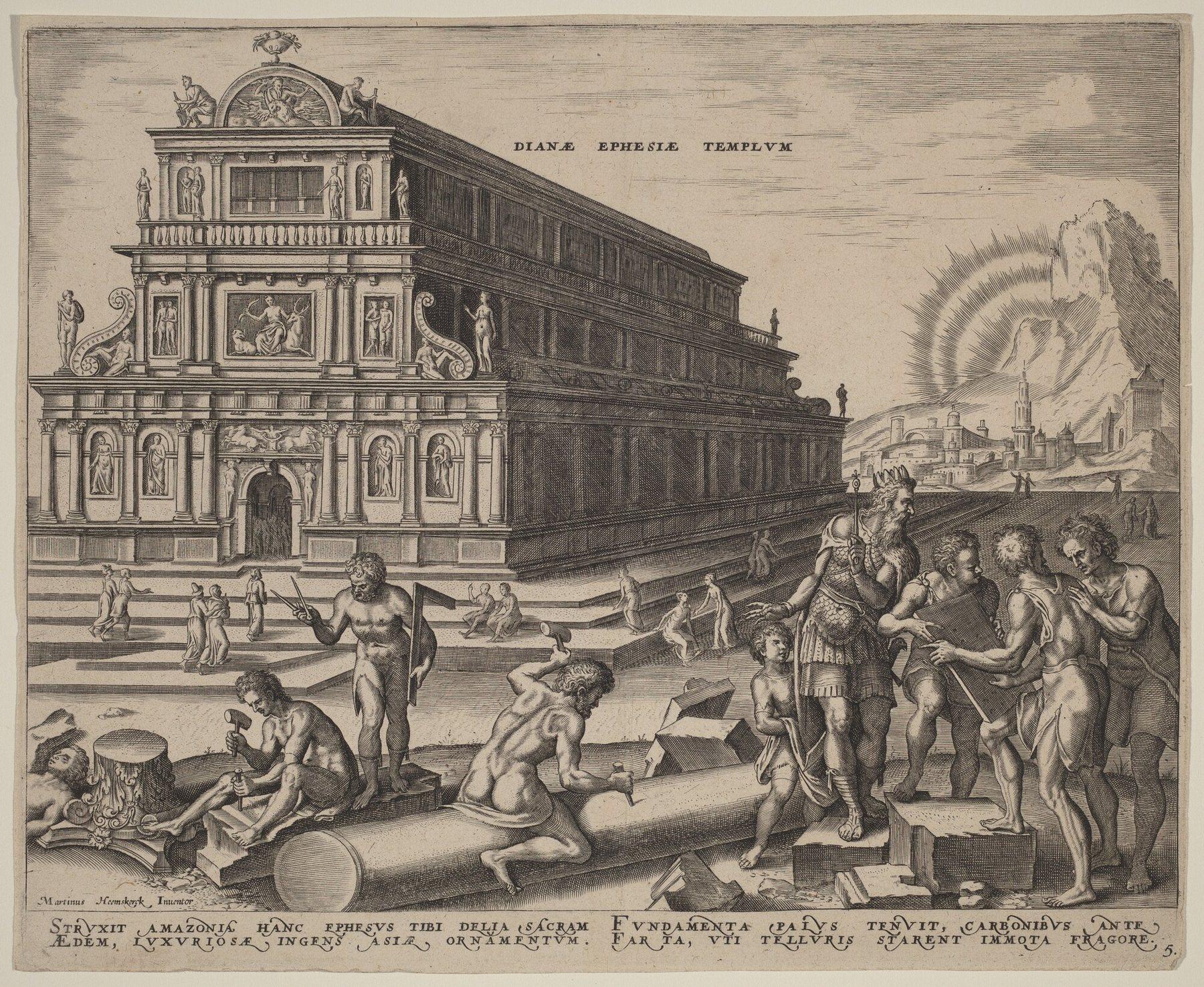
Philip Galle after Heemskerck, The Temple of Diana at Ephesus, 1572. Public domain.
Acts 18 to 20, Ephesians 1:1 and Revelation 2:1 · Place · Featured Study
Ephesus
Ephesus was a Greek city on the coast of Asia Minor, famous for its temple of Artemis.
This continued for two years, so that everyone who lived in the province of Asia, Jews and Greeks alike, heard the word of the Lord.
- Today
- Ruins on the west coast of Turkey
- Region
- The province of Asia
- Site
- 37.939, 27.341
- First named
- Acts 18:19 “When they reached Ephesus, Paul parted…”
- Last named
- Revelation 2:1 “…angel of the church in Ephesus write: These…”
Pliny counted 127 columns on the temple of Diana at Ephesus, each one the gift of a king.
Summary
Paul first stopped at Ephesus on his way from Corinth and came back to stay. A riot over the goddess Artemis ended his stay.
- Paul wrote 1 Corinthians while he was staying at Ephesus.
- Paul later sent for the church's elders and said goodbye to them at Miletus.
- Paul urged Timothy to stay at Ephesus and stop false teaching, 1 Timothy 1:3 records.
Paul at Ephesus
Paul's own words to the elders give the length of his stay.
When they reached Ephesus, Paul parted ways with Priscilla and Aquila. He himself went into the synagogue there and reasoned with the Jews.Paul's first contact with Ephesus was with its synagogue.
Paul returned overland from the interior. He spoke in the synagogue for three months, and then he moved his disciples to a lecture hall.
Therefore be alert and remember that for three years I never stopped warning each of you night and day with tears.The tears and warnings Paul recalls show what the stay cost him.
Ephesus on Knecht's Plate
Knecht's plate shows the coast of Asia Minor and the islands of the Aegean.
Ephesus was the hub of Paul's work in Asia, between Corinth to the west and Troas to the north.
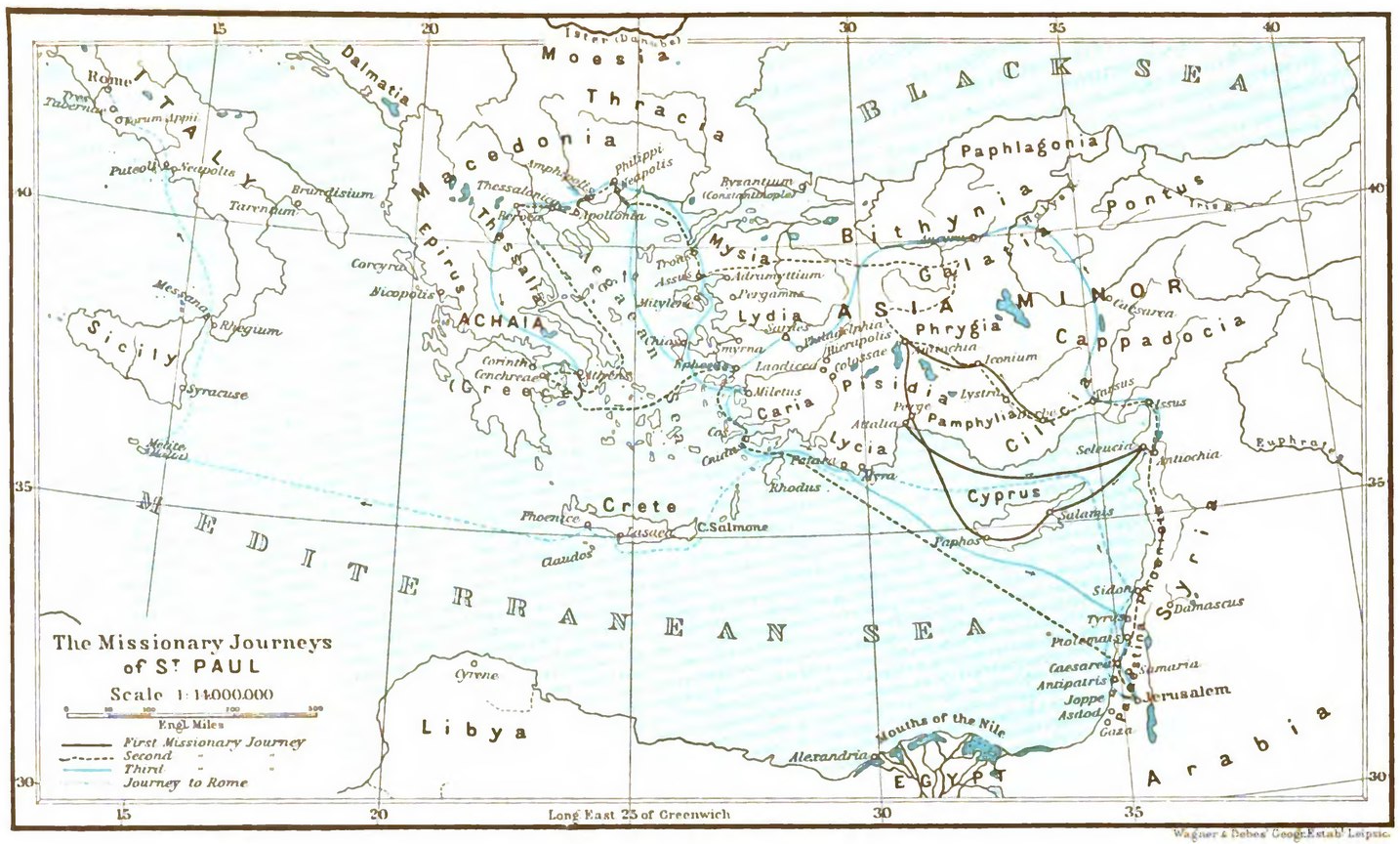
- 1Ephesus, Paul reasons in the synagogue on his first visit Acts 18:19
- 2Corinth, Paul leaves Athens for Corinth before he sails to Ephesus Acts 18:1
- 3Troas, Paul finds a door open for the gospel after leaving Asia 2 Corinthians 2:12
- 4Miletus, The harbor town south of Ephesus Acts 20:17
- 5Patmos, John writes the seven letters from the island Revelation 1:9
- 6Laodicea, The last of the seven churches that open with Ephesus Revelation 3:14
Base map: The missionary journeys of St. Paul, F. J. Knecht, Practical Commentary on Holy Scripture, public domain. Each place stands at its place page's coordinates, set on the plate by Corinth and Ephesus, as the plate prints them.
Six places, each with its verse. Each ring follows the OpenBible.info identification score out of 1,000; all six score 1,000.
Ephesus in Scripture, in Order
The verses run through Acts, three of Paul's letters and Revelation.
Nine verses on Ephesus, from Apollos to the letter to its church in Revelation.
- ActsApollos comes to Ephesus from AlexandriaActs 18:24
- ActsPaul comes to Ephesus and finds some disciplesActs 19:1
- ActsThe whole city rushes into the theatreActs 19:29
- ActsPaul decides to sail past Ephesus to reach Jerusalem by PentecostActs 20:16
- 1 CorinthiansPaul says he fought wild beasts at Ephesus1 Corinthians 15:32
- 1 CorinthiansPaul says he will stay at Ephesus until Pentecost1 Corinthians 16:8
- EphesiansThe letter greets the saints in EphesusEphesians 1:1
- 2 TimothyPaul sends Tychicus to Ephesus2 Timothy 4:12
- RevelationChrist addresses the first letter to the church in EphesusRevelation 2:1
Four of the nine stand in Acts 18 to 20.
Ephesians, 2 Timothy, Revelation
The City of Artemis
The Romans called the goddess Diana, and a silversmith's trade at Ephesus depended on her.
Pliny the Elder wrote that Diana's temple took 120 years to build, with all Asia sharing in the work. He gave its length as 425 feet and its breadth as 225, with columns sixty feet high. It stood on marshy ground, he wrote, so that earthquakes would not harm it.
Strabo tells that a man named Herostratus set an earlier temple on fire, and the citizens built a better one with the women's ornaments and their own goods. He called Ephesus the largest market in Asia this side of the Taurus mountains.
Demetrius made silver shrines of Artemis. W. M. Ramsay described such shrines as small models of the goddess seated in a niche with her lions, bought by worshippers to dedicate in her temple.
There is danger not only that our business will fall into disrepute, but also that the temple of the great goddess Artemis will be discredited and her majesty deposed—she who is worshiped by all the province of Asia and the whole world.”Demetrius names the trade and the temple together, so his fear for his business becomes a defence of the goddess.
What the Excavators Found
J. T. Wood dug at Ephesus and published his finds in 1877.
The temple foundWood, Discoveries at Ephesus (1877)
The temple of Diana had long been lost. Wood found its marble pavement on the last day of 1869, nearly twenty feet below the ground.
The great theatreWood, Discoveries at Ephesus (1877)
Wood measured the theatre where the crowd gathered in Acts 19:29. He gave its diameter as 495 feet, and by his own reckoning it seated 24,500 people.
The inscriptions of the theatreWood's inscriptions, as J. B. Lightfoot read them (1893)
Wood brought to light many inscriptions of the city and its theatre. J. B. Lightfoot noted that they name the three offices Luke names: the proconsul, the town clerk and the Asiarchs. The clerk's name stands on every decree, to make it valid and to fix its date.
Lightfoot translated one inscription that gives the city's titles. It calls the city "twice sacristan of the Augusti according to the decrees of the Senate and sacristan of Artemis". Lightfoot took it as the first direct example of the title the clerk gives the city in Acts 19:35.
Another, dated AD 104, records the gift of Gaius Vibius Salutaris, which included a silver image of Diana. It orders that the images be carried from the temple to the theatre for every meeting of the assembly.
The Church After Paul
False teachers came as Paul foresaw, and the church learned to test them.
I know that after my departure, savage wolves will come in among you and will not spare the flock.Paul's warning explains why the later letters to Ephesus fight false teaching.
I know your deeds, your labor, and your perseverance. I know that you cannot tolerate those who are evil, and you have tested and exposed as liars those who falsely claim to be apostles.A generation later the church at Ephesus is praised for exposing false apostles.
Irenaeus wrote that the church in Ephesus was founded by Paul and that the apostle John stayed there until the reign of Trajan. Eusebius quotes Polycrates, bishop of Ephesus, who said John was buried there. Early in the second century Ignatius wrote to the Ephesians and named their bishop, Onesimus.
Voices on Ephesus
John Chrysostom and Jamieson, Fausset and Brown wrote on the city clerk and the Asiarchs.
John Chrysostom (died 407)
John Chrysostom read the clerk's appeal to the city's fame as a rebuke.
“Well, and with rebuke does the town clerk say, ‘What man is there that knoweth not how that the city of the Ephesians-‘ coming to the point which they were frightened about. Is it this, says he, that ye do not worship her? And he does not say, ‘That knoweth not’ Diana, but, ‘our city,’ that it always worshipped her.”
John Chrysostom · Homily on Acts 42 · on Acts 19:35Patristic
Jamieson, Fausset & Brown (1802 to 1910)
Jamieson, Fausset and Brown described the office of the Asiarchs who warned Paul to keep out of the theatre.
“It was an office of the highest honor and greatly coveted. Certain of these, it seems, were favorably inclined to the Gospel, at least were Paul's ‘friends,’ and knowing the passions of a mob, excited during the festivals, ‘sent (a message) to him desiring him not to adventure himself into the theater.’”
Jamieson, Fausset & Brown · Commentary Critical and Explanatory on the Whole Bible · on Acts 19:31Reformed
Where Readers Differ
One question about the letter that bears the city's name.
Was the letter to the Ephesians written to Ephesus alone?2 paragraphs
The traditional reading takes the letter as written to the church at Ephesus, as nearly every manuscript of Ephesians 1:1 has it, with the words "in Ephesus". Thomas Aquinas held this reading in his Commentary on Ephesians, which says Paul wrote to the Ephesians of Asia Minor. T. K. Abbott, in 1897, named three exceptions: Codex Sinaiticus and Codex Vaticanus, where a later hand added the words, and the minuscule 67, where a corrector struck them out. He added that Basil found the words missing in the ancient copies of his day, and that Origen read the verse without them.
J. Armitage Robinson, in 1903, judged the words almost certainly not Paul's. He held that the letter went round many churches of Asia Minor and came first to Ephesus, the capital of the province, which later gave it its title. Abbott lists Lightfoot, Hort and Ellicott among those who held it a circular letter.
Books to Read Next
Three works of the nineteenth century, each free to read online.
Discoveries at Ephesus
J. T. Wood · 1877
Wood tells how he found the temple and prints the inscriptions of the theatre.
Free at the Internet ArchiveEssays on the Work Entitled Supernatural Religion
J. B. Lightfoot · 1893
Lightfoot's appendix reads Wood's inscriptions beside Acts 19.
Free at the Internet ArchiveSt. Paul the Traveller and the Roman Citizen
W. M. Ramsay · 1896
Ramsay explains the hall of Tyrannus, the silver shrines and the Asiarchs.
Free at the Internet ArchiveA Door Wide Open
Paul gave the Corinthians his reason for staying on.
because a great door for effective work has opened to me, even though many oppose me.Sources
Scripture is the Berean Standard Bible.
- OpenBible.info, Bible-Geocoding-Data, ancient.jsonl, entries Ephesus, Corinth, Troas, Miletus, Patmos and Laodicea (each score 1000)
- F. J. Knecht, Practical Commentary on Holy Scripture, the plate The Missionary Journeys of St. Paul.
- Pliny the Elder, Natural History 36.21, translated by John Bostock and H. T. Riley (1855)
- Strabo, Geography 14.1.22 to 24, translated by Horace Leonard Jones, Loeb Classical Library (1929)
- J. T. Wood, Discoveries at Ephesus, including the Site and Remains of the Great Temple of Diana (London, 1877)
- Wood's inscriptions from the Great Theatre, cited by Lightfoot as Inscr. vi. 1 and Inscr. vi. 6, in J. T. Wood, Discoveries at Ephesus (1877), appendix 6; translated by J. B. Lightfoot (1893)
- J. B. Lightfoot, Essays on the Work Entitled Supernatural Religion (London: Macmillan, 1893), appendix on Wood's Ephesian inscriptions, pp. 297 to 302.
- W. M. Ramsay, St. Paul the Traveller and the Roman Citizen (New York and London: Putnam, 1896)
- W. J. Conybeare and J. S. Howson, The Life and Epistles of Saint Paul, People's Edition (Cincinnati, 1869)
- Irenaeus, Against Heresies 3.3.4, Ante-Nicene Fathers, volume 1 (1885)
- Eusebius, Church History 3.31, translated by A. C. McGiffert, Nicene and Post-Nicene Fathers, second series, volume 1 (1890)
- Ignatius, Epistle to the Ephesians 1 and 6, Ante-Nicene Fathers, volume 1 (1885)
- T. K. Abbott, A Critical and Exegetical Commentary on the Epistles to the Ephesians and to the Colossians (1897)
- J. Armitage Robinson, St Paul's Epistle to the Ephesians (1903)
- John Chrysostom, Homily 42 on Acts; Jamieson, Fausset and Brown, Commentary Critical and Explanatory (1871)
- Thomas Aquinas, Commentary on Ephesians (1274), on Ephesians 1:1.
Keep Studying
People and groups5
Doctrines1