
Acts 2 · 8 · 9 · 10 · 19 · Doctrine
Baptism in the Holy Spirit
Acts records five occasions on which people receive the Holy Spirit, and they do not line up. One happens mid-sermon before anyone can be baptized; one happens days after baptism, when two apostles arrive from Jerusalem; one happens to a man three days blind. Every serious position on this question is an attempt to account for that table. This page prints the table first, then lets each case make its own argument at full strength, and then names this site's tradition.
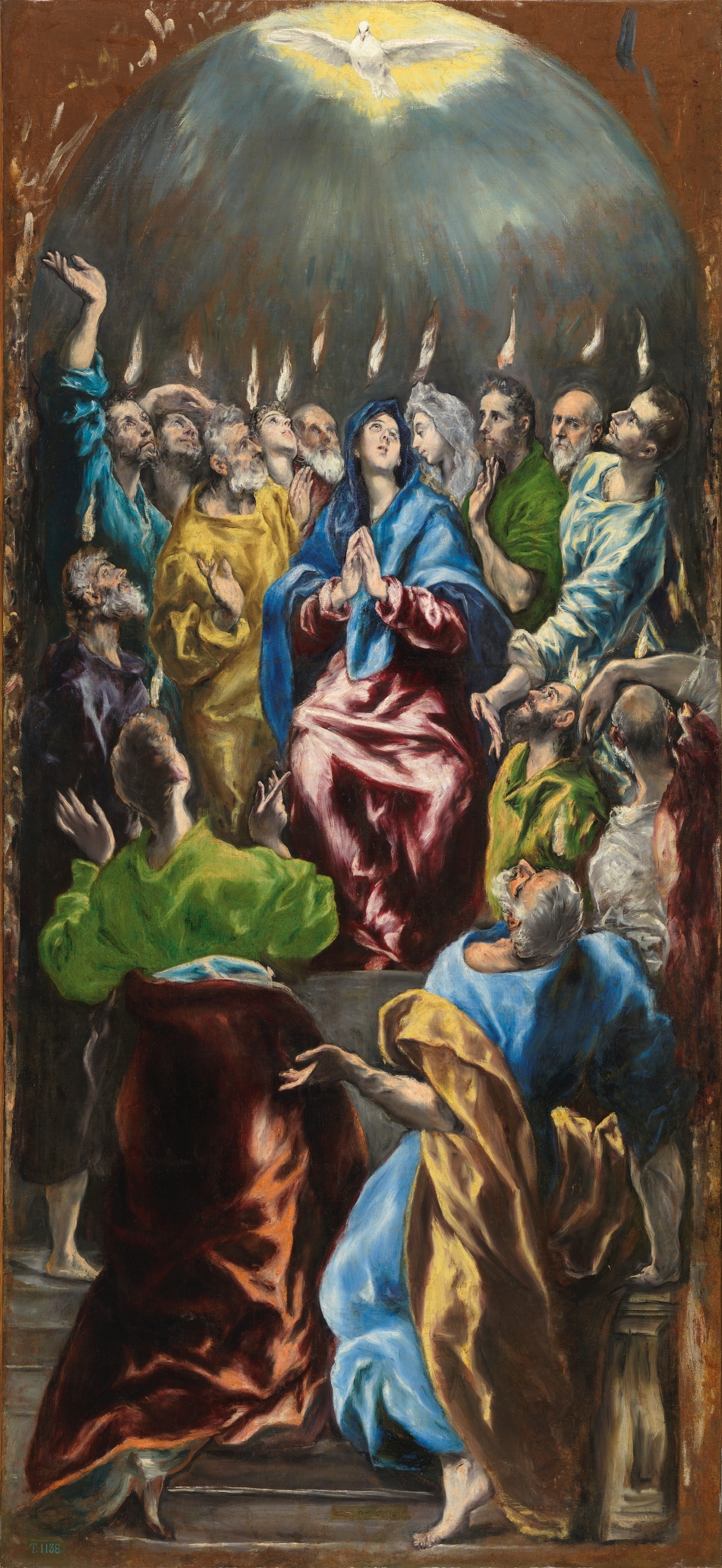
El Greco, Pentecost (c. 1600) — public domain.
THE ARTWORKEl Greco paints the tongues of fire descending on the gathered disciples of Acts 2:4: the first, undisputed reception on the ledger below. Every position on this page has to reckon with what happens in this one room before it can explain why the four receptions after it look so different.
Summary
Every Acts reception of the Spirit is laid out in one table with its differences left in, and the one-stage and two-stage positions are each argued at full strength rather than summarized by their opponents. The texts that set how long the gifts run are read on their own terms before this site's own tradition is named.
- All five receptions of the Spirit in Acts are laid out in one table, with the differences left in.
- The one-stage and two-stage positions are each argued at full strength, not summarized by their opponents.
- Luke's own Greek vocabulary is used to show one baptism and many fillings.
- Five texts set the age of the gifts, from Ephesians 2 and 4 to Joel's last days and Paul's own definition of that which is perfect.
- This site's tradition, Wesleyan-Pentecostal and continuationist, is named directly, with a slot for Marcus's own words.
The Evidence
all five receptions, with the awkward variety left in: every position has to explain this table
Who
About 120 disciples who had followed Jesus and been told to wait for the promise
Laying on of hands
None
When, relative to believing
Long after believing: they had believed through the ministry of Jesus himself and waited ten days for this
The sign
Wind, fire, and speaking with other tongues
Who
Samaritans who believed Philip's preaching and were baptized
Laying on of hands
Yes: Peter and John, sent down from Jerusalem
When, relative to believing
Days later: Luke says plainly that the Spirit had as yet fallen on none of them, though they had believed and been baptized
The sign
Not stated; but Simon saw something worth trying to buy (8:18)
Who
Saul of Tarsus, three days after the road, blind and fasting
Laying on of hands
Yes: Ananias, a disciple nobody has heard of before or since
When, relative to believing
Three days after the encounter, and before his baptism in water
The sign
Not stated; the scales fall and he is baptized
Who
Cornelius, his kinsmen and his near friends: uncircumcised Gentiles
Laying on of hands
None
When, relative to believing
Mid-sermon, at the moment of hearing and believing, before any baptism and before anyone could lay a hand on them
The sign
Tongues, and magnifying God
Who
About twelve men who knew only John's baptism
Laying on of hands
Yes: Paul
When, relative to believing
After being baptized into the name of the Lord Jesus: a distinct, later moment
The sign
Tongues, and prophecy
Four of the five are subsequent to believing, and one (the most theologically loaded of them) is not. Anyone who tells you this question is obvious has not read the table slowly. What follows is each case put as strongly as its own advocates put it.
The Two-Stage Question
both cases at full strength: neither summarised by its opponents
One stage
Spirit-baptism is regeneration itself
- 01
The only doctrinal statement on the subject says so
Paul's one explicit definition is 1 Corinthians 12:13: in one Spirit were we all baptized into one body. All. Not a subset of Christians who pressed further in. If the epistle defines the term and the narrative merely illustrates it, the epistle governs.
- 02
There is no Spirit-less Christian
If any man hath not the Spirit of Christ, he is none of his (Rom 8:9). A category of genuinely converted believers who have not yet received the Spirit does not exist in the epistles; if it did, Paul's pastoral letters to churches full of immature converts would be unrecognisable.
- 03
Each Acts exception has a reason on the face of the text
The 120 straddle the covenants: nobody could receive the Pentecostal gift before Pentecost. Samaria's delay binds a schismatic people to the Jerusalem apostles so that two churches do not start. Caesarea has to be public and unmistakable or the Gentile question never closes. And the Ephesian twelve had not heard the gospel at all: Paul's answer is to baptize them again.
- 04
Narrative describes; it does not prescribe
Acts also records drawing lots for an apostle, selling property into a common purse, and a man raised after falling out of a window. Reading a repeated narrative feature as a required order of salvation needs an argument that the narrative itself never supplies.
- 05
The ledger does not actually line up
Of the five receptions, one is simultaneous with faith (Caesarea), three involve the laying on of hands and one does not, and only two explicitly mention tongues. A doctrine of uniform subsequence has to explain Cornelius; a doctrine of uniform simultaneity has to explain Samaria. Neither side gets a clean table.
Two stages
A distinct empowering, subsequent to the new birth
- 01
Luke asks the question in a form that assumes it
Paul's opening line at Ephesus is did ye receive the Holy Spirit when ye believed? The question is only intelligible if a believer might not have. Nobody asks a question whose answer is guaranteed by definition.
- 02
Samaria is not ambiguous
Luke states that they believed and were baptized, and then states that the Spirit had as yet fallen upon none of them. If Spirit-baptism were regeneration, that sentence could not be written: those would be unregenerate people who had believed the gospel.
- 03
Luke and Paul are answering different questions
Paul's concern in 1 Corinthians 12 is incorporation: how one body is formed out of many members. Luke's concern from 1:8 onwards is power for witness. Two different questions can both have true answers, and forcing Luke to mean what Paul means flattens the one writer who devotes a whole book to the subject.
- 04
The vocabulary distinguishes what the doctrine merges
Luke reserves baptizō for the promise and uses pimplēmi and plēroō for what keeps happening afterwards. One baptism, many fillings: the ledger above is Luke's own, not a Pentecostal invention.
- 05
The pattern is deliberate, not incidental
A historian who repeats an episode three times in nearly identical language, with three different audiences and two different apostles, is teaching something. Luke had every opportunity to present Caesarea as the corrective to Jerusalem and instead presents it as the same thing happening again, further out.
Luke's Own Vocabulary
one baptism, many fillings: the bridge the Greek offers
The promise, spoken of an event
Acts 1:5 · 11:16: and in both places it is Jesus' own words being quoted back
Luke never uses this verb to describe a repeated experience. It names the once-given promise: ye shall be baptized in the Holy Spirit.
The empowering, and it repeats
Acts 2:4 · 4:8 · 4:31 · 9:17 · 13:9
The same people are filled in 2:4, and Peter is filled again in 4:8, and the whole company again in 4:31. Whatever this is, it is not a one-time transaction.
A settled condition, not an event
Acts 6:3 · 6:5 · 7:55
An adjective, used as a job qualification: choose out men full of the Spirit. Fullness is something a person can be known for over time.
An ongoing state
Acts 13:52
The disciples were continually filled with joy and with the Holy Spirit: a durative, not a moment.
This is where the two positions actually meet. There is one baptism (the once-given promise, whatever else it coincides with) and there are many fillings, the repeated empowerings for boldness, utterance and courage that Luke records again and again for the same people. A believer who insists there is nothing further to receive is arguing with Acts 4:31; a believer who insists nothing was received at conversion is arguing with Romans 8:9.
Tongues and Initial Evidence
the sharpest edge of the question
The case for initial evidence
- All three outpourings that Luke describes in detail pair Spirit-reception with tongues (2:4; 10:46; 19:6).
- At Caesarea, tongues are the specific evidence Luke says convinced the sceptical Jewish believers: it functions as evidence in the text itself.
- Peter's report in Jerusalem appeals to the resemblance: the Spirit fell on them as on us at the beginning (11:15), i.e. the recognisable sign.
- The classical Pentecostal doctrine is not that tongues are the greatest gift but that they are the consistent accompanying sign: a distinction its critics often skip.
The case against
- Acts never commands tongues as a test, and never rebukes anyone for lacking them.
- Samaria (8:17) records a reception with no mention of tongues at all: in the one narrative where a visible sign would have settled Simon's question.
- Paul's rhetorical do all speak with tongues? (1 Cor 12:30) expects the answer no, in a letter written to a church that had the gift in abundance.
- In 1 Corinthians 12 the Spirit divides to each one severally even as he will: sovereign distribution, not a uniform issue.
Where the positions meet
Both positions treat tongues as a genuine, welcome manifestation of the Spirit: forbid not to speak with tongues (1 Cor 14:39) is common ground. Where the initial-evidence reading (Prince, Hagin above) becomes a bar telling believers who have not spoken in tongues that they have not received the Spirit, the against position's own texts: Samaria's silent reception (8:17), Paul's rhetorical do all speak with tongues? (1 Cor 12:30): stand as the corrective a doctrine like that has to answer.
The Age of the Gifts
five texts that set how long the Spirit's gifts run, each read on its own terms
The foundation, and the term of service
Paul calls the household of God a building on the foundation of the apostles and prophets (Eph 2:20). In the same letter he gives the ministries their term: until we all attain unto the unity of the faith, and of the knowledge of the Son of God, unto a fullgrown man (Eph 4:11–13). The term is the whole growth of the church into the fulness of Christ, and the church is not there yet.
What the signs did, and whose hands they came through
Hebrews describes God bearing witness with signs, wonders, manifold powers and gifts of the Holy Spirit (Heb 2:3–4), and 2 Corinthians 12:12 calls signs, wonders and mighty works the marks of an apostle. Both texts say what the works did. Neither sets a date on them. Acts hands them beyond the Twelve: Stephen does great wonders and signs (6:8) and Philip's preaching in Samaria carries the same power (8:6–7), and neither man was an apostle.
Joel's span, which Peter is quoting
Peter reads the morning by Joel: it shall be in the last days, saith God, I will pour forth of my Spirit upon all flesh (2:17). Joel runs those days on to the great and notable day of the Lord (2:20). The outpouring is given the length of the age between the two comings, and Peter says so on the first day of it.
That which is perfect, defined by Paul himself
Prophecy, tongues and knowledge are done away when that which is perfect is come (1 Cor 13:8–10), and Paul says what the perfect is three verses later: then face to face; then shall I know fully even as also I was fully known (13:12). That is sight, and no reader has it yet. The same letter opens with a church that comes behind in no gift while it waits for the revealing of our Lord Jesus Christ (1:7), which dates the gifts to His appearing.
Paul's answer to misuse is order
Corinth handled the gifts badly, and Paul gave the church a chapter of regulation: two or three at most, each in turn, tongues interpreted, prophets judged, everything measured by whether the church is built up. He closes with let all things be done decently and in order (14:40), standing beside forbid not to speak with tongues (14:39).
This Site's Tradition
Wesleyan-Pentecostal and continuationist
This site's tradition: Wesleyan-Pentecostal and continuationist
This site's tradition stands in the Wesleyan-Pentecostal continuationist stream: the gifts, offices and outpourings of Acts belong to the whole church age, because the promise is expressly given to you, and to your children, and to all that are afar off, even as many as the Lord our God shall call. The church has never yet run out of calling.
On the two stages
Within this tradition, a real and often distinct empowering for witness, the classical two-stage pattern. The one-stage reading is presented in full above; it is held by serious readers of the same text.
On tongues
Genuine, normative, and to be sought; not forbidden, and not turned into a gate. The initial-evidence position is given its full voice above without being made the price of admission.
On the apostolate
The foundational office, eyewitness of the resurrection, appointed by the risen Lord, is not repeatable. The functions of apostolic pioneering and prophetic edification are. Both held without flattening either.
The Keynote Words
the Greek the argument turns on
The Voices
every position sourced to a specific work: Marcus Brown's commentary leads above all
The Spirit-Filled Believer's Handbook; From Jordan to Pentecost
Prince's is the classical statement: a baptism in the Spirit distinct from and subsequent to the new birth, evidenced by tongues, taught from the Acts pattern rather than from a single proof-text, and framed as the normal entrance into a life of power.
The Holy Spirit and His Gifts
Hagin argues initial physical evidence directly from Acts 2, 10 and 19: where Luke describes the reception, tongues appear. Cited here for the position he represents; the site holds its usual reservations about the wider Word-of-Faith framework around it.
Ever Increasing Faith
Wigglesworth's contribution is not exegetical but evidential: a ministry conducted on the assumption that the Acts pattern was still operating, and reported healings and raisings offered as the argument.
Keys to the Deeper Life; The Pursuit of God
Tozer holds the Keswick middle: a real and often distinct subsequent filling that he refuses to attach to tongues, urged on believers as the difference between a church that is organised and a church that is inhabited.
Learn the Bible in 24 Hours; the Acts commentary (Koinonia House)
Missler affirms the gifts as operative for the whole church age without occupying the tongues-as-initial-evidence position: the moderate continuationist ground much of Marcus Brown's own formation stands on.
Explanatory Notes upon the New Testament; the sermons on Christian perfection (public domain)
The historical headwater of the Wesleyan-Pentecostal reading: a definite second work of grace after justification, taught as sanctification rather than as power for witness, but supplying the structure the Pentecostal movement would later fill with Acts 1:8.
Modern voices are summarised, never quoted at length. Public-domain voices are summarised here as well; their exact wording is pulled to the sources page as it is confirmed against the printed text.
Word studies
The Hebrew and Greek under this study, each word in its own room.
Notable art
— click a piece to enlargeKeep studying
Read it2
On this page
Studies4
Places3
Symbols1
Doctrines15
- The Three Pentecosts
- Pentecost: the feast
- Healing
- Hearing God
- Jesus on the Holy Spirit
- Speaking in Tongues
- The Gifts of the Spirit: 1 Corinthians 12-14
- The Anointing
- The Promise of the Father
- The Spirit in the Old Testament
- Water Baptism
- Who the Holy Spirit Is
- The Messianic Psalms
- Prophecy as a Gift Today
- The Church
Go further1