
1534 to today · The churches · Featured Study
The Anglican Communion
The Church of England and the churches of its prayer book, the Episcopal Church in the United States among them.
In 1549 the rebels of Cornwall refused the new English service, saying, as Cranmer quotes them, that “certain of us understand no English.”
- Began
- November 1534, the Supremacy Act, as Gee and Hardy date it
- Bodies
- The Church of England, The Episcopal Church
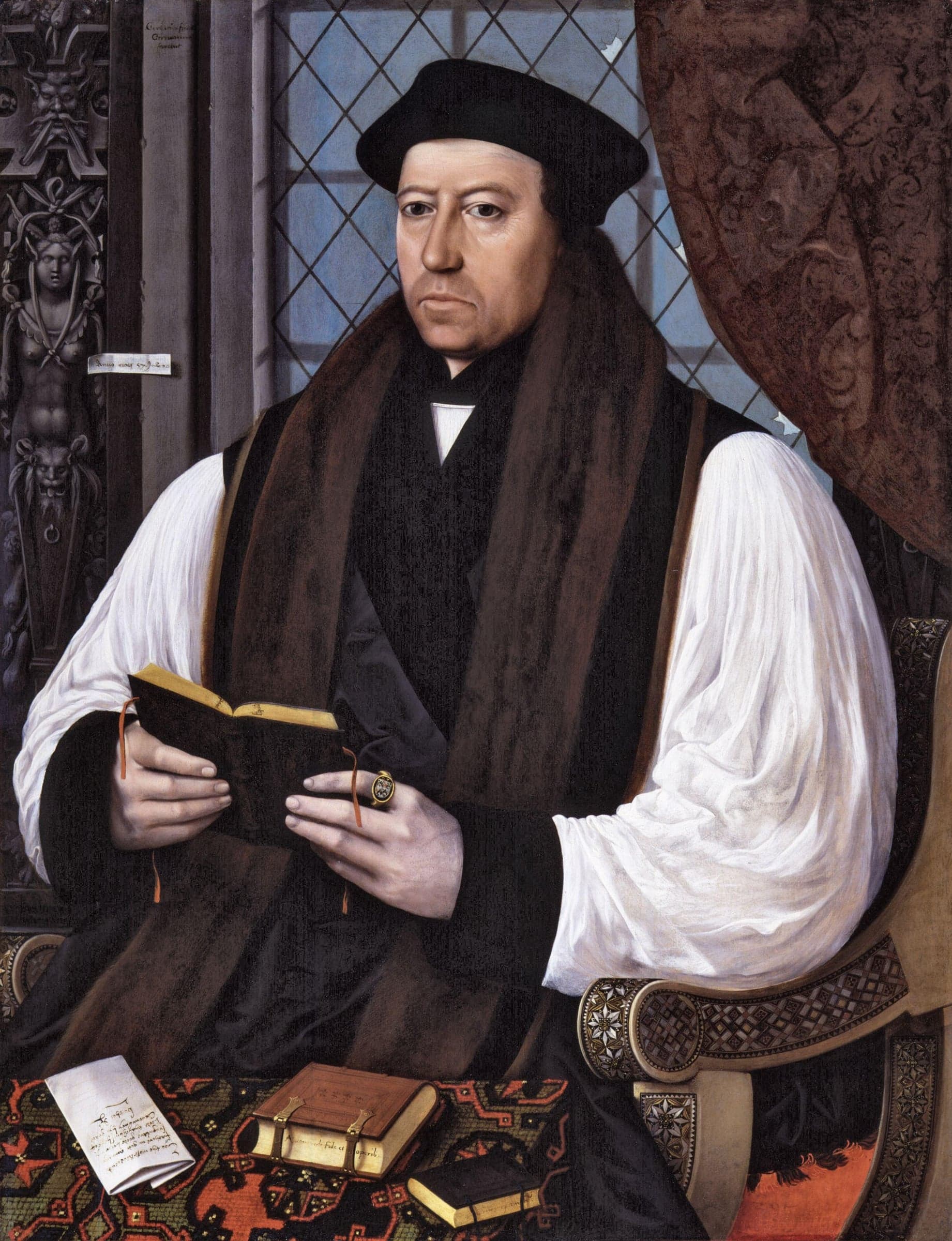
Gerlach Flicke, Thomas Cranmer, 1545. Public domain.
And He is the head of the body, the church; He is the beginning and firstborn from among the dead, so that in all things He may have preeminence.
Summary
The Anglican churches descend from the Church of England, which Parliament set under the king in 1534. Its prayer book put the service into English in 1549, and its Articles of 1571 state its doctrine.
- The statute of 1534 and the preface of 1549 give two different grounds for the change.
- Its doctrine stands in the Articles and its worship in the Book of Common Prayer.
- The Episcopal Church carries the family into the United States.
The Texts the Anglican Churches Stand On
The texts come from 1 Corinthians 14, 2 Timothy 3 and Romans 3.
Verses behind the prayer book and the Articles
But in the church, I would rather speak five coherent words to instruct others than ten thousand words in a tongue.
The preface of 1549 grounds English worship in Paul's wish that the people understand what is said in church.
From infancy you have known the Holy Scriptures, which are able to make you wise for salvation through faith in Christ Jesus.
Article VI holds that Scripture contains all things necessary to salvation, as Paul says it makes wise for salvation.
For we maintain that a man is justified by faith apart from works of the law.
It is Paul's ground for the justification by faith only that Article XI calls a most wholesome doctrine.
Romans 3:28BSB
But everything must be done in a proper and orderly manner.
Paul's rule of order in worship stands behind the 1662 preface's care to keep the liturgy between two extremes.
The Anglican Branch of the Family of Churches
From the Supremacy Act of 1534 to the count of 2023.
The Church of England took its shape in statutes and books between 1534 and 1662.
1534
- The Supremacy Act of Henry VIII
1549
- The first Book of Common Prayer
- The rising in Devon and Cornwall
1562 and 1563
- The Thirty-nine Articles in Latin
1571
- The Articles revised in English
1662
- The Book of Common Prayer of 1662
Today
- The Episcopal Church in the United States
Each generation is dated by the statute, book or count behind it.
The other families of the churches stand together with the dates on which each began.
How the Church of England Began
Gee and Hardy print the statute of 1534 and the Act of 1549.
Henry Gee and William Hardy printed the Supremacy Act in their Documents Illustrative of English Church History in 1896. They record that it passed in November 1534.
The Act says the king is head of the church and is so recognized by the clergy in their Convocations. It enacts, “for corroboration and confirmation thereof,” that he be taken as “the only supreme head in earth of the Church” of England.
The First Act of Uniformity of Edward VI established the first prayer book. Gee and Hardy record that it passed in January 1549.
The statute is the crown's own paper, and the preface of the prayer book is the church's own.
The Truth They Recovered: Worship and Scripture in English
The preface of 1549 gives Paul's reason for English, Article VI sets Scripture over the faith and Article XXIV sets worship in the people's tongue.
The church set its worship in the people's tongue and its faith under Scripture.
| The document | Its words |
|---|---|
| The preface of 1549 | whereas s. Paule would have suche language spoken to the people in the churche, as they mighte understande and have profite by hearyng the same; the service in this Churche of England (these many yeares) hath been read in Latin to the people, whiche they understoode not; so that they have heard with theyr eares onely |
| Article VI | Holy Scripture conteyneth all thinges necessarie to saluation: so that whatsoeuer is not read therein, nor may be proued therby, is not to be required of anye man, that it shoulde be beleued as an article of the fayth |
| Article XXIV | It is a thing playnely repugnaunt to the worde of God, and the custome of the primitiue Churche, to haue publique prayer in the Churche, or to minister the Sacramentes in a tongue not vnderstanded of the people. |
The Articles and the Prayer Book of 1662
The Articles came first in Latin and then in English, and the book of 1662 has its own preface.
Philip Schaff records that the Articles were passed, recorded and ratified in the year 1562, which he also gives as 1563, in Latin only.
Convocation revised and translated them in 1571, and the Latin and English texts were published that year.
Article XI rests righteousness on Christ's merit by faith, and the preface of 1662 keeps the church's liturgy between two extremes.
| The document | Its words |
|---|---|
| Article XI | We are accompted righteous before God, only for the merite of our Lord and sauiour Jesus Christe, by faith, and not for our owne workes or deseruynges. |
| The preface of 1662 | It hath been the wisdom of the Church of England, ever since the first compiling of her Publick Liturgy, to keep the mean between the two extremes, of too much stiffness in refusing, and of too much easiness in admitting any variation from it. |
The Episcopal Church Today
The Episcopal Church counted its parishes, members and attendance for 2023.
The Episcopal Church's Analysis of the 2023 Parochial Report Data was prepared for its Executive Officer by the Hartford Institute for Religion Research, from the parochial reports its congregations sent in.
The analysis gives three totals for 2023.
| Measure | 2023 | What the analysis counts |
|---|---|---|
| Open parishes and missions | 6,754 | Every parish and mission open in 2023 |
| Active baptized members | 1,547,779 | Baptized members the congregations count as active |
| Average Sunday attendance | 410,912 | The average of Sunday worship attendance, all congregations together |
Where Its American Members Gather
The Episcopal Church's members gather most in the Southeastern and Middle Atlantic states.
Three provinces of the United States hold over half the Episcopal Church's members in 2023.
| Provinces | Where | Parishes | Members | Sunday attendance |
|---|---|---|---|---|
| II, III and IV together | The Southeastern and Middle Atlantic states | 48 percent | 55 percent | 60 percent |
| IV alone | Within the same states | Not given | 24 percent | 27 percent |
The Rising of 1549 and Cranmer's Answer
The rebels of the West refused the book, and its maker answered them.
The English book was imposed by an Act of Parliament on Cornish people, some of whom understood no English, though its own preface asked for a language the people understand.
The rebels' words survive only as Thomas Cranmer, the book's maker and an interested witness, quoted them in his Answer to the Fifteen Articles, which the Parker Society printed in 1846.
Their eighth article reads, “We will not receive the new service, because it is but like a Christmas game.”
They asked for “our old service of matins, mass, even-song, and procession in Latin, as it was before.”
Cranmer turned their phrase back on them: “It is more like a game and a fond play to be laughed at of all men, to hear the priest speak aloud to the people in Latin.”
Books to Read Next
Documents Illustrative of English Church History
Henry Gee and William John Hardy · 1896
It prints the Supremacy Act and the Acts of Uniformity from the statutes.
Free at the Internet ArchiveMiscellaneous Writings and Letters of Thomas Cranmer
The Parker Society · 1846
It holds Cranmer's answer to the rebels of 1549 with their articles.
Free at the Internet ArchiveThe Creeds of Christendom, volume 3
Philip Schaff · 1877
Schaff prints the Articles in the Latin of 1563, the English of 1571 and the American text of 1801.
Free at the Christian Classics Ethereal LibraryWhat the Anglican Churches Hand On
The Anglican churches hand on common prayer in the language of the people who pray it, a rule their Article XXIV makes doctrine.
Sources
Scripture is the Berean Standard Bible.
- The Holy Bible, Berean Standard Bible (read 2026)
- Henry Gee and William John Hardy, Documents Illustrative of English Church History (London: Macmillan, first edition 1896, read in the reprint of 1921), No. LV, The Supremacy Act, pages 243 to 244, and No. LXIX, The First Edwardine Act of Uniformity, page 358.
- The Book of Common Prayer (1549), the preface.
- Philip Schaff, The Creeds of Christendom, volume 3 (1877), the Thirty-nine Articles, the headnote and Articles VI, XI and XXIV in the English of 1571.
- The Book of Common Prayer (1662), the preface, in John Baskerville's printing of 1762.
- Thomas Cranmer, Answer to the Fifteen Articles of the Rebels, Devon (1549), in Miscellaneous Writings and Letters of Thomas Cranmer (Cambridge: The Parker Society, 1846), pages 179 to 180.
- The Episcopal Church, Analysis of the 2023 Parochial Report Data (2024), prepared by the Hartford Institute for Religion Research.
Keep Studying
Church history2
People and groups3
Subjects1