
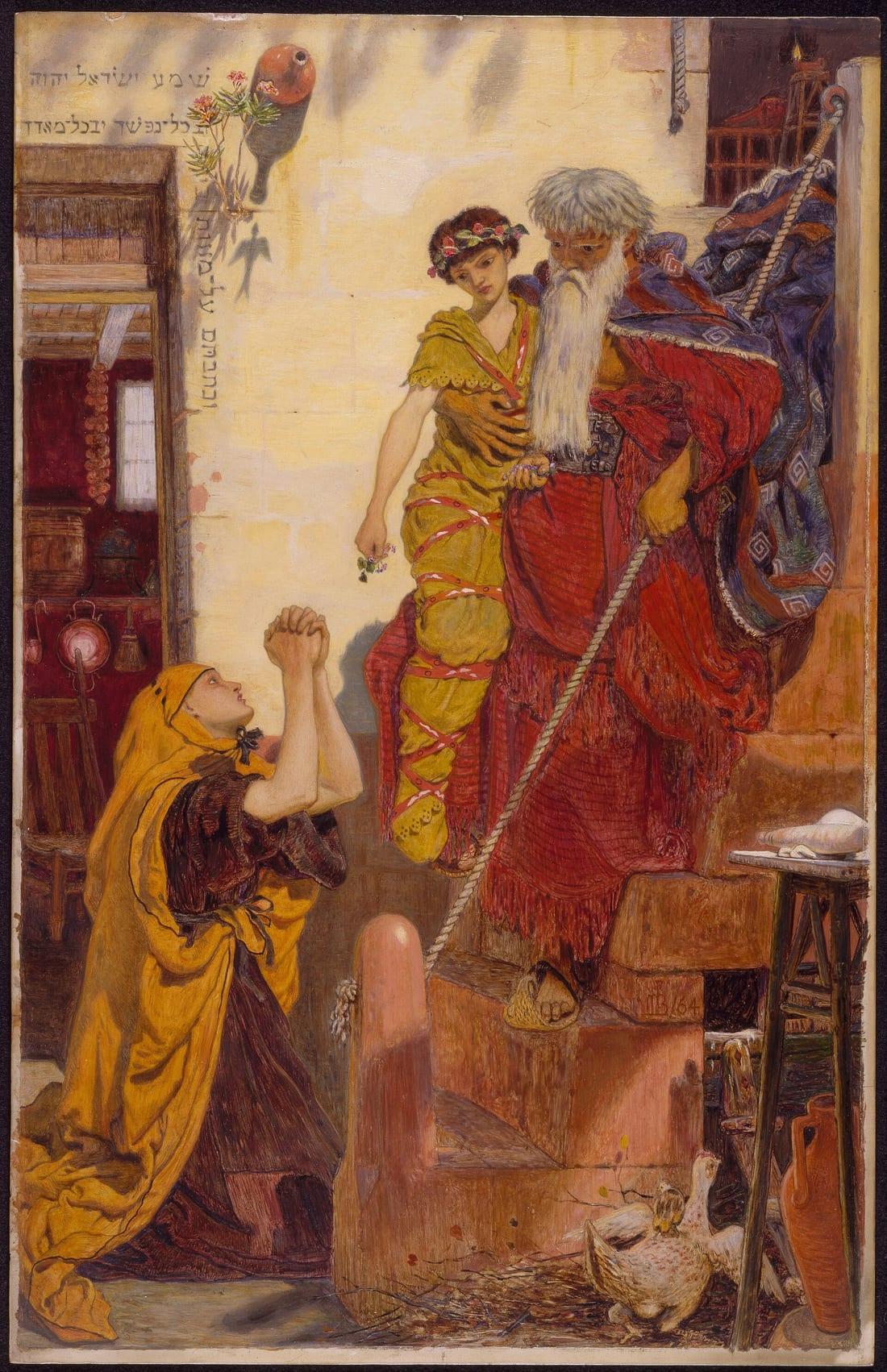
Ford Madox Brown, Elijah and the Widow's Son, 1864. Public domain.
1 Kings 17 · Subject · Featured Study
The Raisings of the Dead in Scripture
The prophets, Jesus and the apostles raised the dead, and the New Testament sets Christ's resurrection apart from them all.
A widow's son died in Zarephath, and Elijah carried him back down the stairs alive.
Then he stretched himself out over the child three times and cried out to the LORD, “O LORD my God, please let this boy’s life return to him!” And the LORD listened to the voice of Elijah, and the child’s life returned to him, and he lived.
Then he stretched himself out over the child three times and cried out to the LORD, “O LORD my God, please let this boy’s life return to him!” And the LORD listened to the voice of Elijah, and the child’s life returned to him, and he lived.
- Books
- 1 Kings, 2 Kings, Acts
- Hold in memory
- Romans 6:9, 1 Corinthians 15:20
Summary
Scripture records nine raisings of the dead: three in the Old Testament and six in the New.
- One man came back to life when his body touched Elisha's bones.
- Christ cannot die again, and Paul calls Him the firstfruits.
- Readers differ on whether Eutychus died and on when the saints of Matthew 27 rose.
The First Raising, at Zarephath
1 Kings 17 records the first time Scripture tells of the dead brought back to life.
Elijah stayed in a widow's upper room while the drought lasted. Her son fell sick and died, and she blamed the prophet.
Then Elijah took the child, brought him down from the upper room into the house, and gave him to his mother. “Look, your son is alive,” Elijah declared. Then the woman said to Elijah, “Now I know that you are a man of God and that the word of the LORD from your mouth is truth.”The raising turns the widow's grief into a confession about the prophet's word.
John Gill, on 1 Kings 17:22, calls this the first instance of anyone being raised from the dead.
But I tell you truthfully that there were many widows in Israel in the time of Elijah, when the sky was shut for three and a half years and great famine swept over all the land. Yet Elijah was not sent to any of them, but to the widow of Zarephath in Sidon.Jesus names the widow of Zarephath in the synagogue at Nazareth.
Women received back their dead, raised to life again. Others were tortured and refused their release, so that they might gain a better resurrection.Hebrews counts the women who received back their dead among the works of faith.
Every Raising, in the Canon's Order
The raisings in the order of the books, and the texts that set Christ's resurrection apart.
Jesus raised three, Elisha two, and Elijah, Peter and Paul one each.
| The one raised | Place | At whose word or touch | What the text records |
|---|---|---|---|
| The widow's son | Zarephath of Sidon | Elijah's prayer | He revives after Elijah's prayer. |
| The Shunammite's son | Shunem | Elisha | He wakes after Elisha lies on him a second time. |
| A man thrown into a tomb | Elisha's tomb | The touch of Elisha's bones | Life returns at the touch of the bones. |
| The daughter of a synagogue leader | The leader's house | Jesus | She rises when Jesus takes her hand. |
| Many saints who had fallen asleep | Tombs near the holy city | At Jesus' death | They are seen in the holy city after His resurrection. |
| The widow's son | Nain | Jesus | He sits up on the bier and speaks. |
| Lazarus | Bethany | Jesus | He walks out of a tomb four days after his burial. |
| Tabitha | Joppa | Peter's prayer | She wakes at Peter's word and is shown alive. |
| Eutychus | Troas | Paul | He falls from a window during Paul's sermon and goes home alive. |
Lazarus, Tabitha, Eutychus
Christ's resurrection differs from the raisings in what came after it.
| The question | The raisings | The resurrection of Christ |
|---|---|---|
| Could death return? | Lazarus was marked for death again. | He cannot die again; death no longer has dominion over Him. |
| What title does it give? | None of the raised is given a title for it. | The beginning and firstborn from among the dead. |
| How long? | The texts follow none of them to a second death. | Alive forever and ever, holding the keys of Death and of Hades. |
Elisha at Shunem and at His Own Grave
Two raisings stand in the story of Elisha, one in his life and one after his death.
Then Elisha got on the bed and lay on the boy, mouth to mouth, eye to eye, and hand to hand. As he stretched himself out over him, the boy’s body became warm. Elisha turned away and paced back and forth across the room. Then he got on the bed and stretched himself out over the boy again, and the boy sneezed seven times and opened his eyes.Elisha lies on the boy mouth to mouth and eye to eye, as Elijah had stretched himself over the widow's son.
And Elisha died and was buried. Now the Moabite raiders used to come into the land every spring. Once, as the Israelites were burying a man, suddenly they saw a band of raiders, so they threw the man’s body into Elisha’s tomb. And as soon as his body touched the bones of Elisha, the man was revived and stood up on his feet.A man is revived by touching the bones of a dead prophet, with no prayer and no word spoken.
The Raisings by Jesus
The Gospels record three raisings by Jesus: a girl, a young man and a friend four days in the tomb.
Then He went up and touched the coffin, and those carrying it stood still. “Young man,” He said, “I tell you, get up!” And the dead man sat up and began to speak! Then Jesus gave him back to his mother.At Nain Jesus touches the coffin and gives the son back to his mother, as Elijah did at Zarephath.
Taking her by the hand, Jesus said, “Talitha koum!” which means, “Little girl, I say to you, get up!” Immediately the girl got up and began to walk around. She was twelve years old, and at once they were utterly astounded.Mark keeps the words Jesus spoke to the girl, Talitha koum, and gives their meaning.
Jerome saw a reason in the food Jesus ordered for the girl.
“For whenever he raised anyone from the dead he ordered that food should be given him to eat, lest the resurrection should be thought a delusion. And this is why Lazarus after his resurrection is described as being at the feast with our Lord.”
Jerome · Against Jovinianus 2.17 · on Mark 5:43Patristic
After Jesus had said this, He called out in a loud voice, “Lazarus, come out!” The man who had been dead came out with his hands and feet bound in strips of linen, and his face wrapped in a cloth. “Unwrap him and let him go,” Jesus told them.John sets this raising just before the council's plot to kill Jesus.
Peter at Joppa and Paul at Troas
Acts records one raising through Peter and one through Paul.
Then Peter sent them all out of the room. He knelt down and prayed, and turning toward her body, he said, “Tabitha, get up!” She opened her eyes, and seeing Peter, she sat up.Peter puts everyone out of the room and prays, as the crowd was put outside at the synagogue leader's house.
And a certain young man named Eutychus, seated in the window, was sinking into a deep sleep as Paul talked on and on. When he was sound asleep, he fell from the third story and was picked up dead. But Paul went down, threw himself on the young man, and embraced him. “Do not be alarmed!” he said. “He is still alive!”This is the raising Barnes and Stokes read two ways, as a death or a faint.
Adam Clarke, on Acts 9:38, observes that none of the apostles had yet raised anyone when Tabitha's friends sent for Peter. On Acts 20:10 he compares Paul's act to Elisha's over the Shunammite's son.
The Words for Rising
Four words of the raisings, from the lexicon of James Strong.
chayah (Hebrew, H2421)
To live, and in the causative to revive; the child lived.
qum (Hebrew, H6965)
To rise; the man stood up on his feet.
egeiro (Greek, G1453)
To waken or rouse, from sleep or from death; the word of the saints raised.
anastasis (Greek, G386)
A standing up again, a resurrection from death.
What the Text Leaves Unsaid
The raisings leave three matters open.
None of those raised says a word about where they had been.
Matthew does not say who the saints of chapter 27 were or what became of them after they appeared. Ezekiel 37 and Revelation 11:11 tell of bodies given breath again, in a vision and a prophecy.
The Firstfruits of Those Who Have Fallen Asleep
Paul names Christ's resurrection as the first of a harvest still to come.
But Christ has indeed been raised from the dead, the firstfruits of those who have fallen asleep. For since death came through a man, the resurrection of the dead comes also through a man. For as in Adam all die, so in Christ all will be made alive. But each in his own turn: Christ the firstfruits; then at His coming, those who belong to Him.Christ rose first, and those who belong to Him will rise at His coming.
But those who are considered worthy to share in the age to come and in the resurrection from the dead will neither marry nor be given in marriage. In fact, they can no longer die, because they are like the angels. And since they are sons of the resurrection, they are sons of God.Jesus answers the Sadducees with a life that has no end.
Adam Clarke, on 1 Corinthians 15:20, reads the firstfruits as the proof of the harvest: the resurrection of Christ proves the resurrection of His people.
Two Voices on the Raisings
Voices from the fifth century to the eighteenth.
Cyril of Alexandria (died 444)
Cyril reads the order of Luke's miracles as deliberate.
“Observe how he joins miracle to miracle. In the former instance, the healing of the centurion's servant, he was present by invitation, but here he draws near without being invited. No one summoned him to restore the dead man to life, but he comes to do so of his own accord. He seems to me to have purposely made this miracle also follow upon the former.”
Cyril of Alexandria · Commentary on Luke, Homily 36 · on Luke 7:11Patristic
Matthew Henry (1662 to 1714)
Matthew Henry reads the man revived at Elisha's grave as a sign of hope for Israel.
“And it may, perhaps, have a reference to Christ, by whose death and burial the grave is made to all believers a safe and happy passage to life. It likewise intimated that though Elisha was dead, yet, in virtue of the promises made by him, Israel's interests, though they seemed quite sunk and lost, should revive and flourish again.”
Matthew Henry · Commentary on the Whole Bible · on 2 Kings 13:21Puritan
Where Readers Differ
Each reading with its holders, its work and the objection to it.
Eutychus was dead and was raisedAlbert Barnes; H. A. W. Meyer; John Gill · Protestant commentators
Albert Barnes, on Acts 20:9 to 10, holds that the obvious meaning is that Eutychus was killed by the fall and restored to life. H. A. W. Meyer says the words affirm that the young man fell down dead and was taken up dead, and John Gill calls him taken up dead.
The objection is Paul's own words, He is still alive, which can be read as a judgment that the life had not left him.
Eutychus had faintedG. T. Stokes; W. M. L. de Wette, as Meyer reports him · Nineteenth-century commentators
G. T. Stokes, in The Expositor's Bible: The Acts of the Apostles (1892), reads Paul's words to mean that the young man had merely fainted and that Paul saw it when he touched him. Meyer reports de Wette's reading, apparently dead.
The objection is the narrator's own word in Acts 20:9: Eutychus was picked up dead.
When the saints of Matthew 27 came to lifeAlbert Barnes; Jerome
Albert Barnes holds that they probably came to life when Jesus died and came out of the tombs after His resurrection. Jerome holds that they did not rise before the Lord rose, so that He would be the firstborn from the dead.
The objection to Jerome's reading is the order of Matthew 27:52 to 53, which sets the opening of the tombs at the death.
Books to Read Next
Two works on the question of Eutychus, each free to read.
The Expositor's Bible: The Acts of the Apostles
G. T. Stokes · 1892
Its chapter on Troas sets the two readings of Acts 20 side by side.
Read it at Project GutenbergNotes, Explanatory and Practical, on the Acts
Albert Barnes · 1832 to 1869
Barnes comments on Acts verse by verse.
Read it at Bible HubRaised to Die No More
Each raising in Scripture pointed beyond itself.
Jesus said to her, “I am the resurrection and the life. Whoever believes in Me will live, even though he dies. And everyone who lives and believes in Me will never die. Do you believe this?”Jesus spoke these words to Martha before He raised Lazarus.
Sources
Scripture is the Berean Standard Bible.
- Strong's dictionaries, entries H2421, H6965, G1453 and G386.
- John Gill, Exposition of the Old Testament and of the New Testament.
- Jerome, Against Jovinianus 2.17; Commentary on Matthew.
- Matthew Henry, Commentary on the Whole Bible, 1710.
- Cyril of Alexandria, Commentary on Luke, Homily 36.
- Adam Clarke, Commentary on the Bible, 1832.
- Albert Barnes, Notes, Explanatory and Practical, on the Old and New Testaments, 1832 to 1869.
- H. A. W. Meyer, Critical and Exegetical Handbook to the Acts of the Apostles, on Acts 20:9.
- G. T. Stokes, The Expositor's Bible: The Acts of the Apostles, volume 2, 1892.
Keep Studying
Read it4
Studies7
People and groups4