
Caesarea
Summary
Herod's harbor city on the coast and the seat of the Roman governors of Judea, where Cornelius's household received the Spirit and where Paul spent two years in custody before his appeal to Caesar.
- Herod the Great built this harbor city on the coast and Rome ran Judea from it, not from Jerusalem.
- The Holy Spirit fell on Cornelius's household here before their baptism, opening the church to the Gentiles.
- Herod Agrippa I died here after a crowd hailed his speech as the voice of a god.
- Paul spent two years in custody here before he appealed to Caesar and sailed for Rome.
- Philip the evangelist lived here with his four daughters, who prophesied.
On this page
In Scripture
- Verses
- 17
- Books
- 3
Near Caesarea
- Dothan28 km · 18 mi E
- Mount Carmel30 km · 18 mi NE
- Samaria38 km · 23 mi SE
- Jezreel42 km · 26 mi E
- Shunem43 km · 27 mi E
- Nazareth45 km · 28 mi NE
Straight-line distances, computed from the gazetteer coordinates.
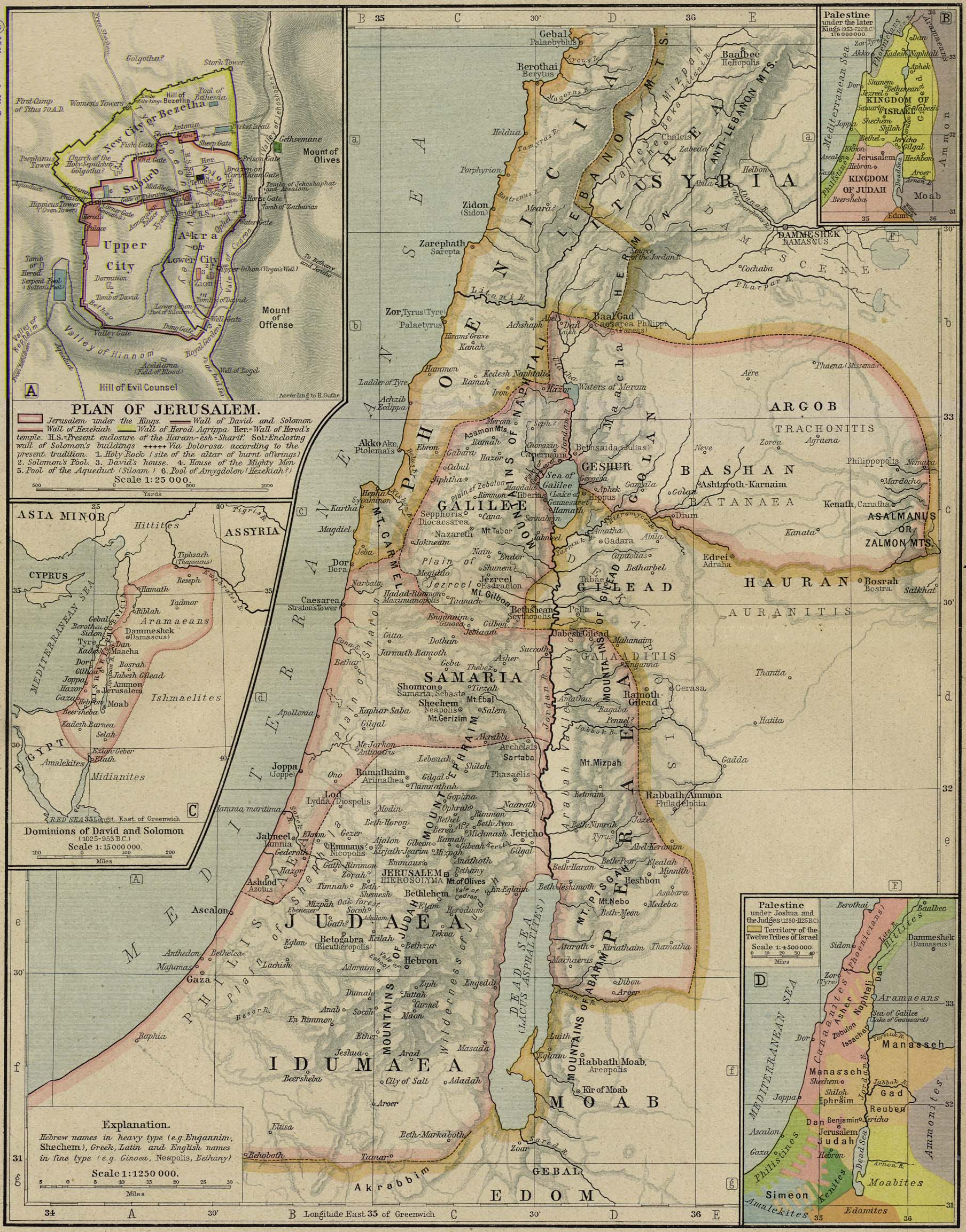
Where it is
the country around it
- Coordinates
- 32.4995° N, 34.8922° Efind it on the Atlas →
- Region
- Judea
- Kind of place
- City
- Located: the gazetteer fixes one site
- Placed: the point stands for an area, or is rounded
Why Caesarea matters
What has been found
the evidence, and where it is disputed
Cornelius, and the Spirit falling on the Gentiles
Acts 10, in the order it happens
Read Acts 10, in the order it happens
- Cornelius's visionActs 10:3One day at about the ninth hour, he had a clear vision of an angel of God who came to him and said, “Cornelius!”
- Peter's vision at JoppaActs 10:15The voice spoke to him a second time: “Do not call anything impure that God has made clean.”
- Cornelius's household gatheredActs 10:24The following day he arrived in Caesarea, where Cornelius was expecting them and had called together his relatives and close friends.
- Peter's sermonActs 10:34Then Peter began to speak: “I now truly understand that God does not show favoritism,
- The Spirit falls before baptismActs 10:44While Peter was still speaking these words, the Holy Spirit fell upon all who heard his message.
- The Gentiles heard speaking in tonguesActs 10:46For they heard them speaking in tongues and exalting God. Then Peter said,
- Baptized in the name of Jesus ChristActs 10:48So he ordered that they be baptized in the name of Jesus Christ. Then they asked him to stay for a few days.
What happened here, in order
in the order the canon tells it
- Philip preaches in every town until he reaches CaesareaActs 8:40But Philip appeared at Azotus and traveled through that region, preaching the gospel in all the towns until he came to Caesarea.
- Saul sent from Caesarea to TarsusActs 9:30When the brothers learned of this, they took him down to Caesarea and sent him off to Tarsus.
- Cornelius, a centurion of the Italian cohort, stationed at CaesareaActs 10:1At Caesarea there was a man named Cornelius, a centurion in what was called the Italian Regiment.
- Herod Agrippa I goes down to CaesareaActs 12:19After Herod had searched for him unsuccessfully, he examined the guards and ordered that they be executed. Then he went down from Judea to Caesarea and spent some time there.
- Herod's royal addressActs 12:21On the appointed day, Herod donned his royal robes, sat on his throne, and addressed the people.
- Herod struck down and eaten by wormsActs 12:23Immediately, because Herod did not give glory to God, an angel of the Lord struck him down, and he was eaten by worms and died.
- Paul lands at Caesarea on his way to AntiochActs 18:22When Paul had landed at Caesarea, he went up and greeted the church at Jerusalem. Then he went down to Antioch.
- Paul stays with Philip the evangelist at CaesareaActs 21:8Leaving the next day, we went on to Caesarea and stayed at the home of Philip the evangelist, who was one of the Seven.
- Philip's four daughters who prophesiedActs 21:9He had four unmarried daughters who prophesied.
- Agabus binds his own hands and feetActs 21:11Coming over to us, he took Paul’s belt, bound his own feet and hands, and said, “The Holy Spirit says: ‘In this way the Jews of Jerusalem will bind the owner of this belt and hand him over to the Gentiles.’”
- Paul sent under guard by night to CaesareaActs 23:23Then he called two of his centurions and said, “Prepare two hundred soldiers, seventy horsemen, and two hundred spearmen to go to Caesarea in the third hour of the night.
- Felix leaves Paul in custody two years, hoping for a bribeActs 24:27After two years had passed, Felix was succeeded by Porcius Festus. And wishing to do the Jews a favor, Felix left Paul in prison.
- Paul appeals to CaesarActs 25:11If, however, I am guilty of anything worthy of death, I do not refuse to die. But if there is no truth to their accusations against me, no one has the right to hand me over to them. I appeal to Caesar!”
- Agrippa's verdict: he could have been set freeActs 26:32And Agrippa said to Festus, “This man could have been released if he had not appealed to Caesar.”
Caesarea in Scripture
17 verses name it, in 3 books
Open a book to read its mentions here. Text: Berean Standard Bible.
Old TestamentNew Testamentsegment width = share of mentions
New Testament3 books · 17 mentions
Matthew1 mention
Mark1 mention
Acts15 mentions
- Acts 8:40But Philip appeared at Azotus and traveled through that region, preaching the gospel in all the towns until he came to Caesarea.
- Acts 9:30When the brothers learned of this, they took him down to Caesarea and sent him off to Tarsus.
- Acts 10:1At Caesarea there was a man named Cornelius, a centurion in what was called the Italian Regiment.
- Acts 10:24The following day he arrived in Caesarea, where Cornelius was expecting them and had called together his relatives and close friends.
- Acts 11:11Just then three men sent to me from Caesarea stopped at the house where I was staying.
- Acts 12:19After Herod had searched for him unsuccessfully, he examined the guards and ordered that they be executed. Then he went down from Judea to Caesarea and spent some time there.
- Acts 18:22When Paul had landed at Caesarea, he went up and greeted the church at Jerusalem. Then he went down to Antioch.
- Acts 21:8Leaving the next day, we went on to Caesarea and stayed at the home of Philip the evangelist, who was one of the Seven.
7 further mentions in Acts, read them in the book.
Common questions
Why did the Holy Spirit fall on Cornelius's household before they were baptized, and why does that matter?
Peter was still preaching when the Spirit fell on everyone listening, Gentiles who had not yet been baptized and had not kept the law Peter had kept his whole life. Peter took it as proof that God accepted them on the same terms as the Jews, and had them baptized afterward. This site teaches the falling of the Spirit here, and everywhere Scripture records it, as a living reality for the church today, not a thing that stopped with the apostles.
Who was Herod Agrippa I, and why does Acts describe his death that way?
Herod Agrippa I was the grandson of Herod the Great and ruled as king over Judea in the years just before his death. Acts records that a crowd hailed a royal address of his as the voice of a god rather than a man, that he did not correct them or give the glory to God, and that he died there in Caesarea.
Why was Paul kept in custody at Caesarea for two years instead of being tried and released?
The governor Felix found no real charge against Paul but left him in prison anyway, because Acts says he was hoping for a bribe and also wanted to do the Jewish leaders a favor. Felix was succeeded by Festus before the case moved forward.
What did it mean for Paul to appeal to Caesar?
As a Roman citizen, Paul had the legal right to have his case heard directly by the emperor rather than by a provincial governor. Once he appealed, Festus had no choice but to send him to Rome, even though King Agrippa said privately that Paul could have simply been set free.
Who was Philip the evangelist, and what does Acts say about his daughters?
Philip was one of the seven chosen in Acts 6 to serve the widows, and Scripture later calls him an evangelist living at Caesarea. Acts 21:9 says he had four unmarried daughters who prophesied, a plain scriptural record of women exercising a prophetic gift in the apostolic church.
Sources cited
- OpenBible.info Bible Geocoding: Caesarearead 2026-08-20The coordinates on this page. Used under CC-BY with attribution to OpenBible.info.
- Berean Standard BiblePublic domain since 2023. All Scripture text on this page.
- J.P. Oleson, "Constructing the Harbour of Caesarea Palaestinae" (ROMACONS project)Herod's harbor engineering: the breakwaters, underwater Roman concrete, and the Drusion lighthouse.
- Wikipedia, "Pilate stone"The 1961 discovery by Antonio Frova's Italian excavation and the inscription's content. Used because no excavation report or museum record for the stone is in this repository or database.
Keep studying
On this page
Studies13
Every page that names it1
Doorway2
Lives that run through it3
Keep this page