
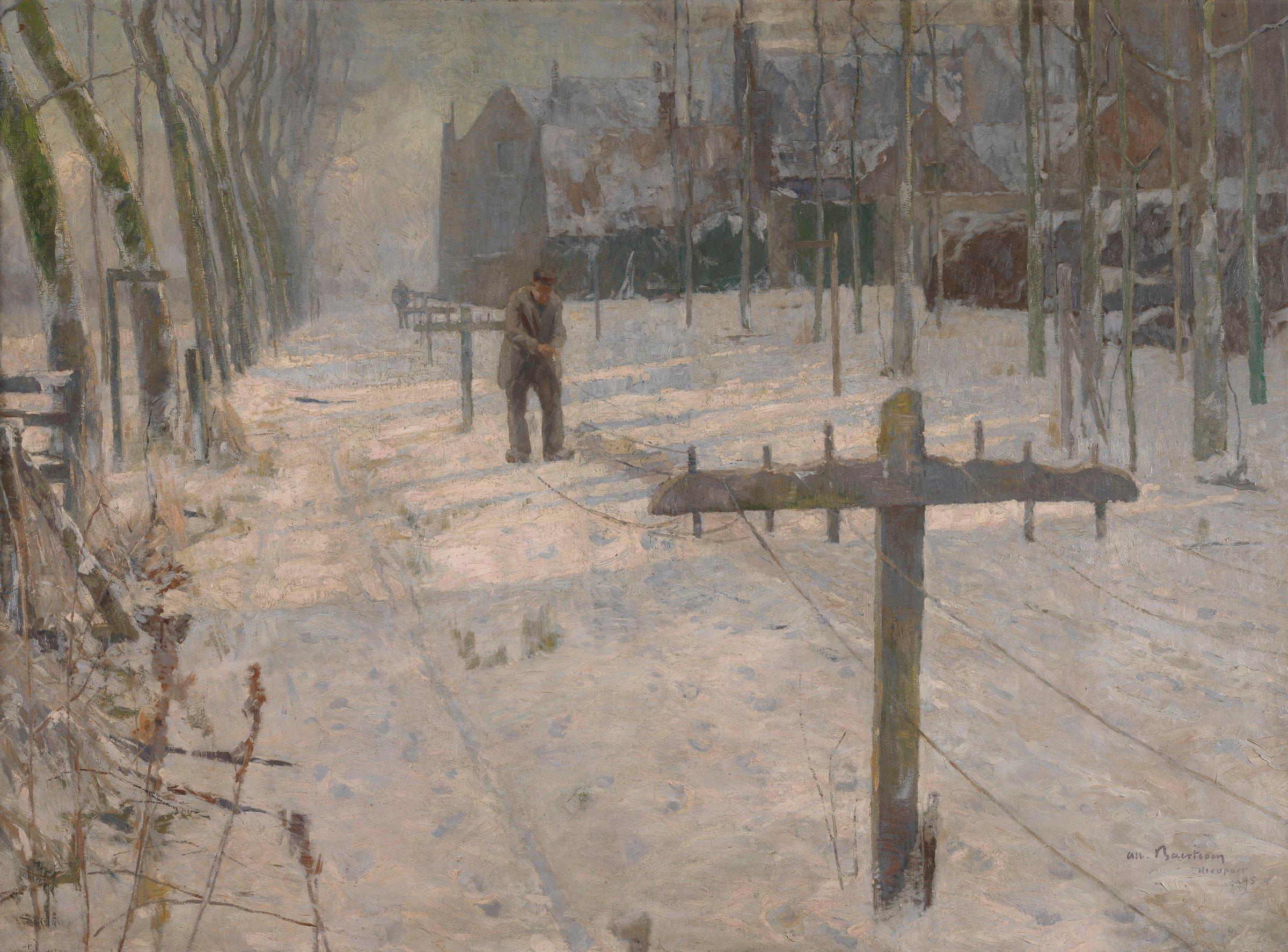
Albert Baertsoen, Rope-Makers on the Ramparts, 1895. Public domain.
Ecclesiastes 4:12 · Symbol · Featured Study
A Cord of Three Strands
Commentators read the third strand of Ecclesiastes 4:12 in four ways.
And though one may be overpowered, two can resist. Moreover, a cord of three strands is not quickly broken.
- The word
- חוּט (chut), H2339
- First appears
- Genesis 14:23 “that I will not accept even a thread,…”
The Teacher ends a passage about two with a cord of three strands.
Summary
The Hebrew word for the cord names a thread, a cord or a measuring line in seven books of Scripture. Commentators part over what the third strand stands for.
- Scripture's cords bind the wicked, save Rahab's house and draw Israel with kindness.
- Henry and Gill find the Christian life in the cord, and the critical commentators keep it to companions.
- Ambrose of Milan held that Paul knew the threefold rope could not break.
What It Stands For
The cord's plain sense is strength in numbers against an attacker.
The Hebrew reads ha-chut ha-meshullash, the threefold thread. James Strong glosses chut (H2339) as a string, and by implication a measuring tape.
George Barton takes the one who overpowers in the verse to be a robber. The Pulpit Commentary pictures a traveller set on by robbers, whom two comrades could resist.
The Thread Across the Canon
The word chut stands in seven verses, from Genesis to Jeremiah.
The Berean text gives the one Hebrew word as thread, cord, circumference and ribbon.
| Verse | The thread in the verse | The Berean word |
|---|---|---|
| Genesis 14:23 | The thread Abram refuses, so that no one can say another made him rich. | thread |
| Joshua 2:18 | The scarlet cord Rahab ties in her window. | cord |
| Judges 16:12 | What Delilah's new ropes become when Samson snaps them. | threads |
| 1 Kings 7:15 | The line that measured each bronze pillar, twelve cubits round. | circumference |
| Ecclesiastes 4:12 | The Teacher's cord, which is not quickly broken. | cord |
| Song of Songs 4:3 | The bride's lips, like a scarlet ribbon. | ribbon |
| Jeremiah 52:21 | The same measure of the pillars, twelve cubits round. | circumference |
Things Done in Threes
The word for threefold stands in six verses.
The verb shalash counts years, regions, days, pourings, strands and stories.
| Verse | What is done in threes | Counted |
|---|---|---|
| Genesis 15:9 | A heifer, a goat and a ram, each three years old. | years |
| Deuteronomy 19:3 | The land divided into three regions for the manslayer. | regions |
| 1 Samuel 20:19 | A wait of three days before going down to the hiding place. | days |
| 1 Kings 18:34 | Water poured on the offering a third time. | pourings |
| Ecclesiastes 4:12 | Three strands that make the Teacher's cord. | strands |
| Ezekiel 42:6 | Upper chambers arranged in three stories, with no pillars. | stories |
The Cambridge Bible gives three reasons for the number in the Teacher's cord. It carries the thought on from two to three, three was for the Israelite the number of completeness, and the rope of three strands was probably the strongest cord in use.
What the Third Strand Is
Each reading has its holders and its own ground in the text.
Three better than twoGenung, as Barton reports; George Barton; John Gill
Barton reports Genung's reading and calls it probably right. Gill writes that three or more joined together are better still, and able to stand against an enemy.
A proverb of unityThe Pulpit Commentary; the Cambridge Bible
The Pulpit Commentary likens the saying to Union is strength. The Cambridge Bible calls it a proverbial expression for the strength of unity.
Christ the third strandMatthew Henry
Henry's Concise Commentary reads the verse of two who are closely joined in holy love, to whom Christ comes by His Spirit to make a threefold cord.
The love of the TrinityJohn Gill
Gill applies the cord to the love of Father, Son and Spirit, which holds the saints. He reports that some apply it to faith, hope and love.
The reading of the cord as a proverb of many, and Gregory the Great's reading of it as faith in the Trinity, are set out on It Is Not Good to Be Alone.
Cords That Bind
Four verses show cords that hold people against their will.
When Samson arrived in Lehi, the Philistines came out shouting against him. And the Spirit of the LORD came mightily upon him. The ropes on his arms became like burnt flax, and the bonds broke loose from his hands.The four verses begin with the one man who breaks his own ropes.
The kings of the earth take their stand and the rulers gather together, against the LORD and against His Anointed One: “Let us break Their chains and cast away Their cords.”Here the rebels count God's rule as bondage.
The iniquities of a wicked man entrap him; the cords of his sin entangle him.A man's own sins become the cords that hold him.
The LORD is righteous; He has cut me from the cords of the wicked.The four verses end with the LORD freeing the one who was held.
Proverbs 5:22, Psalm 129:4
What the Verse Leaves Open
The verse says the cord is not quickly broken.
The Hebrew bimherah means quickly or in haste, so the verse stops short of saying the cord cannot break.
Barton counts Ecclesiastes 4:9 to 12 as current proverbs, and leaves open whether the Teacher or a later hand set them here.
Cords That Hold and Draw
A scarlet cord saves a house, and the LORD leads Israel with cords of kindness.
“Let it be as you say,” she replied, and she sent them away. And when they had gone, she tied the scarlet cord in the window.The cord seals the oath the spies swore to Rahab.
I led them with cords of kindness, with ropes of love; I lifted the yoke from their necks and bent down to feed them.Here the cord is the LORD's own way of leading.
The Teacher's cord belongs with these. It holds people together.
The Voices
Ambrose of Milan wrote on the cord in his Flight from the World.
Ambrose of Milan (died 397)
One night, however, his disciples took him and lowered him in a basket through a window in the wall.Luke tells the escape Ambrose has in mind.
He drew from the escape a lesson for his own readers.
“Paul fled too, that he might pass out through a window and be lowered in a basket. Yes, he knew that the triple-stranded rope could not break, but he fled so that he might preach the gospel of the Lord in the entire world, and consequently he was taken up into paradise. Let us also flee through the window while heeding the Lord's precepts and keeping them with steady vision and chaste eyes.”
Ambrose of Milan · Flight from the World 9:54 · on Ecclesiastes 4:12Patristic
The Readings Weighed
The critical commentators answer the Christian readings.
Gill holds two of the four readings.
| Reading | Held by | Tradition | Representative work |
|---|---|---|---|
| Three better than two | Genung, as Barton reports; George Barton; John Gill | Critical scholarship and Protestant commentary | Barton (1908), page 116 |
| A proverb of unity | Pulpit Commentary; Cambridge Bible | Protestant commentary | The Pulpit Commentary |
| Christ the third strand | Matthew Henry | Protestant devotional commentary | Matthew Henry's Concise Commentary |
| The love of the Trinity | John Gill | Protestant commentary | Gill's Exposition |
Against the third and fourth readings3 paragraphs
Barton calls every suggestion but Genung's fanciful.
The Cambridge Bible holds that the Christian readings of the cord lie outside the range of the Teacher's thoughts.
The Pulpit Commentary holds that the verse has no concern with the mystical readings later given it, faith, hope and charity and the Trinity among them.
The Silver Cord
The last cord in Ecclesiastes is the silver cord of old age, snapped at death.
Remember Him before the silver cord is snapped and the golden bowl is crushed, before the pitcher is shattered at the spring and the wheel is broken at the well,Sources
Scripture is the Berean Standard Bible.
- James Strong, Exhaustive Concordance of the Bible, entries H2339 and H8027, with every verse that carries each word.
- On Ecclesiastes 4:12: Matthew Henry's Concise Commentary; Gill's Exposition of the Entire Bible; the Cambridge Bible for Schools and Colleges; the Pulpit Commentary.
- George Aaron Barton, A Critical and Exegetical Commentary on the Book of Ecclesiastes (1908), pages 115 and 116.
- Ambrose of Milan, Flight from the World 9.54.
- Genung's reading of Ecclesiastes 4:12, as George Barton reports it in A Critical and Exegetical Commentary on the Book of Ecclesiastes (1908), page 116.
Keep Studying
Read it4
Studies6