
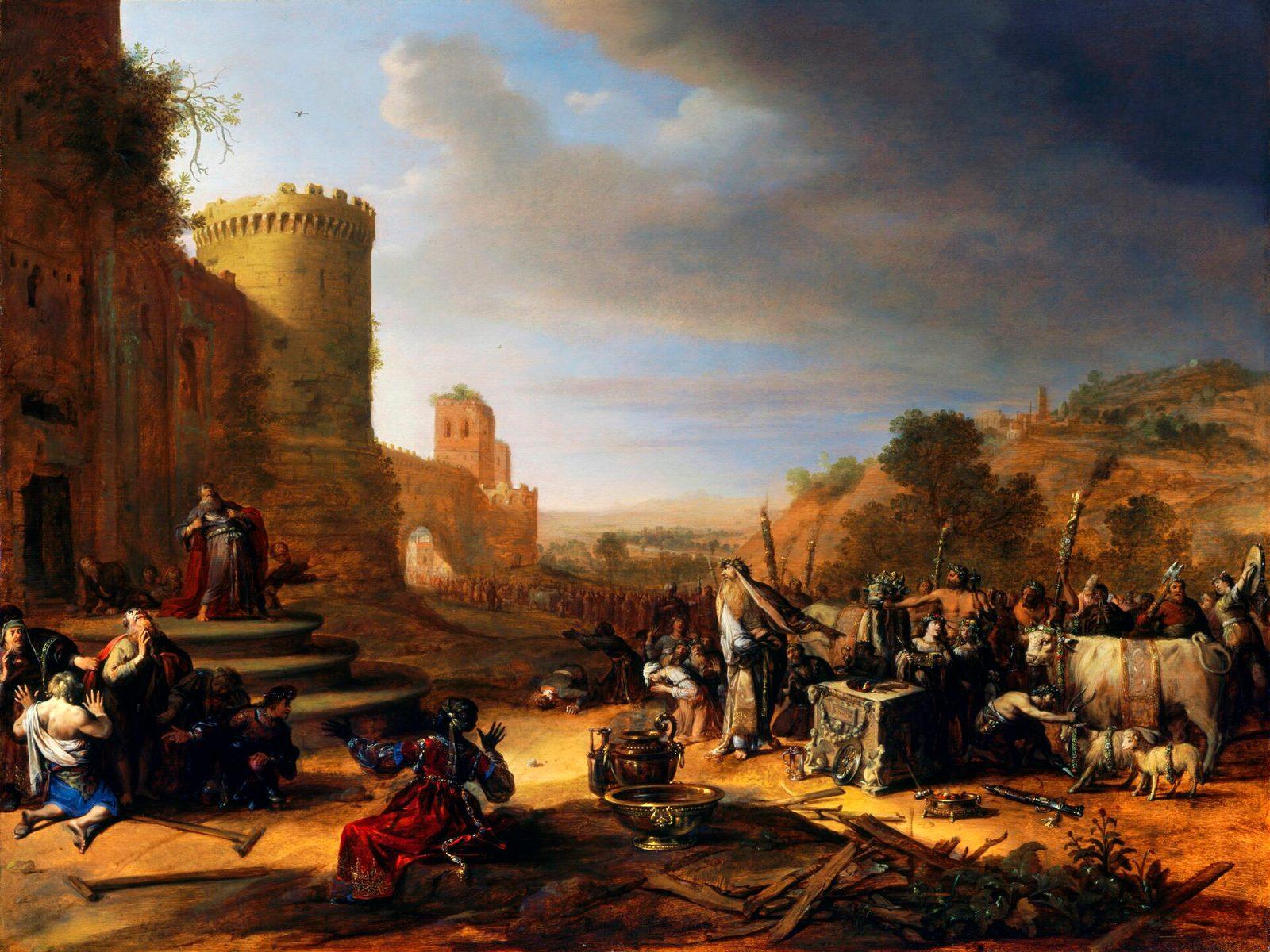
Bartholomeus Breenbergh, Saints Paul and Barnabas at Lystra, 1637. Public domain.
Acts 13 and 14 · Story · Featured Study
Paul's First Mission
Barnabas and Saul went out from Antioch as its teachers and came home as founders of churches.
When they arrived, they gathered the church together and reported all that God had done through them, and how He had opened the door of faith to the Gentiles.
- Where
- Antioch, Cyprus, Lystra
- Who
- Barnabas, Paul, John Mark
- When
- Ramsay dates it to AD 47 to 49 (probable)
At Lystra the crowd called Barnabas Zeus and Paul Hermes, and later the crowd stoned Paul.
Summary
The Holy Spirit told the church at Antioch to set apart Barnabas and Saul. They sailed to Cyprus and then walked inland to the towns of Pisidia and Lycaonia. They preached first in the synagogues and then to Gentiles. Then they came back the way they had come.
- Luke first calls Saul by the name Paul at Paphos, before the proconsul of Cyprus.
- John Mark left them at Perga and went home to Jerusalem.
- On the way home they appointed elders in each church.
The Texts of the First Mission
Three verses mark the sending, the turn to the Gentiles and the hardship the churches were told to expect.
Luke tells the whole mission in two chapters of Acts.
So Barnabas and Saul, sent forth by the Holy Spirit, went down to Seleucia and sailed from there to Cyprus.Luke credits the sending to the Spirit, though the church laid on the hands.
Then Paul and Barnabas answered them boldly: “It was necessary to speak the word of God to you first. But since you reject it and do not consider yourselves worthy of eternal life, we now turn to the Gentiles.At Pisidian Antioch the two men say why they now speak to the Gentiles.
strengthening the souls of the disciples and encouraging them to continue in the faith. “We must endure many hardships to enter the kingdom of God,” they said.Luke places this warning on the road back through towns where the apostles had been driven out and stoned.
The Route From Antioch and Back
The stops in Luke's order, from Antioch and back to Antioch.
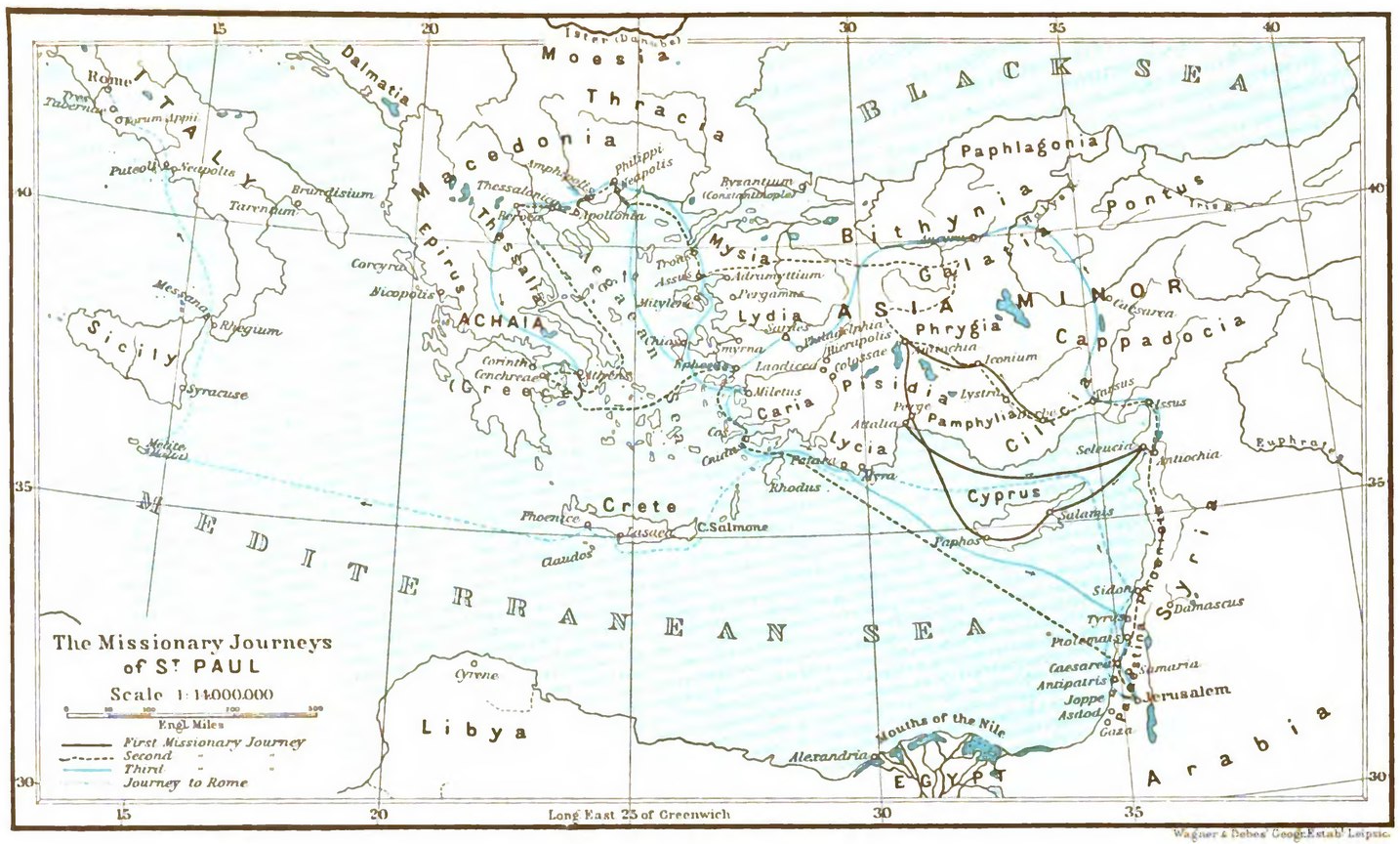
Barnabas and Saul went out by sea through Cyprus, walked back through the highland towns and sailed home from Attalia.
about 500 km (311 miles)
- Known: a score of 800 or more
- The route, in the order the text gives
- 1Antioch, The church fasted, prayed and sent them off. Acts 13:3
- 2Seleucia, They went down to the port and sailed for Cyprus. Acts 13:4
- 3Salamis, They preached in the synagogues of the Jews. Acts 13:5
- 4Paphos, Sergius Paulus believed and Elymas was struck blind. Acts 13:12
- 5Perga, They came ashore from Cyprus. Acts 13:13
- 6Pisidian Antioch, Paul preached in the synagogue on the Sabbath. Acts 13:14
Iconium, Lystra, Derbe, Lystra, Iconium and Antioch again, Perga again, Attalia, Antioch, home
- 7Iconium, Jews and Greeks believed, and the city split. Acts 14:1
- 8Lystra, A lame man walked, and later Paul was stoned. Acts 14:19
- 9Derbe, They preached and made many disciples. Acts 14:21
- 10Lystra, Iconium and Antioch again, They strengthened the disciples on the way back. Acts 14:22
- 11Perga again, They spoke the word there on the way down. Acts 14:25
- 12Attalia, They went down to the harbor. Acts 14:25
- 13Antioch, home, They gathered the church and reported. Acts 14:27
Base map: The missionary journeys of St. Paul, F. J. Knecht, Practical Commentary on Holy Scripture, public domain. Places with a place page stand at its coordinates and the others at the point cited for each, set on the plate by Ephesus and Antioch, as the plate prints them.
Knecht's plate draws this first mission as a solid line. Every place here scores 800 or more of 1,000 in the OpenBible identification data.
The Mission Scene by Scene
Six scenes from the sending at Antioch to the report on the return.
Five prophets and teachers led the church at Antioch, Barnabas and Saul among them. After more fasting and prayer the church laid hands on the two men and sent them off.
While they were worshiping the Lord and fasting, the Holy Spirit said, “Set apart for Me Barnabas and Saul for the work to which I have called them.”Luke opens the mission with the Spirit's command, so the sending begins with God.
On Cyprus the proconsul Sergius Paulus asked to hear them. His attendant, a sorcerer called Elymas, tried to turn him away, and Elymas was struck blind for a time. The proconsul believed.
Then Saul, who was also called Paul, filled with the Holy Spirit, looked directly at ElymasThis rebuke is the first speech Luke gives Paul on the mission.
From Perga in Pamphylia they went inland to Pisidian Antioch, where Paul preached in the synagogue from Israel's history to the raising of Jesus.
Therefore let it be known to you, brothers, that through Jesus the forgiveness of sins is proclaimed to you.The sermon comes to its point here, after the history of Israel.
The next Sabbath nearly the whole city came. When some of the Jews opposed them, Paul and Barnabas turned to the Gentiles, who believed. The leading men drove the two out, and they went on to Iconium.
When the Gentiles heard this, they rejoiced and glorified the word of the Lord, and all who were appointed for eternal life believed.Luke sets the Gentiles' response against the opposition in the synagogue.
At Lystra Paul healed a man lame from birth. The crowd shouted in Lycaonian that the gods had come down, and the priest of Zeus brought bulls to sacrifice. The apostles tore their clothes and stopped them.
Then Jews from Antioch and Iconium won over the crowd, and they stoned Paul and left him for dead. He got up, and the next day he left for Derbe.
“Men, why are you doing this? We too are only men, human like you. We are bringing you good news that you should turn from these worthless things to the living God, who made heaven and earth and sea and everything in them.Paul tells the crowd at Lystra that he and Barnabas are men like them.
From Derbe they turned back through Lystra, Iconium and Antioch. Then they sailed from Attalia to Antioch and gave the church that had sent them their report.
Paul and Barnabas appointed elders for them in each church, praying and fasting as they entrusted them to the Lord, in whom they had believed.The apostles were leaving, so each church needed leaders of its own.
Acts 13:38, Acts 13:48, Acts 14:15, Acts 14:23
Cyprus and the Highlands of Galatia
Readers set the scenes on Cyprus and at Lystra beside an inscription, a language and a Roman poem.
Luke calls Sergius Paulus the proconsul, the Roman governor of Cyprus. Ramsay and Lightfoot both cite a Greek inscription from Soloi in Cyprus dated in the proconsulship of Paulus, and both take him to be the governor of Acts 13.
Ramsay held that the Lycaonian cry at Lystra came from the native townsfolk and not from the Roman colonists who ruled the town.
Conybeare and Howson set the scene beside a story Ovid tells in his Metamorphoses. In it Jupiter and his son Mercury walk the hills of Phrygia in human form, and only an old couple, Baucis and Philemon, take them in.
What the First Mission Set in Motion
The question of the Gentiles went from Antioch to the apostles in Jerusalem.
The report of Acts 14:27 raised the question Luke takes up next. Men from Judea came to Antioch and taught that the Gentile believers must be circumcised, and the church sent Paul and Barnabas to the apostles and elders in Jerusalem.
The churches of the mission stayed in Paul's care. On his next tour he went back to Derbe and Lystra, and there he found Timothy.
The Voices
John Chrysostom preached on the turn to the Gentiles and on the crowd at Lystra.
John Chrysostom (died 407)
Homily on Acts 30
The apostles turned to the Gentiles gently
“They were to go out to the Gentiles: but observe the boldness coming with measure: for if Peter pleaded in his justification, much more these needed a plea, none having called them there. But by saying ‘To you first,’ he showed that to those also it was their duty to preach, and in saying ‘Necessary,’ he showed that it was necessary to be preached to them also. ‘But since ye turn away from it’ - he does not say, ‘Woe unto you,’ and ‘Ye are punished,’ but ‘We turn unto the Gentiles.’ With great gentleness is the boldness fraught! Also he does not say, ‘Ye are unworthy,’ but ‘Have judged yourselves unworthy. Lo, we turn unto the Gentiles.’”
on Acts 13:46Patristic
John Chrysostom
Homily on Acts 30
The crowd's zeal was a new kind of trial
“‘And they called Barnabas, Jupiter; and Paul, Mercurius.’ I suppose Barnabas was a man of dignified appearance also. Here was a new sort of trial, from immoderate zeal, and no small one: but hence also is shown the virtue of the Apostles, and how on all occasions they ascribe all to God.”
on Acts 14:11 to 12Patristic
Where Readers Differ
Three questions of the first mission, with the writers who answer them.
Why did John Mark go home?2 paragraphs
Luke gives no reason, and later says only that Mark had deserted them in Pamphylia. Conybeare and Howson, in 1869, judged that Mark wavered and that Paul was right to doubt his steadiness. They added that a soldier who has wavered in one battle may live to win another.
W. M. Ramsay, in 1896, held that Mark treated the turn inland, which Paul thought necessary for the work to come, as an abandonment of the work.
Why did they leave the coast for the highlands?1 paragraph
Ramsay read Galatians 4:13, where Paul says he first preached to the Galatians because of an illness. He held that Paul fell ill in Pamphylia and went up to the higher ground of Pisidian Antioch to recover, and he suggested a chronic malaria fever. Luke names no illness.
Were these the churches of Galatia?2 paragraphs
J. B. Lightfoot held that the Galatia of Paul's letter was the land of the Gauls in the north. He argued that Luke's own names for Lystra, Derbe and Antioch show they were not called Galatian towns.
Ramsay held that the province of Galatia took in these southern towns, so the letter to the Galatians went to the churches of this mission.
Books to Read Next
Three works of the nineteenth century, each free to read online.
St. Paul the Traveller and the Roman Citizen
W. M. Ramsay · 1896
Ramsay dates the mission and argues for the illness and the turn inland.
Free at the Internet ArchiveThe Life and Epistles of Saint Paul
W. J. Conybeare and J. S. Howson · 1869 edition
They tell the mission town by town and set Lystra beside Ovid's story.
Free at the Internet ArchiveSaint Paul's Epistle to the Galatians
J. B. Lightfoot · 1890
Lightfoot argues in his introduction that the letter went to the north.
Free at the Internet ArchiveWhat the First Mission Left Behind
The mission began with a church obeying the Spirit and ended with that church hearing what God had done among the Gentiles.
Sources
Scripture is the Berean Standard Bible.
- The Holy Bible, Berean Standard Bible (read 2026)
- W. M. Ramsay, St. Paul the Traveller and the Roman Citizen (New York and London: Putnam, 1896)
- W. M. Ramsay, The Church in the Roman Empire before A.D. 170, second edition (London, 1893)
- J. B. Lightfoot, Saint Paul's Epistle to the Galatians, tenth edition (London: Macmillan, 1890), introduction.
- J. B. Lightfoot, Essays on the Work Entitled Supernatural Religion (London: Macmillan, 1893), appendix.
- W. J. Conybeare and J. S. Howson, The Life and Epistles of Saint Paul, People's Edition (Cincinnati, 1869)
- Ovid, Metamorphoses 8.611 and following, translated by Brookes More (1922)
- John Chrysostom, Homily 30 on Acts, Nicene and Post-Nicene Fathers, first series, volume 11.
- OpenBible.info, Bible-Geocoding-Data, ancient.jsonl.
- F. J. Knecht, Practical Commentary on Holy Scripture, the plate The Missionary Journeys of St. Paul.
Keep Studying
Read it1
Doctrines2
Subjects1
Church history1