
From the apostles at Rome to today · The churches · Featured Study
The Roman Catholic Church
The church in communion with the bishop of Rome, from the apostles at Rome to the councils of Trent and the Vatican.
About 180 Irenaeus called the church at Rome “founded and organized at Rome by the two most glorious apostles, Peter and Paul.”
- Began
- The first century at Rome, as the early witnesses report it (proposed)
- Bodies
- One communion under the bishop of Rome, its members counted by baptism
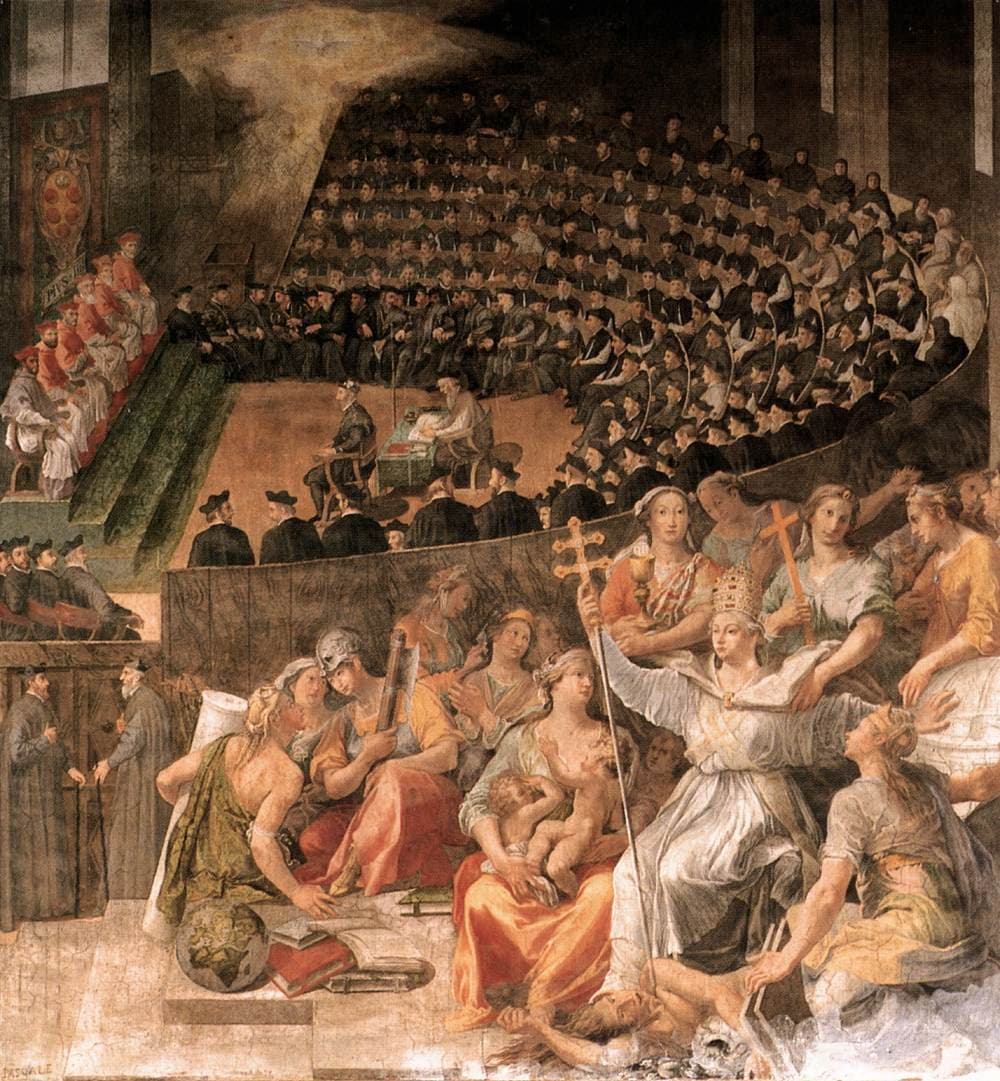
Pasquale Cati, The Council of Trent, 1588. Public domain.
And I tell you that you are Peter, and on this rock I will build My church, and the gates of Hades will not prevail against it. I will give you the keys of the kingdom of heaven. Whatever you bind on earth will be bound in heaven, and whatever you loose on earth will be loosed in heaven.”
Summary
The Catholic Church holds that Christ built His church on Peter and that the bishop of Rome succeeds him.
- The Council of Trent closed in 1563, and the First Vatican Council defined Peter's primacy in 1870.
- Augustine read the rock as the faith Peter confessed.
- Pope John Paul II asked pardon in 2000 for divisions and violence.
The Texts on Peter and the Foundation
The texts come from Matthew 16, John 21, 1 Corinthians 3 and Ephesians 2.
The Catholic Church reads its claim to be the church Christ built on Peter from Christ's words to Simon, as its Catechism and the First Vatican Council quote them.
The rock and the keys
And I tell you that you are Peter, and on this rock I will build My church, and the gates of Hades will not prevail against it. I will give you the keys of the kingdom of heaven. Whatever you bind on earth will be bound in heaven, and whatever you loose on earth will be loosed in heaven.”
Vatican I reads the promise of the keys here, and Augustine reads the rock otherwise.
The charge to Peter
Jesus asked a third time, “Simon son of John, do you love Me?” Peter was deeply hurt that Jesus had asked him a third time, “Do you love Me?” “Lord, You know all things,” he replied. “You know I love You.” Jesus said to him, “Feed My sheep.
Vatican I reads the charge to feed the sheep as Christ giving Peter the primacy.
John 21:17BSB
The one foundation
For no one can lay a foundation other than the one already laid, which is Jesus Christ.
Augustine joins this verse to Christ's words to Peter in his Tractate 124.
The apostles and the cornerstone
built on the foundation of the apostles and prophets, with Christ Jesus Himself as the cornerstone.
The Orthodox Longer Catechism reads it for the apostolic church, and Protestant readers for the foundation laid once in Christ.
John 21:17, 1 Corinthians 3:11, Ephesians 2:20
The Catholic Branch of the Family of Churches
From the church at Jerusalem to the Day of Pardon in 2000.
The church at Rome runs from the apostles through Chalcedon and 1054 to Trent, the First Vatican Council and the pardon of 2000.
Pentecost
The first century
- Linus, Anacletus and Clement, in Irenaeus's list
- The trophies of the apostles at the Vatican, as Gaius reports
447 to 451
- Leo I confesses the Filioque, 447
- Rome receives the Creed of 381 at Chalcedon
1054
- The break with the East
- The Eastern Orthodox churches, the other side of the break
1563 to 1870
- The Council of Trent, closed 4 December 1563
- The First Vatican Council and Peter's primacy, 1870
1965 to 2000
- The sentences of 1054 lifted
- The Day of Pardon, 12 March 2000
Irenaeus and Gaius give the first generations, the Catechism of the Catholic Church dates 447 and 451, and Schaff dates 1054, Trent and Vatican I. The declaration of 1965 and the homily of 2000 give the last generation.
The Christian Traditions sets this branch beside the other families of the churches, each with the date on which it began.
The Witnesses to Peter and Paul at Rome
The earliest witnesses to the apostles at Rome, with the interest of each.
Irenaeus wrote Against Heresies about 180, and its third book stands in the Ante-Nicene Fathers in W. H. Rambaut's English. He says that “it is a matter of necessity that every Church should agree with this Church, on account of its pre-eminent authority.”
The editors mark that phrase with a note, since its Latin is disputed. Irenaeus then names Linus, Anacletus and Clement as the first bishops of Rome after the apostles.
Gaius, a member of the Roman church under its bishop Zephyrinus, wrote in a published disputation with Proclus, whom Eusebius calls “the leader of the Phrygian heresy.” He wrote as a party to that dispute.
Eusebius preserves his words on the places where the apostles lay: “I can show the trophies of the apostles. For if you will go to the Vatican or to the Ostian way, you will find the trophies of those who laid the foundations of this church.”
So the founding at Rome rests on Irenaeus, and the apostles' graves there on Gaius, whom only Eusebius preserves.
The Truth It Keeps: One Church Built on Peter
The Catechism, the First Vatican Council and Lumen Gentium in their own words.
The Catechism of the Catholic Church teaches at paragraph 881 that “The Lord made Simon alone, whom he named Peter, the ‘rock’ of his Church.”
The First Vatican Council taught in Pastor aeternus in 1870. In Manning's English of 1871 it holds that “the primacy of jurisdiction over the universal Church of God was immediately and directly promised and given to blessed Peter.”
At paragraph 816 the Catechism quotes Lumen Gentium 8, a constitution of the Second Vatican Council.
The Church of Christ, it says, “subsists in” the Catholic Church, “which is governed by the successor of Peter and by the bishops in communion with him.”
Augustine on the rock1 table, 1 paragraph
Augustine preached his Tractates on John at Hippo about 416 or later, and Gibb and Innes put them into English in 1873. In the same tractate he says the Church “was personified in the Apostle Peter, on account of the primacy of his apostleship.”
Augustine's two readings of the rock, in the English of the Nicene and Post-Nicene Fathers.
| Where | His words |
|---|---|
| Tractates on John 124.5 | “On this rock, therefore, He said, which thou hast confessed, I will build my Church. For the Rock (Petra) was Christ.” |
| Homilies on the First Epistle of John 10, in Browne's English revised by Myers | “What meaneth, ‘Upon this rock I will build my Church’? Upon this faith.” |
Its Own Statements on the Saints and on Mary
The Council of Trent and the Catechism, as they state the practice.
The Council of Trent teaches in its twenty-fifth session, in Waterworth's English of 1848, that the saints “offer up their own prayers to God for men.”
The same decree calls it “good and useful suppliantly to invoke them,” for benefits obtained “through his Son, Jesus Christ our Lord, who is our alone Redeemer and Saviour.”
The Catechism says at paragraph 956, quoting the Second Vatican Council, that the saints “do not cease to intercede with the Father for us.”
At paragraph 971 it calls devotion to the Virgin Mary “intrinsic to Christian worship,” and says that it “differs essentially from the adoration which is given to the incarnate Word.”
For there is one God, and there is one mediator between God and men, the man Christ Jesus,Trent names this text when it answers the charge that invoking the saints opposes the honour of the one mediator.
The Catholic Church Today
The count of the baptized, from the Church's own statistics.
Agenzia Fides published the figures on 17 October 2025, taking its data from the latest edition of the Church's Book of Statistics.
They count the baptized as the Church registers them, so they measure membership rather than practice.
The Church counted about 1.4 billion baptized Catholics on 30 June 2023.
| What the Church counts | The figure |
|---|---|
| Baptized Catholics on 30 June 2023 | 1,405,454,000 |
| Increase on the year before | 15,881,000 |
Where the Church Spread
Peter's road to Rome as Origen told it, and the growth of 2023 by continent.
Eusebius, who finished his Church History about 324, takes from Origen's Commentary on Genesis that “Peter appears to have preached in Pontus, Galatia, Bithynia, Cappadocia, and Asia to the Jews of the dispersion.”
From the same source he reports that Peter, come at last to Rome, “was crucified head-downwards; for he had requested that he might suffer in this way.”
The detail reaches us only through Origen and Eusebius.
Fides reports that the rise of the year was registered on all five continents, above all in Africa and in America.
| Continent | The rise in the year |
|---|---|
| Africa | 8,309,000 |
| America | 5,668,000 |
| Asia | 954,000 |
| Europe | 740,000 |
| Oceania | 210,000 |
Divisions, Violence and the Pardon of 2000
The Reformed charge of 1647, and the pope's confession at Rome.
Schaff heads the Westminster Confession “A.D. 1647.” Its chapter 25.6 gives the strongest hostile witness: “There is no other head of the Church but the Lord Jesus Christ.”
It goes on that the Pope of Rome cannot “in any sense be head thereof; but is that Antichrist.”
The Confession is a Reformed statement, and it speaks here as a hostile witness to the papacy.
On 12 March 2000 Pope John Paul II preached at Rome, “Let us ask pardon for the divisions which have occurred among Christians, for the violence some have used in the service of the truth.”
that all of them may be one, as You, Father, are in Me, and I am in You. May they also be in Us, so that the world may believe that You sent Me.Christ's prayer for unity is the measure of the divisions the homily confessed.
The same homily names “the infidelities to the Gospel committed by some of our brethren, especially during the second millennium.”
In 1965 Pope Paul VI and Patriarch Athenagoras I committed the excommunications of 1054 “to oblivion.”
Books to Read Next
The Creeds of Christendom, volume 2
Philip Schaff · 1877
It prints the decrees of Trent and of the First Vatican Council in English.
Free at the Christian Classics Ethereal LibraryTractates on the Gospel of John
Augustine, in Gibb and Innes's English · 1873
Augustine's Tractate 124 gives his reading of the rock.
Free at the Christian Classics Ethereal LibraryChurch History
Eusebius, translated by Arthur Cushman McGiffert · 1890
It holds the Church History in McGiffert's English, with his notes.
Free at the Christian Classics Ethereal LibraryWhat the Catholic Church Hands On
The Catholic claim turns on one reading of Matthew 16, which Vatican I made binding and Augustine read otherwise.
A reader can weigh it against the witnesses of the first centuries, against the Reformed answer of 1647, and against the church's own confession of fault.
The line through this page
The verse whose work this page shows continuing, then 1 link to other pages, in order of date.
The verse whose work this page shows continuing.
The first century, as Irenaeus reports it about 180, disputed
The Apostolic Age to The Roman Catholic Church
Irenaeus then names Linus, Anacletus and Clement as the first bishops of Rome after the apostles.
This page
The Roman Catholic Church
Sources
Scripture is the Berean Standard Bible.
- The Holy Bible, Berean Standard Bible (read 2026)
- Catechism of the Catholic Church, paragraphs 247, 816, 881, 956 and 971 (Libreria Editrice Vaticana; read 2026)
- The First Vatican Council, Pastor aeternus (1870), chapter 1, in Manning's English, Petri Privilegium (London, 1871), in Philip Schaff, The Creeds of Christendom, volume 2.
- The Council of Trent, Session XXV, the decree on the invocation of saints, in Waterworth's English (1848), in Philip Schaff, The Creeds of Christendom, volume 2; the council's close on 4 December 1563 from Schaff, volume 3.
- Irenaeus, Against Heresies 3.3.2 and 3 (about AD 180), book 3 in W. H. Rambaut's English, in the Ante-Nicene Fathers, volume 1.
- Eusebius, Church History 2.25.6 and 7 and 3.1.2 and 3, with Origen's report (completed about 324), translated by Arthur Cushman McGiffert, in the Nicene and Post-Nicene Fathers, second series, volume 1 (New York, 1890)
- Augustine, Tractates on the Gospel of John 124.5 (about AD 416 or later), translated by Gibb and Innes (1873), and Homilies on the First Epistle of John 10, translated by Browne, revised by Myers, in the Nicene and Post-Nicene Fathers, first series, volume 7 (New York, 1886)
- The Westminster Confession of Faith (1647, as Schaff heads it), chapter 25.6, in Philip Schaff, The Creeds of Christendom, volume 3.
- Pope John Paul II, Homily for the Day of Pardon, 12 March 2000.
- Joint Catholic-Orthodox Declaration of Pope Paul VI and Patriarch Athenagoras I, 7 December 1965.
- Agenzia Fides, Catholic Church Statistics 2025, 17 October 2025.
- Philip Schaff, History of the Christian Church, volume 4, section 71, Progress and Completion of the Schism (read 2026)
Keep Studying
People and groups9
Symbols1
Doctrines1
Subjects1