
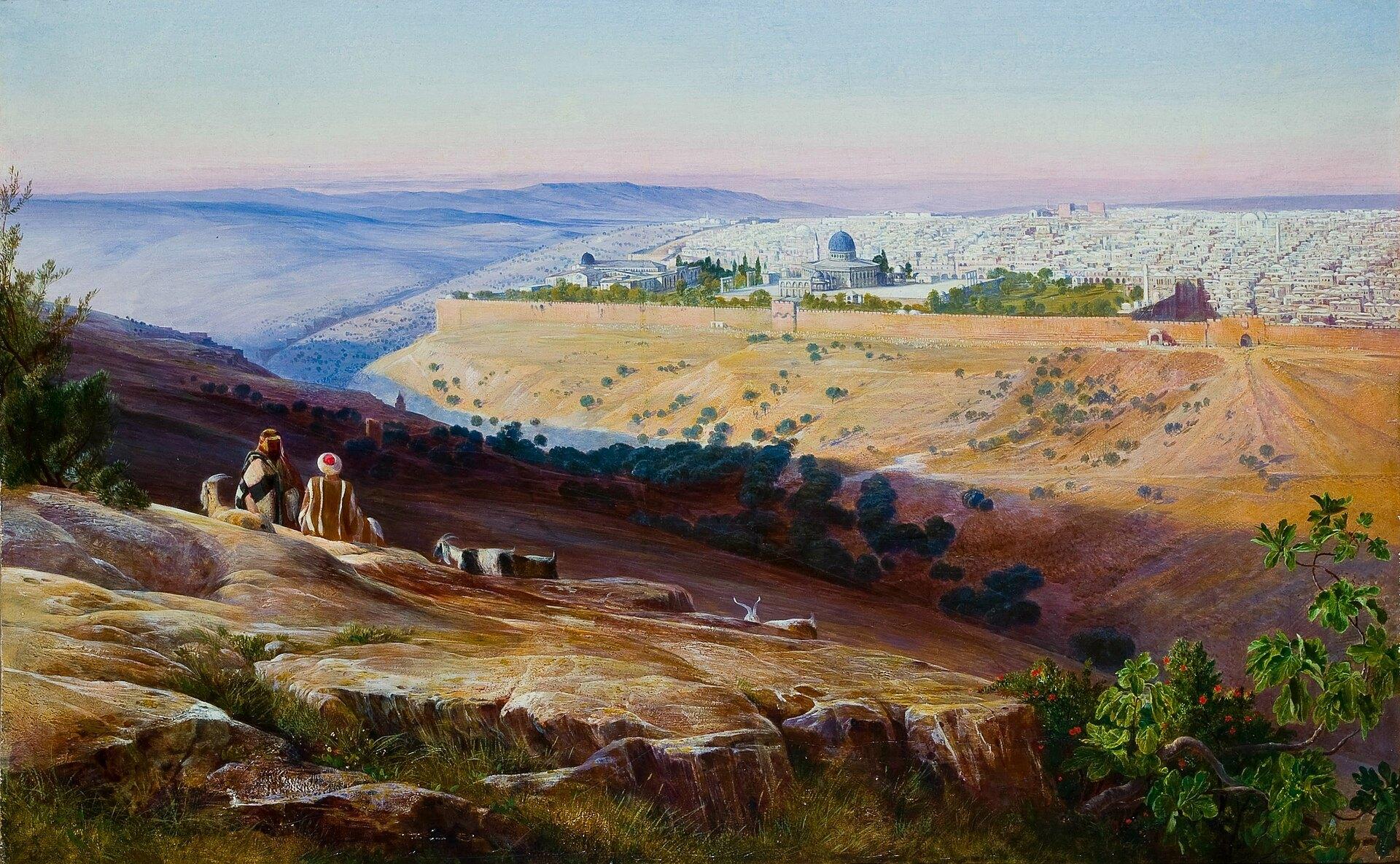
Edward Lear, Jerusalem from the Mount of Olives, 1858 to 1859. Public domain.
Isaiah 52:7, Nahum 1:15 and Romans 10:15 · Subject · Featured Study
The Herald of Good News
Isaiah praises the feet of the messenger who brings Zion news of peace.
How beautiful on the mountains are the feet of those who bring good news, who proclaim peace, who bring good tidings, who proclaim salvation, who say to Zion, “Your God reigns!”
- Books
- Isaiah, Nahum, Romans
- Hold in memory
- Isaiah 40:9, Romans 10:15
Paul quoted Isaiah's herald to explain why preachers must be sent.
Summary
Isaiah pictures a runner on the hills near Jerusalem. He brings news that the LORD reigns. Nahum uses the same picture, and in the New Testament the news is the gospel of Christ.
- One Hebrew verb, to bear tidings, lies behind each herald in Isaiah.
- A scroll from the Dead Sea applied the line to an anointed figure.
- Readers differ over who the herald of Isaiah 40:9 is.
How Beautiful on the Mountains
Isaiah 52 sets the herald on the mountains and the watchmen in Zion.
Listen! Your watchmen lift up their voices, together they shout for joy. For every eye will see when the LORD returns to Zion.The news turns the city's lookouts into singers.
Adam Clarke pictures the watchmen catching sight of the messenger far off on the mountains.
The Herald Through Scripture
The herald moves from Isaiah's Zion to the preachers of the New Testament.
The news of God's reign becomes the gospel of peace.
1Zion
- Isaiah 40:9
- Zion is told to carry the news to the cities of Judah
- Isaiah 41:27
- The LORD sends Jerusalem a herald
- Isaiah 52:7
- The herald tells Zion that its God reigns
- Isaiah 61:1
- The anointed one is sent with good news for the poor
- Nahum 1:15
- A herald tells Judah that its invader is cut off
- Matthew 11:5
- Jesus points John's messengers to the poor who hear the good news
- Mark 1:1
- Mark calls his book the gospel of Jesus Christ
- Luke 4:18 to 19
- Jesus reads the anointed one's commission in Nazareth
- Acts 10:36
- Peter speaks of the gospel of peace through Jesus Christ
10Paul
- Romans 10:15
- Paul quotes the line of the beautiful feet
Ten verses in the order of the Bible.
Mark's first line, Nazareth, Peter, Paul
Nahum's Herald and the Fall of the Assyrian
In Nahum the herald's news is the end of the Assyrian threat to Judah.
Look to the mountains—the feet of one who brings good news, who proclaims peace! Celebrate your feasts, O Judah; fulfill your vows. For the wicked will never again march through you; they will be utterly cut off.Nahum's herald announces a deliverance Judah can celebrate.
Joseph Benson took the good tidings of Nahum to be that Nineveh was destroyed. Matthew Poole named the wicked one who would not return as Sennacherib.
The Pulpit Commentary notes that the Hebrew and Syriac begin Nahum's second chapter with this verse.
Who Is the Herald of Isaiah 40:9?
The Hebrew allows two readings, and commentators divide between them.
Zion is the heraldEllicott; Joseph Benson
Go up on a high mountain, O Zion, herald of good news. Raise your voice loudly, O Jerusalem, herald of good news. Lift it up, do not be afraid! Say to the cities of Judah, “Here is your God!”The Berean text makes Zion the herald.
Ellicott and Benson held that the feminine words agree with Zion and Jerusalem.
The objection: the Cambridge Bible notes that Zion always stands in this prophecy as the one who receives salvation.
A herald comes to ZionThe Cambridge Bible; Jamieson, Fausset and Brown; Albert Barnes
The Cambridge Bible prefers the Revised Version's reading, a herald who tells good tidings to Zion, citing Isaiah 41:27 and Isaiah 52:7. Jamieson, Fausset and Brown also point to Isaiah 52:7. Barnes held that the feminine participle suits someone who brings good tidings to Zion.
The objection: Ellicott notes that no woman herald other than Jerusalem appears in the passage.
The Word Behind the Herald
One Hebrew verb and one Greek verb carry the idea from Isaiah to the New Testament.
The Hebrew verb basar means to bear tidings. Its form mebasser, the one who brings the news, stands at Isaiah 41:27. At Isaiah 40:9 the form is feminine, used twice in the verse.
The Septuagint, the Greek translation of the Old Testament, gives the herald of Isaiah 52 the verb euangelizomai, to announce good news, and uses it again at Isaiah 61:1. Strong's dictionary traces the verb to the Greek eu and aggelos.
Matthew Poole notes that at Romans 10:15 Paul leaves the Greek and follows the Hebrew text.
How Can They Preach Unless They Are Sent?
Paul builds a chain from calling on the Lord back to the sending of preachers.
How then can they call on the One in whom they have not believed? And how can they believe in the One of whom they have not heard? And how can they hear without someone to preach? And how can they preach unless they are sent? As it is written: “How beautiful are the feet of those who bring good news!”Each link depends on the one before it.
But not all of them welcomed the good news. For Isaiah says, “Lord, who has believed our message?”Paul turns at once to Isaiah 53:1.
A Dead Sea scroll, 11QMelchizedek, quotes Isaiah's line of the beautiful feet. In the translation Joseph Angel gives, it says the messenger is the anointed of the spirit.
“The Spirit of the Lord is on Me, because He has anointed Me to preach good news to the poor. He has sent Me to proclaim liberty to the captives and recovery of sight to the blind, to release the oppressed, to proclaim the year of the Lord’s favor.”The anointed one's task becomes His own.
Voices on the Herald
Three early Christian writers and Matthew Henry read the beautiful feet as the feet of Christ's messengers.
Tertullian (died 220)
Against Marcion Book III
How this text has been taught
“You have the work of the apostles also predicted: ‘How beautiful are the feet of them which preach the gospel of peace, which bring good tidings of good,’ not of war nor evil tidings.”
on Romans 10:15Patristic
Origen of Alexandria (died 253)
COMMENTARY ON THE GOSPEL OF JOHN 1:11
How this text has been taught
“‘How are beautiful are the feet of those who announce good things!’ Since Isaiah perceived the beautiful and opportune preaching of the apostles who follow the One who said, ‘I am the way,’ he praises the feet that proceed over the intelligible way, which is Christ Jesus, and go in to God through the door. Those whose feet are beautiful announce Jesus as ‘good tidings.’”
on Isaiah 52:7Patristic
Eusebius of Caesarea (died 339)
PROOF OF THE GOSPEL 3:1
How this text has been taught
“Here [Isaiah] says very particularly that it is the feet of those who publish the good news of Christ that are beautiful. For how could they not be beautiful, which in so small, so short a time have run over the whole earth and filled every place with the holy teaching about the Savior of the world?”
on Isaiah 52:7Patristic
Matthew Henry (1662 to 1714)
Commentary on the Whole Bible
How this text has been taught
“These words are also quoted by the apostle, both from Isaiah and Nahum, and applied to the great redemption wrought out for us by our Lord Jesus, and the publishing of it to the world by the everlasting gospel, Rom. x. Christ's ministers are those messengers of good tidings, that preach peace by Jesus Christ. How beautiful are the feet of those messengers!”
on Nahum 1:15Puritan
Who Wrote the Line First?
Isaiah's line and Nahum's open with nearly the same words, and commentators divide over which came first.
Nahum drew on IsaiahAlbert Barnes; Adam Clarke
Isaiah 52 draws on NahumKeil and Delitzsch
Keil and Delitzsch, on Isaiah 52:7, refer to Nahum 2:1, the Hebrew numbering of Nahum 1:15, as the primary passage.
The objection: Ellicott traces the image of Isaiah 52:7 to Isaiah 40:9, earlier in the same book.
The Gospel of Peace
and with your feet fitted with the readiness of the gospel of peace.Paul hands the herald's readiness to every believer.
Sources
Scripture is the Berean Standard Bible.
- Ellicott's Commentary for English Readers; Keil and Delitzsch, Commentary on the Old Testament; Albert Barnes, Notes on the Bible; Joseph Benson; Matthew Poole; the Cambridge Bible for Schools and Colleges; the Pulpit Commentary; Jamieson, Fausset and Brown; each on Isaiah 40:9, Isaiah 52:7, Nahum 1:15 or Romans 10:15.
- Brown, Driver and Briggs, Hebrew and English Lexicon, entry 1319; Strong's Greek dictionary, entry 2097.
- Lancelot Brenton, The Septuagint with Apocrypha, the Greek of Isaiah 52 and Isaiah 61.
- 11QMelchizedek (11Q13), column 2, in the translation Joseph Angel gives after Florentino García-Martínez, E. J. C. Tigchelaar and A. S. van der Woude, as the Armstrong Institute reproduces it.
- Tertullian, Against Marcion Book III; Origen, Commentary on the Gospel of John 1:11; Eusebius of Caesarea, Proof of the Gospel 3:1; Matthew Henry, Commentary on the Whole Bible (1710), on Nahum 1:15; Adam Clarke, Commentary on the Bible (1832), on Nahum 1:15 and Isaiah 52:7.
Keep Studying
Read it6
Studies2
Places1
Doctrines4