
Malta
Summary
The island where Paul's ship ran aground after fourteen days adrift, where a viper did him no harm, the governor's father was healed, and the crew wintered three months before sailing for Rome.
- Paul's ship went down here after fourteen days adrift in a Mediterranean hurricane, and every one of the 276 aboard reached land alive.
- A viper fastened on Paul's hand and did him no harm, and the islanders changed their verdict on him twice, from murderer to god.
- Publius, the island's chief official, hosted the shipwrecked company, and Paul healed his father of fever and dysentery.
- The company wintered three months before sailing on to Rome in a ship that had wintered in the same harbor.
- An inscription found on Malta gives a local official the exact title Luke gives Publius, matching Luke's own record.
On this page
In Scripture
- Verses
- 1
- Books
- 1
Where it is
the country around it
- Coordinates
- 35.8528° N, 14.5324° Efind it on the Atlas →
- Region
- Mediterranean
- Kind of place
- Region
- Placed: the point stands for an area, or is rounded
Why Malta matters
The wreck, the island, and the three months that followed
Acts 27:39 to 28:11, in the order it happens
Read Acts 27:39 to 28:11, in the order it happens
- Daylight, and an unfamiliar bayActs 27:39When daylight came, they did not recognize the land, but they sighted a bay with a sandy beach, where they decided to run the ship aground if they could.
- The ship runs agroundActs 27:41But the vessel struck a sandbar and ran aground. The bow stuck fast and would not move, and the stern was being broken up by the pounding of the waves.
- Every one of them reaches land safelyActs 27:44The rest were to follow on planks and various parts of the ship. In this way everyone was brought safely to land.
- The island is MaltaActs 28:1Once we were safely ashore, we learned that the island was called Malta.
- The islanders' kindness in the rain and coldActs 28:2The islanders showed us extraordinary kindness. They kindled a fire and welcomed all of us because it was raining and cold.
- The viperActs 28:5But Paul shook the creature off into the fire and suffered no ill effects.
- Publius, the chief official of the islandActs 28:7Nearby stood an estate belonging to Publius, the chief official of the island. He welcomed us and entertained us hospitably for three days.
- Publius's father healedActs 28:8The father of Publius was sick in bed, suffering from fever and dysentery. Paul went in to see him, and after praying and placing his hands on him, he healed the man.
- Three months, then RomeActs 28:11After three months we set sail in an Alexandrian ship that had wintered in the island. It had the Twin Brothers as a figurehead.
Luke was on the ship. Acts 27 and 28 are written in the first person plural, an eyewitness account of the whole voyage.
Paul's Shipwreck: the full study of Acts 27-28What happened here, in order
in the order the canon tells it
- The voyage is already dangerous; the safe season has closedActs 27:9By now much time had passed, and the voyage had already become dangerous because it was after the Fast. So Paul advised them,
- The Northeaster sweeps downActs 27:14But it was not long before a cyclone called the Northeaster swept down across the island.
- All hope of being saved is abandonedActs 27:20When neither sun nor stars appeared for many days and the great storm continued to batter us, we abandoned all hope of being saved.
- An angel stands beside Paul in the nightActs 27:23For just last night an angel of God, whose I am and whom I serve, stood beside me
- The promise: every life aboard is given to PaulActs 27:24and said, ‘Do not be afraid, Paul; you must stand before Caesar. And look, God has granted you the lives of all who sail with you.’
- Four anchors dropped from the sternActs 27:29Fearing that we would run aground on the rocks, they dropped four anchors from the stern and prayed for daybreak.
- Paul breaks bread before them allActs 27:35After he had said this, Paul took bread and gave thanks to God in front of them all. Then he broke it and began to eat.
- 276 souls aboardActs 27:37In all, there were 276 of us on board.
- The islanders' first verdict: a murdererActs 28:4When the islanders saw the creature hanging from his hand, they said to one another, “Surely this man is a murderer. Although he was saved from the sea, Justice has not allowed him to live.”
- Their second verdict: a godActs 28:6The islanders were expecting him to swell up or suddenly drop dead. But after waiting a long time and seeing nothing unusual happen to him, they changed their minds and said he was a god.
- The rest of the island's sick are healedActs 28:9After this had happened, the rest of the sick on the island came and were cured as well.
- The islanders supply the voyage aheadActs 28:10The islanders honored us in many ways and supplied our needs when we were ready to sail.
Malta in Scripture
1 verse names it, in 1 book
Open a book to read its mentions here. Text: Berean Standard Bible.
New Testament1 book · 1 mention
Common questions
Why does Luke call the island "Melita," and how do we know it is Malta?
Luke's own word is Melita, and two independent lines of evidence confirm modern Malta. An inscription found on the island gives a local Roman knight the title first man of the Melitans, in Greek and in Latin, the exact rank Luke gives Publius when he calls him the chief official of the island. Separately, James Smith's nineteenth-century study of the winds, currents and soundings recorded in Acts 27 traces the ship's drift and lands it at Malta on its own terms, without relying on the island's name at all.
Why did the islanders first call Paul a murderer and then call him a god?
Both verdicts are the islanders' own pagan reasoning, stated plainly by Luke rather than endorsed by him. First they assumed the viper was Justice catching a guilty man who had escaped the sea; when nothing happened to him, they swung to the opposite extreme. Paul never claims either title for himself.
Who was Publius, and what happened to his father?
Publius held the title chief official of the island, confirmed by inscriptions naming that exact office on Malta. He hosted the shipwrecked company for three days, and Paul repaid the hospitality by praying for his father, who was healed of fever and dysentery. Afterward the rest of the island's sick came and were healed too.
Why did the ship winter three months on the island?
The voyage was already dangerous before the storm hit, because it was sailing after the close of the safe season. Once wrecked, the company had no choice but to wait through the winter months for a ship willing to risk the crossing to Rome again in spring.
Did anyone die in the wreck?
No. Luke states plainly that all 276 people aboard reached land safely, some swimming and the rest carried in on planks and broken pieces of the ship, exactly as the angel had promised Paul in the night.
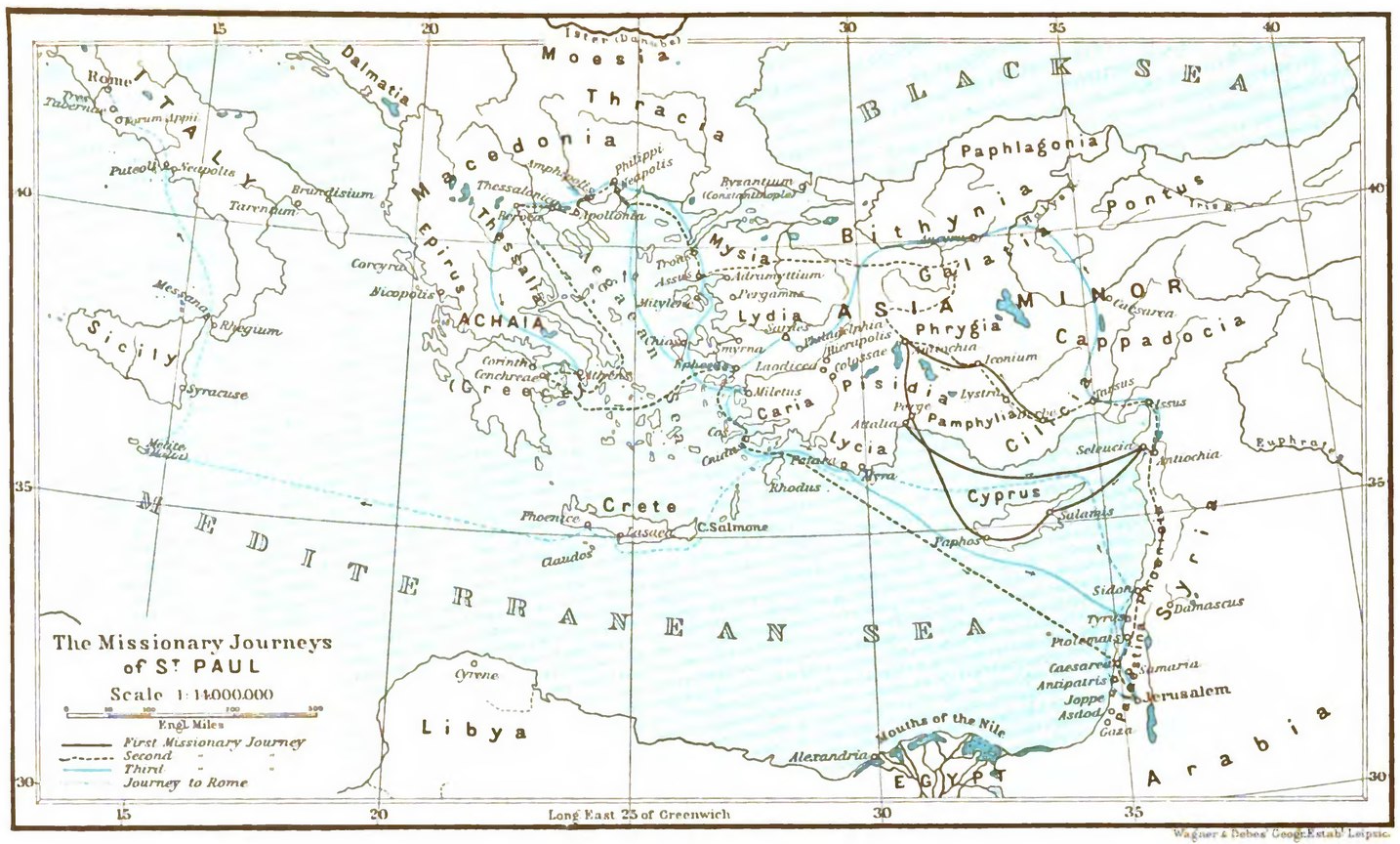
Has anyone argued for an island other than Malta?
Readers differ; the positions are named
In the 1730s the Croatian scholar Ignjat Đurđević argued that Luke's Melita was Mljet, an island in the Adriatic off the Dalmatian coast, not the Mediterranean island now called Malta. His case rested on medieval sources that had used the same name for Mljet. Most readers today hold that Mljet does not fit the rest of the voyage: after leaving the island, Paul's ship sailed on to Syracuse in Sicily and then to Rhegium and Puteoli on the Italian coast, a route that fits a landing at Malta far better than one far north in the Adriatic. Within Malta itself, a bay on the island's north coast has carried the name St Paul's Bay since at least the twelfth century, and a local tradition naming it the exact spot of the landing is traced to a priest in the 1500s. This page names both traditions and does not choose a precise beach for the wreck beyond what Luke himself records.
Sources cited
- OpenBible.info Bible Geocoding: Maltaread 2026-08-20The coordinates on this page. Used under CC-BY with attribution to OpenBible.info.
- Berean Standard BiblePublic domain since 2023. Every verse quoted on this page, from the site's own verse store.
- James Smith, The Voyage and Shipwreck of St. Paul (1848)Named and recommended, not quoted, per the site's own Acts commentary data and the pauls-shipwreck study. His independent reconstruction of the storm's currents and soundings confirms the landing at Malta.
- Hill Museum and Manuscript Library, "Contesting Saint Paul's Shipwreck"Names Ignjat Đurđević's 1730s argument for Mljet (Meleda) over Malta as Luke's Melita. Confirmed by re-verification web search, 2026-09-02.
- BiblePlaces.com, "St. Paul's Bay, Malta"Names the bay's use since about the twelfth century and a local landing tradition traced to a sixteenth-century priest. No stronger source for this specific tradition was found; cited here for that reason. Confirmed by re-verification web search, 2026-09-02.
Keep studying
On this page
Books that name it1
Doorway2
Keep this page