
Genesis 16 and 21 · Story · Loneliness
The God Who Sees Me
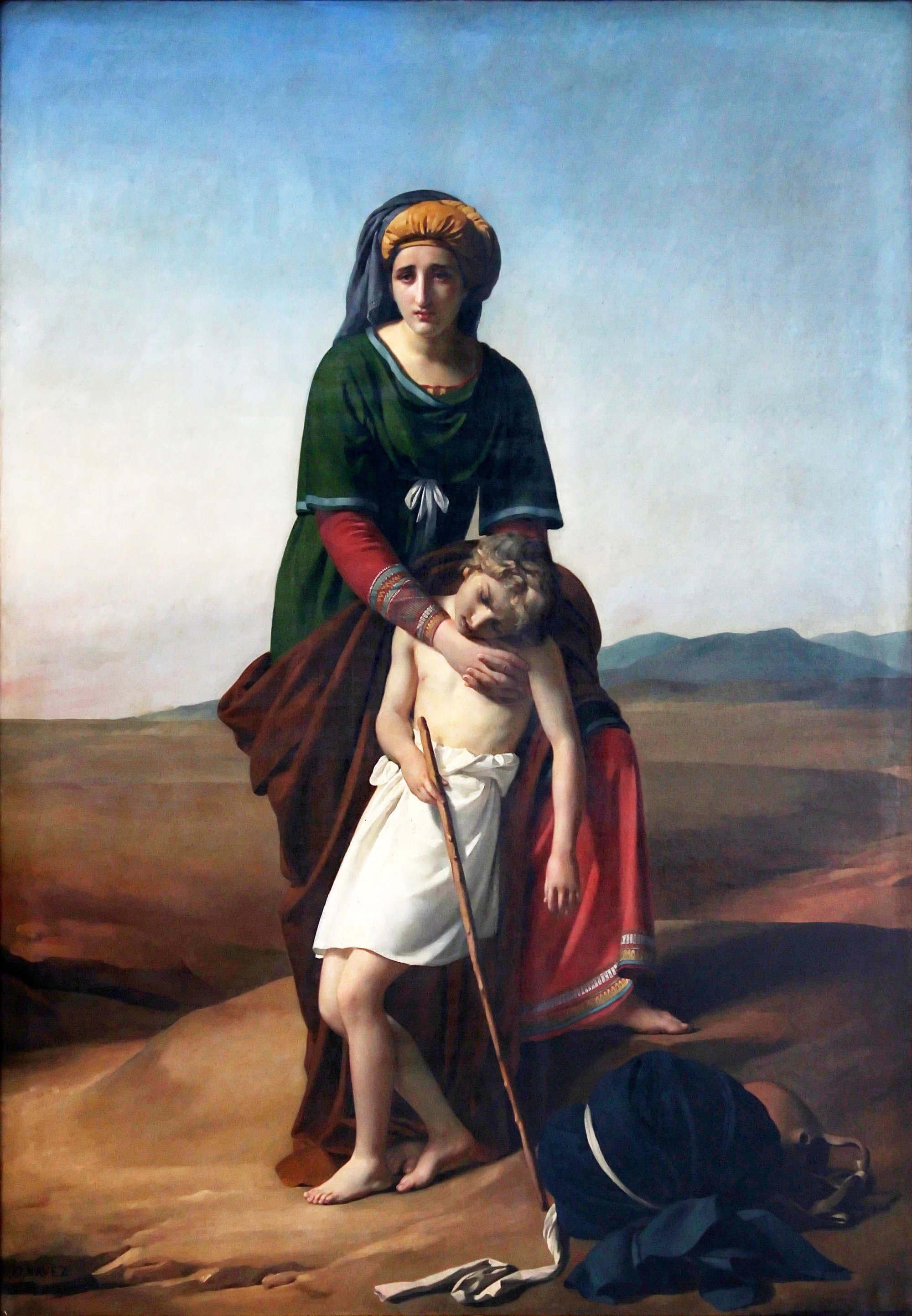
Hagar, an Egyptian servant in Abram's household, met God twice in the wilderness, once as a runaway and once sent away with her son.
Of the two questions the angel asked Hagar at the spring, she answered only the first.
So Hagar gave this name to the LORD who had spoken to her: “You are the God who sees me,” for she said, “Here I have seen the One who sees me!”
- Where
- Beersheba
- Who
- Hagar, Abraham, Sarah, Ishmael
- When
- Abram was eighty-six years old when Ishmael was born (Genesis 16:16)
Summary
Hagar had no standing in Abram's house. Her mistress Sarai gave her to Abram as a wife, and when she conceived and despised Sarai, Sarai dealt so harshly with her that she fled. In the desert, where no one from the household came, God sought her out and gave her a promise for the child she carried.
- The child was named Ishmael because the LORD had heard Hagar's cry of affliction (Genesis 16:11).
- Hagar gave the LORD a name of her own, the God who sees me (Genesis 16:13).
- When the water ran out in the Wilderness of Beersheba, God heard the boy and showed Hagar a well (Genesis 21:17 to 19).
Hagar in the First Wilderness
Genesis 16 moves from a household in Canaan to a spring in the desert.
The God Who Sees Me reads Genesis 16:1 to 16 and Genesis 21:8 to 21. It belongs to the trial of loneliness, the pain of being alone or of having no one who cares, and the story follows a servant who was driven from the household she had served.
The question the story answers is whether God sees and hears a person whom everyone else has driven away. It tells the account from the Berean text with the Hebrew of the names that came out of it, sets the events on a timeline and gives two readings of who the angel was.
Hagar was “an Egyptian maidservant” of Sarai (Genesis 16:1), and she ran from her mistress while she was carrying Abram's child.
Now the angel of the LORD found Hagar by a spring of water in the desert—the spring along the road to Shur.The verse shows God seeking the runaway, since the angel is the one who finds her and not she who looks for him.
In Genesis 16:8 he calls her by name and asks, “where have you come from, and where are you going?”
She answers, “I am running away from my mistress Sarai.”
He sends her back with the words “Return to your mistress and submit to her authority” (Genesis 16:9). Then he promises, “I will greatly multiply your offspring so that they will be too numerous to count” (Genesis 16:10).
The angel of the LORD proceeded: “Behold, you have conceived and will bear a son. And you shall name him Ishmael, for the LORD has heard your cry of affliction.The child's name is a record of what God did for a servant in distress, so every time it was spoken it told that He had heard her.
In Hebrew the verb in Genesis 16:11 is shama', he has listened, and the name Yishma'el is built on it. The name Hagar gives the LORD in Genesis 16:13 is 'el ro'i, a God of seeing, and the well is called Beer-lahai-roi (Genesis 16:14).
Two Wildernesses
Genesis gives a place for each meeting and an age for Abram at Ishmael's birth.
The events run from Sarai's gift of Hagar in Canaan to Ishmael's home in the Wilderness of Paran.
- Sarai gives Hagar to Abramafter ten years in CanaanGenesis 16:3
- Hagar fleesfrom Abram's householdGenesis 16:6
- The angel of the LORD finds hera spring on the road to ShurGenesis 16:7
- Hagar names the LORD who spoke to herat the wellGenesis 16:13 to 14
- Ishmael is bornAbram eighty-six years oldGenesis 16:15 to 16
- Hagar and the boy are sent awayafter the feast of Isaac's weaningGenesis 21:14
- God hears the boythe Wilderness of BeershebaGenesis 21:17 to 19
- The boy grows upthe Wilderness of ParanGenesis 21:20 to 21
A timeline of eight events in Genesis 16 and 21, each with its verse.
God hears the boy, The boy grows up
The Second Wilderness
Years later Hagar is sent away for good, and God meets her again at the point of death.
Sarah saw Hagar's son “mocking her son” (Genesis 21:9). She told Abraham, “Expel the slave woman and her son” (Genesis 21:10), and God told Abraham to listen to her, promising, “I will also make a nation of the slave woman's son” (Genesis 21:13).
When the water in the skin was gone she left the boy under a bush and sat about a bowshot away, and in Genesis 21:16 she says, “I cannot bear to watch the boy die!”
Then God heard the voice of the boy, and the angel of God called to Hagar from heaven, “What is wrong, Hagar? Do not be afraid, for God has heard the voice of the boy where he lies.God hears again, and the verb is the one that gave Ishmael his name, so the boy's name is kept in the wilderness.
“Then God opened her eyes, and she saw a well of water” (Genesis 21:19). “And God was with the boy” (Genesis 21:20).
Shur, Beersheba and Paran
In Genesis 16 Hagar was on the road home to Egypt, the land she came from.
What Genesis 21 Leaves Unsaid
The second account records Hagar's weeping and the boy's voice.
Genesis 21:16 says that Hagar “lifted up her voice and wept”, and the next verse says that God heard the voice of the boy. The account gives no words of prayer from either of them, so God answered a cry that had no words. After Hagar took a wife for Ishmael “from the land of Egypt” (Genesis 21:21), Genesis names her only once more, as Ishmael's mother (Genesis 25:12), and records nothing of her death.
God Meets the Outcast
The story teaches the lonely that God sees and hears those whom others have sent away.
Hagar had been passed from one person to another in Abram's house, and in the desert she was known. The name she gave the LORD is the comfort of every lonely believer, for the One who saw her sees them.
A lonely reader may take the same comfort, and where loneliness weighs on the mind or the body he should also seek a pastor and a doctor, beside prayer and never in its place.
Paul later reads Hagar and Sarah as two covenants, “One covenant is from Mount Sinai and bears children into slavery: This is Hagar” (Galatians 4:24).
How Teachers Have Read the Story
John Wesley read the naming of Ishmael as a word to the afflicted.
1703 to 1791 · John Wesley
Explanatory Notes upon the Old Testament
The quotation1 quotation
“Ishmael, that is, God will hear; and the reason is, because the Lord hath heard: he hath, and therefore he will. The experience we have had of God's seasonable kindness in distress should encourage us to hope for the like help in the like exigencies. Even there, where there is little cry of devotion, the God of pity hears the cry of affliction: tears speak as well as prayers.”
John Wesley · Explanatory Notes upon the Old Testament · on Genesis 16:11Evangelical
Who the Angel Was
Two readings of the angel of the LORD in Genesis 16, each with its holder and the objection to it.
The Son before His incarnationAdam Clarke
Adam Clarke, in his Commentary on the Bible (1832), wrote on Genesis 16:7, “That Jesus Christ, in a body suited to the dignity of his nature, frequently appeared to the patriarchs”. On Genesis 16:10 he wrote that the speaker “speaks with all the authority which is proper to God”.
The objection: in Genesis 21:17 the angel of God calls to Hagar from heaven, which reads as a messenger sent.
A created angel speaking in God's nameAugustine of Hippo
Augustine, in On the Trinity (translated by Arthur West Haddan, 1887), said of the appearances of God to the fathers, “yet we say that they were wrought by angels”.
The objection: Hagar names the speaker “the LORD who had spoken to her” (Genesis 16:13), and he makes his promise in the first person.
Seen and Heard
Psalm 34 promises the righteous what the two names of Genesis 16 record.
The eyes of the LORD are on the righteous, and His ears are inclined to their cry.The verse holds together the seeing that 'el ro'i names and the hearing that Ishmael's name records.
The righteous cry out, and the LORD hears; He delivers them from all their troubles.The psalm sets the LORD's rescue after His hearing, the order Genesis 21 keeps.
Sources
Scripture is the Berean Standard Bible.
- STEP Bible, the tagged Hebrew Bible (Tyndale House, Cambridge), CC BY 4.0.
- STEP Bible brief lexicon of Extended Strongs for Hebrew (Tyndale House, Cambridge), CC BY 4.0, with the Strong's glosses.
- John Wesley, Explanatory Notes upon the Old Testament (1765), on Genesis 16:11.
- Jerome, Hebrew Questions on Genesis, on Genesis 16:7.
- Adam Clarke, Commentary on the Bible (1832), on Genesis 16:7 and 16:10.
- Augustine of Hippo, On the Trinity, Book 3, chapter 11, section 22, translated by Arthur West Haddan (Nicene and Post-Nicene Fathers, first series, volume 3, Buffalo: Christian Literature Publishing, 1887)
Keep Studying
In this trial7
People and groups9