
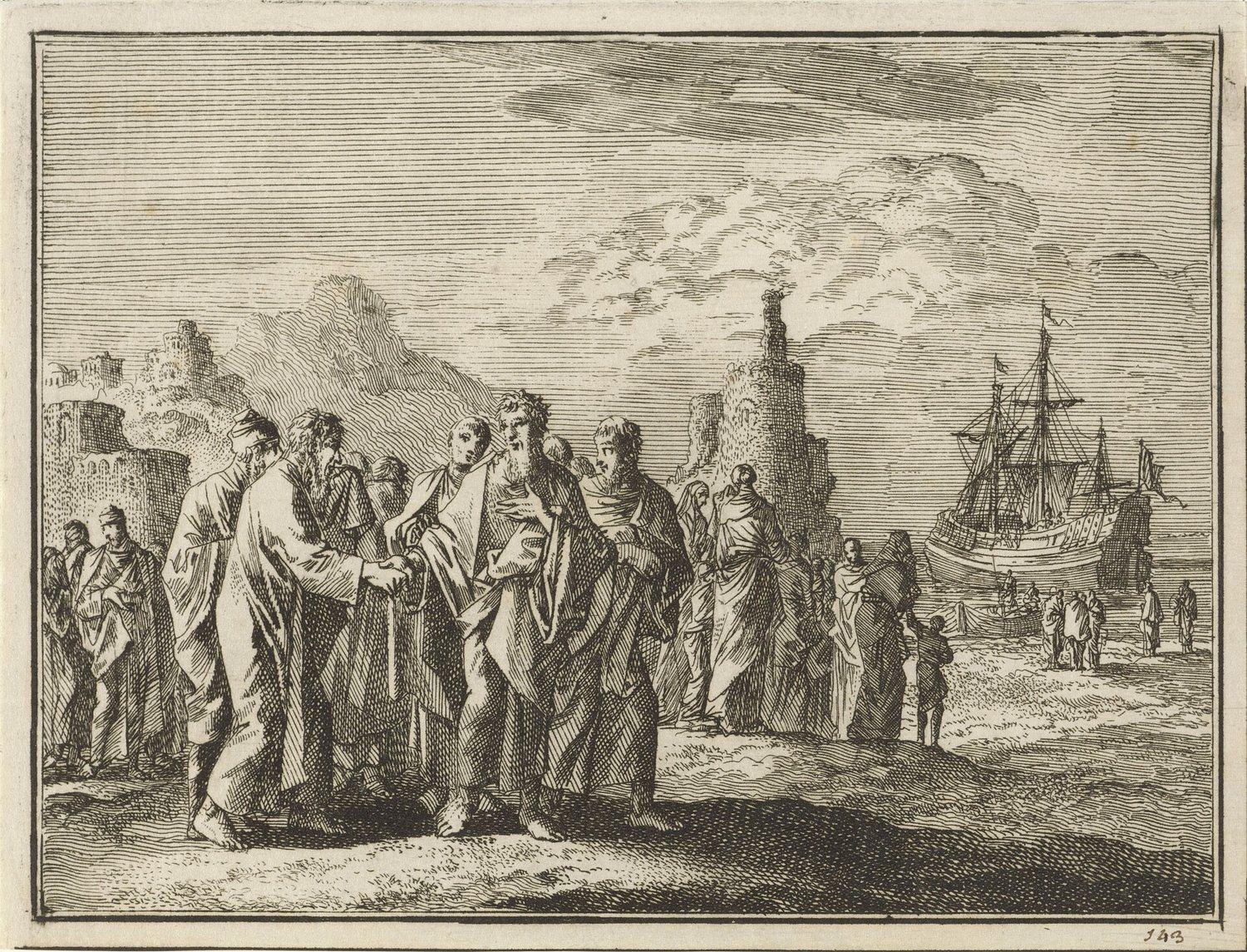
Jan Luyken, 1712. CC0.
Acts 16 to 28 · Subject · Featured Study
The We Passages of Acts
In four stretches of Acts the writer says we and tells the story as one of Paul's company.
As soon as Paul had seen the vision, we got ready to leave for Macedonia, concluding that God had called us to preach the gospel to them.
- Book
- Acts
- Hold in memory
- Acts 16:10, Colossians 4:14
At Troas the story of Acts turns from they to we.
Summary
The writer of Acts speaks in the first person only while Paul travels. He joins the company after Paul's vision at Troas and is still aboard when the ship reaches Italy.
- R. J. Knowling counts ninety-seven verses in the four stretches together.
- R. B. Rackham joins the second and third stretches into one, from Acts 20:5 to 21:18.
- The first stretch stops at Philippi, and the second picks up again in the same city.
Where the We Begins and Ends
Three verses mark where the we comes back, where it pauses and where it ends.
The next day Paul went in with us to see James, and all the elders were present.The third stretch ends as Paul goes in to James, some days before the riot in the temple.
When we arrived in Rome, Paul was permitted to stay by himself, with a soldier to guard him.The last we stands at Rome, where the book's journeys end.
The Four Stretches Measured
The we passages differ in length, and the voyage to Rome is the longest by far.
The voyage to Rome holds sixty verses, more than the other three stretches together.
The four counts as a table
| The stretch | Verses | From and to | Verse |
|---|---|---|---|
| The first stretch | 8 | Troas to Philippi | Acts 16:10 to 17 |
| The second stretch | 11 | Philippi to Miletus | Acts 20:5 to 15 |
| The third stretch | 18 | Miletus to Jerusalem | Acts 21:1 to 18 |
| The fourth stretch | 60 | Caesarea to Rome |
Each bar counts the verses of one stretch within the bounds Knowling gives.
The we passages follow the company by sea and road from Troas to Philippi, from Philippi to Jerusalem, and from Caesarea to Rome.
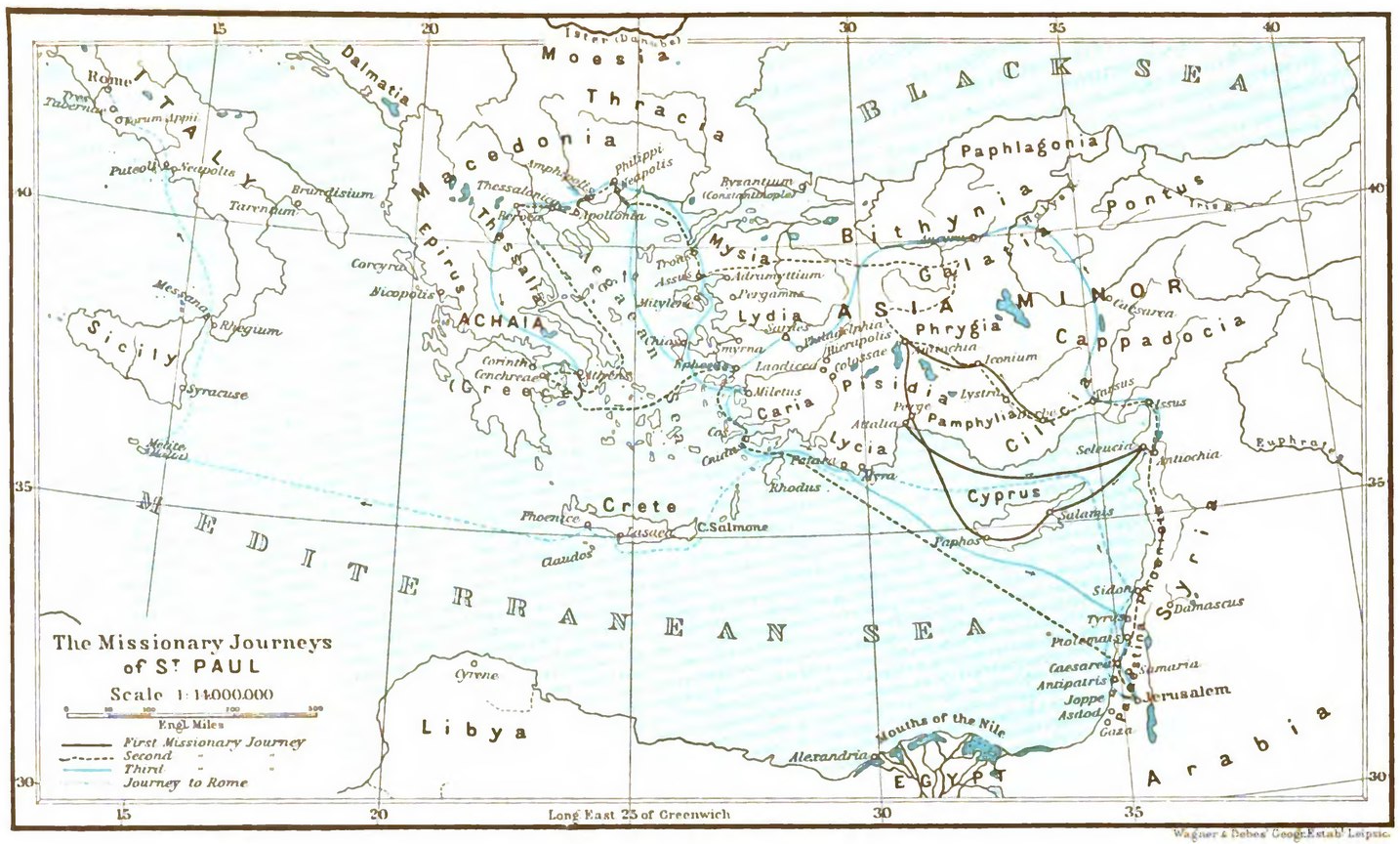
about 500 km (311 miles)
Base map: The missionary journeys of St. Paul, F. J. Knecht, Practical Commentary on Holy Scripture, public domain.
Eighteen places on Knecht's plate of Paul's journeys, each scoring 1,000 of 1,000 in the OpenBible identification data. Jerusalem stands off the line, since the we stops there and starts again at sea.
- Known: a score of 800 or more
- The route, in the order the text gives
- 1Troas, We got ready to leave for Macedonia Acts 16:10
- 2Samothrace, We sailed straight to the island Acts 16:11
- 3Neapolis, The port of the next day Acts 16:11
- 4Philippi, Lydia and her household were baptized Acts 16:15
- 5Troas again, Eutychus fell from the window Acts 20:9
- 6Assos, Paul came on foot and joined the ship Acts 20:14
Mitylene, Miletus, Patara, Tyre, Caesarea, Jerusalem, Sidon, Myra and 5 more
- 7Mitylene, The town where the ship put in next Acts 20:14
- 8Miletus, Paul sent for the Ephesian elders Acts 20:17
- 9Patara, They found a ship crossing to Phoenicia Acts 21:2
- 10Tyre, They stayed seven days with the disciples Acts 21:4
- 11Caesarea, They stayed with Philip the evangelist Acts 21:8
- 12Jerusalem, The brothers welcomed them Acts 21:17
- 13Sidon, Julius let Paul visit his friends Acts 27:3
- 14Myra, The centurion found an Alexandrian ship Acts 27:6
- 15Fair Havens, Paul warned of disaster on the voyage Acts 27:10
- 16Malta, All aboard came safely ashore Acts 28:1
- 17Syracuse, They stayed three days Acts 28:12
- 18Puteoli, Brothers invited them to stay a week Acts 28:14
- 19Rome, Paul was allowed to stay by himself Acts 28:16
The Four Stretches in Turn
Each stretch tells of travel, and the writer drops out of the story between them.
The first stretch starts after Paul's vision of the man of Macedonia. It follows the company from Troas to Philippi, to the prayer place by the river and to the slave girl who cried out after them.
This girl followed Paul and the rest of us, shouting, “These men are servants of the Most High God, who are proclaiming to you the way of salvation!”The first stretch ends with this verse, and the jail at Philippi is told of Paul and Silas alone.
The second stretch covers the night at Troas when Eutychus fell from a window, and the voyage down the coast to Miletus.
We went on ahead to the ship and sailed to Assos, where we were to take Paul aboard. He had arranged this because he was going there on foot.Here the writer sets himself apart from Paul, who walked to Assos while the rest sailed.
The third stretch sails by Cos, Rhodes and Patara to Tyre and goes on to Caesarea, where the company stayed with Philip. From there they went up to Jerusalem.
When we heard this, we and the people there pleaded with Paul not to go up to Jerusalem.This verse shows the writer acting in the story as well as watching it.
The fourth stretch begins when Paul sails for Italy as a prisoner. It tells the storm, the wreck on Malta and the last road into Rome.
In all, there were 276 of us on board.Luke's exact count of those aboard reads like a witness's note.
Acts 21:12, Acts 27:37
Luke in the Letters and in Eusebius
Paul's letters name Luke three times, and Eusebius says Luke wrote Acts from what he saw.
What the We Leaves Unsaid
The writer leaves his own name out of the book.
Rackham warned that a return to the third person does not prove the writer was away, since the third person appears often inside the last voyage.
The Voices
Irenaeus and Theophylact of Ohrid read the we as Luke's own.
Irenaeus (died 202)
Against Heresies Book III, Chapter 14, Section 1
Inseparable, as the writer shows
“But that this Luke was inseparable from Paul, and his fellow-labourer in the Gospel, he himself clearly evinces, not as a matter of boasting, but as bound to do so by the truth itself.”
on Acts 20:5Patristic
Theophylact of Ohrid (died 1107)
Commentary on Acts
The writer joins himself to the story
“It should be noted that in these cities Luke was also with Paul. This is evident from the fact that the latter unites his own person with the former, when he says: ‘we resolved to set out... we sailed a straight course... we stayed.’”
on Acts 16:10Patristic
Where Readers Differ
Four questions about the we, with the writers who answer them.
Did the companion write the whole book?2 paragraphs
Harnack granted that the we sections read like a diary, and he thought Luke drew on notes of his own.
Did the writer copy someone else's diary?2 paragraphs
F. C. Baur, in the English edition of his Paul (1876), held that Acts came from a later writer than Luke, who may have used Luke's own account of Paul's last voyage. Knowling reports that critics who split the diary from the book named Timothy, Silas or Titus as its keeper, and that Holtzmann decided for Luke.
Knowling answered with Vogel that a writer of such finished style would hardly have woven another man's travel diary into his book without changing its pronouns.
Is the we a device?2 paragraphs
Baur also asked whether the writer used the we to put himself in Luke's place. Knowling reports that Hilgenfeld and Wendt set it beside the first person of Ezra, Nehemiah and Tobit. Harnack reports Wellhausen's view that the voyage was an older sea story turned into a story of Paul, and he rejected it.
Knowling asked why a writer seeking an air of truth would leave the we out of Peter's escape from prison in Acts 12.
Is there a we at Antioch in Acts 11:28?2 paragraphs
Codex Bezae and some Old Latin copies read a we in Acts 11:28, when the prophet Agabus spoke at Antioch. Knowling held that the reading may come from an early draft. Harnack did not take it as original, but he said it rightly marks the story there as Antioch's.
Ramsay took the reading as a sign that the Bezan text is not Luke's own.
Books to Read Next
Two works, each free to read online.
The Acts of the Apostles
Adolf Harnack, translated by J. R. Wilkinson · 1909
The book is Harnack's answer to the critics who split Acts into sources.
Free at the Internet ArchiveSt. Paul the Traveller and the Roman Citizen
W. M. Ramsay · 1896
Ramsay follows the we from Troas to Rome and dates the voyages.
Free at the Internet ArchiveWhat the We Gives the Reader
A small pronoun puts a witness on the ship and in the house at Caesarea. Readers who weigh it differently still read the same voyages, told by a voice that says it shared them.
Sources
Scripture is the Berean Standard Bible.
- The Holy Bible, Berean Standard Bible (read 2026)
- R. J. Knowling, The Acts of the Apostles, in The Expositor's Greek Testament, volume 2 (1900)
- R. B. Rackham, The Acts of the Apostles, Westminster Commentaries (1901)
- Eusebius, Church History 3.4, Nicene and Post-Nicene Fathers, second series, volume 1.
- W. M. Ramsay, St. Paul the Traveller and the Roman Citizen (New York and London: Putnam, 1896)
- Adolf Harnack, The Acts of the Apostles, translated by J. R. Wilkinson, Crown Theological Library (1909)
- F. C. Baur, Paul the Apostle of Jesus Christ, volume 1, edited by E. Zeller, translated by A. Menzies (1876)
- Irenaeus, Against Heresies 3.14.1, Ante-Nicene Fathers, volume 1.
- Theophylact of Ohrid, Commentary on Acts.
- OpenBible.info, Bible-Geocoding-Data, ancient.jsonl.
- F. J. Knecht, Practical Commentary on Holy Scripture, the plate The Missionary Journeys of St. Paul.
Keep Studying
Studies6