
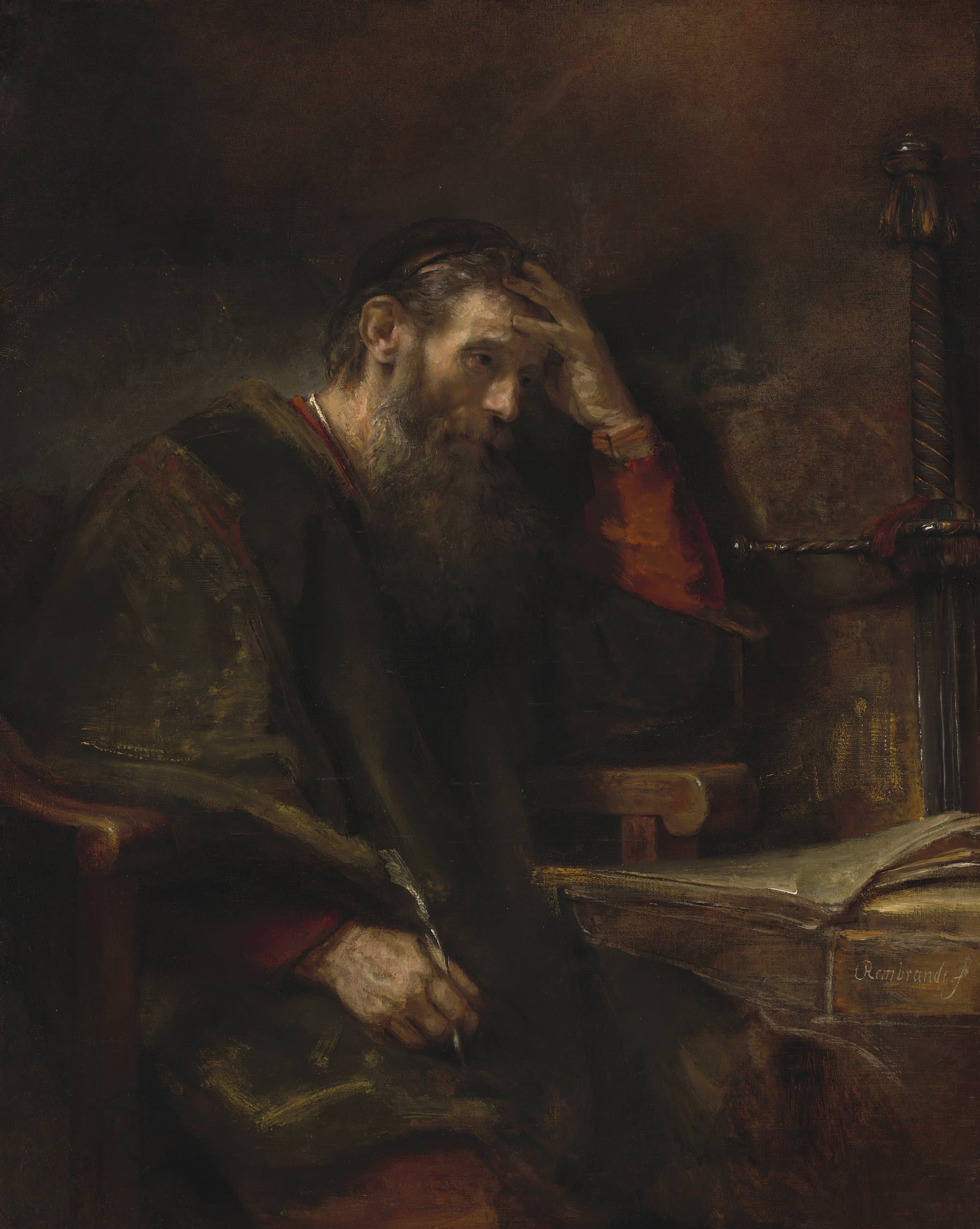
2 Timothy 1:6 to 8 · Passage · Fear
A Spirit of Power and Love
In 2 Timothy 1:6 to 8 Paul, a prisoner, urges Timothy to rekindle God's gift and to share in suffering for the gospel.
The verb Paul chooses for stirring up God's gift, anazopureo, to kindle anew, stands nowhere else in the New Testament (2 Timothy 1:6).
For God has not given us a spirit of fear, but of power, love, and self-control.
- The passage
- 2 Timothy 1:6 to 8, 2 Timothy 1:9 to 12, 2 Timothy 4:6
- Book
- 2 Timothy
- Hold in memory
- 2 Timothy 1:7, 2 Timothy 1:12
Summary
Paul writes to Timothy, whom he calls “my beloved child” (2 Timothy 1:2), and answers the fear that could hold him back with what God has already given him. The command not to be ashamed rests on what God has done, for God saved and called His people, and Christ Jesus abolished death through the gospel (2 Timothy 1:9 to 10).
- Paul wrote the letter as a prisoner who expected to die soon (2 Timothy 1:8 and 2 Timothy 4:6).
- The gift Timothy must keep burning came to him through the laying on of hands (2 Timothy 1:6 and 1 Timothy 4:14).
- The fear 2 Timothy 1:7 rejects is timidity, the shrinking that would make Timothy ashamed of the gospel and of Paul.
A Letter from Prison
The letter's own words name the place where Paul writes and the people around him.
A Spirit of Power and Love studies 2 Timothy 1:6 to 8, a passage of the trial of fear. It asks what God gives a believer who is tempted to shrink back from the gospel out of fear, and what He asks of him in return.
The study sets the three verses in their letter. It gives the Greek verb for rekindling the gift, the word for the fear and the words for the three things God gives in its place. It then follows the reasons Paul gives in the verses after. It also sets out two questions on which interpreters differ, with the holders of each reading and the objection to it.
Paul writes that “everyone in the Province of Asia has deserted me” (2 Timothy 1:15), and that Onesiphorus, “when he arrived in Rome, he searched diligently until he found me” (2 Timothy 1:17).
What God Has Given
Power, love and self-control answer the shrinking of fear.
Each word of 2 Timothy 1:7 is shown at work elsewhere in Paul's letters to Timothy, the timidity by its opposite and the three gifts by name.
| The word | The Greek | The gloss | Where the letters show it |
|---|---|---|---|
| Fear | deilia | timidity | Its opposite in Onesiphorus, who “was unashamed of my chains” (2 Timothy 1:16) |
| Power | dunamis | force | “join me in suffering for the gospel by the power of God” (2 Timothy 1:8) |
| Love | agape | affection or benevolence | “with the faith and love that are in Christ Jesus” (2 Timothy 1:13) |
| Self-control | sophronismos | discipline, self-control | The overseer must be “self-controlled” (1 Timothy 3:2) |
Sophronismos stands only in this verse of the New Testament, and 1 Timothy 3:2 uses the related adjective sophron for the overseer. Deilia names the shrinking of a man who will not stand up when it costs him.
Fan into Flame
Courage begins with something received.
For this reason I remind you to fan into flame the gift of God, which is in you through the laying on of my hands.The verse gives the reason for courage before the command, a gift of God already in Timothy that he must keep alive.
John Wesley, in his Explanatory Notes upon the New Testament (1755), glossed the verb as “blowing up the coals into a flame”. The picture is of a fire that burns low and is blown back to life, and the fuel is the gift God has already given.
Do not neglect the gift that is in you, which was given you through the prophecy spoken over you at the laying on of the hands of the elders.Paul's first letter names the same gift and the same laying on of hands, by the elders, so the gift of 2 Timothy 1:6 has a known beginning.
Unashamed of the Gospel and of Paul
Paul gives the reasons for his command in 2 Timothy 1:9 to 12.
In 2 Timothy 1:8 Timothy is to refuse shame, both for the testimony of the Lord and for Paul in chains.
God “has saved us and called us to a holy calling, not because of our works” (2 Timothy 1:9). Christ Jesus “has abolished death and illuminated the way to life and immortality through the gospel” (2 Timothy 1:10).
For this reason, even though I suffer as I do, I am not ashamed; for I know whom I have believed, and I am convinced that He is able to guard what I have entrusted to Him for that day.Paul gives his own case as the pattern, so the command not to be ashamed comes from a man who keeps it in prison.
Fear can lodge in the body and the mind as well as the will. Where it does, a physician's care belongs beside prayer, and the power God gives is never a reason to refuse that care.
The Gift Kept Burning
Timothy's fear is met by what God has given and what God has done.
Timothy's courage was to rest on what he had already received, and the letter offers the same ground to every reader who is afraid.
Sources
Scripture is the Berean Standard Bible.
- STEP Bible, Translators Amalgamated Greek New Testament (Tyndale House, Cambridge), CC BY 4.0.
- STEP Bible brief lexicon of Extended Strongs for Greek (Tyndale House, Cambridge), CC BY 4.0, with the Strong's glosses.
- John Wesley, Explanatory Notes upon the New Testament (1755), on 2 Timothy 1:6.
- John Chrysostom, Homilies on the Second Epistle to Timothy, Homily 1, on 2 Timothy 1:7 (Nicene and Post-Nicene Fathers, first series, volume 13)
- Robert Jamieson, A. R. Fausset and David Brown, Commentary Critical and Explanatory on the Whole Bible (1871), on 2 Timothy 1:7.
- Albert Barnes, Notes, Explanatory and Practical, on the Old and New Testaments (1832 to 1869), on 2 Timothy 1:7.
- Adam Clarke, Commentary on the Bible (1832), on 2 Timothy 1:7.
- J. B. Lightfoot, Biblical Essays (Macmillan, London and New York, 1893), St Paul's History after the Close of the Acts.
- P. N. Harrison, The Problem of the Pastoral Epistles (Oxford University Press, Humphrey Milford, 1921), chapter 1.
Keep Studying
Studies1
People and groups10
Places1
Values1