
Genesis 17:1 and 1 Thessalonians 5:23 to 24 · Doctrine · Featured Study
Christian Perfection
Taught by Wesley, restated by Free Methodists, Nazarenes and others, and set against the Westminster Confession.
The Nazarene Manual gives entire sanctification six other names, among them Christian Perfection, Perfect Love and Heart Purity.
- First taught
- Genesis 17:1 “When Abram was ninety-nine years old, the LORD…”
- Fullest statement
- 1 Thessalonians 5:23 to 24 “Now may the God of peace Himself sanctify…”
- Confessed by
- Methodists, Free Methodists, Nazarenes, Salvation Army
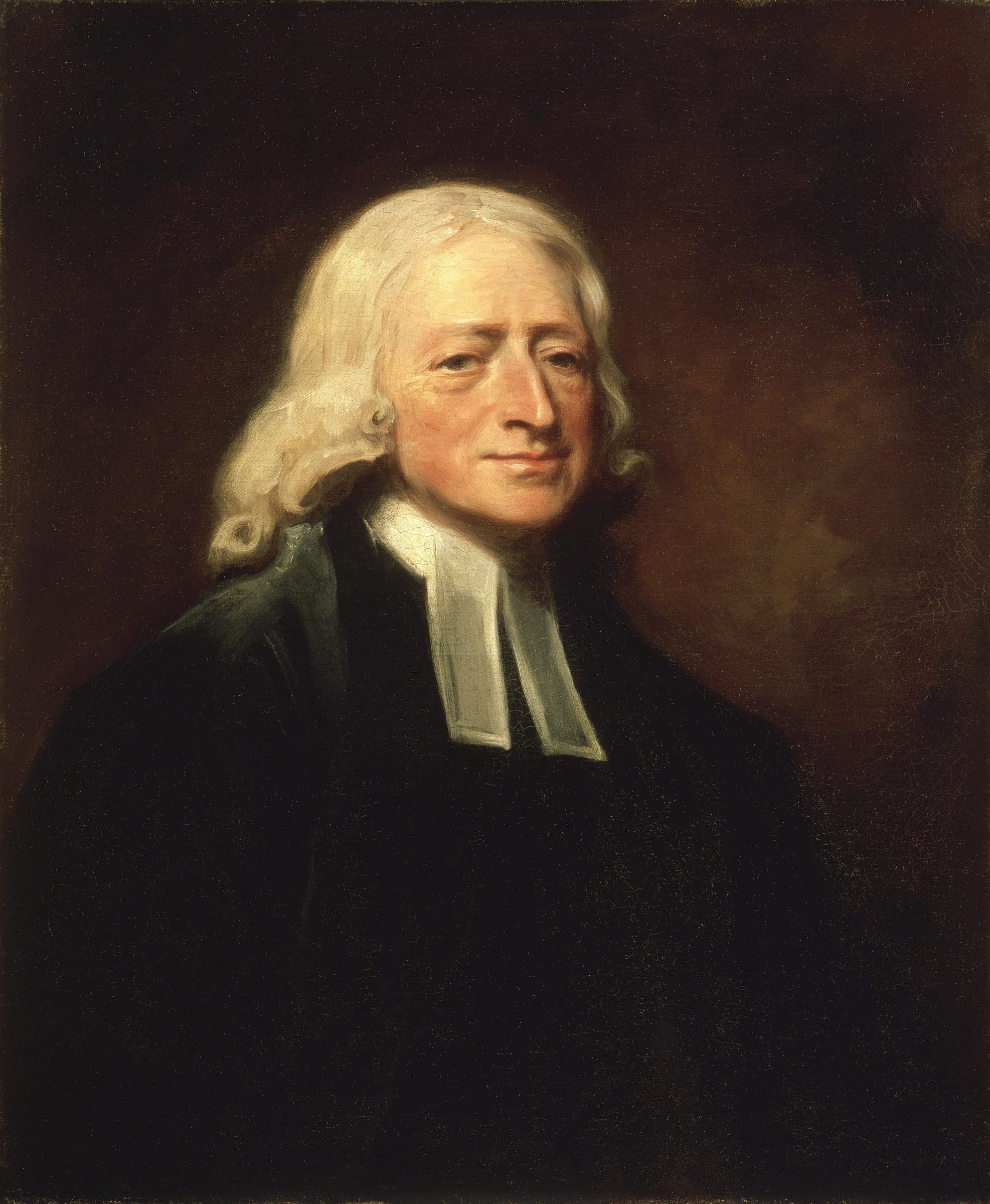
George Romney, John Wesley, 1788 to 1789. Public domain.
Summary
Christian perfection is Wesley's name for love of God and neighbour that rules the heart, received by faith in this life. The Holiness churches made it the centre of their teaching. The Westminster Confession, older than Wesley's teaching, holds sanctification imperfect in this life.
- He held that it is received by faith in a moment and grows before and after.
- He taught that one who has received it can still fall away.
- The Holiness churches called it entire sanctification.
- That Confession holds that the saints persevere to the end.
The First Text and the Fullest
The doctrine starts from God's word to Abram at ninety-nine and Paul's prayer for the church at Thessalonica.
The doctrine's fullest text is Paul's prayer in 1 Thessalonians 5:23 to 24, that God will sanctify His people completely.
When Abram was ninety-nine years old, the LORD appeared to him and said, “I am God Almighty. Walk before Me and be blameless.It is the first text of the doctrine, and its Hebrew word for blameless is tamim.
The words the doctrine turns on1 table, 1 paragraph
Three words from the two texts and 1 John 4, with the senses Strong's lexicon gives.
| Word | Where | Strong's sense |
|---|---|---|
| tamim (h8549) | Genesis 17:1, blameless | “entire (literally, figuratively or morally)” |
| holoteles (g3651) | 1 Thessalonians 5:23, completely | “complete to the end, i.e. absolutely perfect” |
| teleios (g5046) | 1 John 4:18, perfect love | “complete (in various applications of labor, growth, mental and moral character, etc.)” |
Blameless and complete are the words the texts use, and blameless is a different claim from sinless.
Seven Texts From the Minutes of 1745
From Psalm 130:8 to Romans 8:3 to 4.
The texts run from the Law and the Psalms to the letters of Paul and John, in the order Wesley's Plain Account prints them. The minutes cite Ezekiel 36:29 with Ezekiel 36:25.
And He will redeem Israel from all iniquity.It is the first text the minutes give for full salvation.
I will also sprinkle clean water on you, and you will be clean. I will cleanse you from all your impurities and all your idols.It is the second, cited with Ezekiel 36:29.
Therefore, beloved, since we have these promises, let us cleanse ourselves from everything that defiles body and spirit, perfecting holiness in the fear of God.It is the third, Paul's call to the church at Corinth.
The LORD your God will circumcise your hearts and the hearts of your descendants, and you will love Him with all your heart and with all your soul, so that you may live.It is the fourth, from the Law.
The one who practices sin is of the devil, because the devil has been sinning from the very start. This is why the Son of God was revealed, to destroy the works of the devil.It is the fifth, from the first letter of John.
Husbands, love your wives, just as Christ loved the church and gave Himself up for her to sanctify her, cleansing her by the washing with water through the word, and to present her to Himself as a glorious church, without stain or wrinkle or any such blemish, but holy and blameless.It is the sixth, from Paul's letter to the Ephesians.
For what the law was powerless to do in that it was weakened by the flesh, God did by sending His own Son in the likeness of sinful man, as an offering for sin. He thus condemned sin in the flesh, so that the righteous standard of the law might be fulfilled in us, who do not walk according to the flesh but according to the Spirit.It is the seventh and last text of the minutes.
2 Corinthians 7:1, Deuteronomy 30:6, 1 John 3:8, Ephesians 5:25 to 27, Romans 8:3 to 4
What Wesley Taught, in His Own Words
Wesley defines perfection and sin, and calls the work both a moment and a growth.
Wesley's A Plain Account of Christian Perfection, read in Jackson's edition of 1872, carries the title “As believed and taught by the Reverend Mr. John Wesley, from the year 1725, to the year 1777.”
In section 18 he writes that he and his brother held “That Christian perfection is that love of God and our neighbour, which implies deliverance from all sin.”
They held it to be “received merely by faith,” “given instantaneously, in one moment,” and to be expected “not at death, but every moment.”
In the minutes of 1759 Wesley defined sin “properly so called” as “a voluntary transgression of a known law.”
He wrote that even involuntary transgressions need “the atoning blood,” and so “sinless perfection is a phrase I never use.”
He also wrote that “there is a gradual work, both before and after that moment,” so that one may call the work gradual and another instantaneous “without any manner of contradiction.”
Jesus declared, “‘Love the Lord your God with all your heart and with all your soul and with all your mind.’Wesley's definition of perfection is the love of God with all the heart that this command asks.
How the Holiness Churches Stated It, 1843 to 1908
Palmer, the Free Methodists, Simpson, Brengle and the Nazarenes.
After Wesley, each Holiness body stated the doctrine in its own words.
| Holder | Work and year | In their words |
|---|---|---|
| Phoebe Palmer | The Way of Holiness, 1843 | “there is a shorter way” |
| The Free Methodist Church | Its article of 1860, as Roberts reprints it in 1879 | “Entire sanctification takes place subsequently to justification, and is the work of God, wrought instantaneously upon the consecrated, believing soul.” |
| A. B. Simpson | The Four-Fold Gospel, copyright 1890 | “Sanctification is not self-perfection.” |
| Samuel Logan Brengle | Helps to Holiness, preface dated 1896 | “neither the Bible nor experience proves that a man gets a clean heart when he is converted” |
| Pentecostal Church of the Nazarene | Manual, 1908 | “Entire sanctification is that act of God, subsequent to justification, by which regenerate believers are made free from inbred sin” |
Palmer taught believers to lay all on the altar.
You blind men! Which is greater: the gift, or the altar that makes it sacred?Palmer took her picture of the altar from this verse.
The Nazarene Manual says inbred sin remains in the regenerate “until eradicated and destroyed by the baptism with the Holy Spirit.”
In that Manual the word Pentecostal in the church's name stands for entire sanctification, and so does the phrase “The Baptism with the Holy Spirit.”
Where Readers Disagree: Perfection in This Life, and Falling
Wesley, the Holiness churches and the Westminster Assembly part on both.
The first question is whether a believer can be wholly sanctified in this life. The Westminster Confession of 1646, chapter XIII.2, holds that sanctification is “imperfect in this life, there abiding still some remnants of corruption in every part.”
J. C. Ryle, in Holiness (first published in 1877 or 1879), warned against holiness “by faith only, and not at all by personal exertion.”
The second question is whether one who is sanctified can fall and be lost. Wesley wrote, “They who are sanctified, yet may fall and perish.” He also wrote, “it is an exceeding common thing for persons to lose it more than once.”
How much more severely do you think one deserves to be punished who has trampled on the Son of God, profaned the blood of the covenant that sanctified him, and insulted the Spirit of grace?Wesley cites it in brackets after his sentence on the sanctified who fall.
The same Confession, in chapter XVII.1, holds the other side, that the sanctified “can neither totally nor finally fall away from the state of grace.”
MannaFest holds eternal security as its own position, from John 10:28 to 29, and its study of eternal security sets out that reading.
I give them eternal life, and they will never perish. No one can snatch them out of My hand. My Father who has given them to Me is greater than all. No one can snatch them out of My Father’s hand.MannaFest's position that the believer is kept rests on these words of Jesus.
Books to Read Next
A Plain Account of Christian Perfection
John Wesley · 1777
It is Wesley's own account of the doctrine, with the minutes of his conferences.
Free at the Christian Classics Ethereal LibraryManual of the Pentecostal Church of the Nazarene
The General Assembly at Pilot Point · 1908
It gives the Nazarene statement of entire sanctification and its other names.
Free at the Wesleyan Holiness Digital LibraryThe Four-Fold Gospel
A. B. Simpson · 1890
Simpson teaches sanctification as a free gift to be received.
Free at the Internet ArchiveThe Confession of Faith of the Assembly of Divines at Westminster
The Westminster Assembly · 1646
Its chapters XIII and XVII give the Reformed teaching on both questions.
Free at WikisourceWhat the Doctrine Asks
For Wesley the hope was love for God filling the heart now, given in a moment and still growing after it.
Sources
Scripture is the Berean Standard Bible.
- The Holy Bible, Berean Standard Bible (read 2026)
- James Strong, Exhaustive Concordance (1890), Hebrew and Greek dictionaries, entries h8549, g3651 and g5046.
- John Wesley, A Plain Account of Christian Perfection (last revised 1777), in The Works of John Wesley, edited by Thomas Jackson (1872), volume 11, pages 366 to 446.
- Phoebe Palmer, The Way of Holiness (New York: Piercy and Reed, 1843)
- B. T. Roberts, Why Another Sect (Rochester: The Earnest Christian Publishing House, 1879), pages 19 to 21, the Cyclopaedia of Methodism's article as Roberts reprints it.
- A. B. Simpson, The Four-Fold Gospel, third edition, revised (New York: Christian Alliance Publishing Co., copyright 1890), chapter 2.
- Samuel Logan Brengle, Helps to Holiness, The Red-Hot Library No. IV, edited by Bramwell Booth (London: The Salvation Army Book Department; preface dated 1896), page 8.
- Manual of the Pentecostal Church of the Nazarene (Nazarene Publishing Company, 1908), pages 26 to 29.
- The Confession of Faith of the Assembly of Divines at Westminster (1646), chapters XIII.2 and XVII.1, in S. W. Carruthers's transcription of 1946.
- J. C. Ryle, Holiness (first edition 1877 or 1879), introduction, the first caution.
Keep Studying
Studies4
Places1
Doctrines8