
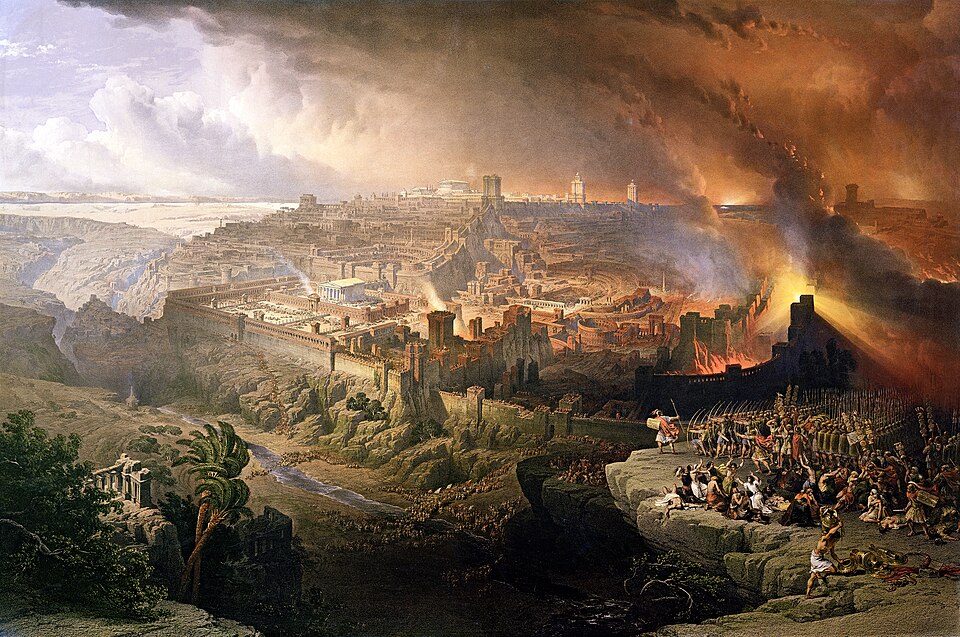
An Ancient Empire · The Fourth Kingdom
Rome
Every book of the New Testament was written inside one empire. Daniel calls it the fourth kingdom, strong as iron, and the whole New Testament breathes inside the world that kingdom built: its roads, its peace, its citizenship, its cross, and, eventually, its persecution. This page follows Rome from Daniel’s own frame through the empire the gospel actually traveled in, the instrument that killed Jesus, what Paul tells Christians to render to it, what John sees it become from underneath its own persecution, and the fall of Jerusalem Jesus foretold before any of it happened.
Summary
Daniel's vision names a fourth kingdom, strong as iron, that the majority reading across church history identifies as Rome. That empire is the actual world the New Testament was written inside: its roads carried the gospel, its citizenship protected Paul, its cross killed Jesus, and its persecution shaped how Revelation describes it from underneath. Romans 13 tells Christians to honor the empire as God's own institution; Jesus foretold the fall of its rebellious province's capital, Jerusalem, in AD 70, and it happened exactly as he said.
- Daniel 2:40 and 7:7 both describe a fourth kingdom stronger and more terrible than the three before it; the majority reading across church history names it Rome
- The ten toes and the little horn carry more than one reading; this site's own dispensational tradition reads them as a future, revived form of the empire, named beside the historicist reading rather than in place of it
- Rome's peace, roads, and common citizenship carried the gospel across the Mediterranean world within one generation of the resurrection
- Romans 13:1-7 calls civil government God's own institution owed honor and tribute, written to Christians living inside the same empire that would soon execute believers for refusing its emperor cult
- Jesus foretold Jerusalem's fall in detail (Luke 19:41-44, 21:20-24); Rome's legions destroyed the temple in AD 70, exactly as he said
The Legs of Iron
Daniel 2:33, 40-44: the fourth kingdom in Nebuchadnezzar's own dream
“His legs of iron, his feet part of iron and part of clay.” Daniel 2:33
“And the fourth kingdom shall be strong as iron: forasmuch as iron breaketh in pieces and subdueth all things: and as iron that breaketh all these, shall it break in pieces and bruise.” Daniel 2:40
Nebuchadnezzar’s dream image runs gold to silver to bronze to iron, four kingdoms in descending value and rising hardness. Babylon is the gold head, named outright in the text (2:38). Medo-Persia and Greece follow as silver and bronze, both identified in Daniel’s later visions (8:20-21). The fourth kingdom, legs of iron, breaks and crushes everything before it the way none of the others could.
“‘And there shall be a fourth empire like unto iron. Just as iron breaks to pieces and overcomes all else, so it shall break to pieces and shatter all these preceding empires . ...’ Now the fourth empire, which clearly refers to the Romans, is the iron empire which breaks in pieces and overcomes all others.”
Jerome · Commentary on Daniel, 420Church Father
Daniel 2:40
“And the fourth kingdom - Represented in the image by the legs of iron, and the feet 'part of iron, and part of clay,' Dan 2:33. The first question which arises here is, what kingdom is referred to by this? In regard to this, there have been two leading opinions: one, that it refers to the Roman empire; the other, that it refers to the kingdoms or dynasties that immediately succeeded the reign of Alexander the Great; embracing the kingdoms of the Seleucidae and Lagidae, Syria, and Egypt ...”
Albert Barnes · Notes, Explanatory and Practical, on the Old and New Testaments, 1832-1869Evangelical
Daniel 2:40
Barnes names the minority reading honestly rather than hiding it: some scholars count Alexander’s own empire as the third kingdom and the Seleucid-Ptolemaic successor states as the fourth, which would make Greece rather than Rome the last kingdom named. The reading held across the great majority of church history, and the one this page follows, is Jerome’s: the fourth kingdom is Rome.
- goldBabylon, named outright (2:38)
- silverMedo-Persia, per 8:20
- bronzeGreece, per 8:21
- ironthe fourth kingdom, majority reading Rome
The Fourth Beast
Daniel 7:7, 19-25: diverse from all the others
“After this I saw in the night-visions, and, behold, a fourth beast, terrible and powerful, and strong exceedingly; and it had great iron teeth; it devoured and brake in pieces, and stamped the residue with its feet: and it was diverse from all the beasts that were before it; and it had ten horns.” Daniel 7:7
Chapter 7 gives the same fourfold sequence again, this time as beasts rather than metals: a lion, a bear, a leopard, and a fourth beast the text refuses to name by comparison at all, calling it only “diverse from all the beasts that were before it.” No animal in the ancient world’s imagination fit what this kingdom would be.
“‘After this, I beheld in the night-vision, and behold, there was a fourth beast, terrible and wonderful and exceedingly strong. He had large iron teeth, devouring and crushing, and everything that was left he stamped to pieces under his feet.’ The fourth empire is the Roman Empire, which now occupies the entire world, and concerning which it was said in connection with the image, ‘Its lower legs were of iron, and part of its feet were of iron, and part of clay.’”
Jerome · Commentary on Daniel, 420Church Father
Daniel 7:7
“To Balaam's ‘Asshur’ correspond Daniel's two eastern kingdoms, Babylon and Medo-Persia; to ‘Chittim,’ the two western kingdoms, Greece and Rome (compare Ge 10:4, 11, 22).”
Jamieson, Fausset & Brown · Commentary Critical and Explanatory on the Whole Bible, 1871Reformed
Daniel 7:19
“Thus he said, The fourth beast shall be a fourth kingdom upon earth, which shall be diverse from all the kingdoms, and shall devour the whole earth, and shall tread it down, and break it in pieces” (7:23). The interpreting angel confirms what the vision showed: a kingdom unlike the three before it, and worse.
The Toes and the Little Horn
ten kings still to come, or a history already told: both readings, named
“And of the ten horns that were in his head, and of the other which came up, and before whom three fell; even of that horn that had eyes, and a mouth that spake very great things.” Daniel 7:20
Both visions end with the fourth kingdom carrying ten horns, or in chapter 2, ten toes mixed of iron and clay, and a smaller power rising among them that speaks great words and wears out the saints (7:25). The church has read this ending two main ways.
John Gill reads the ten toes as the ten kingdoms Rome divided into after its fifth-century collapse: Britons, Saxons, Franks, Burgundians, Visigoths, and others, following a chronology tradition dating the division to around AD 456. Adam Clarke and John Wesley, writing from within a long Protestant tradition, read the little horn historically as the medieval papacy, a power that arose among Rome’s successor states, spoke great words, and claimed authority belonging to God alone.
This site’s own dispensational posture, consistent with its premillennial reading named across its prophecy pages, reads the ten toes and the little horn as still future: a revived, ten-part form of Roman power in the last days, carrying the beast of Revelation 13. Nothing in the text of Daniel 2 or 7 alone settles the timing; the case for a future fulfillment rests on reading these chapters alongside Revelation’s own beast with ten horns.
“And the ten horns out of this kingdom are ten kings that shall arise,..... Or ten kingdoms which sprung out of the Roman empire, or into which it was broken and divided upon the dissolution of it, about A.D. 476.”
John Gill · Exposition of the Old Testament, 1771Particular Baptist
Daniel 7:24
Both readings agree on the same ground beneath them: Rome does not simply vanish from Scripture’s own story. It either finishes its part in the history already told, or its final form is still ahead. Where the two readings diverge, and how Revelation’s beast bears on the question, belongs to its own page. The Beast and the False Prophet argues it in full.
The Empire the Gospel Traveled In
peace, roads, citizenship, the census, procurators, patronage, and the emperor cult
By the time Jesus was born, Rome had held the Mediterranean world under one peace for decades, the Pax Romana. That peace built and maintained a road network stretching from Britain to the Persian frontier, and it kept the sea lanes clear of the piracy that had made travel dangerous a century earlier. Paul’s missionary journeys, letter routes, and even his final trip to Rome as a prisoner all move on that same infrastructure. The empire that would eventually persecute the church first built the roads the church used to spread.
Roman citizenship was not universal, and where a person had it, it mattered. Paul was born a citizen, a fact he uses at exactly the right moment to stop an illegal flogging.
“And as they stretched him out with the thongs, Paul said unto the centurion that stood by, Is it lawful for you to scourge a man that is a Roman, and uncondemned?” Acts 22:25
The chief captain had paid a great sum for his own citizenship; Paul was born to it (22:28). Citizenship gave Paul the legal standing that eventually let him appeal to Caesar himself and be carried to Rome under Roman protection rather than mob violence, a detail Luke narrates with the same precision he gives to every other Roman office and title he names.
Luke’s Gospel opens two of its narratives on the machinery of empire directly: a census under Caesar Augustus sets the stage for Bethlehem (Luke 2:1), and the Gospels and Acts together name procurators, governors, tetrarchs, and centurions with an accuracy that has been checked against the historical record and held up. Rome ruled its provinces through a mix of direct governors like Pontius Pilate and local client rulers like Herod, bound together by a web of patronage where loyalty to Rome, and eventually to the emperor himself, secured a ruler’s position.
That loyalty increasingly took a religious form. The emperor cult asked subjects across the empire to offer worship, incense, or a simple confession, “Caesar is lord,” as a mark of political loyalty. For most of the empire’s subjects this cost nothing they valued. For Christians, who confessed instead that Jesus is Lord, it became the line that separated ordinary civic participation from martyrdom.
- 27 BCAugustus, the Pax Romana begins
- Acts 22:28Paul's citizenship, born rather than bought
- Luke 2:1the census that sets Bethlehem's scene
- "Caesar is lord"the confession Christians refused
How precisely Luke names Rome’s own shifting titles and offices across two books, and why that precision matters for reading Luke and Acts as careful history, is its own page. Luke the Historian carries that ground in full.
Crucifixion, Rome's Instrument
the empire's own method of execution, and what it was built to do
Crucifixion was not a Roman invention, but Rome refined it into a public instrument of terror, reserved for slaves, rebels, and provincials, almost never for citizens. Its purpose was not only death but display: a body left exposed beside a public road, visible to everyone who passed, a warning against defying Rome’s authority. The Gospels record all four of the details a Roman crucifixion required: a Roman governor’s sentence, a Roman method of execution, a Roman guard, and a public place outside the city where the sentence could be seen.
The charge nailed above Jesus’ head, “THE KING OF THE JEWS,” was a political charge in Roman terms, treason against Caesar’s own claim to rule. Rome killed Jesus with the exact instrument it built to answer any rival claim to authority, and did not understand what it was doing.
The Powers That Be
Romans 13:1-7: government as God's own institution
“Let every soul be in subjection to the higher powers: for there is no power but of God; and the powers that be are ordained of God.” Romans 13:1
Paul writes this to Christians in Rome itself, inside the empire’s own capital, under the same government that would execute both Paul and Peter within a decade. The text does not soften for the circumstances. Civil authority itself, not any particular ruler’s conduct, is named as God’s ordinance.
“By him kings reign, Prov. viii. The usurpation of power and the abuse of power are not of God, for he is not the author of sin; but the power itself is. As our natural powers, though often abused and made instruments of sin, are from God's creating power, so civil powers are from God's governing power.”
Matthew Henry · Commentary on the Whole Bible, 1710Nonconformist
Romans 13:1
“Let every soul be subject to the supreme powers - An admonition peculiarly needful for the Jews. Power, in the singular number, is the supreme authority; powers are they who are invested with it.”
John Wesley · Explanatory Notes upon the New Testament, 1755Wesleyan
Romans 13:1
“Whosoever therefore resisteth the power--‘So that he that setteth himself against the authority.’ resisteth the ordinance of God; and they that resist shall receive to themselves damnation--or, ‘condemnation,’ according to the old sense of that word; that is, not from the magistrate, but from God, whose authority in the magistrate's is resisted.”
Jamieson, Fausset & Brown · Commentary Critical and Explanatory on the Whole Bible, 1871Reformed
Romans 13:2
“For rulers - The apostle here speaks of rulers 'in general.' It may not be 'universally' true that they are not a terror to good works, for many of them have 'persecuted' the good; but it is generally true that they who are virtuous have nothing to fear from the laws. It is 'universally' true that the design of their appointment by God was, not to injure and oppress the good, but to detect and punish the evil.”
Albert Barnes · Notes, Explanatory and Practical, on the Old and New Testaments, 1832-1869Evangelical
Romans 13:3
Barnes names the honest limit himself: it is not universally true that rulers never persecute the good, and the empire this letter was written to would soon prove that limit in Paul’s own body. The general rule and the coming exception both stand in the text without contradiction. What the whole passage requires of a Christian, in ordinary times and under real persecution alike, is its own page. The Governing Authorities argues Romans 13 in full.
“Render therefore ... - This injunction is often repeated in the Bible; see the notes at Mat 22:21; see also Mat 17:25-27; 1Pe 2:13-17; Pro 24:21. It is one of the most lovely and obvious of the duties of religion. Christianity is not designed to break in upon the proper order of society, but rather to establish and confirm that order.”
Albert Barnes · Notes, Explanatory and Practical, on the Old and New Testaments, 1832-1869Evangelical
Romans 13:7
The View from Under Persecution
Revelation sees the same empire from the other side of the sword
Romans 13 was written before Rome turned its sword against the church in earnest. By the time John writes Revelation, that had changed. The same empire Paul calls God’s minister for good appears in Revelation as a beast demanding worship, drunk with the blood of the saints. Both books describe the same Roman power. They are not in tension with each other; they describe two different postures of the same government toward the church, one before organized persecution and one after it, or, on the reading many hold, one describing the state’s ordinary function and the other its final, corrupted form.
Whether Revelation’s “Babylon the Great” names first-century Rome, a future revived empire, or something else entirely is a real, disputed question this page does not argue. It belongs to its own page in full.
Babylon the Great argues the identification question in full, with every reading and its holders named.
Jerusalem's Fall
Luke 19:41-44 and 21:20-24: told as the text gives it
“And when he drew nigh, he saw the city and wept over it, saying, If thou hadst known in this day, even thou, the things which belong unto peace! but now they are hid from thine eyes.” Luke 19:41-42
Jesus weeps over Jerusalem before he ever enters it that final week, and names what is coming in specific, physical terms: a trench thrown up around the city, an army that compasses it on every side, the city and its children dashed to the ground, not one stone left upon another (19:43-44). Luke records the same warning again in the Olivet discourse, with the detail that would matter most to anyone still inside the city when it began.
“But when ye see Jerusalem compassed with armies, then know that her desolation is at hand. Then let them that are in Judaea flee unto the mountains.” Luke 21:20-21
The Roman general Titus besieged Jerusalem in AD 70, following a Jewish revolt against Roman rule that had begun four years earlier. The siege ended with the temple burned, the city’s walls torn down, and the destruction so complete that the historian Josephus, an eyewitness, records almost nothing left standing to show the city had ever been inhabited. Jerusalem’s fall closes the story this page opened with Daniel’s own vision: the fourth kingdom, iron enough to break every kingdom before it, breaking the very city and temple its own governors had once ruled.
The Voices
with the work named
Commentary on Daniel (5th century) · public domain
States plainly that the fourth kingdom "clearly refers to the Romans," and contrasts Rome's early strength with its late weakness.
Notes, Explanatory and Practical (1832-1869) · public domain
Names both leading readings of the fourth kingdom honestly, and marks the honest limit of Romans 13's own general rule.
Commentary Critical and Explanatory on the Whole Bible (1871) · public domain
Ties Daniel's own "Chittim" to Greece and Rome together, the two western kingdoms of the vision.
Exposition of the Old Testament (1748-1763) · public domain
Names the ten kingdoms Rome divided into after its fall, on the historicist reading of the ten toes.
Commentary on the Bible (1832) · public domain
Reads the stone that breaks the image as Christ's own kingdom, standing forever after every empire named here has passed.
Commentary on the Whole Bible (1710) · public domain
Distinguishes civil power itself, ordained of God, from any ruler's abuse of it.
Explanatory Notes upon the New Testament (1755) · public domain
Reads Romans 13:1 as an admonition especially needful for the Jewish believers among Paul's first readers.
Marcus Brown's own commentary leads above all. No roster voice met the relevance gate for this historical portrait; none is used. Historical detail on Rome's roads, citizenship, census, and patronage described from the general historical record.
Keep Studying
On this page
People and groups1
Symbols1