
Acts 9:4 · Symbol · Persecution
The Words Dioko and Martys
The English words persecute and martyr render two Greek words of the New Testament, the verb diōkō and the noun mártys.
Paul uses one verb both for hunting the church and for pressing on toward God's prize.
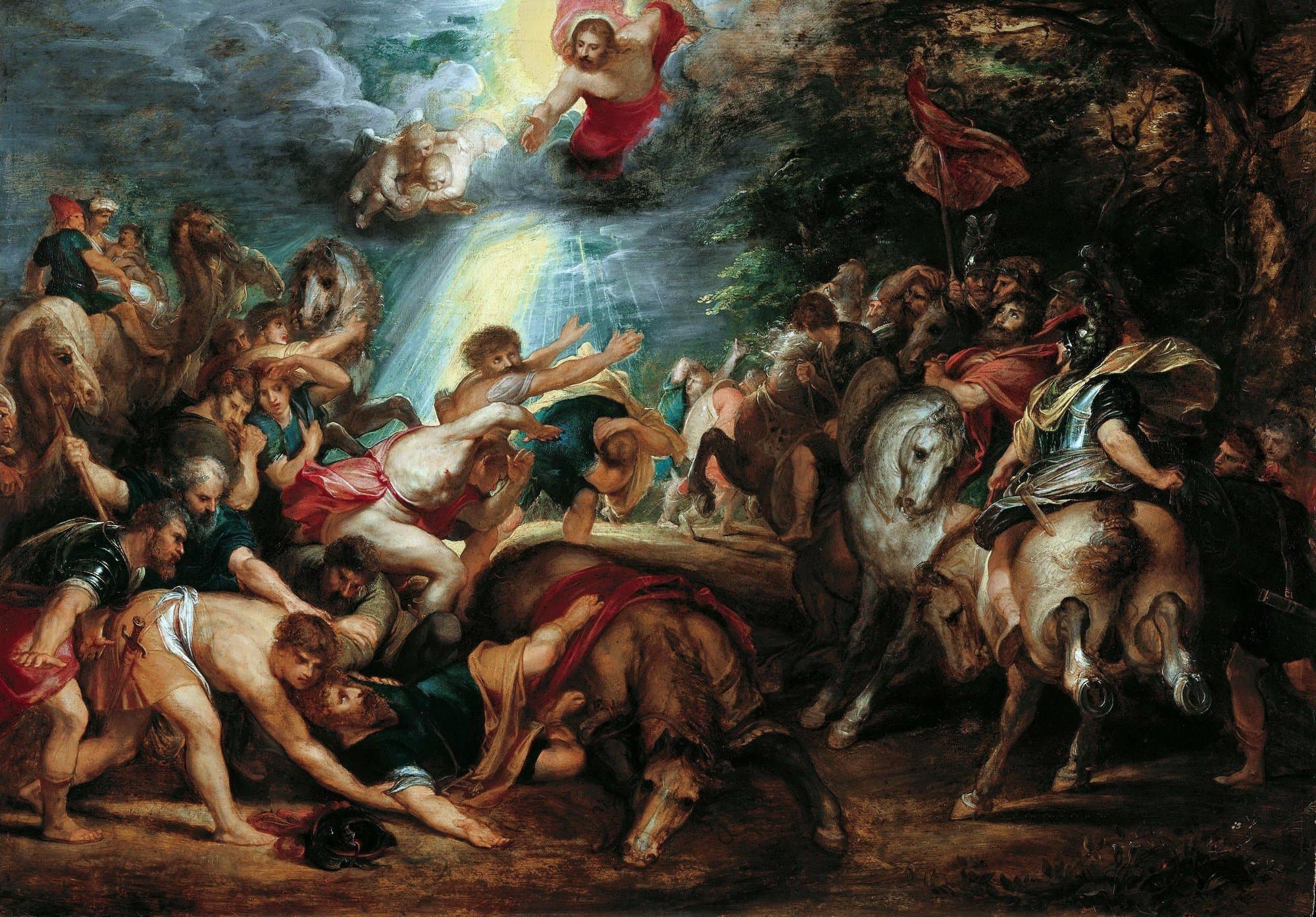
He fell to the ground and heard a voice say to him, “Saul, Saul, why do you persecute Me?”
- The word
- διώκω (diōkō), G1377
- First appears
- Matthew 5:10 “Blessed are those who are persecuted because of…”
Summary
Diōkō means to pursue, and the New Testament uses it both for hunting people down and for chasing a goal. Its noun diōgmós names persecution itself. Mártys means a witness, one who tells what he has seen, in a court or before the world. Because many who bore witness to Christ were killed for it, the church came to use mártys for one who dies for the faith.
- Jesus told Saul on the road to Damascus that Saul was persecuting Him.
- The apostles' task in Acts is to be witnesses of the risen Christ (Acts 1:8 and Acts 1:22).
- Stephen and Antipas are each called a witness of Christ in the verse that tells of his death.
Three Greek Words
Two Greek words carry most of what the New Testament says about persecution and testimony. Diōkō is a verb of pursuit, used for a hunter and for a runner, and mártys names a witness.
This study asks what diōkō, diōgmós and mártys mean, and how the third of them came to name those killed for their faith. It gives the uses of each word by sense, follows the verb through the life of Paul, and sets out where readers differ on when the later sense began. It is the word study of the trial of persecution.
Jesus called the persecuted blessed in the last of the Beatitudes.
Where the Words Stand
Diōkō is the most frequent of the three words, and the Berean text renders it persecute in most of its verses.
| Word and sense | Verse | The Berean text |
|---|---|---|
| Diōkō (G1377), verb, 45 uses in 44 verses, rendered persecute in 30 of them | ||
| To persecute | John 15:20 | If they persecuted Me, they will persecute you as well; if they kept My word, they will keep yours as well. |
| To persecute | Acts 22:4 | I persecuted this Way even to the death, detaining both men and women and throwing them into prison, |
| To persecute | 1 Corinthians 15:9 | For I am the least of the apostles and am unworthy to be called an apostle, because I persecuted the church of God. |
| To persecute | Galatians 1:13 | For you have heard of my former way of life in Judaism, how severely I persecuted the church of God and tried to destroy it. |
| Diōkō (G1377), rendered pursue, press on, chase after or practice in the other 14 verses | ||
| To practise | Romans 12:13 | Share with the saints who are in need. Practice hospitality. |
| To pursue | Romans 14:19 | So then, let us pursue what leads to peace and to mutual edification. |
| To pursue | 1 Timothy 6:11 | But you, O man of God, flee from these things and pursue righteousness, godliness, faith, love, perseverance, and gentleness. |
| To pursue | 1 Peter 3:11 | He must turn from evil and do good; he must seek peace and pursue it. |
| Diōgmós (G1375), noun, 10 uses in 9 verses | ||
| Persecution | Matthew 13:21 | But since he has no root, he remains for only a season. When trouble or persecution comes because of the word, he quickly falls away. |
| Persecution | Acts 8:1 | On that day a great persecution broke out against the church in Jerusalem, and all except the apostles were scattered throughout Judea and Samaria. |
| Persecution | Romans 8:35 | Who shall separate us from the love of Christ? Shall trouble or distress or persecution or famine or nakedness or danger or sword? |
| Mártys (G3144), noun, 35 uses in 35 verses | ||
| A witness at law | Hebrews 10:28 | Anyone who rejected the law of Moses died without mercy on the testimony of two or three witnesses. |
| A witness of the risen Christ | Acts 1:22 | For one of these must become a witness with us of His resurrection. |
| A witness of the risen Christ | Luke 24:48 | You are witnesses of these things. |
To practise, To pursue, To pursue, To pursue, Diōgmós (G1375), noun, 10 uses in 9 verses, Persecution, Persecution, Persecution and 4 more
The Persecutor Who Pressed On
Acts and the letter to the Philippians show the verb in Paul's own life.
Saul was breathing out murderous threats against the disciples of the Lord when he set out for Damascus to bring them back as prisoners (Acts 9:1 to 2). John Chrysostom drew the lesson of the question Jesus asked him, "Thus also Paul persecuted Him, in persecuting them that are His".
as to zeal, persecuting the church; as to righteousness in the law, faultless.The participle here is diōkō, and Paul uses the same verb again in Philippians 3:12.
I press on toward the goal to win the prize of God’s heavenly calling in Christ Jesus.This is the second of the two uses of diōkō in Philippians 3:12 to 14, and it describes the rest of Paul's life.
John Chrysostom, preaching on Philippians 3:12, noticed that Paul chose the stronger verb of the chase over the plain verb to run, "For you know with what eagerness a man pursues."
A Witness in Court and in Acts
Mártys began as a word of the law court and became the word for those who saw the risen Christ.
In Matthew 18:16 Jesus applies the rule that every matter must be established by two or three witnesses, and at His trial the high priest asked why any more witnesses were needed (Matthew 26:65). Joseph Henry Thayer's Greek-English Lexicon of 1889 sorts the word's uses into a legal sense and a historical sense, the second for an eyewitness.
Peter told the crowd at Pentecost that God had raised Jesus, "to which we are all witnesses" (Acts 2:32). The risen Jesus appointed Paul "as a servant and as a witness of what you have seen from Me" (Acts 26:16).
Witnesses Who Died
Three verses join the word to a death, and the church's later word grew from them.
Paul recalled "the blood of Your witness Stephen" (Acts 22:20). Christ named "My faithful witness Antipas", who "was killed among you" (Revelation 2:13), and John saw a woman "drunk with the blood of the saints and witnesses for Jesus" (Revelation 17:6).
Of the second man Adam Clarke wrote, "Who this Antipas was we cannot tell." Scripture names him once.
The King James Version renders mártys martyr in these three verses, "thy martyr Stephen", "Antipas was my faithful martyr" and "the martyrs of Jesus". Thayer's lexicon gives the same three verses a sense of their own, for those "who after his example have proved the strength and genuineness of their faith in Christ by undergoing a violent death".
Early Christian readers took the blood of Babylon's drunkenness as the blood of martyrs.
“When great Babylon likewise is represented as drunk with the blood of the saints, doubtless the supplies needful for her drunkenness are furnished by the cups of martyrdoms; and what suffering the fear of martyrdoms will entail, is in like manner shown.”
Tertullian · Scorpiace · on Revelation 17:6Patristic
The church of Smyrna wrote a letter on the death of its bishop Polycarp. It says he put an end to the persecution, "having, as it were, set a seal upon it by his martyrdom".
A Later Sense Read Back
Readers differ on when mártys first took the sense martyr.
Mártys in the lettersRomans 1:9, Philippians 1:8, 1 Timothy 6:12
The picture of the chaseAlbert Barnes, on Matthew 5:10
The verses that use diōkō for practising hospitality or pursuing peace carry the chase without the enemy. Albert Barnes gave the picture on Matthew 5:10, "To persecute means literally to pursue; follow after, as one does a flying enemy."
When Witness Came to Mean Martyr
Readers differ on whether the sense of martyr stands in the New Testament itself.
Already in the New TestamentMaurice Hassett, 1910
Maurice Hassett wrote the article on the martyr in the Catholic Encyclopedia of 1910. He held that within the apostles' lifetime a witness of Christ was one who might die for his testimony. He read the word in that full sense when John uses it of Antipas.
The strongest objection is that Acts 22:20 and Revelation 2:13 read plainly with witness, as the Berean text renders them, so the sentence supplies the death and the noun keeps its sense.
A sense the second century madeG. W. Bowersock, Martyrdom and Rome, 1995
G. W. Bowersock, in Martyrdom and Rome, tied the new sense to the Roman world and wrote that without Rome "a martys would have remained what he had always been", a witness only.
The strongest objection is Revelation 2:13, which already gives the title faithful witness to a man killed in a city where the church held fast to Christ's name.
Surrounded by Witnesses
One chapter of Hebrews sets both words before a church that had suffered.
Therefore, since we are surrounded by such a great cloud of witnesses, let us throw off every encumbrance and the sin that so easily entangles, and let us run with endurance the race set out for us.The writer sets the witnesses of faith around the church as it runs, and the word for them is mártys.
The same chapter commands, "Pursue peace with everyone, as well as holiness" (Hebrews 12:14), with the verb that elsewhere names persecution.
In 2 Timothy 3:12 Paul puts the same verb in the passive and in the future tense.
Sources
Scripture is the Berean Standard Bible.
- The Holy Bible, King James Version (1611)
- STEP Bible, the Brief lexicon of Extended Strongs for Greek based on Abbott-Smith (1922), Tyndale House, Cambridge, CC BY 4.0, with Strong's definitions.
- STEP Bible, the Translators Amalgamated Greek New Testament (TAGNT), Tyndale House, Cambridge, CC BY 4.0.
- Joseph Henry Thayer, A Greek-English Lexicon of the New Testament (1889), the entry μάρτυς.
- The Martyrdom of Polycarp, translated by Alexander Roberts and James Donaldson, Ante-Nicene Fathers, volume 1 (Buffalo, Christian Literature Publishing Co., 1885)
- Maurice Hassett, "Martyr", The Catholic Encyclopedia, volume 9 (New York, Robert Appleton Company, 1910)
- G. W. Bowersock, Martyrdom and Rome (Cambridge, Cambridge University Press, 1995), page 73, as quoted in the review of the book in Scripta Classica Israelica.
- Tertullian, Scorpiace, on Revelation 17:6.
- John Chrysostom, Homilies on Philippians, Homily 11, on Philippians 3:12.
- John Chrysostom, Homilies on Matthew, Homily 88.
- Albert Barnes, Notes, Explanatory and Practical (1832 to 1869), on Matthew 5:10.
- Adam Clarke, Commentary on the Bible (1832), on Revelation 2:13.
Keep Studying
Read it1
In this trial4
People and groups8