
Place
Damascus
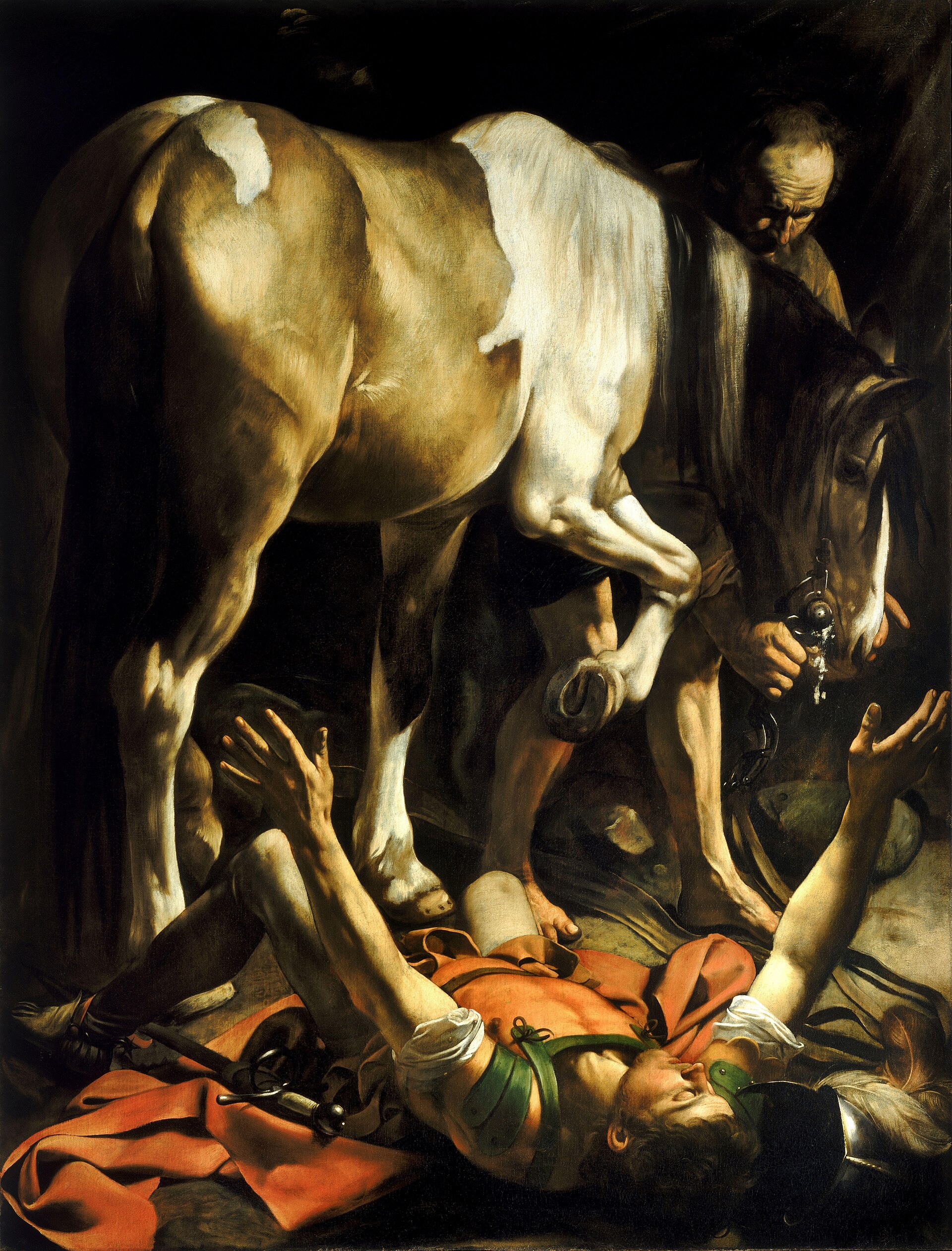
Caravaggio, Conversion on the Way to Damascus (c. 1600-01). Public domain, via Wikimedia Commons.
Summary
The Syrian city Saul was travelling to with letters of arrest when the light stopped him on the road; he entered it blind and left it preaching.
- Damascus stands behind Abram's heir in Genesis and is still a working city with synagogues when Saul rides for it.
- For two centuries it was the capital of Aram, Israel's hardest neighbour, and the home of Naaman and of Hazael.
- Assyria took the city in 732 BC, and Ahaz copied the altar he saw there into the temple at Jerusalem.
- Saul of Tarsus went down on the road outside it, entered blind, and left it preaching that Jesus is the Son of God.
- The oldest known mention of David outside the Bible was written by a king of Damascus.
On this page
In Scripture
- Verses
- 55
- Books
- 15
Near Damascus
- Mount Hermon44 km · 27 mi W
- Dan68 km · 42 mi SW
- Capernaum99 km · 61 mi SW
- Sea of Galilee104 km · 64 mi SW
- Riblah104 km · 64 mi N
Straight-line distances, computed from the gazetteer coordinates.
Where it is
the country around it
- Coordinates
- 33.5193° N, 36.3135° Eopen the Atlas →
- Region
- Syria
- Kind of place
- City
- Located: the gazetteer fixes one site
Not located: The Temple, Assyria, Eden. The gazetteer records no location for them, so they are not marked.
Why Damascus matters
What has been found
the evidence, and where it is disputed
The road to Damascus, and the street called Straight
Acts 9:1 to 9:25, in the order it happens
Read Acts 9:1 to 9:25, in the order it happens
- Saul asks for the lettersActs 9:1Meanwhile, Saul was still breathing out murderous threats against the disciples of the Lord. He approached the high priest
- Letters to the synagogues in DamascusActs 9:2and requested letters to the synagogues in Damascus, so that if he found any men or women belonging to the Way, he could bring them as prisoners to Jerusalem.
- The light, as he draws near the cityActs 9:3As Saul drew near to Damascus on his journey, suddenly a light from heaven flashed around him.
- The voice names itselfActs 9:4He fell to the ground and heard a voice say to him, “Saul, Saul, why do you persecute Me?”
- Led by the hand into DamascusActs 9:8Saul got up from the ground, but when he opened his eyes he could not see a thing. So they led him by the hand into Damascus.
- The house of Judas on Straight StreetActs 9:11“Get up!” the Lord told him. “Go to the house of Judas on Straight Street and ask for a man from Tarsus named Saul, for he is praying.
- Ananias calls him brotherActs 9:17So Ananias went to the house, and when he arrived, he placed his hands on Saul. “Brother Saul,” he said, “the Lord Jesus, who appeared to you on the road as you were coming here, has sent me so that you may see again and be filled with the Holy Spirit.”
- The scales, and the baptismActs 9:18At that instant, something like scales fell from Saul’s eyes, and his sight was restored. He got up and was baptized,
- Preaching in the synagogues he came to raidActs 9:20Saul promptly began to proclaim Jesus in the synagogues, declaring, “He is the Son of God.”
- Down the wall in a basketActs 9:25One night, however, his disciples took him and lowered him in a basket through a window in the wall.
Acts tells this story three times and Paul tells it twice more in his own letters, and the full study sets the accounts side by side. One painting of the road is shown on this page. The site holds no image of the street called Straight, the wall, the basket, Ananias or Naaman, so nothing else is shown here rather than filling the space with scenes from somewhere else.
The Damascus Road: the full studyWhat happened here, in order
in the order the canon tells it
- Abram's night march reaches Hobah, north of DamascusGenesis 14:15During the night, Abram divided his forces and routed Chedorlaomer’s army, pursuing them as far as Hobah, north of Damascus.
- Eliezer of Damascus stands to inherit Abram's houseGenesis 15:2But Abram replied, “O Lord GOD, what can You give me, since I remain childless, and the heir of my house is Eliezer of Damascus?”
- David garrisons Aram of Damascus2 Samuel 8:6Then he placed garrisons in Aram of Damascus, and the Arameans became subject to David and brought him tribute. So the LORD made David victorious wherever he went.
- Rezon seizes the city in Solomon's reign1 Kings 11:24and had gathered men to himself. When David killed the Zobaites, Rezon captained a band of raiders and went to Damascus, where they settled and gained control.
- Asa empties the temple treasury to buy Ben-hadad1 Kings 15:18So Asa withdrew all the silver and gold that remained in the treasuries of the house of the LORD and the royal palace. He entrusted it to his servants and sent them with this message to Ben-hadad son of Tabrimmon, the son of Hezion king of Aram, who was ruling in Damascus:
- Ahab gains trading quarters inside Damascus1 Kings 20:34Ben-hadad said to him, “I will restore the cities my father took from your father; you may set up your own marketplaces in Damascus, as my father did in Samaria.” “By this treaty I release you,” Ahab replied. So he made a treaty with him and sent him away.
- Naaman argues for the rivers of Damascus2 Kings 5:12Are not the Abanah and Pharpar, the rivers of Damascus, better than all the waters of Israel? Could I not have washed in them and been cleansed?” So he turned and went away in a rage.
- Elisha comes to Damascus while Ben-hadad is sick2 Kings 8:7Then Elisha came to Damascus while Ben-hadad king of Aram was sick, and the king was told, “The man of God has come here.”
- Hazael takes the throne2 Kings 8:15But the next day Hazael took a thick cloth, dipped it in water, and spread it over the king’s face. So Ben-hadad died, and Hazael reigned in his place.
- Assyria captures the city in 732 BC2 Kings 16:9So the king of Assyria responded to him, marched up to Damascus, and captured it. He took its people to Kir as captives and put Rezin to death.
- Ahaz sees the altar and sends home the plans2 Kings 16:10Then King Ahaz went to Damascus to meet Tiglath-pileser king of Assyria. On seeing the altar in Damascus, King Ahaz sent Uriah the priest a model of the altar and complete plans for its construction.
- Ahaz sacrifices to the gods of Damascus2 Chronicles 28:23Since Damascus had defeated him, he sacrificed to their gods and said, “Because the gods of the kings of Aram have helped them, I will sacrifice to them that they may help me.” But these gods were the downfall of Ahaz and of all Israel.
- The head of Aram is only DamascusIsaiah 7:8For the head of Aram is Damascus, and the head of Damascus is Rezin. Within sixty-five years Ephraim will be shattered as a people.
- The burden against DamascusIsaiah 17:1This is the burden against Damascus: “Behold, Damascus is no longer a city; it has become a heap of ruins.
- Fire on the walls of DamascusJeremiah 49:27“I will set fire to the walls of Damascus; it will consume the fortresses of Ben-hadad.”
- The gates broken, the people exiled to KirAmos 1:5I will break down the gates of Damascus; I will cut off the ruler of the Valley of Aven and the one who wields the scepter in Beth-eden. The people of Aram will be exiled to Kir,” says the LORD.
- Damascus trades wine from Helbon with TyreEzekiel 27:18Because of your many products and your great wealth of goods, Damascus traded with you wine from Helbon, wool from Zahar,
- Saul asks for letters to the city's synagoguesActs 9:2and requested letters to the synagogues in Damascus, so that if he found any men or women belonging to the Way, he could bring them as prisoners to Jerusalem.
- Saul proves in Damascus that Jesus is the ChristActs 9:22But Saul was empowered all the more, and he confounded the Jews living in Damascus by proving that Jesus is the Christ.
- Paul tells the escape himself2 Corinthians 11:33But I was lowered in a basket through a window in the wall and escaped his grasp.
Where it points
The voices
each quoted from the work named
HOW MARVELLOUS the condescension which induced the Saviour to take notice of such a wretch as Saul! Enthroned in the highest heavens, amidst the eternal melodies of the redeemed, and the seraphic sonnets of the cherubim and all the angelic hosts, it was strange that the Saviour should stoop himself from his dignity to speak to a persecutor.
Letters to Damascus to the synagogues - Damascus, anciently called דמסק Damask, and דרמסק Darmask, was once the metropolis of all Syria. It was situated at fifty miles’ distance from the sea; from which it is separated by lofty mountains. It is washed by two rivers, Amara or Abara, which ran through it, and Pharpar, called by the Greeks Chrysorrhoas, the golden stream, which ran on the outside of its walls. It is one of the most ancient cities in the world, for it existed in the time of Abraham, Gen 14:15; and how long before is not known.
Into the street which is called Straight - This street extends now from the eastern to the western gate, about three miles, crossing the whole city and suburbs in a direct line. Near the eastern gate is a house, said to be that of Judah, in which Paul lodged. There is in it a very small closet, where tradition reports that the apostle passed three days without food, until Ananias restored him to sight.
4 more teachers on these versesJamieson, Fausset & Brown · Albert Barnes · John Gill
Then the disciples . . . by night let him down--"through a window" (2Co 11:33). by the wall--Such overhanging windows in the walls of Eastern cities were common, and are to be seen in Damascus to this day.
governor--Greek, "Ethnarch": a Jewish officer to whom heathen rulers gave authority over Jews in large cities where they were numerous. He was in this case under Aretas, king of Arabia. Damascus was in a Roman province.
The Abana is the Barada, or true river of Damascus, which, rising in the anti-Libanus, flows westward from its foot and forms the oasis within which Damascus is placed. The Pharpar is usually identified with the Awaaj. Naaman thinks that, if washing is to cure him, his own rivers may serve the purpose. Their water was brighter, clearer, and colder than that of Jordan.
How is the city of praise not left,.... The city of Damascus, famous for its antiquity, its wealth and riches, strength and power; and with the Heathens for its devotion and superstition.
Damascus in Scripture
55 verses name it, in 15 books
Open a book to read its mentions here. Text: Berean Standard Bible.
Old TestamentNew Testamentsegment width = share of mentions
Old Testament12 books · 40 mentions
Genesis2 mentions
2 Samuel2 mentions
1 Kings4 mentions
- 1 Kings 11:24and had gathered men to himself. When David killed the Zobaites, Rezon captained a band of raiders and went to Damascus, where they settled and gained control.
- 1 Kings 15:18So Asa withdrew all the silver and gold that remained in the treasuries of the house of the LORD and the royal palace. He entrusted it to his servants and sent them with this message to Ben-hadad son of Tabrimmon, the son of Hezion king of Aram, who was ruling in Damascus:
- 1 Kings 19:15Then the LORD said to him, “Go back by the way you came, and go to the Desert of Damascus. When you arrive, you are to anoint Hazael as king over Aram.
- 1 Kings 20:34Ben-hadad said to him, “I will restore the cities my father took from your father; you may set up your own marketplaces in Damascus, as my father did in Samaria.” “By this treaty I release you,” Ahab replied. So he made a treaty with him and sent him away.
2 Kings8 mentions
- 2 Kings 5:12Are not the Abanah and Pharpar, the rivers of Damascus, better than all the waters of Israel? Could I not have washed in them and been cleansed?” So he turned and went away in a rage.
- 2 Kings 8:7Then Elisha came to Damascus while Ben-hadad king of Aram was sick, and the king was told, “The man of God has come here.”
- 2 Kings 8:9So Hazael went to meet Elisha, taking with him a gift of forty camel loads of every good thing from Damascus. And he went in and stood before him and said, “Your son Ben-hadad king of Aram has sent me to ask, ‘Will I recover from this illness?’”
- 2 Kings 14:28As for the rest of the acts of Jeroboam, along with all his accomplishments and might, and how he waged war and recovered both Damascus and Hamath for Israel from Judah, are they not written in the Book of the Chronicles of the Kings of Israel?
- 2 Kings 16:9So the king of Assyria responded to him, marched up to Damascus, and captured it. He took its people to Kir as captives and put Rezin to death.
- 2 Kings 16:10Then King Ahaz went to Damascus to meet Tiglath-pileser king of Assyria. On seeing the altar in Damascus, King Ahaz sent Uriah the priest a model of the altar and complete plans for its construction.
- 2 Kings 16:11And Uriah the priest built the altar according to all the instructions King Ahaz had sent from Damascus, and he completed it by the time King Ahaz had returned.
- 2 Kings 16:12When the king came back from Damascus and saw the altar, he approached it and presented offerings on it.
1 Chronicles2 mentions
- 1 Chronicles 18:5When the Arameans of Damascus came to help King Hadadezer of Zobah, David struck down twenty-two thousand men.
- 1 Chronicles 18:6Then he placed garrisons in Aram of Damascus, and the Arameans became subject to David and brought him tribute. So the LORD made David victorious wherever he went.
2 Chronicles4 mentions
- 2 Chronicles 16:2So Asa withdrew the silver and gold from the treasuries of the house of the LORD and the royal palace, and he sent it with this message to Ben-hadad king of Aram, who was ruling in Damascus:
- 2 Chronicles 24:23In the spring, the army of Aram went to war against Joash. They entered Judah and Jerusalem and destroyed all the leaders of the people, and they sent all the plunder to their king in Damascus.
- 2 Chronicles 28:5So the LORD his God delivered Ahaz into the hand of the king of Aram, who attacked him and took many captives to Damascus. Ahaz was also delivered into the hand of the king of Israel, who struck him with great force.
- 2 Chronicles 28:23Since Damascus had defeated him, he sacrificed to their gods and said, “Because the gods of the kings of Aram have helped them, I will sacrifice to them that they may help me.” But these gods were the downfall of Ahaz and of all Israel.
Song of Solomon1 mention
Isaiah5 mentions
- Isaiah 7:8For the head of Aram is Damascus, and the head of Damascus is Rezin. Within sixty-five years Ephraim will be shattered as a people.
- Isaiah 8:4For before the boy knows how to cry ‘Father’ or ‘Mother,’ the wealth of Damascus and the plunder of Samaria will be carried off by the king of Assyria.”
- Isaiah 10:9“Is not Calno like Carchemish? Is not Hamath like Arpad? Is not Samaria like Damascus?
- Isaiah 17:1This is the burden against Damascus: “Behold, Damascus is no longer a city; it has become a heap of ruins.
- Isaiah 17:3The fortress will disappear from Ephraim, and the sovereignty from Damascus. The remnant of Aram will be like the splendor of the Israelites,” declares the LORD of Hosts.
Jeremiah3 mentions
- Jeremiah 49:23Concerning Damascus: “Hamath and Arpad are put to shame, for they have heard a bad report; they are agitated like the sea; their anxiety cannot be calmed.
- Jeremiah 49:24Damascus has become feeble; she has turned to flee. Panic has gripped her; anguish and pain have seized her like a woman in labor.
- Jeremiah 49:27“I will set fire to the walls of Damascus; it will consume the fortresses of Ben-hadad.”
Ezekiel5 mentions
- Ezekiel 27:18Because of your many products and your great wealth of goods, Damascus traded with you wine from Helbon, wool from Zahar,
- Ezekiel 47:16On the north side it will extend from the Great Sea by way of Hethlon through Lebo-hamath to Zedad, Berothah, and Sibraim (which is on the border between Damascus and Hamath), as far as Hazer-hatticon, which is on the border of Hauran.
- Ezekiel 47:17So the border will run from the Sea to Hazar-enan, along the northern border of Damascus, with the territory of Hamath to the north. This will be the northern boundary.
- Ezekiel 47:18On the east side the border will run between Hauran and Damascus, along the Jordan between Gilead and the land of Israel, to the Eastern Sea and as far as Tamar. This will be the eastern boundary.
- Ezekiel 48:1“Now these are the names of the tribes: At the northern frontier, Dan will have one portion bordering the road of Hethlon to Lebo-hamath and running on to Hazar-enan on the border of Damascus with Hamath to the north, and extending from the east side to the west side.
Amos3 mentions
- Amos 1:3This is what the LORD says: “For three transgressions of Damascus, even four, I will not revoke My judgment, because they threshed Gilead with sledges of iron.
- Amos 1:5I will break down the gates of Damascus; I will cut off the ruler of the Valley of Aven and the one who wields the scepter in Beth-eden. The people of Aram will be exiled to Kir,” says the LORD.
- Amos 5:27Therefore I will send you into exile beyond Damascus,” says the LORD, whose name is the God of Hosts.
New Testament3 books · 15 mentions
Acts13 mentions
- Acts 9:2and requested letters to the synagogues in Damascus, so that if he found any men or women belonging to the Way, he could bring them as prisoners to Jerusalem.
- Acts 9:3As Saul drew near to Damascus on his journey, suddenly a light from heaven flashed around him.
- Acts 9:8Saul got up from the ground, but when he opened his eyes he could not see a thing. So they led him by the hand into Damascus.
- Acts 9:10In Damascus there was a disciple named Ananias. The Lord spoke to him in a vision, “Ananias!” “Here I am, Lord,” he answered.
- Acts 9:19and after taking some food, he regained his strength. And he spent several days with the disciples in Damascus.
- Acts 9:22But Saul was empowered all the more, and he confounded the Jews living in Damascus by proving that Jesus is the Christ.
- Acts 9:27Then Barnabas brought him to the apostles and described how Saul had seen the Lord, who spoke to him on the road to Damascus, and how Saul had spoken boldly in that city in the name of Jesus.
- Acts 22:5as the high priest and the whole Council can testify about me. I even obtained letters from them to their brothers in Damascus, and I was on my way to apprehend these people and bring them to Jerusalem to be punished.
5 further mentions in Acts, read them in the book.
2 Corinthians1 mention
The account
Read the account as one telling
Damascus is named in writing long before the kingdom years. A name usually read Timasqu appears in the topographical list of Thutmose III at Karnak in the fifteenth century BC, and the Amarna letters of the fourteenth century BC name Dimasqu in the land of Upi. Genesis puts the city on Abram's night march after Chedorlaomer and puts a Damascene, Eliezer, inside his household. Josephus, in the Antiquities of the Jews, quotes Nicolaus of Damascus, a court historian of the first century BC, to the effect that Abram reigned in the city and that a village nearby still carried his name. Genesis says nothing of the kind, and the page gives the tradition with its source and leaves it there.
David fought the Arameans of Damascus when they came to help Hadadezer of Zobah, and he placed garrisons in Aram of Damascus so that the city paid him tribute. That arrangement did not outlive Solomon. Rezon son of Eliada, an officer who had escaped David's defeat of Zobah, gathered raiders, took Damascus and ruled there, and 1 Kings 11 names him as an adversary God raised up against Solomon.
For the next two centuries Damascus is the capital of Aram and Israel's constant enemy. Ben-hadad son of Tabrimmon took Asa's silver and gold and broke his treaty with Baasha. A later Ben-hadad besieged Samaria with thirty-two kings, lost, and bought his life with a treaty that gave Ahab trading quarters inside Damascus, so the two capitals traded as well as fought. Outside the Bible, the Kurkh Monolith of Shalmaneser III places a king of Damascus and Ahab of Israel in the same coalition at Qarqar in 853 BC.
Elisha is the only prophet Scripture records walking into the city. He went there while Ben-hadad lay sick, and he wept in front of the officer sent to ask whether the king would recover, because he knew what that officer would do to Israel. The next day Hazael spread a wet cloth over his king's face and reigned in his place. Before that, Naaman had gone the other way, down from Damascus to a muddy river in Israel, and had come up clean.
In the days of Ahaz, Rezin of Damascus and Pekah of Israel marched on Jerusalem together. Isaiah told Ahaz that the head of Aram was only Damascus and the head of Damascus was only a man, and that the two kings frightening him would not stand. Ahaz did not believe it. He took the silver and gold of the house of the LORD and sent it to Tiglath-pileser king of Assyria, asking to be saved.
- 732 BC
Assyria came, and in 732 BC the city fell. 2 Kings 16 gives the outcome in a sentence: Damascus captured, the people carried to Kir, Rezin put to death. Ahaz travelled up to meet the Assyrian king in the fallen city, saw an altar he admired, and sent Uriah the priest a model and full plans, so that when he came home the copy was standing. Chronicles records his own reason for sacrificing to the gods of Aram, that those gods had helped Aram, and calls it his downfall.
- 732 BC
After 732 BC Damascus is an Assyrian provincial centre and never again an independent kingdom in the biblical period. The prophets keep naming it. Isaiah's burden calls it a heap of ruins. Jeremiah sets fire to its walls. Amos charges it with threshing Gilead and sends its people into exile at Kir, which is exactly where 2 Kings says they went. Ezekiel has it trading wine from Helbon with Tyre, and later sets the restored land's northern border along it. Zechariah opens a burden with Hadrach and Damascus, and that passage runs on to the king who comes lowly and riding on a donkey.
- 63 BC
Pompey's settlement of Syria in 64 and 63 BC brought the city into the Roman sphere. The Hellenistic and Roman grid gave the old city a long east-west main street, the decumanus maximus, and that is the street Acts 9:11 calls Straight. By the first century the city held a large Jewish population and more than one synagogue, which is why Saul asked the high priest for letters addressed to them. A Nabataean community lived there too, under a ruler the Nabataeans called an ethnarch.
Common questions
Where was the road to Damascus, and how long was the ride?
Scripture never names the route. Jerusalem to Damascus is roughly 220 kilometres, about 135 miles by the ancient roads, which is close to a week's travel on foot. Luke says only that Saul was drawing near the city when the light came, and Paul twice adds that it was about noon.
The spot shown outside the city today is a tradition. The text gives no location closer than near Damascus.
Is the street called Straight still there?
In line, if not in level. Roman Damascus had a long east-west main street, the decumanus maximus, running from the western gate to the eastern one, and that is the street Acts 9:11 names. Its line still runs through the old city, above the Roman paving, and the Roman east gate still stands.
Albert Barnes, writing in the nineteenth century, described the street running about three miles from gate to gate counting the suburbs, which is longer than the colonnaded Roman street itself.
Who was the ethnarch of Aretas, and does he date Paul's escape?
Readers differ; the positions are named
Aretas IV ruled Nabataea from 9 BC to AD 40, and Paul says his ethnarch secured the city in order to arrest him. One reading, stated at length in Emil Schürer's history, is that Damascus was under Nabataean control at that moment, argued from a gap in the city's Roman imperial coinage and from the redrawing of eastern client territories under Caligula. Another, argued by E. A. Knauf in 1983 and widely followed since, is that the ethnarch led the resident Nabataean community inside a city that stayed Roman.
Either way Aretas died in AD 40, which sets an outer limit. With the three years of Galatians 1:18 counted back, the escape is usually placed in AD 37 to 39 and the conversion in AD 33 to 35. This page names the positions and does not settle between them.
Is Damascus really the oldest city in the world?
Readers differ; the positions are named
The claim is made for Damascus, and also for Jericho, Byblos and Aleppo, and it turns on whether you are counting a settlement, a city, or occupation with no break in it. For Damascus, the city is named in Egyptian and Amarna texts of the second millennium BC, which is early and firm evidence.
What is missing is a published stratigraphic sequence under the old city, because people have never stopped living on top of it. Damascus holds one of the strongest claims on the list, and the evidence for it is textual rather than dug.
Isaiah 17 says Damascus will be a heap of ruins. What does that mean?
Readers differ; the positions are named
The oracle is addressed to the Damascus of Isaiah's own day, the capital of Aram allied with Ephraim against Judah. Most readers, Calvin and Barnes among them, take it as fulfilled when Tiglath-pileser III took the city in 732 BC, killed Rezin and deported the people to Kir, which is what 2 Kings 16:9 reports and what Amos 1:5 had already named. Others hold that parts of the chapter, and especially its closing verses, look beyond that event.
The page gives both readings and stops there. Scripture itself keeps naming the city after Isaiah, in Jeremiah, Amos, Ezekiel and Zechariah, and Acts 9 finds it full of people.
Why did Naaman say the rivers of Damascus were better?
Because in one respect they were. The Abanah and the Pharpar run clear and cold out of the mountains and make the oasis the city sits in, and the lower Jordan is a muddy river.
Naaman had pictured a prophet coming out to wave a hand over him, and what he got was an errand. His own servants pointed out that he would have done something great without complaining, and when he obeyed the small thing he was clean.
Does anything outside the Bible mention the kings of Damascus?
Yes, and one of those texts carries the earliest known mention of David outside Scripture. The Kurkh Monolith of Shalmaneser III, dated 853 BC, names a king of Damascus and Ahab of Israel in the same coalition at Qarqar. The Zakkur stele from Tell Afis names Bar-Hadad son of Hazael, which is the succession 2 Kings 13 gives.
The Tel Dan stele, found in 1993 and 1994 and published by Avraham Biran and Joseph Naveh, has an Aramean king, most often identified as Hazael of Damascus, boast that he killed a king of Israel and a king of the House of David. That reading of the four consonants has been contested, and the case on both sides is set out further up this page.
Where did Paul go after Damascus, and do Acts and Galatians agree?
Acts moves from the escape to Jerusalem in a sentence. Paul fills the gap himself: he went into Arabia, came back to Damascus, and only after three years went up to Jerusalem to see Cephas for fifteen days.
Luke's line that many days had passed is the room those three years occupy. The two accounts tell the same stretch of time at different speeds, and Paul's is the detailed one.
Sources cited
- OpenBible.info Bible Geocoding: Damascusread 2026-08-20The coordinates on this page. Used under CC-BY with attribution to OpenBible.info.
- Caravaggio, Conversion on the Way to Damascus (c. 1600-01)The hero painting on this page. Public domain, via Wikimedia Commons.
- Avraham Biran and Joseph Naveh, Israel Exploration Journal 43 (1993) and 45 (1995)The excavation and first publication of the Tel Dan fragments and the reading of bytdwd.
- Henri Pognon, Inscriptions sémitiques de la Syrie, de la Mésopotamie et de la région de Mossoul (Paris, 1907-1908)The Zakkur stele from Tell Afis, which names Bar-Hadad son of Hazael and the place Hadrach.
- Daniel David Luckenbill, Ancient Records of Assyria and Babylonia (Chicago, 1926)The Kurkh Monolith and the annals of Shalmaneser III. Public domain.
- Hayim Tadmor, The Inscriptions of Tiglath-pileser III, King of Assyria (Jerusalem, 1994)The critical edition for the 733 to 732 BC campaign against Damascus.
- Morton Cogan, Imperialism and Religion (1974), and John McKay, Religion in Judah under the Assyrians (1973)The counter-reading of Ahaz's altar, against the older view that Assyria imposed its cult on vassals.
- Emil Schürer, A History of the Jewish People in the Time of Jesus ChristThe older reading that Damascus was under Nabataean control at the time of Paul's escape. Public domain.
- E. A. Knauf, "Zum Ethnarchen des Aretas 2 Kor 11:32", Zeitschrift für die neutestamentliche Wissenschaft 74 (1983)The reading that the ethnarch led the resident Nabataean community. Modern, cited only.
- Rainer Riesner, Paul's Early Period: Chronology, Mission Strategy, Theology (Eerdmans, 1998)The chronology behind the AD 37 to 39 range for the escape. Modern, cited only.
- Flavius Josephus, Antiquities of the Jews 1.7.2 and Jewish War, books 2 and 7Nicolaus of Damascus on Abram, and the two figures Josephus gives for the Jews of Damascus in AD 66. Whiston translation, public domain.
- Solomon Schechter, Documents of Jewish Sectaries, vol. 1: Fragments of a Zadokite Work (Cambridge, 1910)The first publication of the Damascus Document from the Cairo Genizah. Public domain.
- Irenaeus, Against Heresies, book 3 (c. AD 180)The early citation of the Damascus preaching as apostolic fact. Public domain.
- John Chrysostom, Homilies on the Acts of the Apostles, Homily 20The reading of the scales as a double blindness removed. Public domain.
- Charles H. Spurgeon, The New Park Street Pulpit, Sermon No. 202Public domain, CCEL edition.
- Adam Clarke, Commentary on the Bible (1832); Albert Barnes, Notes, Explanatory and Practical, on the Old and New Testaments; Jamieson, Fausset & Brown, Commentary Critical and Explanatory on the Whole Bible (1871); John Gill, Exposition of the Old TestamentThe public domain commentators quoted on this page. CCEL editions.
Keep studying
On this page
Studies7
Doorway2
Keep this page