
Skip to content
mannafest.faith
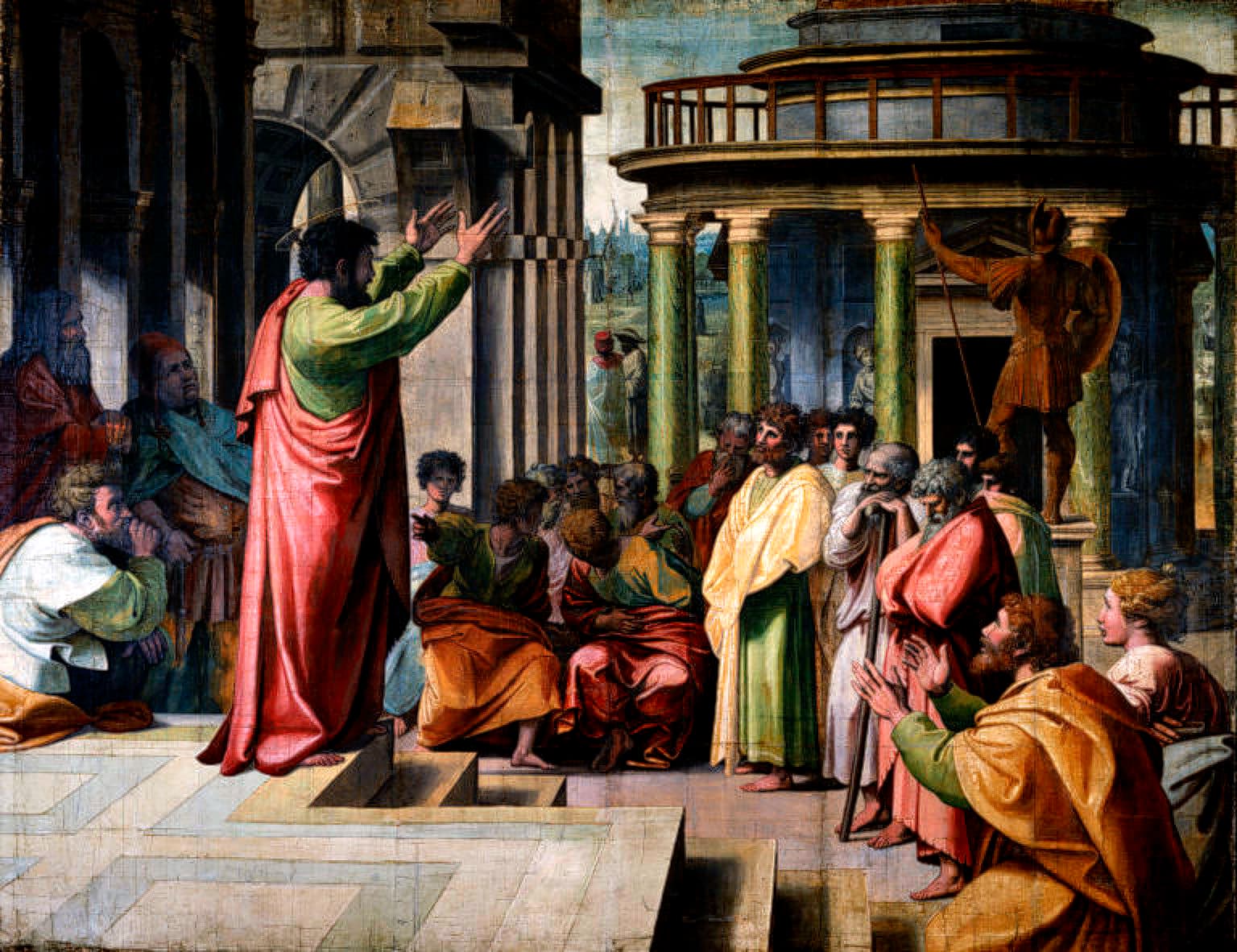
St Paul Preaching in Athens

St Paul Preaching in Athens, Raphael, 1515. Public domain.

The Great Cloud of Witnesses, era 1 of 10 · Church history · Featured Study

The Apostolic Age

This is the church's first breath. The men and women who had walked with Jesus took His message out of Jerusalem, and within one lifetime it reached the capital of the world.

Span
to AD 100
Boundary
The span closes at about AD 100.

The church started in Jerusalem.

Summary

Inside seventy years it had reached most cities of the east, and Rome. On the dating most conservative scholars hold, every book of the New Testament was written inside that span. Other scholars date four groups later: 2 Peter, the Pastoral Epistles, and John with his letters and Revelation.

  • The Spirit fell at Pentecost in Jerusalem, about AD 30.
  • One firm date: a stone at Delphi puts Paul in Corinth about AD 51.
  • About AD 49 the leaders in Jerusalem ruled that Gentiles need not be circumcised.
  • The letters came first. The Gospels were written later, inside the same span.
  • Whether every New Testament book fits inside the span is a dating question scholars divide on, and the page says which books are argued either way.
  • Rome burned in AD 64 and Nero blamed the Christians. Jerusalem fell in AD 70.

The era's own voice

Why he wrote it: Rome wrote to Corinth because the Corinthian church had deposed its own elders, and the letter argues for putting them back. The passage on Peter and Paul is offered as a recent example of where envy leads, not as a martyr story told for its own sake.

What else says so: Eusebius, Ecclesiastical History 3.16, written about AD 325, names the letter and its occasion. Nothing else surviving describes the deaths of Peter and Paul this early. The usual date of about AD 96 rests on Eusebius rather than on the letter, which carries no date of its own, and some scholars argue it was written before AD 70.

“Let us set before our eyes the illustrious apostles. Peter, through unrighteous envy, endured not one or two, but numerous labours; and when he had at length suffered martyrdom, departed to the place of glory due to him. Owing to envy, Paul also obtained the reward of patient endurance, after being seven times thrown into captivity, compelled to flee, and stoned.”

Clement of Rome · Clement of Rome, 1 Clement 5 (written c. AD 96), translated by Roberts and Donaldson, Ante-Nicene Fathers vol. 1, 1885Patristic

The turning points

The era hangs on these moments, each with a document a reader can open.

  1. c. AD 30Pentecost in JerusalemEvery later claim of the church rests on what began that morning, and Luke gives it as a public event in a crowded city rather than a private experience.Acts 2
  2. c. AD 49The Jerusalem CouncilIt settled that a Gentile did not have to become a Jew first, which is why the church spread as a movement of the nations and not a sect of Judaism.Acts 15, with Paul's own account in Galatians 2
  3. AD 51Paul before Gallio at CorinthIt is the one fixed date in the whole era: a stone naming Gallio's year of office anchors Paul's movements to the Roman calendar.The Delphi inscription of Claudius, printed in Sylloge Inscriptionum Graecarum 801D
  4. AD 64Nero blames the Christians for the fire at RomeA hostile Roman historian records that Christians existed in numbers at Rome and were punished as a group, and the pattern of the state as persecutor begins here.Tacitus, Annals 15.44, written about AD 116
  5. AD 70The temple fallsThe sacrificial system stopped, and the church's centre of gravity moved out of Jerusalem for good.Josephus, The Jewish War, Books 5 and 6, written about AD 75

The 5 turning points of The Apostolic Age, to AD 100, in order, each with the document that records it and why it earned its place.

The story

A believer in AD 60 had no New Testament. He had the Hebrew Scriptures in a synagogue scroll, whatever letter of Paul his own church happened to own, and the memory of people who had met Jesus. If he wanted to check a teaching he asked a man who had been there.

It begins in a rented upstairs room with about a hundred and twenty people waiting, because Jesus had told them to wait. At the feast of Pentecost, with Jerusalem crowded by pilgrims from every direction, the Spirit comes with a sound like wind and what looked like fire. Peter, the man who had denied he even knew Jesus a few weeks earlier, stands up in the street and preaches Him as risen Lord. About three thousand are baptized that day (Acts 2).

But you will receive power when the Holy Spirit comes upon you, and you will be My witnesses in Jerusalem, and in all Judea and Samaria, and to the ends of the earth.”
Acts 1:8BSB

The marching order Jesus gave before He left, Jerusalem, Judea, Samaria, the ends of the earth, and Acts is simply the story of that sentence coming true.

The first church was a Jerusalem church, and it looked Jewish. Believers kept meeting in the temple courts at the hours of prayer, then broke bread in one another's houses. They pooled money so that no one among them went without, and the apostles taught daily. Growth brought the first practical crisis almost at once: Greek-speaking widows were being missed in the food handouts, so seven men were appointed to run it, Stephen among them.

Stephen argued in the synagogues of the Greek-speaking Jews, lost no argument, and was dragged outside the walls and stoned. A young Pharisee named Saul kept the coats of the men who threw the rocks. The persecution that followed drove believers out of Jerusalem, and that scattering, meant to end the movement, is what spread it. Philip preached in Samaria and baptized a court official from Ethiopia on a desert road, and the message was suddenly outside Judea.

For we cannot stop speaking about what we have seen and heard.”
Acts 4:20BSB

Peter and John, ordered by the council to stop preaching, answer that they cannot help speaking about what they have seen and heard; that refusal is what most of these witnesses eventually died for.

The next barrier was bigger than geography. Peter, sent by a vision to the house of a Roman officer named Cornelius in Caesarea, watched the Spirit fall on Gentiles who had never been circumcised, and had no answer except to baptize them (Acts 10). In Antioch, believers started preaching to Greeks on purpose. The city gave the movement its nickname, "Christians," Christ-people, and it stuck, though at first it was probably not meant kindly.

Antioch also sent out the missionaries. Barnabas and Saul, with John Mark, sailed for Cyprus around AD 46 and then went inland through the Galatian towns. The pattern almost never varied: find the synagogue, preach Jesus from the Scriptures the audience already trusted, gather whoever believes: Jews first, then the Gentile "God-fearers" who hung around the edges of synagogue life. Paul was stoned at Lystra and left for dead, got up, and walked back into the city.

For what I received I passed on to you as of first importance: that Christ died for our sins according to the Scriptures,
1 Corinthians 15:3BSB

Paul hands on a summary he says he first received from believers before him, Christ died for our sins, which makes this the oldest statement of the faith we can put our hands on.

The roads and the sea lanes did the rest. Rome had spent a century building paved highways and clearing pirates out of the Mediterranean, and a traveler could cross from Jerusalem to Rome in a few weeks on one passport and one language, the common Greek that a Judean tentmaker and a Corinthian dockworker both spoke. Jewish communities were already settled in nearly every port and provincial capital, each with a synagogue, and each synagogue was a ready-made first audience. The gospel traveled the empire's own arteries.

Where it landed, it met in houses. There were no church buildings for a long time, believers gathered in a courtyard or a dining room, thirty or forty at most, around a shared meal. That is why the letters name so many hosts: Priscilla and Aquila, who moved from Rome to Corinth to Ephesus and carried a church with them each time; Lydia, a dealer in purple cloth at Philippi; Nympha in Colossae; Philemon. It also meant the movement had no headquarters to raid, you could arrest a household and the church down the street kept meeting.

I am not ashamed of the gospel, because it is the power of God for salvation to everyone who believes, first to the Jew, then to the Greek.
Romans 1:16BSB

The gospel is for the Jew first and also for the Greek, the conviction behind the Jerusalem Council and behind every road Paul walked.

The Gentile turn forced a decision no one could dodge, and around AD 49 the leaders met in Jerusalem to make it. The question was whether a Greek had to take on circumcision and the law of Moses to belong to the Messiah of Israel. Peter told what he had seen at Cornelius's house, Paul and Barnabas reported what God had done among the nations, and James, the brother of Jesus, now leading the Jerusalem church, gave the ruling: do not make it harder for them (Acts 15). It kept the church one body instead of two.

The costs were not abstract. James the son of Zebedee was executed by Herod Agrippa I in AD 44, the first apostle to die. Paul once summarized his own record almost impatiently, five floggings of thirty-nine lashes, three beatings with rods, three shipwrecks, a night and a day in open water (2 Corinthians 11). In AD 62 the high priest Ananus used a gap between Roman governors to have James the brother of Jesus stoned; Josephus, who was no Christian, reports that decent people in the city were disgusted by it.

The era's writings, 1 to 3 of 8: each with its date and one line on what it holds.

WritingDateWhat it holds
The letters of Paulc. AD 49–65Real mail to real congregations, dictated to a scribe and carried by hand; 1 Thessalonians is usually reckoned the earliest surviving Christian writing of any kind.
The four Gospelsc. AD 65–95Written accounts of the life, death, and resurrection of Jesus, put on paper as the eyewitnesses began to die; most place Mark first and John last, though the range is debated.
Acts of the Apostlesc. AD 62–85 (disputed)Luke's second volume, and the only inside narrative of this era we possess, without it we would know the shape of these seventy years only in fragments. The book stops with Paul alive under house arrest and says nothing of his death, Nero's persecution, or the fall of the temple, which argues for the early 60s; many scholars still prefer the 70s or 80s.

In July of AD 64 fire burned through Rome for days, and Nero needed someone to blame. Tacitus, writing about fifty years later and with no sympathy for the victims, describes Christians torn by dogs, nailed up, and set alight to light the emperor's gardens (Annals 15.44). It is here that tradition places the deaths of Peter and Paul: Peter crucified, Paul beheaded outside the city as a Roman citizen. The New Testament never records either death; 1 Clement, written about thirty years afterward, is our earliest witness, and it speaks of their suffering without describing it.

Six years later the other center fell. Judea revolted in AD 66, and in AD 70 the legions of Titus broke into Jerusalem and burned the temple, exactly as Jesus had said would happen (Matthew 24:2). Eusebius preserves a tradition that the believers had already left for Pella, east of the Jordan. Whatever the details, the effect was permanent: the sacrifices stopped, the mother church lost its city, and the faith's center of gravity moved out into the empire and never moved back.

The era's writings, 4 to 6 of 8: each with its date and one line on what it holds.

WritingDateWhat it holds
The general letters and Revelationc. AD 50–95Hebrews, James, 1–2 Peter, the three letters of John, Jude, and the Revelation, written to scattered believers under pressure rather than to one city.
The Didache ("The Teaching of the Twelve Apostles")disputed; c. AD 50–120A short handbook on baptism, fasting, the Lord's Supper, and how to tell a true traveling teacher from a freeloader; lost for centuries and rediscovered in a Constantinople library manuscript in 1873.
1 Clementc. AD 95–96A long letter from the Roman church urging the Corinthians to reinstate elders they had pushed out, and, in passing, the earliest witness to the deaths of Peter and Paul.

How do we know any of this? Mostly from inside, Luke's Acts and the letters, which are the closest thing to a running record. But the outside evidence lines up in ways worth knowing: Tacitus and Suetonius on Nero and Claudius, Josephus on James and the siege, a stone at Delphi that dates Gallio's year in office and anchors the whole timeline, a pavement at Corinth naming a city official called Erastus that may well be the man Paul greets in Romans 16. And the writings themselves survive in more early copies than any other book of the ancient world; a scrap of John's Gospel found in Egypt is usually dated to the first half of the AD 100s. The dates in this era are careful reconstructions, not certainties, but the shape of what happened is about as well attested as ancient history gets.

The era's writings, 7 to 8 of 8: each with its date and one line on what it holds.

WritingDateWhat it holds
The seven letters of Ignatius of Antiochc. AD 107–110Written while he was marched to Rome to die; they sit just past this era's boundary, but their author was formed inside it and they show what the apostles' churches looked like a decade on.
Josephus, Antiquities of the Jews and The Jewish WarAD 75–94Not a Christian source at all, but the historian who gives us Herod's family, the revolt, the siege of Jerusalem, and passing notices of John the Baptist, James, and Jesus.

1 Corinthians 15:3, Romans 1:16

Why these years

The span closes at about AD 100. That is when the last men who had known the apostles died. The next generation's letters already speak of the apostles as men of an earlier time. The date is a convention of church historians, Philip Schaff's first volume among them, and no event marks it. A witness hangs in the era that formed him, not the year he died, so Ignatius, Polycarp and Papias stand here although all three died later.

What did not change

The meeting did not change. From Pentecost to the end of the span believers gathered in houses around a meal, the reading of Scripture and prayer, and no building anywhere in the empire was set aside for it.

The hard part

Almost everything this page dates confidently is dated from inside the New Testament, and the New Testament dates almost nothing. The year of Acts is the clearest case. The book stops with Paul alive in Rome. That reads naturally as an ending written about AD 62. It reads just as well as a deliberate close by an author writing twenty years later. Nothing outside the text settles it, and the whole chronology of Paul's letters moves when the answer moves.

The deaths of Peter and Paul are not described by any writer who saw them. The earliest account is 1 Clement 5, written a generation later, and it says only that they suffered. The crucifixion upside down and the sword at Rome come from Tertullian and from later acts, a century and more after the fact. The flight of the Jerusalem church to Pella is reported by Eusebius alone, in the fourth century. Some historians read it as a story told to explain why the church was no longer in the city.

What this page leaves out

This page follows the line that runs through Jerusalem, Antioch, Asia Minor and Rome, because that is the line the sources let us follow. It leaves out the church in Egypt, the church east of the Euphrates, and the traditions about Thomas in India. All three are real. None of them has first-century documentation of the kind used here.

What it handed the church

This era handed the church its books: twenty-seven writings produced inside seventy years by people who had seen Jesus or sat under those who had.

It settled, at the Jerusalem Council, that the gospel goes to the nations as they are, a decision that made Christianity a world faith instead of a Jewish sect.

It proved the movement could survive without a headquarters, a temple, or a single leader, because it lived in ordinary houses and ordinary hands.

It left a living chain of teaching, person to person: John taught Polycarp, and Polycarp taught Irenaeus, who wrote it down for the rest of us.

It set the price. Before the century ended, the apostles were mostly dead by violence, and the church already knew that following the risen Christ could cost everything it claimed to be worth.

The dated line14 dated moments of the era in order, the turning points included

Every dated moment of The Apostolic Age in order, 14 in all, the turning points included.

YearMomentWhat happened
c. AD 30–33Pentecost in JerusalemFifty days after Passover, with the city packed for the feast, the Holy Spirit falls on about a hundred and twenty believers in an upstairs room. Peter preaches in the street and about three thousand are baptized (Acts 2). The two candidate years depend on which date you take for the crucifixion. AD 30 and AD 33 both fit the astronomy.
c. AD 32–35Stephen is stoned and the church scattersStephen, one of seven men chosen to oversee the daily food distribution, is dragged outside Jerusalem and stoned. A young Pharisee named Saul stands guard over the coats. Believers flee into Judea and Samaria, and preach wherever they land, which is how Philip ends up baptizing Samaritans and an Ethiopian official on the desert road (Acts 6–8).
c. AD 34Saul of Tarsus meets Jesus on the Damascus roadCarrying arrest warrants for Christians in Damascus, Saul is struck to the ground by a light and a voice. A frightened local believer named Ananias is sent to lay hands on him. Saul is baptized, spends time in Arabia and back home in Tarsus, and does not become the church's most famous missionary for another decade (Acts 9; Galatians 1).
c. AD 38–45The door opens to the nations, and Antioch names the movementPeter is sent to the household of Cornelius, a Roman officer in Caesarea, and watches the Spirit fall on uncircumcised Gentiles exactly as at Pentecost (Acts 10). In Antioch, the third-largest city of the empire, up the Syrian coast, believers begin preaching to Greeks as well as Jews, and the crowd there coins the nickname "Christians" (Acts 11:26).
c. AD 46–48The first missionary journeyThe Antioch church sends out Barnabas and Saul, with young John Mark along. They cross Cyprus, then push inland to Pisidian Antioch, Iconium, Lystra, and Derbe. At Lystra Paul is stoned and left for dead; he gets up and keeps going (Acts 13–14).
c. AD 49The Jerusalem CouncilThe leaders meet to settle the question that could have broken the church in two: must a Gentile become a Jew in order to follow the Jewish Messiah? Peter, Paul, Barnabas, and James the brother of Jesus all speak, and the answer is no (Acts 15). Somewhere near these years the Roman writer Suetonius records that Claudius expelled the Jews from Rome, which is how Paul later meets the exiled couple Priscilla and Aquila in Corinth (Acts 18:2). Suetonius gives no date; the year AD 49 comes from the much later historian Orosius, and some scholars put the expulsion in AD 41 instead.
AD 51–52Paul before Gallio in CorinthPaul spends about eighteen months in Corinth and is hauled before the proconsul Gallio, who throws the case out (Acts 18:12–17). A broken inscription found at Delphi fixes Gallio's year in office, and that stone is the firmest peg in the whole New Testament calendar, nearly every other date in this era is measured back and forth from it.
c. AD 52–55Three years in EphesusPaul teaches daily in a rented lecture hall belonging to a man named Tyrannus, and the message spreads out along the roads of the province. It spreads far enough to hurt the trade in silver shrines of Artemis, and a silversmith named Demetrius starts a riot in the great theater (Acts 19).
c. AD 57–62Arrest in Jerusalem, then Rome in chainsPaul is seized in the temple courts, held two years at Caesarea, appeals to Caesar as a Roman citizen, is shipwrecked off Malta, and finally reaches Rome. Acts ends with him under house arrest, chained to a soldier, still preaching to everyone who comes to the door (Acts 21–28).
AD 62James, the brother of Jesus, is killed in JerusalemThe Jewish historian Josephus reports that the high priest Ananus used a gap between Roman governors to convene a court and have James stoned, and that fair-minded citizens in the city objected. Josephus calls him "the brother of Jesus who was called Christ," and that is an outside witness to a leader the New Testament also names (Antiquities 20.200).
AD 64Fire burns Rome and Nero blames the ChristiansThe Roman historian Tacitus says Nero pinned the fire on a group "hated for their abominations," and describes them being torn by dogs, crucified, and burned as torches (Annals 15.44). Tradition, early and widely held, but tradition, puts the deaths of both Peter and Paul in Rome during these years, Peter crucified and Paul beheaded.
AD 66–70Revolt, siege, and the destruction of the templeJudea rises against Rome; four years later the legions under Titus break into Jerusalem and the temple burns. Eusebius passes on a tradition that the believers there had already fled the city for Pella across the Jordan. The sacrificial system stopped that summer and has never restarted.
c. AD 95–96A letter from Rome, and a vision from PatmosThe church at Rome writes to the church at Corinth to settle a leadership quarrel, the letter we call 1 Clement, one of the two oldest Christian writings we have outside the New Testament. The other is the Didache, whose date is disputed and may be earlier still. In the same decade, by the tradition Irenaeus reports, John is exiled to the small island of Patmos and receives the Revelation.
c. AD 100The last apostle dies at EphesusIrenaeus, who as a boy had heard Polycarp, and Polycarp had heard John, says the apostle lived at Ephesus into the reign of Trajan, which began in AD 98. With John's death the generation that had seen and touched the risen Jesus is gone, and everything now depends on what they wrote and whom they taught.

AD 51–52, c. AD 52–55, c. AD 57–62, AD 62, AD 64, AD 66–70, c. AD 95–96, c. AD 100

Books to Read Next

Ecclesiastical History (The Church History)
Eusebius of Caesarea · 325

The first history of the church, written around AD 325 by a man who had older documents we have since lost. Books I–III cover this era. Free, public domain.

History of the Christian Church, Vol. 1: Apostolic Christianity
Philip Schaff

The classic full-length survey of these seventy years, patient with the evidence and generous with sources. Free, public domain.

The Apostolic Fathers in English
Michael W. Holmes, editor and translator

Read 1 Clement, the Didache, and Ignatius for yourself in modern English; older public-domain translations of the same texts are free online.

The Spreading Flame: The Rise and Progress of Christianity from Its First Beginnings to the Conversion of the English
F. F. Bruce

The best one-volume answer to how a small Jerusalem movement reached the whole Roman world, written by a historian who handles the outside evidence carefully.

Paul: A Biography
N. T. Wright

Follows Paul town by town and letter by letter, so the epistles stop being abstract and start sounding like mail from a man on a hard road.

The Antiquities of the Jews and The Jewish War
Flavius Josephus

The world Acts happens in, described by a Jewish general who lived through the revolt and the fall of Jerusalem. Free, public domain.

The line through this page

The verse whose work this page shows continuing, then 2 links to other pages, in order of date.

  1. Acts 1:8

    The verse whose work this page shows continuing.

  2. This page

    The Apostolic Age

  3. The first century, as Eusebius reports the tradition, disputed

    The Apostolic Age to The Oriental Orthodox Churches and the Church of the East

    The tradition says Mark founded the church of Alexandria.

  4. The first century, as Irenaeus reports it about 180, disputed

    The Apostolic Age to The Roman Catholic Church

    Irenaeus then names Linus, Anacletus and Clement as the first bishops of Rome after the apostles.

Sources

Scripture is the Berean Standard Bible.

  1. Eusebius of Caesarea, Ecclesiastical History, Books I–III (c. AD 325)
  2. Michael W. Holmes, ed. and trans., The Apostolic Fathers in English, 3rd edition, 2006 (1 Clement, the Didache, Ignatius)
  3. Tacitus, Annals 15.44 (c. AD 116), and Suetonius, Lives of the Caesars: Claudius 25, Nero 16 (c. AD 121)
  4. Flavius Josephus, Antiquities of the Jews, Book 20 (AD 93–94), and The Jewish War, Books 5–6 (c. AD 75)
  5. Philip Schaff, History of the Christian Church, vol. 1: Apostolic Christianity (1858)
  6. F. F. Bruce, The Spreading Flame: The Rise and Progress of Christianity from Its First Beginnings to the Conversion of the English (1958)
  7. Kenneth Scott Latourette, A History of the Expansion of Christianity, vol. 1: The First Five Centuries (1937)
  8. N. T. Wright, Paul: A Biography (2018)
  9. For the early dating of the New Testament books: D. A. Carson and Douglas Moo, An Introduction to the New Testament, 2nd edition, 2005.
  10. For the earliest dating argued by a mainstream scholar: John A. T. Robinson, Redating the New Testament, 1976.
  11. For the later dating of 2 Peter, the Pastorals and the Johannine books: Raymond E. Brown, An Introduction to the New Testament, 1997.

Every cited work: the sources registry →