
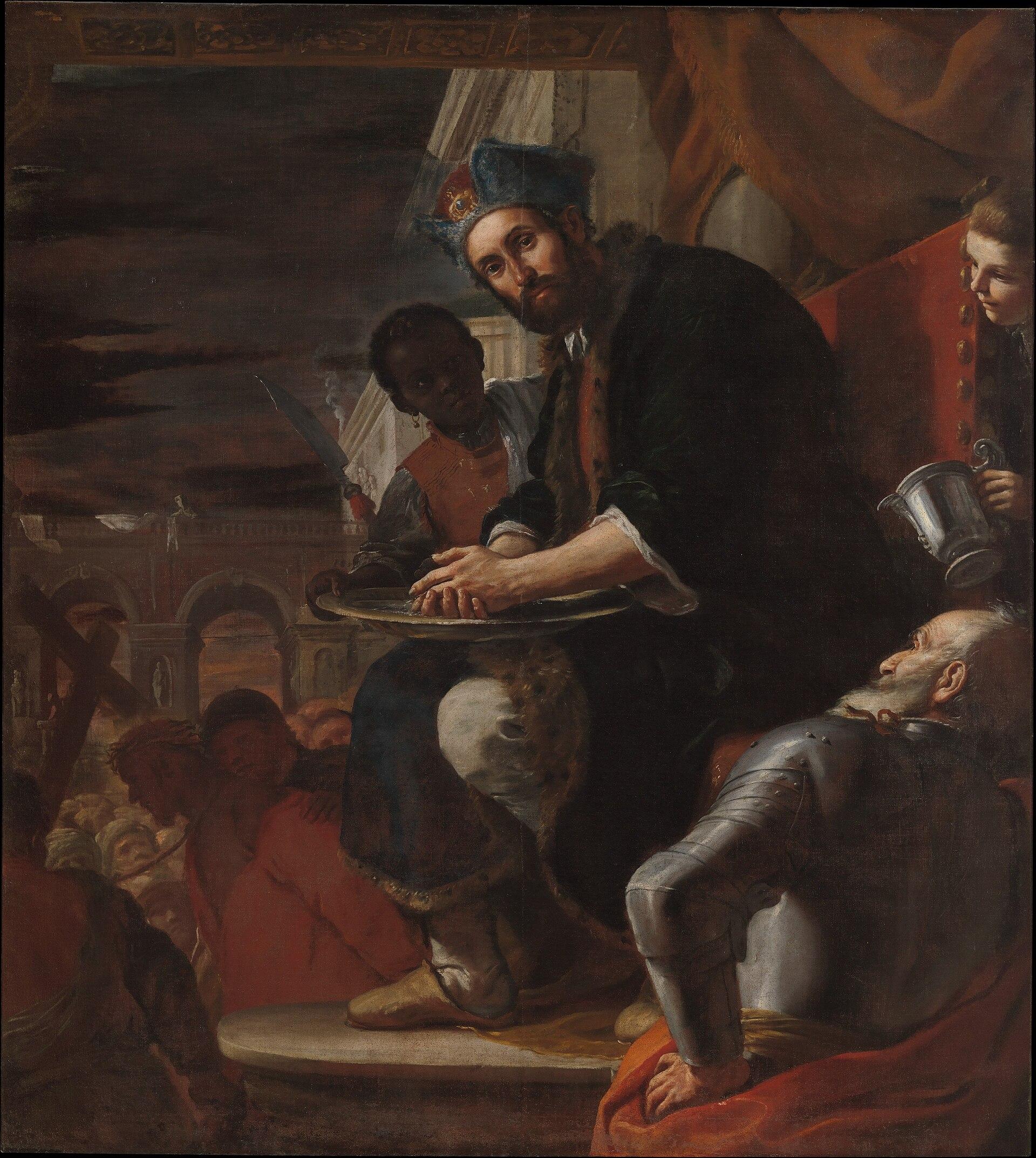
Mattia Preti, Pilate Washing His Hands, 1663. CC0.
John 18:28 to 19:22 · Person · Featured Study
Pontius Pilate
Pontius Pilate was the Roman governor who sentenced Jesus to be crucified.
Before the crowd he washed his hands and called himself innocent of this man's blood.
Pilate answered, “What I have written, I have written.”
- The name means
- Pilate: close-pressed, that is, firm, by Strong's dictionary
- Died
- under the emperor Gaius, by his own hand, as Eusebius reports (Church History 2.7) (proposed)
- Family
- wife: not named in Scripture (Matthew 27:19)
- Places
- Caesarea, Jerusalem, the Praetorium, the Stone Pavement, Samaria, Rome
- First named
- Matthew 27:2 “They bound Him, led Him away, and handed…”
- Last named
- 1 Timothy 6:13 “…confession in His testimony before Pontius Pilate:”
Summary
Pilate ruled Judea for the emperor Tiberius for ten years, by Josephus's count. When Jesus was brought to his court he could find no basis for a charge. Yet he yielded to the clamour, set Barabbas free and handed Him over. Afterward Vitellius of Syria sent him to Rome to answer for his rule. By the account Eusebius gives, he later died by his own hand.
- Peter and Paul named him in their preaching, and Paul named him again in a letter.
- Philo calls him inflexible, merciless and obstinate.
- A stone found at Caesarea in 1961 bears his name and title.
Governor of Judea
His name stands beside the emperor's in Luke's dating of John the Baptist's call.
In the fifteenth year of the reign of Tiberius Caesar, while Pontius Pilate was governor of Judea, Herod tetrarch of Galilee, his brother Philip tetrarch of Ituraea and Trachonitis, and Lysanias tetrarch of Abilene,Five rulers fix the year in this verse.
The Gospels call him the governor; his Roman title was prefect, and Tacitus calls him a procurator, the later name of the office. Luke 13:1 also records that he mixed the blood of some Galileans with their sacrifices.
Three Verdicts and a Sentence
John records three times that Pilate found no basis for a charge, and then the sentence he gave.
He declared Jesus innocent three times and then handed Him over.
- John 18:38First verdict, after he questions Jesus inside the PraetoriumJohn 18:38
- John 19:4Second verdict, as he brings Jesus out to the crowdJohn 19:4
- John 19:6Third verdict, when the chief priests shout, Crucify HimJohn 19:6
- John 19:12He hears that releasing Jesus would make him no friend of CaesarJohn 19:12
- John 19:13 to 16He sits on the judgment seat and hands Jesus over to be crucifiedJohn 19:13 to 16
- John 19:19 to 22He writes the notice for the cross and will not change itJohn 19:19 to 22
- Mark 15:43 to 45He grants the body to Joseph of ArimatheaMark 15:43 to 45
- Matthew 27:62 to 66He lets the chief priests seal the tomb and post a guardMatthew 27:62 to 66
Luke gives his three verdicts in other words (Luke 23:4, 14 and 22).
Mark 15:43 to 45, Matthew 27:62 to 66
Pilate Outside the Gospels
Two Jewish writers and a Roman historian record his rule.
Josephus says Pilate brought the army's ensigns bearing the emperor's image into Jerusalem. He also paid for an aqueduct into the city with the sacred money of the temple. Each act raised protests from the people. Tacitus, writing of Nero's Rome, says Christus suffered the extreme penalty in the reign of Tiberius at the hands of Pontius Pilatus.
Philo of Alexandria tells how Pilate set gilt shields in Herod's palace in Jerusalem. Tiberius ordered them sent to the temple of Augustus at Caesarea. Philo calls him a man of a very inflexible disposition, merciless and obstinate, and charges him with the murder of people untried and uncondemned.
His Circle
The Gospels name the emperor he served and a ruler who became his friend.
He served Tiberius and dealt with Herod, the priests and a centurion.
| Person | Tie to Pilate | Told in |
|---|---|---|
| Tiberius Caesar | The emperor in whose reign he governed | Luke |
| Herod the tetrarch | An enemy who became his friend on the day of the trial | Luke |
| The chief priests | Brought Jesus to him and asked for His death | all four Gospels |
| The centurion | Confirmed for him that Jesus was dead | Mark |
His Places
Every place the Gospels give him stands in Jerusalem.
He questioned Jesus in the Praetorium, sentenced Him at Gabbatha and labelled His cross.
| Place | What happened there | Told in |
|---|---|---|
| The Praetorium | He questioned Jesus inside while the accusers stayed out | John |
| The Stone Pavement, Gabbatha | He sat on the judgment seat to give sentence | John |
| The place of the cross | His notice was read there in Hebrew, Latin and Greek | John |
The Stone, the Dream and His End
A stone names him, his wife warned him, and his last years are told outside Scripture.
The Pilate StoneCaesarea Maritima, found in 1961
A stone found in the Roman theatre at Caesarea in 1961 carries an inscription that names Pontius Pilate and calls him prefect of Judea. The stone is kept in the Israel Museum in Jerusalem.
His wife's dreamMatthew 27:19
While Pilate was sitting on the judgment seat, his wife sent him this message: “Have nothing to do with that innocent man, for I have suffered terribly in a dream today because of Him.”Only Matthew records the message.
What became of Pilate?Josephus, Antiquities 18.4; Eusebius, Church History 2.7; the Ethiopian Synaxarium
Josephus says Pilate's horsemen fell on a crowd of Samaritans gathered at a village to go up Mount Gerizim. The Samaritans complained to Vitellius, the governor of Syria, who sent Pilate to Rome to answer to the emperor, and Tiberius died before he arrived.
Eusebius reports that under the emperor Gaius, Pilate fell into such misfortunes that he took his own life. He names Greek historians as his source. The Ethiopian Synaxarium, the church's book of saints, keeps Pilate as a confessor on the 25th day of the month Sane.
What Is Truth?
John alone records the exchange.
“Then You are a king!” Pilate said. “You say that I am a king,” Jesus answered. “For this reason I was born and have come into the world, to testify to the truth. Everyone who belongs to the truth listens to My voice.”It is the claim Pilate's question answers.
“What is truth?” Pilate asked. And having said this, he went out again to the Jews and told them, “I find no basis for a charge against Him.Pilate's question stands between the claim and the verdict.
Voices on Pilate
Augustine of Hippo and Ambrose of Milan wrote on the notice he posted and the friendship he made with Herod.
Ambrose of Milan (died 397)
EXPOSITION OF THE GOSPEL OF LUKE 10.103
Ambrose read the new friendship of the two rulers as a sign for the nations.
“In the figure of Herod and Pilate also, who became friends from enemies through Jesus Christ, the figure of the people of Israel and the Gentile people is preserved, so that through the passion of the Lord there will be future harmony between them both: in such a way, however, that the pious people of the nations receive the word of God and transmit their faith to the Jewish people with their devotion; so that they too may clothe the body of Christ with the glory of their majesty, whom they had previously despised.”
on Luke 23:12Patristic
Augustine of Hippo (died 430)
SERMON 201.2
Augustine paired Pilate with the magi, one Gentile at each end of the life of Jesus.
“The magi were from the Gentiles. Pilate too was a Gentile. They saw a star in the sky; he wrote a title on the tree. Both, however, were looking for or acknowledging the king, not of the Gentiles but of the Jews. Thus already there was a prefiguring of what the Lord himself spoke about later, ‘Many will come from the east and the west and sit down with Abraham and Isaac and Jacob in the kingdom of heaven. But the children of the kingdom will go into outer darkness.’ The magi, you see, had come from the east, Pilate from the west. So they bore witness to the king of the Jews rising, that is, to his being born. Pilate bore witness to the king of the Jews setting, that is, to his dying. In this way, they could take their seats in the kingdom of heaven with Abraham and Isaac and Jacob, from whom the Jews derived their descent. They were not descended from them, of course, in the flesh but grafted into them by faith. Thus the wild olive the apostle talks about, that was to be grafted into the olive, was already being prefigured.”
on John 19:22Patristic
What Did Pilate Mean by What Is Truth?
He left before Jesus could answer, and readers have taken his question three ways.
A question asked in contemptAlbert Barnes
Barnes holds that Pilate asked in contempt, and that Jesus would have answered a sincere seeker as He answered Nicodemus.
The objection: Pilate went out to declare Jesus innocent, which sits ill with scorn for Him.
A courtier's weary questionJohn Wesley
Wesley reads it as a courtier asking whether truth was worth a man's life. He holds that Pilate took Jesus for an innocent but weak man.
The objection: John 19:8 says Pilate grew more afraid when he heard Jesus called the Son of God, which suggests more than weariness.
A question cut short by the custom of the feastAugustine of Hippo, Tractate 115 on John
Augustine believed that as Pilate spoke, the Passover custom of releasing a prisoner came to his mind. He hurried out to use it to free Jesus.
The objection: John gives no reason for his leaving, so the reading rests on the order of John 18:38 and 39 alone.
The Good Confession Before Pilate
The apostles named Pilate when they preached the death of Jesus, and Paul named him in his charge to Timothy.
The God of Abraham, Isaac, and Jacob, the God of our fathers, has glorified His servant Jesus. You handed Him over and rejected Him before Pilate, even though he had decided to release Him.Peter holds the crowd to account for the choice.
I charge you in the presence of God, who gives life to all things, and of Christ Jesus, who made the good confession in His testimony before Pontius Pilate:Paul sets the confession of Jesus before Pilate as the pattern for Timothy.
Sources
Scripture is the Berean Standard Bible.
- Flavius Josephus, Antiquities of the Jews 18.3.1 to 2 and 18.4.1 to 2, translated by William Whiston.
- Philo of Alexandria, On the Embassy to Gaius 38, sections 299 to 305, translated by C. D. Yonge.
- Tacitus, Annals 15.44, translated by Alfred Church and William Brodribb.
- The Israel Museum, Jerusalem, Pontius Pilate, Prefect of Judah: Latin dedicatory inscription, IAA 61-531 (the museum's collection page); with Archeobiblion, Pontius Pilate, the inscription (the find of 1961 by A. Frova's mission in the Roman theatre at Caesarea)
- Eusebius, Church History 2.7, translated by A. C. McGiffert, Nicene and Post-Nicene Fathers, second series, vol. 1.
- E. A. Wallis Budge, The Book of the Saints of the Ethiopian Church, a translation of the Ethiopic Synaxarium (Cambridge, 1928), the 25th of Sane, page 1034.
- Augustine of Hippo, Sermon 201.2 and Tractates on John 115; Ambrose of Milan, Exposition of the Gospel of Luke 10.103; Albert Barnes, Notes, on John 18:38; John Wesley, Explanatory Notes upon the New Testament (1755) on John 18:38.
Keep Studying
Read it5
Studies5
People and groups11
Subjects3