
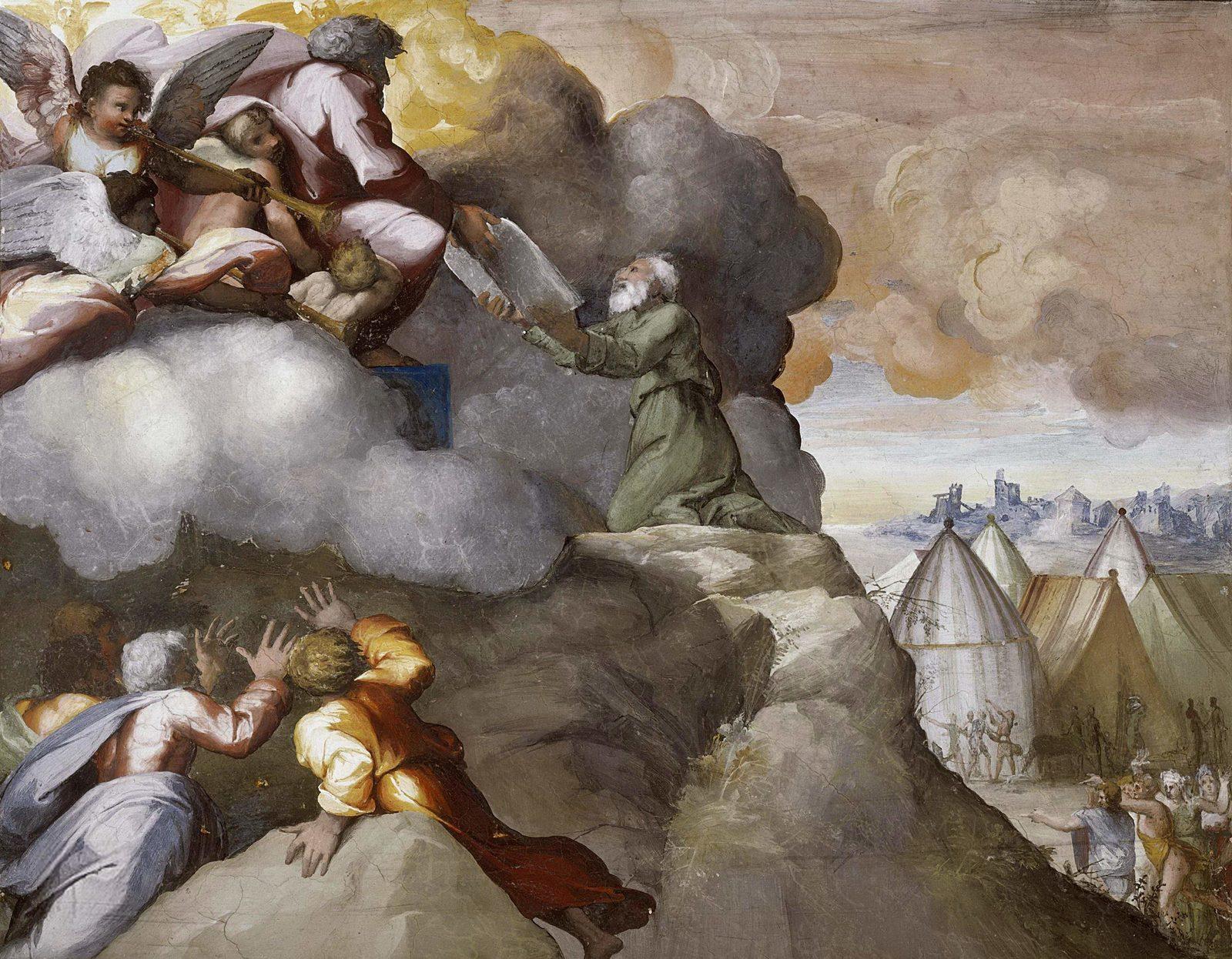
Workshop of Raphael, God gives the tablets of the Law to Moses, 1519. Public domain.
Exodus 24:12 · Symbol · Featured Study
The tablets of stone
Moses carried tablets down Sinai twice, once to break them and once to lay them in the ark.
Then the LORD said to Moses, “Come up to Me on the mountain and stay here, so that I may give you the tablets of stone, with the law and commandments I have written for their instruction.”
- The word
- לוּחַ (luach), H3871
- First appears
- Exodus 24:12 “…I may give you the tablets of stone,…”
For the second tablets, God told Moses in Exodus 34:1 to chisel out the stones.
Summary
The tablets of stone held the covenant of Sinai in writing. In Jeremiah 31:33 the LORD says He will inscribe His law on their hearts.
- In Exodus 25:16 the LORD tells Moses to place the Testimony inside the ark.
- In Deuteronomy 4:13 Moses says the LORD declared His covenant, the Ten Commandments, and wrote them on two tablets of stone.
- In 2 Corinthians 3:7 Paul speaks of the ministry of death, which was engraved in letters on stone.
Written by the Finger of God
Exodus 32:15 to 16 says who made the first tablets and who wrote on them.
Moses had already written down the words of the LORD, in Exodus 24:4. He read the Book of the Covenant to the people at the foot of Sinai, in Exodus 24:7. God then called him up the mountain to receive tablets of stone, in Exodus 24:12. The phrase the finger of God first stands in Exodus 8:19. There Pharaoh's magicians said it to Pharaoh when they could not copy the plague of gnats. The question here is what the tablets were and what became of them. The answer is given by their history from the mountain to the ark and by the breaking. It is also given by what Exodus and Deuteronomy each say of the second pair. The words for the tablets and the prophets' promise of a law on the heart complete it.
Then Moses turned and went down the mountain with the two tablets of the Testimony in his hands. They were inscribed on both sides, front and back. The tablets were the work of God, and the writing was the writing of God, engraved on the tablets.It stands here because these verses answer the section's question from the text itself.
Rashi on Exodus 32:15Pentateuch with Rashi's commentary
Rashi, the Jewish commentator of France who lived from 1040 to 1105, cites the Talmud at Shabbat 104a on the tablets inscribed on both sides, front and back. He reads the words to mean the letters could be read from either side, and he calls it a miracle.
The Tablets From Sinai to the Heart
The stops follow the tablets from the promise on the mountain to Paul's letter to Corinth.
The history of the tablets ends in the ark, and the prophets carry the writing on to the heart.
- PromisedThe tablets are promised for the people's instructionExodus 24:12
- GivenMoses receives them at the end of forty days and nightsDeuteronomy 9:11
- BrokenMoses throws them down when he sees the calfExodus 32:19
- Cut againMoses chisels two new stones like the firstExodus 34:4
- Written againThe LORD writes again, in Moses' accountDeuteronomy 10:4
- Laid upKept in the ark Moses madeDeuteronomy 10:5
- In the templeThe two tablets inside the ark1 Kings 8:9
- Promised againA law written on the heartJeremiah 31:33
- Paul's letterTablets of human hearts2 Corinthians 3:3
Each stop opens its verse in the reader.
In the temple, Promised again, Paul's letter
Broken at the Foot of the Mountain
Moses came down with the tablets and found Israel worshipping a calf.
While Moses was on the mountain the people had a calf of gold made, and Exodus 32:4 records their cry over it. Deuteronomy 9:17 adds that Moses broke the tablets before the people's eyes.
As Moses approached the camp and saw the calf and the dancing, he burned with anger and threw the tablets out of his hands, shattering them at the base of the mountain.This verse tells the breaking itself, and Exodus 34:1 later recalls it.
Rashi on Exodus 32:19Pentateuch with Rashi's commentary
Rashi gives Moses' own reasoning, from the law of the Passover. Exodus 12:43 says no foreigner is to eat the Passover, and that is one commandment. Moses asked how he could then give the whole law to a people who had made themselves strangers to God.
Who Wrote the Second Tablets?
Exodus 34 and Deuteronomy 10 each give an account of the writing on the second tablets.
In Exodus 34:1 God promises, “I will write on them the words that were on the first tablets”. Exodus 34:27 to 28 and Deuteronomy 10:4 follow, each as its own text states it.
The LORD also said to Moses, “Write down these words, for in accordance with these words I have made a covenant with you and with Israel.” So Moses was there with the LORD forty days and forty nights without eating bread or drinking water. He wrote on the tablets the words of the covenant—the Ten Commandments.It stands here because in these verses a reader must decide who wrote on the tablets.
And the LORD wrote on the tablets what had been written previously, the Ten Commandments that He had spoken to you on the mountain out of the fire on the day of the assembly. The LORD gave them to me,It stands here because Moses, telling the story again, names the LORD as the writer.
Adam Clarke on Exodus 34:1Commentary on the Bible
Adam Clarke, the Methodist commentator, reads Exodus 34:1 beside Exodus 32:16 in his Commentary on the Bible. In his reading God made and wrote the first pair, and Moses prepared the second pair for God to write on.
The Words for the Tablets
Two Hebrew words and one Greek word name the tablets and what was written on them.
luach
43 uses in the canon
The word names a tablet of stone, wood or metal, probably for its polished face.
eduth
59 uses in the canon
The word means testimony, and it names both the tablets of the Testimony and the ark of the Testimony that held them.
plax
3 uses in the canon
The word means a flat surface, a plate or a tablet, and Paul uses it in 2 Corinthians 3:3 both of tablets of stone and of tablets of human hearts.
What the Text Leaves Unsaid
Exodus 34:4 records who cut the second stones and how many.
One silence remains about the tablets themselves.
| What the text states | What it leaves unsaid |
|---|---|
| The second pair was made like the originals. | No verse gives the tablets a size, a weight or a kind of stone. |
The text also leaves unsaid how the ten words were divided between the two tablets, and the numbering of the commandments takes up that question.
Written on the Heart
The prophets looked for a law kept from within, and Paul applies their promise to the church in Corinth.
Proverbs 3:3 tells the reader to write loving devotion and faithfulness on the tablet of the heart. Jeremiah 17:1 says Judah's sin was engraved with a diamond point on the tablets of their hearts. Ezekiel 36:26 promises a heart of flesh in place of a heart of stone.
“But this is the covenant I will make with the house of Israel after those days, declares the LORD. I will put My law in their minds and inscribe it on their hearts. And I will be their God, and they will be My people.It stands here because Jeremiah names the heart as the new place of the writing.
It is clear that you are a letter from Christ, the result of our ministry, written not with ink but with the Spirit of the living God, not on tablets of stone but on tablets of human hearts.Paul sets the Corinthians beside the stones of Sinai.
Books to Read Next
One Jewish commentary opens Exodus 32 for a reader who wants the next step.
Pentateuch with Rashi's commentary
Rashi, translated by M. Rosenbaum and A. M. Silbermann · 1929 to 1934
It is free to read at Sefaria, with the Hebrew beside it.
READ HIS NOTES ON EXODUS 32 →My Laws in Their Hearts
Hebrews 10:15 to 16 quotes Jeremiah's promise again after the one sacrifice of Christ in Hebrews 10:12 to 14.
let us draw near with a sincere heart in full assurance of faith, having our hearts sprinkled to cleanse us from a guilty conscience and our bodies washed with pure water.Hebrews draws its call to the reader from the covenant it has just quoted.
Sources
Scripture is the Berean Standard Bible.
- James Strong, Exhaustive Concordance of the Bible, 1890, entries H3871, H5715 and G4109.
- Adam Clarke, Commentary on the Bible, on Exodus 34:1.
- Rashi (1040 to 1105, France), Commentary on Exodus 32:15 and 32:19, in Pentateuch with Rashi's commentary, translated by M. Rosenbaum and A. M. Silbermann, 1929 to 1934.