
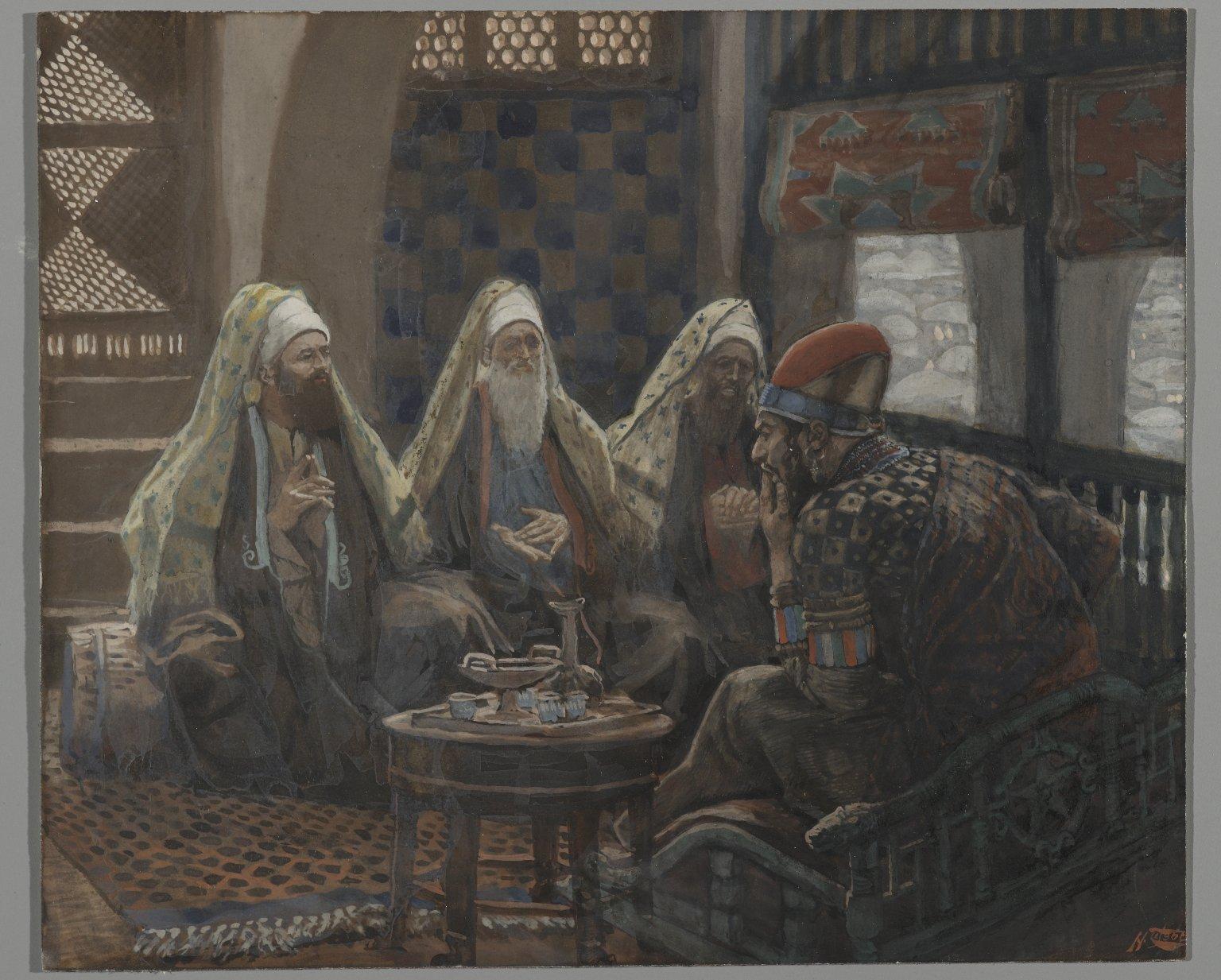
James Tissot, The Magi in the House of Herod, 1886 to 1894. Public domain.
Matthew 2, Luke 3:1 and Acts 12 · Group · Featured Study
Herod and His House
Herod the Great and his descendants ruled the Jewish land as kings and tetrarchs under Rome.
Immediately, because Herod did not give glory to God, an angel of the Lord struck him down, and he was eaten by worms and died.
- Began
- the 184th Olympiad, by Josephus's count
Four generations of one family ruled where the Gospels and Acts take place.
Summary
The New Testament names ten members of one family. Herod the Great was king when Jesus was born. His son Antipas ruled Galilee in the years Jesus taught. His grandson Agrippa put James to death. His great-grandson Agrippa heard Paul speak in his own defence.
- Josephus's Antiquities is the chief record of the family outside Scripture.
- Three of the house sought the lives of Jesus or His apostles: Herod, Antipas and Agrippa I.
- Readers part over why no other writer records the slaughter at Bethlehem.
Where Scripture Names the Herods
The name Herod belongs to several rulers, and the Gospels and Acts tell them apart by title and time.
After Jesus was born in Bethlehem in Judea, during the time of King Herod, Magi from the east arrived in Jerusalem,Matthew dates the birth of Jesus by the first Herod.
In the fifteenth year of the reign of Tiberius Caesar, while Pontius Pilate was governor of Judea, Herod tetrarch of Galilee, his brother Philip tetrarch of Ituraea and Trachonitis, and Lysanias tetrarch of Abilene,Luke dates John's preaching by two of Herod's sons.
About that time, King Herod reached out to harm some who belonged to the church.The persecutor of Acts 12 belongs to the same house.
After several days had passed, King Agrippa and Bernice came down to Caesarea to pay their respects to Festus.Acts brings the great-grandson to Paul's hearing.
Strong's dictionary gives Herod as the name of four rulers. Matthew calls the first King Herod, and Luke calls his son Herod the tetrarch.
Acts 12:1, Acts 25:13
The House of Herod
Josephus supplies the descent that ties the members Scripture names into one house.
From Herod the Great to the brother and sisters who met Paul, the house spans four generations.
Generation 1
- Herod the Greatking of Judea when Jesus was born
Generation 2
- Archelausson of Herod, who reigned in Judea after him
- Herod Antipasson of Herod, tetrarch of Galilee
- Philipson of Herod, tetrarch of Ituraea and Trachonitis
- Herod, called Philip by Markson of Herod, first husband of Herodias
Generation 3
- Herodiasgranddaughter of Herod, wife of Antipas
- Herod Agrippa Igrandson of Herod, the king who killed James
Generation 4
- Agrippa IIson of Agrippa I, the king who heard Paul
- Bernicedaughter of Agrippa I, at Paul's hearing
- Drusilladaughter of Agrippa I, wife of the governor Felix
The tree sets out the family by generation, as Scripture and Josephus give it.
The King and His Will
Josephus tells how Herod won the crown, built, killed his own family, and divided his kingdom as he died.
Josephus says Herod went to Rome and was made king of the Jews by the senate, with the support of Antony and Caesar. In the eighteenth year of his reign he began to rebuild the temple in Jerusalem on a larger plan.
“This temple took forty-six years to build,” the Jews replied, “and You are going to raise it up in three days?”The work was still remembered in the time of Jesus.
He put to death his wife Mariamne, then his sons Alexander and Aristobulus, and five days before his own death his son Antipater.
Herod died after an illness, having gone to Jericho at the end. His will gave Archelaus the kingdom, made Antipas tetrarch of Galilee and Perea, and gave Philip Gaulonitis, Trachonitis and Paneas as a tetrarchy.
But when he learned that Archelaus was reigning in Judea in place of his father Herod, he was afraid to go there. And having been warned in a dream, he withdrew to the district of Galilee,Archelaus reigns in Judea, as the will gave him.
Josephus adds that Caesar later banished Archelaus to Vienna, a city of Gaul, and took his money.
Antipas in the Gospels
The Herod of the ministry of Jesus ruled Galilee, and Jesus called him a fox.
At that very hour, some Pharisees came to Jesus and told Him, “Leave this place and get away, because Herod wants to kill You.”Pharisees bring a warning that draws His answer.
But Jesus replied, “Go tell that fox, ‘Look, I will keep driving out demons and healing people today and tomorrow, and on the third day I will reach My goal.’His answer keeps His work on His own timetable.
Members of his court came to follow Jesus. Luke names Joanna, the wife of Herod's household manager Chuza, among the women who supported Jesus, and Manaen, who had been brought up with Herod, among the teachers of the church at Antioch.
The Death of Agrippa at Caesarea
Luke and Josephus tell the same death, each in his own terms.
Both accounts set the scene at Caesarea, with royal robes, a crowd that calls him a god, and a sudden end.
| Question | Acts 12 | Josephus |
|---|---|---|
| Where? | Caesarea, after Judea | Caesarea, at shows held in honour of Caesar |
| What did he wear? | His royal robes | A garment made wholly of silver, shining in the morning sun |
| What did the crowd cry? | This is the voice of a god, not a man | He was a god |
| How did he die? | Struck by an angel of the Lord, eaten by worms | Pain in his belly for five days |
| Why? | He did not give glory to God | He neither rebuked the flatterers nor rejected their words |
Josephus says Agrippa died in the fifty-fourth year of his age and the seventh year of his reign.
The Herodians
Mark names a party called by the family's name, and says little more about them.
At this, the Pharisees went out and began plotting with the Herodians how they might kill Jesus.Mark introduces the party here.
Later, they sent some of the Pharisees and Herodians to catch Jesus in His words.They come again with a question about taxes.
Strong's dictionary defines the Herodians as partisans of Herod. Scripture does not say what they taught, and Jesus warned His disciples against the leaven of the Pharisees and of Herod.
Voices on the Herods
Irenaeus, Theophylact and Matthew Henry wrote on the fox, the Herodians and the children of Bethlehem.
Irenaeus (died 202)
Against Heresies Book IV
Irenaeus read the name fox as a word on Herod's cunning.
“And therefore did the Lord term those whom He knew to be the offspring of men ‘a generation of vipers;’ because after the manner of these animals they go about in subtilty, and injure others. For He said, ‘Beware of the leaven of the Pharisees and of the Sadducees.’ Speaking of Herod, too, He says, ‘Go ye and tell that fox,’ aiming at his wicked cunning and deceit.”
on Luke 13:32Patristic
Theophylact of Ohrid (died 1107)
Catena Aurea by Aquinas
Theophylact of Ohrid held that the Herodians taught that Herod was the Christ.
“He means by leaven their hurtful and corrupt doctrine, full of the old malice, for the Herodians were the teachers, who said that Herod was the Christ.”
on Mark 8:15Patristic
Matthew Henry (1662 to 1714)
Commentary on the Whole Bible
Matthew Henry called the children of Bethlehem martyrs.
“The diseases and deaths of little children are proofs of original sin. But we must look upon this murder of the infants under another character: it was their martyrdom. How early did persecution commence against Christ and his kingdom!”
on Matthew 2:16Puritan
Why Does No Other Writer Record the Slaughter at Bethlehem?
Matthew alone tells it, and Josephus, who records many of Herod's killings, does not.
When Herod saw that he had been outwitted by the Magi, he was filled with rage. Sending orders, he put to death all the boys in Bethlehem and its vicinity who were two years old and under, according to the time he had learned from the Magi.Matthew's account, which each reading must explain.
An act like Herod's, too small for the historiesEllicott, the Cambridge Bible, Paul Maier and R. T. France
Ellicott judged the act in keeping with Herod's character. The Cambridge Bible adds that Bethlehem was a small town, so the children killed were few, and that Josephus could not record every cruelty of such a ruler. M. J. Mans reports that Paul Maier makes the same case and puts the dead at twenty to twenty-five. R. T. France also argues for the account.
The objection: Josephus records Herod's killing of his own sons in detail, and Matthew is the only witness.
An echo in Augustus's jestMacrobius, Saturnalia 2.4.11, and Adam Clarke
Macrobius sets Augustus's saying about Herod's pig on the news that Herod had ordered the boys under two in Syria killed, and that his own son was among them. Adam Clarke took this as a clear allusion to the slaughter.
The objection: Macrobius wrote long after, may have drawn on Matthew, and confuses the events. D. F. Strauss and the Pulpit Commentary both note that he took the execution of Herod's son Antipater for a death in the massacre.
A story told on the pattern of PharaohD. F. Strauss, Andrew Lincoln and Jodi Magness
D. F. Strauss read the story as legend. He argues that as Abraham had his Nimrod and Moses his Pharaoh, legend found a persecutor for the Messiah in Herod. Andrew Lincoln holds that Matthew modelled the story on Pharaoh's killing of the Hebrew boys, and Jodi Magness that it is folklore drawn from Herod's reputation. M. J. Mans notes that many historians, commentators and critical scholars have questioned the account.
The objection: a likeness to the Exodus does not show that an event did not happen, and the act fits what Josephus records of Herod.
The Word Continued to Spread
Luke closes Agrippa's story with one line on the church.
But the word of God continued to spread and multiply.The verse follows directly on the king's death.
Sources
Scripture is the Berean Standard Bible.
- Strong's dictionary, G2264 and G2265, from the STEP Bible lexicon.
- Flavius Josephus, Antiquities of the Jews 14.14.4 to 5, 15.7, 15.11.1, 16.11, 17.6 to 8, 17.13.2, 18.5.4, 19.8.2 and 20.7, translated by William Whiston.
- Macrobius, Saturnalia 2.4.11, Latin text, LacusCurtius.
- Ellicott's Commentary for English Readers, the Cambridge Bible for Schools and Colleges and the Pulpit Commentary (quoting Farrar), on Matthew 2:16.
- D. F. Strauss, The Life of Jesus Critically Examined, translated from the fourth German edition, sections 34 and 36.
- R. T. France, Herod and the Children of Bethlehem, Novum Testamentum 21 (1979); Paul L. Maier (1998), page 187; Andrew Lincoln (2013), page 44; Jodi Magness (2021), page 126; as reported by Wikipedia, Massacre of the Innocents.
- M. J. Mans, The early Latin Church Fathers on Herod and the Infanticide, HTS 53 (1997), page 93 and note 6, citing Paul Maier (1975)
- Irenaeus, Against Heresies 4; Theophylact of Ohrid in the Catena Aurea of Thomas Aquinas; Matthew Henry, Commentary on the Whole Bible (1710); Adam Clarke, Commentary on the Bible (1832), on Matthew 2:16.
Keep Studying
Read it5
Studies5
People and groups10
Go further3
Church history1