
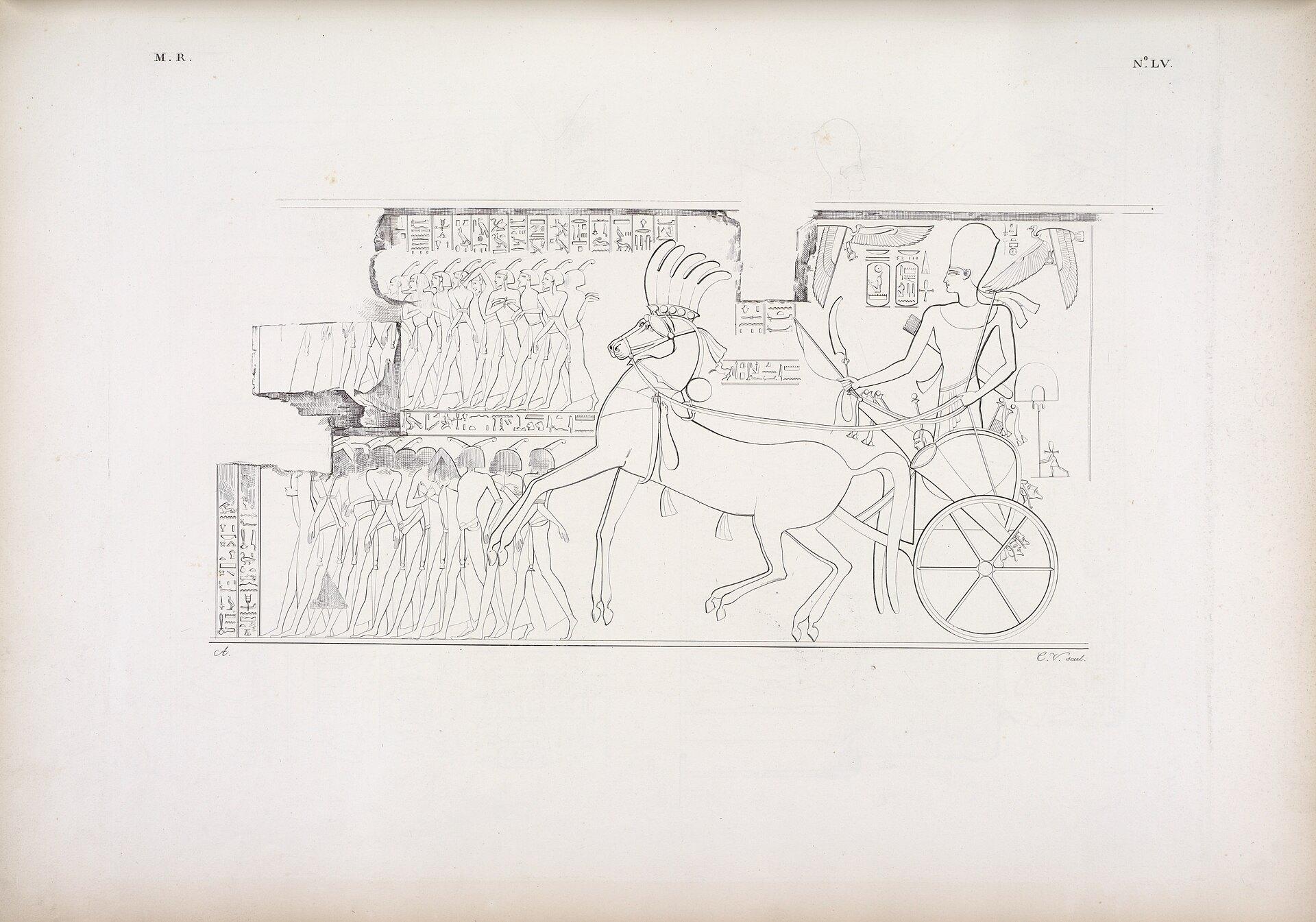
Ippolito Rosellini, I monumenti dell'Egitto e della Nubia, 1832. Public domain.
Isaiah 28 to 31 · Passage · Featured Study
The Covenant With Death: Judah's Alliance With Egypt
Isaiah 28 to 31 answer the rulers of Jerusalem who looked to Egypt for help against Assyria.
For the Lord GOD, the Holy One of Israel, has said: “By repentance and rest you would be saved; your strength would lie in quiet confidence—but you were not willing.”
- The passage
- Isaiah 28:14 to 22, Isaiah 30:1 to 17, Isaiah 31:1 to 9, Isaiah 36:4 to 9
- Book
- Isaiah
- Hold in memory
- Isaiah 30:15, Isaiah 31:1
Isaiah gave Egypt a nickname: Rahab Who Sits Still.
Summary
The rulers boasted of a pact that would keep them safe when the Assyrian scourge passed through. Isaiah warned that the pact would be dissolved and that Egypt's horses and chariots would fail them. He called Judah to repentance and rest instead.
- Egypt's army was beaten near Eltekeh, by Sennacherib's own account.
- The law of Moses had already forbidden the road back to Egypt.
- Isaiah 28:16 is quoted twice in the New Testament.
A Covenant With Death
The rulers' boast and the LORD's answer stand side by side.
Therefore hear the word of the LORD, O scoffers who rule this people in Jerusalem. For you said, “We have made a covenant with death; we have fashioned an agreement with Sheol. When the overwhelming scourge passes through it will not touch us, because we have made lies our refuge and falsehood our hiding place.”The rulers' own words are the charge against them.
The rulers think their pact will keep the coming scourge from them. The prophet calls their refuge a lie.
Your covenant with death will be dissolved, and your agreement with Sheol will not stand. When the overwhelming scourge passes through, you will be trampled by it.The same words come back as a sentence of judgment.
Albert Barnes did not suppose that they had formally said these words. He read them as what their conduct said.
From the Boast to the Rescue
The woes run on through chapters 28 to 31, and chapters 36 and 37 tell the outcome.
Isaiah answered the pact in a series of woes, and the siege of Jerusalem showed which refuge held.
- Isaiah 28:22A decree of destruction stands against the whole landIsaiah 28:22
- Isaiah 29:15The planners work in the dark and think no one seesIsaiah 29:15
- Isaiah 30:8Isaiah is told to write his warning down as a witnessIsaiah 30:8
- Isaiah 30:10The people tell the seers to stop seeing visionsIsaiah 30:10
- Isaiah 30:12 to 13Their trust in deceit is a wall about to fallIsaiah 30:12 to 13
- Isaiah 30:16They plan to escape on swift horsesIsaiah 30:16
- Isaiah 30:18The LORD waits to be graciousIsaiah 30:18
- Isaiah 31:4The LORD comes down like a lion to fight for ZionIsaiah 31:4
- Isaiah 31:8Assyria falls by a sword no mortal madeIsaiah 31:8
- Isaiah 36:6The Assyrian envoy mocks the trust in PharaohIsaiah 36:6
- Isaiah 37:9Tirhakah of Cush marches against SennacheribIsaiah 37:9
- Isaiah 37:36The angel of the LORD strikes the Assyrian campIsaiah 37:36
Twelve steps in the order of the book, each with its verse.
Isaiah 30:18, Isaiah 31:4, Isaiah 31:8, Isaiah 36:6, Isaiah 37:9, Isaiah 37:36
The Embassy to Egypt
The prophet traces the envoys from their plan to their arrival in Egypt.
A plan made without the LORDIsaiah 30:1 to 2; Keil and Delitzsch
“Woe to the rebellious children,” declares the LORD, “to those who carry out a plan that is not Mine, who form an alliance, but against My will, heaping up sin upon sin. They set out to go down to Egypt without asking My advice, to seek shelter under Pharaoh’s protection and take refuge in Egypt’s shade.The prophet names the embassy as rebellion.
Keil and Delitzsch saw here the secret plan of Isaiah 29:15 carried a step further. By then, they wrote, the talks through envoys had already begun.
Zoan and HanesIsaiah 30:4; Jamieson, Fausset and Brown
For though their princes are at Zoan and their envoys have arrived in Hanes,The envoys' road led deep into Egypt.
Jamieson, Fausset and Brown place Hanes west of the Nile in central Egypt, the city the Greeks called Heracleopolis.
The caravan of the NegevIsaiah 30:6
This is the burden against the beasts of the Negev: Through a land of hardship and distress, of lioness and lion, of viper and flying serpent, they carry their wealth on the backs of donkeys and their treasures on the humps of camels, to a people of no profit to them.The cost of the alliance is carried through dangerous country.
Matthew Henry wrote that they loaded the beasts of the south with their riches.
The name for EgyptIsaiah 30:7; the Cambridge Bible; Ellicott
Egypt’s help is futile and empty; therefore I have called her Rahab Who Sits Still.The name mocks Egypt's promise of help.
Rahab is an old poetic name for Egypt, found also in Psalm 87:4 and Isaiah 51:9. The Cambridge Bible renders the Hebrew literally as Rahab, they are a sitting still, and calls Egypt a proud boastful monster whose proper name is Inaction. Ellicott called the name almost a political caricature.
What Sennacherib's Annals Say of Egypt
The Assyrian king's prism gives his side of the campaign.
Sennacherib's prism, now in Chicago, tells of his third campaign. The men of Ekron, it says, called on the kings of Egypt and the bowmen, chariots and horses of the king of Meluhha, which the translator renders Ethiopia.
The prism says the two armies met near Eltekeh. Sennacherib claims he captured the Egyptian charioteers and princes alive, with the charioteers of the Ethiopian king.
The Pulpit Commentary judges it very uncertain which Pharaoh Isaiah 30:2 means. It thinks the supreme power was probably in Tirhakah's hands, with Shabatok chief among the princes of Lower Egypt.
A Question of Trust
Isaiah treats the alliance as a choice between Egypt's horses and the Holy One of Israel.
Woe to those who go down to Egypt for help, who rely on horses, who trust in their abundance of chariots and in their multitude of horsemen. They do not look to the Holy One of Israel; they do not seek the LORD.The alliance is weighed as a matter of faith.
But the Egyptians are men, not God; their horses are flesh, not spirit. When the LORD stretches out His hand, the helper will stumble, and the one he helps will fall; both will perish together.The next verses set flesh against spirit.
Joseph Benson and Matthew Poole linked the woe to the law that forbade a king to send the people back to Egypt for horses.
But the king must not acquire many horses for himself or send the people back to Egypt to acquire more horses, for the LORD has said, ‘You are never to go back that way again.’The king's law named this very temptation.
Paul and Peter read the tested stone of Isaiah 28:16 as Christ.
So this is what the Lord GOD says: “See, I lay a stone in Zion, a tested stone, a precious cornerstone, a sure foundation; the one who believes will never be shaken.The promise rests on faith in the stone.
as it is written: “See, I lay in Zion a stone of stumbling and a rock of offense; and the one who believes in Him will never be put to shame.”Paul joins it to the stone of stumbling.
For it stands in Scripture: “See, I lay in Zion a stone, a chosen and precious cornerstone; and the one who believes in Him will never be put to shame.”Peter applies the verse to believers in Christ.
Deuteronomy 17:16, Isaiah 28:16, Romans 9:33, 1 Peter 2:6
Voices on the Alliance With Egypt
Matthew Henry read the woes of Isaiah 30 and 31 as a lesson in where to place trust.
Matthew Henry (1662 to 1714)
Commentary on the Whole Bible
Henry drew a general rule from Judah's shame.
“Those that trust in God, in his power, providence, and promise, are never made ashamed of their hope; but those that put confidence in any creature will sooner or later find it a reproach to them. God is true, and may be trusted, but every man a liar, and must be suspected. The Creator is a rock of ages, the creature a broken reed.”
on Isaiah 30:5Puritan
Matthew Henry
Commentary on the Whole Bible
He also reported what some thought the pact had cost Judah.
“Some think the Egyptians made it one condition of their coming into an alliance with him that they should worship the gods of Egypt, and they consented to it, and therefore they are both called evil-doers and workers of iniquity.”
on Isaiah 31:2Puritan
What Was the Covenant With Death?
Each reading names its holders and the case against it.
An alliance with EgyptKeil and Delitzsch; the Pulpit Commentary
Keil and Delitzsch held that the rulers' confidence rested on an alliance with Egypt against Assyria. The Pulpit Commentary points to Isaiah 30:1 to 7 and Isaiah 36:6 to 9 and concludes that the refuge was Egypt.
The objection: the Pulpit Commentary itself calls the boast enigmatic, a secret agreement whose terms the rulers kept to themselves.
A treaty with AssyriaJamieson, Fausset and Brown
Jamieson, Fausset and Brown see a hidden reference to Judah's covenant with the Assyrians early in Hezekiah's reign, before he stopped paying tribute.
The objection: the woes that follow in Isaiah 30:1 to 2 and Isaiah 31:1 name Egypt as the refuge.
A figure of false securityAlbert Barnes; Ellicott; Matthew Poole
Barnes, Ellicott and Poole read the words as a figure for people who live as if death could not touch them. Ellicott calls the phrase proverbial and compares Job 5:23 and Hosea 2:18.
The objection: Isaiah 30:2 shows a plan acted on, with envoys sent to Pharaoh.
A league with idolsThomas Aquinas
Thomas Aquinas, in his Commentary on Isaiah, took the covenant to be one made with idols, and the league with death to be a league with the devil.
The objection: the verses around it speak of envoys, horses and chariots, the things of a political alliance.
Your Strength Would Lie in Quiet Confidence
Like birds hovering overhead, so the LORD of Hosts will protect Jerusalem. He will shield it and deliver it; He will pass over it and preserve it.”The protection Judah sought in Egypt is promised by God.
Sources
Scripture is the Berean Standard Bible.
- Keil and Delitzsch, Commentary on the Old Testament; Ellicott's Commentary for English Readers; the Cambridge Bible for Schools and Colleges; the Pulpit Commentary; Albert Barnes, Notes on the Bible; Jamieson, Fausset and Brown; Matthew Poole; Joseph Benson; each on Isaiah 28:15, Isaiah 30:2, Isaiah 30:7 and Isaiah 31:1.
- Sennacherib's prism, the Oriental Institute, Chicago, columns 2 and 3, in the translation adapted by K. C. Hanson from Daniel David Luckenbill, The Annals of Sennacherib (1924)
- Matthew Henry, Commentary on the Whole Bible (1710), on Isaiah 30:5, Isaiah 30:6 and Isaiah 31:2; Jamieson, Fausset and Brown on Isaiah 30:4; Thomas Aquinas, Commentary on Isaiah, on Isaiah 28:15; Albert Barnes on Isaiah 28:15.
Keep Studying
Read it5