
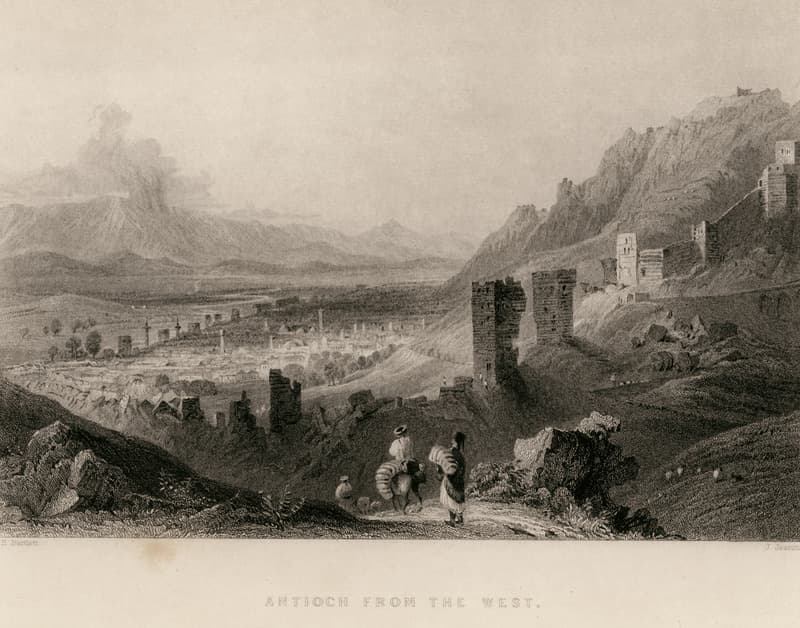
Antioch from the West, after W. H. Bartlett, 1836. Public domain.
Acts 11 to 15 · Story · Featured Study
The Church at Antioch
Luke tells its story in Acts 11, 13, 14 and 15.
- Where
- Antioch
- Who
- Barnabas, Paul, Peter
- When
- The 40s AD (probable)
The Greek word Christianos stands only three times in the New Testament, and the first is at Antioch.
and when he found him, he brought him back to Antioch. So for a full year they met together with the church and taught large numbers of people. The disciples were first called Christians at Antioch.
Summary
After Stephen died, believers fled Jerusalem and came to Antioch, the capital of Syria. Some of them preached to Greeks as well as Jews. Barnabas and Saul taught the church there for a year. There the disciples were first called Christians. Then the church sent Barnabas and Saul out to the work the Holy Spirit gave them.
- W. M. Ramsay dates Saul's coming to Antioch to the early months of AD 43.
- Ramsay dates the great famine in Palestine probably to AD 46.
- Thayer's lexicon gives the verb of Acts 11:26 the sense to receive a name or title.
The Texts of the Church at Antioch
Luke tells its founding in Acts 11 and its first sending in Acts 13.
Luke tells three things of the church at Antioch.
But some of them, men from Cyprus and Cyrene, went to Antioch and began speaking to the Greeks as well, proclaiming the good news about the Lord Jesus.Luke gives the home islands and cities of these preachers, and not their names.
While they were worshiping the Lord and fasting, the Holy Spirit said, “Set apart for Me Barnabas and Saul for the work to which I have called them.”This is the sending from Antioch that opens the mission of Acts 13 and 14.
Who Came to Antioch and Who Went Out
Ten movements, from the scattering after Stephen to Cephas at Antioch.
Antioch received preachers from Jerusalem and sent its own out.
| Who went | From | To | Why |
|---|---|---|---|
| Those scattered after Stephen | Jerusalem | Phoenicia, Cyprus and Antioch | Driven out by the persecution |
| Men of Cyprus and Cyrene | Cyprus and Cyrene | Antioch | To preach the Lord Jesus |
| Barnabas | Jerusalem | Antioch | Sent by the church in Jerusalem |
| Barnabas | Antioch | Tarsus, and back | To find Saul |
| Barnabas and Saul | Antioch | Judea | To carry the famine relief |
| Barnabas and Saul | Antioch | The work the Spirit named | Set apart and sent off by the church |
| Paul and Barnabas | The churches of their journey | Antioch | To report to the church |
| Paul and Barnabas, with others | Antioch | Jerusalem | To settle the question the men from Judea raised |
| Judas and Silas, with Paul and Barnabas | Jerusalem | Antioch | To bring the letter |
| Cephas | Not given | Antioch | Paul does not say why |
Paul and Barnabas, Paul and Barnabas, with others, Judas and Silas, with Paul and Barnabas, Cephas
The Story From the Scattering to the Clash
Seven scenes from Acts 11 to 15 and Galatians 2.
The preachers who came to Antioch had fled the persecution after Stephen's death. Luke gives no year for their coming.
The hand of the Lord was with them, and a great number of people believed and turned to the Lord.Luke credits the growth of the church to the Lord.
When the church in Jerusalem heard, it sent Barnabas, and he brought Saul back with him. For a year the two taught the church there.
Then Barnabas went to Tarsus to look for Saul,This verse brings Saul into the church at Antioch.
A prophet named Agabus foretold a great famine, and the disciples sent relief to the brothers in Judea by Barnabas and Saul.
Josephus dates "that great famine" in Judea to the governors Fadus and Tiberius Alexander. He tells of Queen Helena of Adiabene buying corn at Alexandria for Jerusalem. Suetonius and Tacitus report scarcity of grain at Rome under Claudius, and neither names Judea.
One of them named Agabus stood up and predicted through the Spirit that a great famine would sweep across the whole world. (This happened under Claudius.)This is the famine Josephus, Suetonius and Tacitus are read beside.
Luke names five prophets and teachers of the church, Barnabas and Saul among them.
The church set them apart and sent them off.
Now in the church at Antioch there were prophets and teachers: Barnabas, Simeon called Niger, Lucius of Cyrene, Manaen (who had been brought up with Herod the tetrarch), and Saul.The church that sent them was led by men from Cyprus, Africa, Herod's court and Tarsus.
They sailed back to Antioch, gathered the church and reported all God had done through them.
When they arrived, they gathered the church together and reported all that God had done through them, and how He had opened the door of faith to the Gentiles.The church that had sent them heard their report first.
Then men came down from Judea teaching that the brothers must be circumcised to be saved. The church sent Paul and Barnabas up to Jerusalem about the question.
The letter came back with Judas and Silas, and when the church read it, they rejoiced. Paul and Barnabas stayed on at Antioch.
Then some men came down from Judea and were teaching the brothers, “Unless you are circumcised according to the custom of Moses, you cannot be saved.”Luke gives the words of the men from Judea as they taught them.
Paul writes that when Cephas came to Antioch and drew back from eating with the Gentiles, he opposed him to his face, and that even Barnabas was led astray.
When Cephas came to Antioch, however, I opposed him to his face, because he stood to be condemned.Paul tells the clash in his own words to the Galatians.
Acts 11:28, Acts 13:1, Acts 14:27, Acts 15:1, Galatians 2:11
Antioch, the Capital of Syria
A Greek city of the Seleucid kings, with a large Jewish community.
Strabo writes that Seleucus Nicator founded Antioch and named it for his father. He calls it the metropolis of Syria, not much less in wealth and size than Seleucia on the Tigris and Alexandria.
Josephus calls it "the third city in the habitable earth that was under the Roman empire".
He writes that Seleucus made the Jews citizens of Antioch, that they lived there in the greatest numbers with privileges equal to the Greeks, and that they made proselytes of many Greeks.
Chrysostom counted those who gathered in its congregations in his day at one hundred thousand, a count of Christians and not of the city.
The Church at Antioch After Acts
Eusebius gives the city's first two bishops.
Eusebius writes that Luke was of Antiochian parentage. He names Evodius the first bishop of Antioch and Ignatius the second, and McGiffert notes that the dates of its early bishops are not known.
Antioch as the Pattern of Sending
Carey in 1792 and Eugene Stock in 1889 read the church's sending as a pattern.
William Carey, arguing in 1792 that Christians must send missionaries to the nations, retold Antioch. He wrote that "a church was formed in that city also, which in a little time sent out several eminent preachers."
He called the mission of Acts 13 and 14 the first attack on the heathen world.
Eugene Stock, writing of the Cambridge Seven in 1889, cited Acts 13:2 for a church that must send out its best men, with fasting and prayer.
How the Key Verse Was Taught
Three writers of three centuries on Acts 11:26.
Ignatius of Antioch (died 108)
The Epistle to the Magnesians, chapter 10
Ignatius told the Magnesians to live by the name they bore.
“Let us not, therefore, be insensible to His kindness. For were He to reward us according to our works, we should cease to be. Therefore, having become His disciples, let us learn to live according to the principles of Christianity. For whosoever is called by any other name besides this, is not of God.”
Early Church
John Chrysostom (died 407)
Homily on Acts 25
John Chrysostom, a preacher of Antioch, tied the name to the year Paul taught there.
“‘And when he had found him, he brought him to Antioch.’ Verily this is the reason why it was there they were appointed to be called Christians, because Paul there spent so long time! ‘And it came to pass, that a whole year they assembled themselves with the Church, and taught much people. And the disciples were first called Christians at Antioch.’ No small matter of praise to that city! This is enough to make it a match for all, that for so long a time it had the benefit of that mouth, it first, and before all others: wherefore also it was there in the first place that men were accounted worthy of that name.”
on Acts 11:26Patristic
John Wesley (1703 to 1791)
Explanatory Notes upon the New Testament
John Wesley added that before Antioch the disciples had been called Nazarenes and Galileans.
“Here it was that they first received this standing appellation. They were before termed Nazarenes and Galileans.”
on Acts 11:26Evangelical
Where Readers Differ
Three questions of the church at Antioch, with the writers who answer them.
Who first called them Christians?3 paragraphs
W. M. Ramsay wrote in 1896 that "obviously the name originated outside the brotherhood". Henry Alford, in 1865, held that Christians never use the name of themselves in the New Testament and that the Jews would not have given it. J. B. Lightfoot called it "a term of ridicule and contempt then".
Christopher Wordsworth, in 1872, read Eusebius as giving the name to the church itself, and quoted Bishop Pearson that Evodius, the bishop of the city, gave it.
Albert Barnes, in 1850, set out the readings and inclined to a name the Gentiles gave without reproach.
Who founded the church?2 paragraphs
Luke credits no one person with beginning the church.
How did the clash end?2 paragraphs
Paul does not say how Peter answered him. Lightfoot notes that by the end of the chapter Paul's words have "drifted away from Peter at Antioch to the Judaizers in Galatia."
Lightfoot also writes that the church of Antioch "took the larger and truer view", with Jewish and Gentile converts living together as one brotherhood.
Books to Read Next
Three works, each free to read online, in editions of the nineteenth century.
St. Paul the Traveller and the Roman Citizen
W. M. Ramsay · 1896
He argues that the name came from outside the brotherhood, and gives dates for the church's first years.
Free at the Internet ArchiveSaint Paul's Epistle to the Galatians
J. B. Lightfoot · 1887
Lightfoot weighs the clash at Antioch in his notes on Galatians 2 and in his essay St Paul and the Three.
Free at the Internet ArchiveHomilies on the Acts of the Apostles
John Chrysostom, in the Nicene and Post-Nicene Fathers, first series, volume 11 · 1889
Chrysostom preached his twenty-fifth homily on the founding of the church at Antioch in Acts 11.
Free at the Christian Classics Ethereal LibraryWhat the Church at Antioch Left
After Acts, the church at Antioch stands in Eusebius's list of bishops and in the missions that took its sending as their pattern. The question of circumcision raised at Antioch went up to the apostles and elders at Jerusalem.
Sources
Scripture is the Berean Standard Bible.
- The Holy Bible, Berean Standard Bible (read 2026)
- Flavius Josephus, The Wars of the Jews 3.2.4 and 7.3.3, and The Antiquities of the Jews 12.3.1, 20.2.5 and 20.5.2, translated by William Whiston (1737)
- Strabo, Geography 16.2.4 and 16.2.5, translated by H. C. Hamilton and W. Falconer (1903)
- Suetonius, Claudius 18.2, translated by J. C. Rolfe, Loeb (1914)
- Tacitus, Annals 12.43, translated by A. J. Church and W. J. Brodribb.
- John Chrysostom, Homily 25 on Acts, Nicene and Post-Nicene Fathers, first series, volume 11 (1889), and Homily 85 on Matthew, volume 10.
- Eusebius, Church History 3.4.7, 3.22 and 3.36, translated by A. C. McGiffert, Nicene and Post-Nicene Fathers, second series, volume 1 (1890), with McGiffert's notes.
- Origen, Homily 6 on Luke, in Jerome's Latin, Migne, Patrologia Graeca 13 (1862)
- J. B. Lightfoot, Saint Paul's Epistle to the Galatians, ninth edition (London, 1887), the notes on 2:11 and 2:14 to 21 and the essay St Paul and the Three.
- W. M. Ramsay, St. Paul the Traveller and the Roman Citizen (New York: Putnam, 1896)
- Henry Alford, The Greek Testament, volume 2, fifth edition (1865), on Acts 11:26.
- Albert Barnes, Notes on the Acts of the Apostles, tenth edition (1850), on Acts 11:26.
- Christopher Wordsworth, The New Testament in the Original Greek, volume 1, new edition (1872), on Acts 11:26.
- Strong's Greek 5546, Christianos, with Thayer's Greek-English Lexicon (1889) on 5537.
- William Carey, An Enquiry into the Obligations of Christians, to Use Means for the Conversion of the Heathens (Leicester, 1792), section II.
- Eugene Stock, in B. Broomhall, ed., The Evangelisation of the World (London, 1889)
- Ignatius, To the Magnesians 10, the shorter recension, The Ante-Nicene Fathers, volume 1 (1885)
- John Wesley, Explanatory Notes upon the New Testament (1755), on Acts 11:26.
Keep Studying
Read it1
Studies6
Places1
Church history1
Doctrines1