
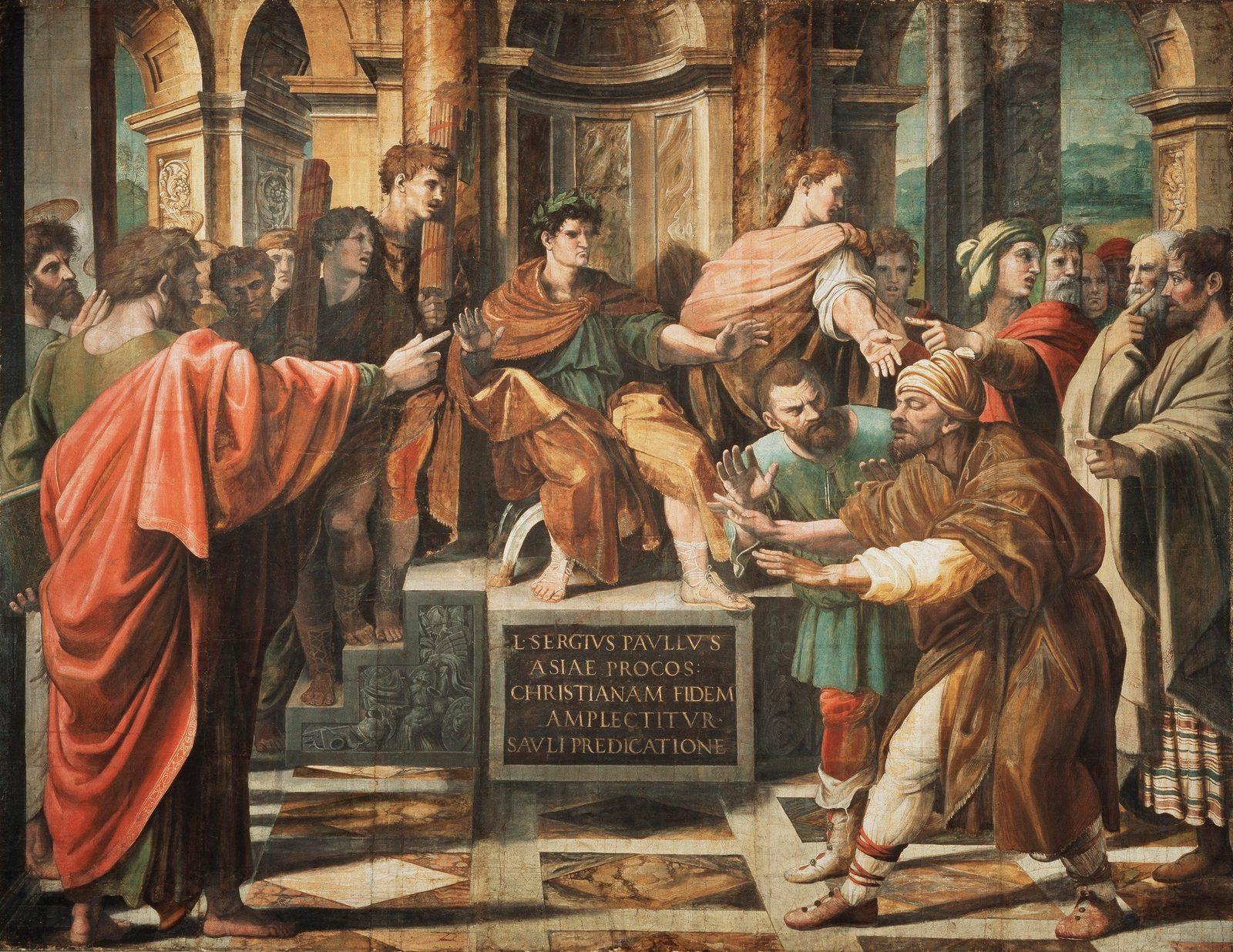
Raphael, The Conversion of the Proconsul, 1515 to 1516. Public domain.
Numbers 24:24 · Place · Featured Study
Cyprus
Paul and his companions set sail from Paphos and came to Perga in Pamphylia (Acts 13:13).
Once more Balaam lifted up an oracle, saying: “Ah, who can live unless God has ordained it? Ships will come from the coasts of Cyprus; they will subdue Asshur and Eber, but they too will perish forever.”
- Region
- The eastern Mediterranean, west of Syria and south of Cilicia
- First named
- Numbers 24:24 “…come from the coasts of Cyprus; they will…”
- Last named
- Acts 27:4 “…sailed to the lee of Cyprus because the…”
Balaam's last oracle has ships come from the coasts of Cyprus, as the Berean prints Kittim, to subdue Asshur and Eber.
Summary
Acts names Cyprus in seven verses, more than any other book of Scripture.
- The believers scattered after Stephen's death reached Cyprus and spoke the message only to Jews (Acts 11:19).
- Mnason, an early disciple at whose home Paul lodged, was a Cypriot (Acts 21:16).
- Paul's later voyages passed the island twice, south of it on the way to Syria (Acts 21:3) and in its lee on the way to Rome (Acts 27:4).
Kittim and Cyprus
The Berean prints Cyprus in five of the verses where the Hebrew reads Kittim, and the identification of Kittim with the island is Josephus's.
Why does the Berean text print Cyprus where the Hebrew reads Kittim? The Hebrew words of the verses show Kittim in all eight verses the STEP Bible lexicon of Tyndale House counts, from Genesis to Daniel. The Berean Standard Bible prints Kittites in Genesis 10:4 and 1 Chronicles 1:7, Kittim in Daniel 11:30, and Cyprus in the other five. In William Whiston's translation of the Antiquities of the Jews, Book 1, chapter 6, section 1, Flavius Josephus writes that Cethimus possessed the island Cethima. In the same passage he says it is now called Cyprus. He adds that one city of Cyprus kept the old name, called Citius by those who speak Greek. That lexicon glosses a Kittite as a Cypriote and, by extension, as an islander, the Greeks or Romans on the shores opposite Palestine.
Cyprus on van Doetecum's Plate
The engraver drew sailing ships in the sea off the north coast.
The plate sets Paphos on the south-west coast and the district of Salaminia on the east.
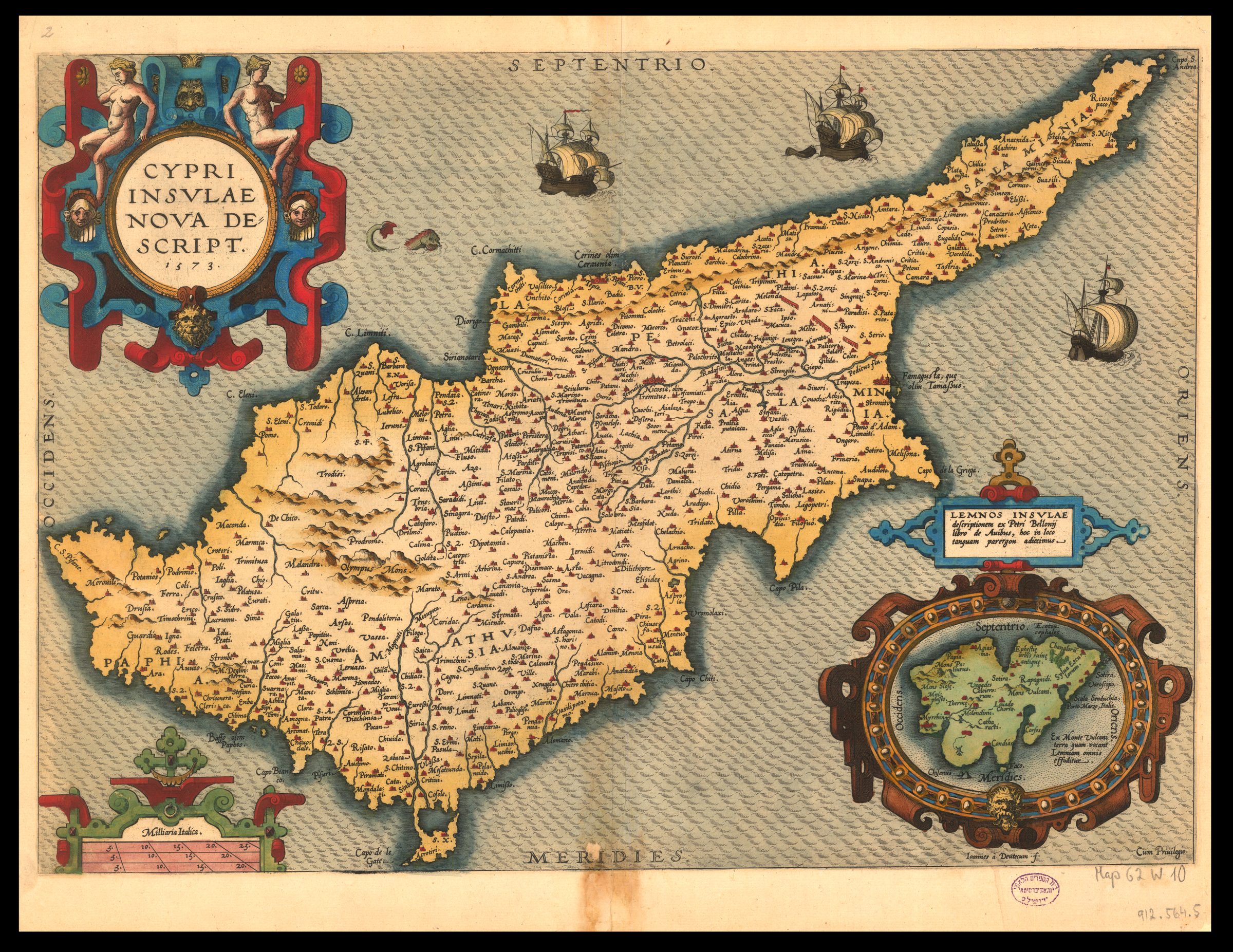
Joannes van Doetecum I, Cypri Insulae Nova Descript., 1573. Public domain (PD-old-assumed); Eran Laor Cartographic Collection, National Library of Israel; Wikimedia Commons, File:Joannes_van_Doetecum_I,_Cypri_Insulae_Nova_Descript_(FL35076758_2565136).jpg.
Three places are numbered where the plate prints them. Joannes van Doetecum's plate of 1573 is a sixteenth-century engraver's drawing of the island, with the towns of his own day. Its inset is the island of Lemnos. The OpenBible gazetteer rates all three identifications known. North is at the top, and the plate is not to a modern scale.
Cyprus in Acts
The voyage of Acts 13 set out from Seleucia (Acts 13:4).
Acts names the island where Barnabas first appears, a Levite from Cyprus (Acts 4:36). Barnabas sails there again with Mark after parting from Paul (Acts 15:39).
Mark: Useful to Me for Ministry
They traveled through the whole island as far as Paphos, where they found a Jewish sorcerer and false prophet named Bar-Jesus, an attendant of the proconsul, Sergius Paulus. The proconsul, a man of intelligence, summoned Barnabas and Saul because he wanted to hear the word of God.Luke names both men the missionaries met at Paphos and gives the governor his rank.
Albert Barnes, on Acts 13:7, calls Luke's title for Sergius Paulus worthy of special remark. Barnes explains that Augustus divided the provinces between his own officers and the senate's. Jamieson, Fausset and Brown add that proconsul was the title of a governor of a senatorial province. They note that the New Testament never gives the title to Pilate, Felix or Festus. Acts 13:8 calls the sorcerer Elymas, the same Bar-Jesus. In Acts 13:11 Paul tells him that the hand of the Lord is against him and that for a time he will be blind, and mist and darkness come over him.
The Ships of Kittim
Adam Clarke comments on Kittim in all three verses, and Jamieson, Fausset and Brown, John Wesley and John Gill on one each.
Of six readings in three verses, two take Kittim for Greece and Rome together, two for Rome, one reports Rome and Macedonia, and one prefers Italy.
| Verse | Reading of Kittim | Holder and work |
|---|---|---|
| Numbers 24:24 | The Greeks under Alexander and his successors, and after them the Romans | Jamieson, Fausset and Brown, Commentary Critical and Explanatory |
| Numbers 24:24 | The Grecian and Roman empire, the scourge of Asshur and Eber | John Wesley, Explanatory Notes |
| Numbers 24:24 | Some take Kittim for the Romans and others for the Macedonians, and Augustin Calmet holds Macedonia | Clarke, Commentary, reporting both |
| Daniel 11:30 | The Roman empire, whose legates turned Antiochus back from Alexandria | Clarke, Commentary |
| Daniel 11:30 | The Roman ambassadors Caius Popilius Laenas, Caius Decimus and Caius Hostilius, sent in ships from Macedonia | John Gill, Exposition |
| Jeremiah 2:10 | Italy and the coasts of Europe, after Samuel Bochart, against Josephus's Cyprus | Clarke, Commentary |
Ships of Kittim will come against him, and he will lose heart. Then he will turn back and rage against the holy covenant and do damage. So he will return and show favor to those who forsake the holy covenant.The Berean keeps the form Kittim in this verse alone of the eight.
The Coast of the Prophets
Isaiah 23 and Ezekiel 27 set Kittim beside Tyre and Sidon.
This is the burden against Tyre: Wail, O ships of Tarshish, for Tyre is laid waste, without house or harbor. Word has reached them from the land of Cyprus.This is the first verse outside Numbers where the Berean prints Cyprus.
Of oaks from Bashan they made your oars; of wood from the coasts of Cyprus they made your deck, inlaid with ivory.The lament over Tyre pictures the city as a ship, and this is its one verse to name the island.
Isaiah 23:12 sends the Virgin Daughter of Sidon across to Cyprus, as the Berean prints it. Jeremiah 2:10 to 11 sends Israel across to the coasts of Cyprus and to Kedar to see whether a nation has ever changed its gods. Jamieson, Fausset and Brown, on Jeremiah 2:10, take the two names for the heathen nations of the west and the east.
What Scripture Leaves Unsaid
Two things the Cyprus texts leave unnamed.
Who Can Live Unless God Has Ordained It?
In Balaam's last oracle the ships come under God's ordaining.
Jerome on the Proconsul's Name
Jerome tied the apostle's Roman name to the proconsul of Cyprus.
Astonished at the Teaching
When the proconsul saw what had happened, he believed, for he was astonished at the teaching about the Lord.Luke gives the reason for the governor's faith in the verse's last clause.
Sources
Scripture is the Berean Standard Bible.
- STEP Bible TBESH glosses (Tyndale House, CC BY 4.0), entry h3794 Kittim.
- OpenBible.info, Bible Geocoding Data, ancient places (CC BY 4.0)
- Flavius Josephus, Antiquities of the Jews, Book 1, chapter 6, section 1, translated by William Whiston, Project Gutenberg text 2848.
- Jamieson, Fausset and Brown, Commentary Critical and Explanatory on the Whole Bible, on Numbers 24:24.
- John Wesley, Explanatory Notes upon the Old Testament, on Numbers 24:24.
- Adam Clarke, Commentary on the Bible, on Numbers 24:24.
- Adam Clarke, Commentary on the Bible, on Daniel 11:30.
- John Gill, Exposition of the Old Testament, on Daniel 11:30.
- Adam Clarke, Commentary on the Bible, on Jeremiah 2:10.
- Jamieson, Fausset and Brown, Commentary Critical and Explanatory on the Whole Bible, on Jeremiah 2:10.
- Albert Barnes, Notes, Explanatory and Practical, on the Old and New Testaments, on Acts 13:7.
- Jamieson, Fausset and Brown, Commentary Critical and Explanatory on the Whole Bible, on Acts 13:7.
- Jerome, On Illustrious Men 5.4, on Acts 13:7.
Keep Studying
People and groups5
Church history1