History · 1 Samuel
The Hinge of Israel's History
Israel’s worship collapses under a corrupt priesthood even as a barren woman’s prayer births the nation’s last judge. The elders demand a king “like all the nations”(8:5); the LORD grants Saul — tall, capable, outwardly royal — then rejects him for partial obedience, because “Jehovah looketh on the heart” (16:7). And the LORD’s true choice, a shepherd from Bethlehem, is anointed in secret and proved in a decade of unjust persecution — still uncrowned when the book ends.

The Hinge
— three acts, and the crossing point where a king falls as a shepherd rises1 Samuel is the book where Israel’s government changes shape — from charismatic judges raised up as needed to a permanent throne — and it tells that change as a single story in three acts: a judge rises, a king is given and falls, a shepherd is chosen and tested. Every chapter below is a door into the reader.
- Samuel Rises1 Samuel 1:1–7:17A barren woman's vow → a corrupt priesthood's fall → a boy's call
“The word of Jehovah was precious in those days; there was no frequent vision” (3:1)
Hannah's prayer and vow open the book, and her son Samuel grows up inside the collapse of Eli's house — priests who despise the offering and defile the tabernacle. The ark itself is captured, sets a pagan god on its face, and comes home to Kiriath-jearim while Samuel grows into the last of the judges and the first of the prophet-kingmakers.
- Saul Given, Saul Rejected1 Samuel 8:1–15:35Three-stage installation → covenant renewal → two rejection-words
“Make us a king to judge us like all the nations” (8:5)
Israel asks for what every other nation has, and Samuel hears the theology under the request: “they have not rejected thee, but they have rejected me” (8:7). Saul is anointed in private, chosen by lot in public, and confirmed by victory at Jabesh-gilead — then unravels across two acts of partial obedience until the word comes: the kingdom is torn from him.
- David Anointed, David Tested1 Samuel 16:1–31:13A secret anointing → a decade of persecution → a throne not yet possessed
“Jehovah looketh on the heart” (16:7)
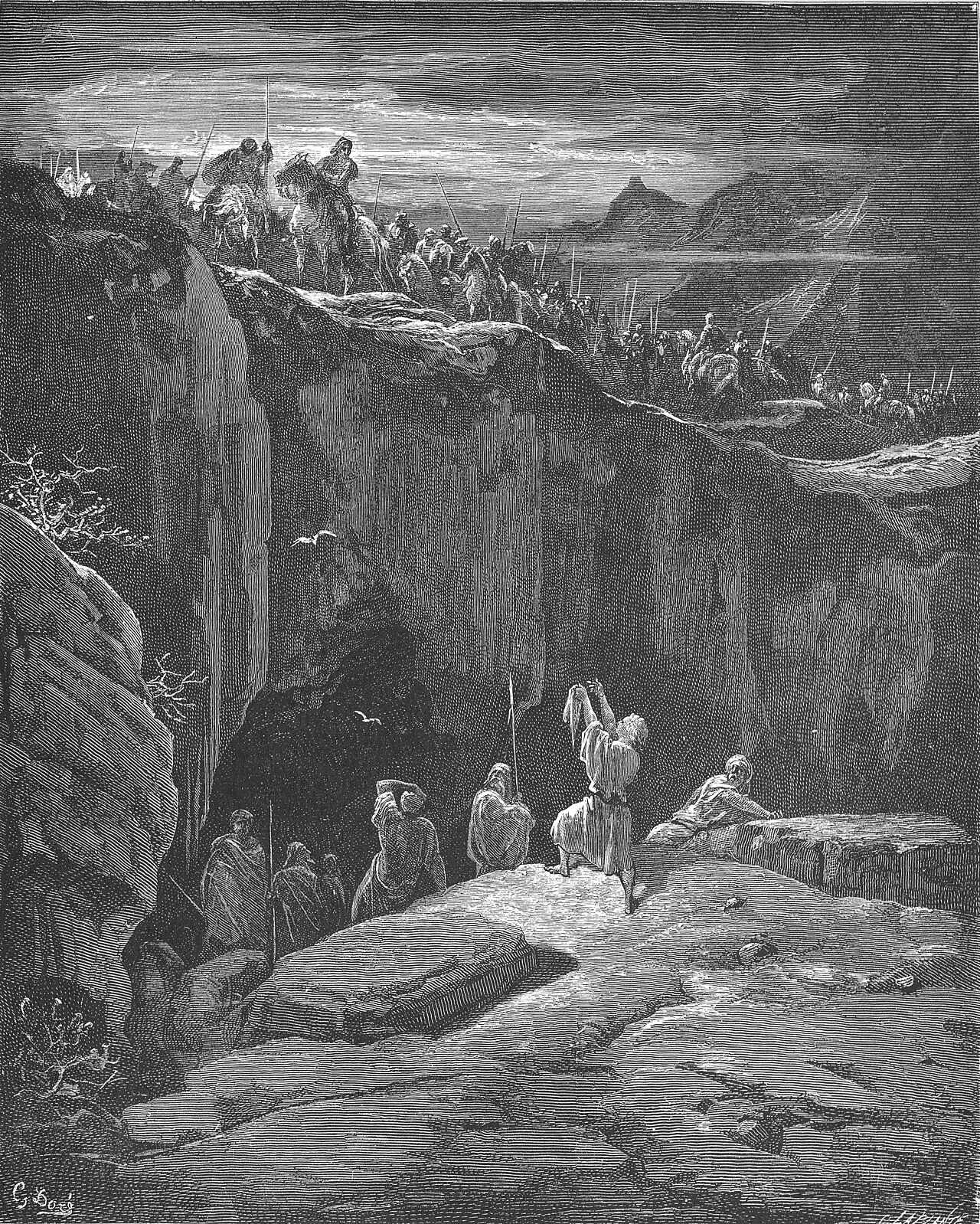
David is anointed while Saul still reigns and the Spirit still moves on Saul's rival — then spends the rest of the book uncrowned: a court musician, a giant-killer, a fugitive, twice sparing the man hunting him. The book ends with Saul dead on Gilboa and David still waiting on a promise God has not yet made him take by force.
Standing before the LORD, chapters 8–31 — where the two lines cross
The two lines are not circumstance — David’s falls in the world’s eyes for most of the book, a fugitive with a price on his head. They plot standing before the LORD: obedience kept or broken, mercy given or withheld. Saul peaks at Jabesh-gilead and never recovers past ch. 15; David is anointed while still a nobody, and his line keeps climbing through exile because what is being measured is the heart, not the throne.
The Argument
— the whole book in three sentences- Attribution
- Tradition: Samuel (early chapters) → Nathan & Gad (from 25:1) · anonymous in the text itself
- Span
- Judges' twilight → the eve of David's reign
- Genre
- Covenant-historical narrative — the Deuteronomistic history
- Shape
- 31 chapters · 3 acts · 1 hinge (ch. 16)
- 1
Israel's worship collapses under a corrupt priesthood even as a barren woman's prayer births the last and greatest judge, Samuel, who anchors the nation in the word of the LORD.
- 2
The elders demand a king “like all the nations” (8:5); the LORD grants Saul — tall, capable, outwardly royal — and then rejects him for partial obedience, because “Jehovah looketh on the heart” (16:7).
- 3
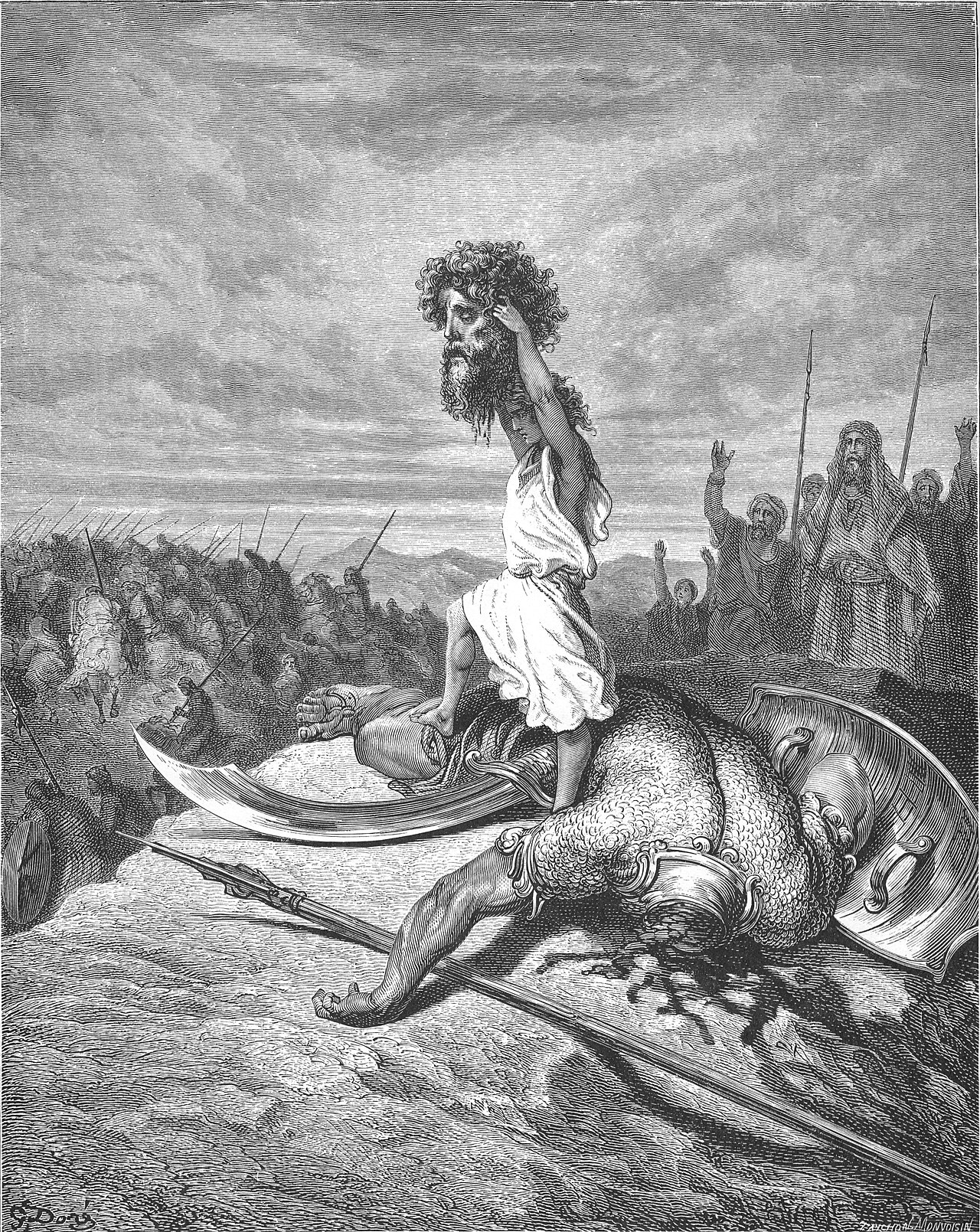
The LORD's true choice, David the shepherd of Bethlehem, is anointed in secret, proves himself in the valley of Elah and in a decade of unjust persecution, and emerges — still uncrowned when the book ends — as the king after God's own heart, tested by suffering before he is exalted.
The Keystone
— a promise sung, a trial named, a verdict spoken — three verses, one claim“He raiseth up the poor out of the dust, He lifteth up the needy from the dunghill, To make them sit with princes, And inherit the throne of glory.”
Hannah sings this before a single king has been named. It is the book's whole grammar of reversal, stated as praise before it is a plot — and everything from Eli's fall to David's rise plays it out in flesh and blood.
“Behold, to obey is better than sacrifice, and to hearken than the fat of rams.”
Saul kept the best of Amalek's flocks “to sacrifice unto Jehovah thy God” (15:15) — disobedience dressed as worship. Samuel's verdict names the book's second thesis: religious activity cannot substitute for a plain command kept in full.
“Man looketh on the outward appearance, but Jehovah looketh on the heart.”
Spoken to Samuel himself, drawn to Eliab's height exactly as Israel had been drawn to Saul's. The sentence that passes over seven sons for the youngest, still in the field, is the standard the whole book asks to be read by.
“Obedience is enjoyed by the eternal law of nature, but sacrifice only by a positive law. Obedience was the law of innocency, but sacrifice supposes sin come into the world, and is but a feeble attempt to take that away which obedience would have prevented. God is more glorified and self more denied by obedience than by sacrifice.”
Matthew Henry, Commentary on the Whole Bible (1710), on 1 Samuel 15:22–23 — public domain.
Christ in 1 Samuel
— the covenant's prehistory — the man chosen, anointed, and proved before the promise is spokenDavid is taken from the sheepfolds to shepherd Jacob (Ps 78:70–71, looking back on this book). The title Samuel's horn of oil confers here — mashiach, the anointed one — culminates in “great David's greater Son”: Christ, born in the same Bethlehem, the Good Shepherd Himself called Christos, the Greek translation of this very Hebrew word.
David is anointed king while Saul still reigns, then spends the rest of the book rejected, hunted, and homeless before he is ever crowned — the Old Testament's most sustained narrative rehearsal of the pattern the New Testament names of Christ: humbled, and only then highly exalted.

David refuses twice to kill the man actively hunting him, because Saul is still the LORD's anointed. Read typologically — not as an NT-cited fulfillment — as a king who wins his throne by patient mercy rather than seized violence, a pattern MannaFest carries carefully as homiletical rather than exegetically certain.
Mary’s Magnificat echoes Hannah’s prayer so closely in structure, vocabulary, and theme — reversal, the LORD who exalts the lowly — that most commentators read it as a deliberate allusion: the mother of the last judge prefiguring the mother of the Messiah.
Themes
— six load-bearing lines through the bookThe LORD is the true King
Samuel's protest at the demand for a king is theological, not political: Israel has not rejected Samuel but rejected the LORD's own reign over them. The whole book tests whether a human throne can exist under YHWH's kingship without displacing it.
The heart, not the appearance
Israel is drawn to Saul's height; Samuel is drawn to Eliab's. Both are corrected by the same verdict — the LORD sees what outward measure cannot, and chooses accordingly.
Obedience over sacrifice
Saul's rejection is not for irreligion but for partial obedience dressed as worship. Divided obedience is disobedience — the book's second programmatic verse.
Reversal — the humbled exalted
Hannah's prayer states the book's grammar before the narrative enacts it twice: Eli's house falls as Samuel's rises; the tall king falls as the youngest, still keeping sheep, rises.
Covenant loyalty (ḥesed)
Where Saul's court runs on suspicion, David and Jonathan's covenant runs on chesed — personal loyalty as the counter-model to political self-preservation, and what lets David refuse to harm “the LORD's anointed.”
Waiting on the LORD's timing
David is anointed in ch. 16 and does not reign until 2 Samuel 5. 1 Samuel is a sustained meditation on how to wait for a promise already given without seizing it by force.
Original Language
— the shophet→melek transition, visible in the vocabulary itselfSamuel anoints Saul nagid — “leader, ruler-designate” — before the word melek, “king,” is used of him publicly (9:16; 10:1). The softer, prophet-conferred title lets a ruler be installed under YHWH's authority before the people crown him with the more absolute title they demanded; the seam between theocracy and monarchy is visible in the vocabulary itself, and the book uses nagid again of David (13:14; 25:30).
The Approved Voices on 1 Samuel
— the roster applied — the specific work named, so you can go to ithis Koinonia House expository catalog
Reads Samuel's prophetic office and David's secret anointing as deliberate Christ-typology — the same integrated-design method he brings to Genesis and the Torah.
The Holiness of God (1985)
The ark narrative's terror before a holy God (1 Sam 4–6) as paradigmatic of the creature's right response to holiness — the same theme he traces from Isaiah 6 onward.
The Fear of the Lord
Reads Saul's presumptuous sacrifice (13:8–14) and incomplete obedience (ch. 15) as the book's central case study in the difference between religious activity and genuine reverence.
Intercessory Prayer
Treats Samuel's vow, “far be it from me that I should sin against Jehovah in ceasing to pray for you” (12:23), as a keystone biblical text on the intercessor's office.
his covenant-theology teaching
Reads the David–Jonathan bond (18:3–4; 20:42) as a model instance of biblical covenant-cutting standing alongside the Abrahamic, Mosaic, and Davidic covenants.
his preaching on Hannah's prayer and on David's restraint toward Saul
Returns repeatedly to 16:7 as a searching text on hypocrisy and true religion, and to David's refusal to avenge himself as a picture of leaving vengeance to God (cf. Rom 12:19).
An Exposition of the Old and New Testament
Full verse-by-verse devotional exposition of 1 Samuel — Hannah's vow read as a model of importunate, believing prayer wedded to costly consecration.
A Commentary, Critical and Explanatory, on the Whole Bible
Treats “rebellion is as the sin of witchcraft” (15:23) as naming self-willed disobedience with the same spiritual root as occult rebellion against God's authority.
Commentary on the Old Testament
The standard conservative-critical philological treatment — strong on the nagid/melek distinction (9:16; 10:1) and the Hannah narrative's Hebrew detail.
his providential theology, touching Saul's rejection and David's election
Consistent with his broader doctrine of providence — Saul's fall and David's rise read as the LORD's sovereign hand, not blind history.
Marcus Brown’s own commentary leads above all; within a tier, all voices are equal — Missler and Spurgeon carried as through-lines, never elevated above their tier.
Contested Points
— presented at full strength, then MannaFest's flagThe “doublets” in Saul's installation (9:1–10:16 private · 10:17–27 public lot · 11:1–15 battlefield)
The source-critical case
Since Wellhausen, critics have assigned these accounts to independent, even opposed, sources — an early source that views kingship as God's gracious gift, and a later Deuteronomistic source that views it as covenant rebellion — stitched together imperfectly, so that Saul is “made king” three separate times.
The staged-installation reading
The three scenes are not competing accounts of one event but three stages of a single, deliberately staged installation: private divine designation, public confirmation before the tribes, and final national acclamation only after Saul proves himself in battle — a pattern matched by David's own multi-stage rise (private anointing → public proof → eventual coronation).
MannaFest flag — The “anti-monarchic” material (ch. 8, 12) is read as Samuel's own theological commentary on the same installation, not a separate source: kingship is both YHWH's genuine gift and a concession to Israel's unbelief — both true at once, which is the book's tension, not an editorial accident.
The Amalekite herem (ch. 15) — the moral difficulty
The moral challenge
The command to “utterly destroy… man and woman, infant and suckling” (15:3) is among Scripture's starkest ethical difficulties — how can a good God command the killing of noncombatant children, and how does this differ from other ancient Near Eastern conquest ideology?
The covenant-justice reading
Amalek is singled out for an unprovoked, cowardly attack on Israel's weakest at the Exodus (Deut 25:17–18), and the sentence pronounced then (Exod 17:14–16) is executed here roughly four centuries later — the “full measure of iniquity” pattern already seen with the Amorites (Gen 15:16), a bounded judicial act rather than a template for warfare in general.
MannaFest flag — MannaFest presents the difficulty honestly rather than minimizing it, while holding the text's own verdict: the chapter's real center of gravity is not the command's difficulty but Saul's partial obedience — he spares exactly what serves him while completing the parts that cost him nothing.
Goliath's height — the Masoretic and Septuagint texts disagree
The “four cubits” case
The Septuagint and the Dead Sea Scrolls' 4QSamᵃ read “four cubits and a span” (roughly 6'9") at 17:4, a figure matching Josephus, and many textual scholars judge this the earlier reading against the Masoretic Text's “six cubits and a span” (roughly 9'9").
The received-text case
The Masoretic Text is the base text behind the ASV, KJV, and WEB and remains MannaFest's default; text-critical plurality in the transmission history — real and worth noting — does not threaten the inerrancy of the autographs.
MannaFest flag — 1 Samuel shows some of the widest MT–LXX divergence anywhere in the Old Testament, and the Qumran Samuel scrolls often side with the LXX. MannaFest presents the variant honestly as a witness worth knowing, not an inconvenience to suppress.
The Cast
— the people and places 1 Samuel moves throughPlaces