
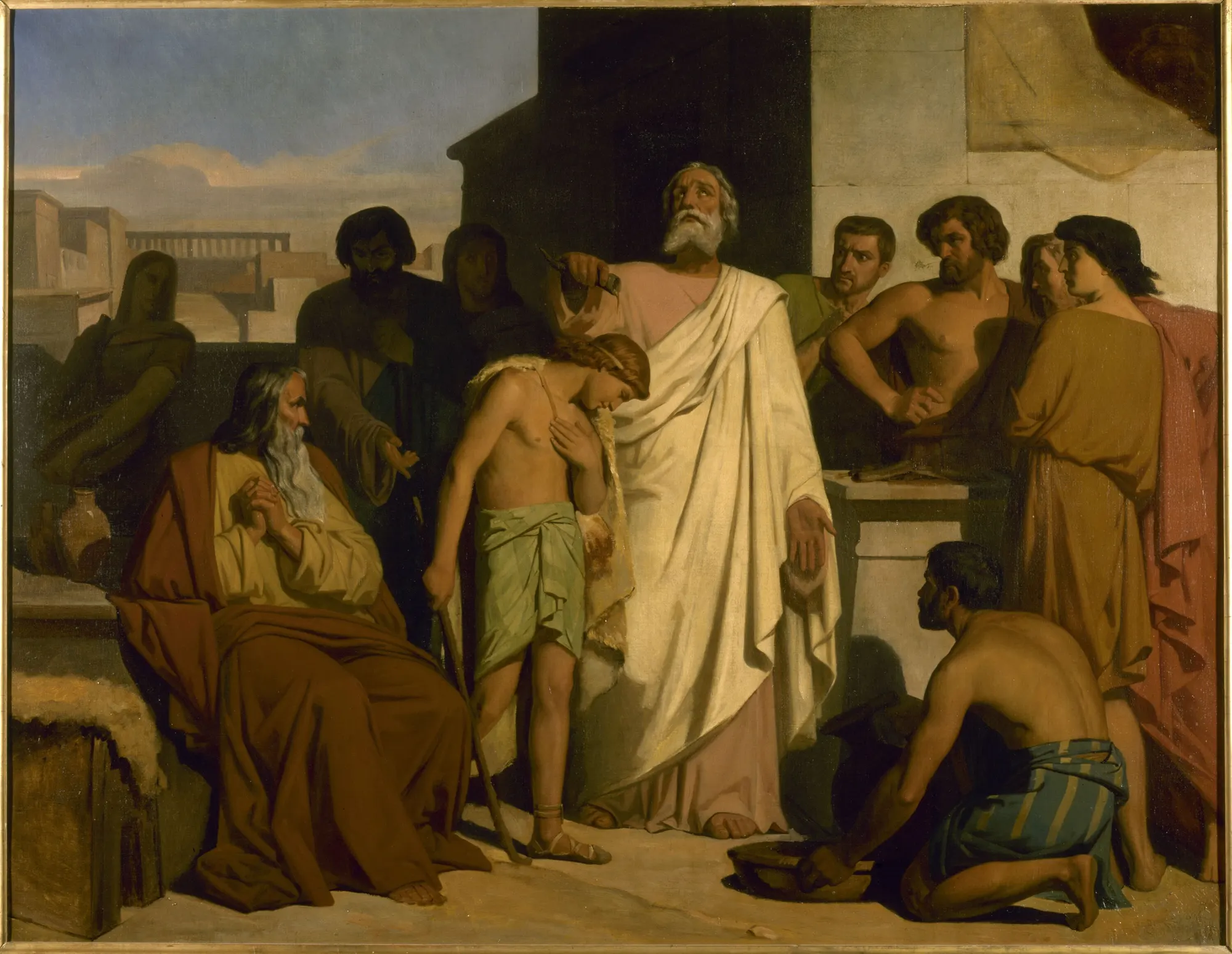
1 Samuelchapter 22
23 verses · Samuel, Nathan and Gad, by tradition · 10th century BC · History
So David left Gath and took refuge in the cave of Adullam. When his brothers and the rest of his father’s household heard about it, they went down to him there.
Introduction
Samuel, Nathan and Gad, by tradition, History, 1 Samuel Overview.
This chapter was recorded for a people who knew that a king who killed the LORD's priests had crossed a line no ruler should cross. It moves between two camps. One is a fugitive gathering desperate men in the hills of Judah, and the other is a king holding court under a tree at Gibeah. Listen to how each man speaks to the people around him, and to the one speech in the chapter made of nothing but suspicion. Watch the foreigner who was named once in the chapter before. Listen at the end for the words David says when the news reaches him.
Context
- Who
- Israelites who knew what it meant for a king to kill the priests of the LORD
- What
- An account of David's band forming at Adullam, Saul's charge against his own officers, and the killing of the priests of Nob.
- Where
- The cave of Adullam in the Judean foothills, Mizpeh in Moab, the forest of Hereth, and Saul's court at Gibeah.
- When
- The text gives no date; on the common reckoning it falls about 1018 BC, at the start of David's years as an outlaw.
- Why
- To set the two courts side by side, the king who kills priests and the fugitive who shelters the one survivor.
Historical context
The chapter belongs to David, now a captain over four hundred men rather than a lone fugitive, and to Saul, a reigning king holding court among his own tribesmen. Ahimelech the priest of Nob, Doeg the Edomite and Abiathar the one survivor of his house carry the second half. The time is about 1018 BC on the traditional conservative reckoning, within the decade between Saul's rejection and his death about 1010 BC.
Show the rest of the historical context, 4 more paragraphs
The places are the cave of Adullam in the hill country between Judah and the Philistine plain, Moab where David lodges his parents, and the forest of Hereth where the prophet Gad sends him. The occasion is the hunt for David turning into a purge of anyone suspected of helping him.
A first hearer knew the country at Adullam, riddled with caves and close enough to Judah's towns for a band to live off them, far enough from Gibeah to be hard to reach. He knew what the four hundred were, since everyone in distress, in debt and discontented is the underside of Saul's kingdom, men ruined by taxes, by debt and by bad rulings, with nowhere to go.
He knew why Moab was the asylum David chose, since David's great-grandmother was Ruth the Moabitess and there was family on that plateau. Saul's speech under the tamarisk at Gibeah revealed how he secured loyalty, since asking his tribesmen whether the son of Jesse would give them fields and vineyards points to land and rank distributed inside Benjamin.
He knew what the linen ephod on the men killed at verse 18 meant, since it marked them as priests serving before the LORD, which is why Saul's footmen refused to touch them.
Significance
Saul had spared the best of Amalek when the ban was commanded, and here he destroys an Israelite priest town entire, men, women, children and cattle, on his own initiative. First hearers were meant to set the two scenes side by side.
Show the rest of the significance, 2 more paragraphs
David tells Abiathar that he has occasioned the death of all the persons of his father's house, and then takes him in with a promise of safety.
The two courts are now visible together. One is a king on a throne killing priests, the other a fugitive in a cave sheltering the survivor.
This chapter in Jewish lifeWhat this chapter is in Jewish life and reading.
How it is read
Rashi reads this chapter as the price of sheltering a hunted man, and he carries two traditions into it. On David's parents left in Moab he hands on the Midrash of Rabbi Tanchuma. On that account the king of Moab killed David's father, mother and brothers after David moved on, and one brother survived because Nahash the Ammonite raised him. Rashi cites Bamidbar Rabbah 14:1, and reads the later kindness David speaks of in II Shmuel 10:2 from it (Rashi on I Samuel 22:4:1, the Metsudah Tanach series, Lakewood, N.J., CC-BY). On the tamarisk tree Saul sat under he gives the plain reading first, a hill inside Benjamin's border. He then gives the Rabbis' reading from Maseches Taanis 5b, that the great tamarisk is Samuel at Ramah, whose prayer held Saul's reign in place (Rashi on I Samuel 22:6:2, same edition). On Saul's charge against the priest he states the legal point plainly. Inquiry of the Urim and Thummim was not made for a commoner, so to inquire for David was to treat him as king (Rashi on I Samuel 22:13:1, same edition). On the priest's defence he reads the question as an appeal to long service. The community's concern had been David's since the day he was appointed to lead Israel out and back (Rashi on I Samuel 22:15:1, same edition). On the men who refused the king's order he identifies them as Abner and Amasa (Rashi on I Samuel 22:17:1, same edition). On the Edomite who obeyed it he reports the change in the spelling of his name, which the Rabbis read as a word for a fisherman. He cites Talmud Yerushalmi Maseches Sanhedrin 10:2 and Maseches Sanhedrin 106b there (Rashi on I Samuel 22:18:1, same edition). On David's word to the escaped priest he follows Targum Yonoson, that the man who seeks one life seeks both (Rashi on I Samuel 22:23:1, same edition). Radak stands as a citation at I Samuel 22:2:1, 22:3:1, 22:4:1, 22:5:1, 22:7:1, 22:8:1, 22:9:1, 22:12:1 and 22:19:1. Metzudat David stands at 22:1:1, 22:2:1, 22:3:1 and 22:10:1, and Malbim at 22:1:1. The corpus holds no English version of them.
What the rabbis say
The corpus records forty rabbinic locators on this chapter, thirty-seven of them Midrash and three Talmud, each a locator without text. The men in distress who gathered to David draw Tanna DeBei Eliyahu Zuta 5:1. His parents brought to Moab draw Bamidbar Rabbah 14:1 and Midrash Tanchuma Buber, Vayera 25:1, which is where the tradition Rashi hands on is taken up. The prophet Gad sending David back to Judah draws Midrash Tehillim 23:6. Saul under the tamarisk draws Bereshit Rabbah 54:6, Midrash Sekhel Tov, Bereshit 21:34:6, Ein Yaakov, Taanit 1:15 and Ein Yaakov (Glick Edition), Taanit 1:14. Saul's speech to his servants draws Midrash Tehillim 4:7, Pesikta DeRav Kahana 18:1, Pesikta Rabbati 32:1 and Yalkut Shimoni on Torah 615:3. His complaint that no one tells him anything draws Berakhot 12b:8, Ein Yaakov (Glick Edition), Berakhot 1:55, Midrash Tanchuma Buber, Chukat 7:1 and Midrash Tanchuma Buber, Metzora 1:1. Doeg's report draws Bamidbar Rabbah 18:17, Bamidbar Rabbah 19:2, Midrash Tanchuma Buber, Chukat 8:2 and Midrash Tanchuma Buber, Noach 23:1. The summoning of the priests of Nob draws Yalkut Shimoni on Torah 558:1. The charge of inquiring for David draws Midrash Sekhel Tov, Shemot 8:11:2, and the priest's answer draws Pesikta DeRav Kahana 4:2 and Midrash Sekhel Tov, Bereshit 41:54:1. The sentence on the priests draws Midrash Tehillim 52:2, Midrash Lekach Tov, Leviticus 14:2:3, Midrash Tanchuma, Metzora 2:1 and Midrash Tanchuma Buber, Metzora 4:1. The refusal of Saul's runners draws Bamidbar Rabbah 8:4, Bereshit Rabbah 32:1, Jerusalem Talmud Sanhedrin 10:2:19 and Midrash Tehillim 52:4. The killing itself draws Ein Yaakov, Yoma 2:2, Ein Yaakov (Glick Edition), Yoma 2:2 and Midrash Aggadah, Leviticus 14:2:2. The destruction of the town draws Kohelet Rabbah 7:16:1, Midrash Tanchuma, Metzora 1:1 and Tanna DeBei Eliyahu Rabbah 31:1. Abiathar's escape draws Sanhedrin 95b:4 and Ein Yaakov (Glick Edition), Sanhedrin 11:32. The rabbis teach in these places, and this site reports them as their teaching rather than as a rule of the text.
Sources: Rashi, Rashi on I Samuel 22:4:1, 22:6:2, 22:13:1, 22:15:1, 22:17:1, 22:18:1 and 22:23:1, the Metsudah Tanach series, Lakewood, N.J., CC-BY; Radak, Radak on I Samuel 22:2:1, 22:3:1, 22:4:1, 22:5:1, 22:7:1, 22:8:1, 22:9:1, 22:12:1 and 22:19:1, cited only, no English version in the corpus; Metzudat David, Metzudat David on I Samuel 22:1:1, 22:2:1, 22:3:1 and 22:10:1, cited only; Malbim, Malbim on I Samuel 22:1:1, cited only.
The heads below are this chapter's scenes. The numbered points under each are its verses.
Adullam: the distressed and the debtors gather
1 Samuel 22:1-2
took refuge in the cave of Adullam: David takes refuge in the cave of Adullam. Those who gather next are the distressed, the indebted and the discontented, and David becomes their leader. Blaikie reads the anointed king not yet enthroned, gathering the desperate, as a picture of Christ before his kingdom comes, and Spurgeon preached it.
1 Samuel 22:1
“They are on the borders of the Philistine plain at the base of the Judea mountains, six miles southwest from Beth-lehem, and well adapted for concealing a number of refugees. his brethren and all his father's house . . . went down--to escape the effects of Saul's rage, which seems to have extended to all David's family.”
Jamieson, Fausset & Brown · Commentary Critical and Explanatory on the Whole Bible (1871)reformed
3 more voices on this verseWhat preachers and commentators have said about this verse, in their own words.
1 Samuel 22:1
“For if it is a bad thing to flee, it is much worse to persecute. The one party hides himself to escape death, the other persecutes with a desire to kill. It is written in the Scriptures that we ought to flee; but he that seeks to destroy transgresses the law and also is himself the occasion of the other's flight. If then they [the Arians] reproach me with my flight, let them be more ashamed of their own persecution. Let them cease to conspire, and those who flee will immediately cease to do so.”
Athanasius of Alexandria · written before 373 · Defense of His Flight 8patristic
1 Samuel 22:1
“To the cave Adullam - Or rather “of Adullam.” Adullam was the name of a town of Judah in the “Shephelah,” not far from Bethlehem, and below it. Innumerable caverns, one nearly 100 feet long, are excavated in the soft limestone hills in the neighborhood of Beit-Jibrin. (The cave is placed by Ganneau and Conder on the hill (500 feet high) over ‘Aid el Ma or Miyeh.) David’s brethren and kinsmen joined him partly from sympathy with him, and partly because their own lives were in jeopardy front Saul’s furious enmity.”
1 Samuel 22:1
“DAVID in the caverns of Adullam is a type of our Lord Jesus Christ despised and rejected among the sons of men. Christ is the Lord's Anointed, but men perceive not the anointing. He is persecuted by His great enemy, the world, as David was persecuted by Saul, and he now rather dwells in the Cave of Adullam than sits upon his throne. Just as when David was in his dishonor, it was the time for his true friends to rally around him.”
Charles Spurgeon · written before 1892 · The Metropolitan Tabernacle Pulpit, Sermon No. 3533: “Recruits for the King” (lightly modernized text, CCEL edition)Particular Baptist
all who were distressed or indebted or discontented: Barnes reads the discontented as men embittered by Saul's rule, and he compares 30:6, where David's men grow bitter in spirit. Clarke thinks some hoped for revenge and plunder. Henry notes that David used his four hundred men only as a guard and never raised a hand against the king.
1 Samuel 22:2
“And every one that was in distress - debt - discontented - It is very possible that these several disaffected and exceptionable characters might at first have supposed that David, unjustly persecuted, would be glad to avail himself of their assistance that he might revenge himself upon Saul, and so they in the mean time might profit by plunder, etc. But if this were their design they were greatly disappointed, for David never made any improper use of them.”
Adam Clarke · Commentary on the Bible (1810-1826)evangelical
1 Samuel 22:3-4
Mizpeh of Moab: David leaves his father and mother with the king of Moab “until I learn what God will do for me”. Barnes reads the refuge as owing to David's descent from Ruth the Moabitess, whose line runs from Ruth 4:17. Gill notes that Scripture never says what became of David's parents.
1 Samuel 22:3
“David went thence to Mizpeh of Moab--"Mizpeh" signifies a watchtower, and it is evident that it must be taken in this sense here, for it is called "the hold" or fort (1Sa 22:4).”
Jamieson, Fausset & Brown · Commentary Critical and Explanatory on the Whole Bible (1871)reformed
2 more voices on this verse
1 Samuel 22:3
“It was at this time that David penned Psalm cxlii. , which is entitled, A prayer when David was in the cave; and there he complains that no man would know him and that refuge failed him, but hopes that shortly the righteous would compass him about.”
Matthew Henry · Commentary on the Whole Bible (1707-1721)puritan
1 Samuel 22:3
“Mizpeh of Moab - A good conjecture connects it with “Zophim” (a word of the same root as Mizpeh) on the top of Pisgah Num 23:14. It is probable that David’s descent from Ruth the Moabitess may have had something to do with his seeking an asylum for Jesse, Ruth’s grandson, in the land of her birth. It would be very easy to get to the Jordan from the neighborhood of Bethlehem, and cross over near its embouchure into the Dead Sea. Come forth, and be with you - The construction of the Hebrew is very strange.”
the whole time David was in the stronghold: The stronghold is unnamed. Barnes places it in Moab and reads the time as a stay of some length, while Gill weighs Adullam against a fortress at Mizpeh. Wesley takes the word to cover every stronghold David used, so his father and mother stayed in Moab through all his wandering.
1 Samuel 22:4
“And he brought them before the king of Moab,.... Having leave from him for it, and left them with him; so the Targum,"caused them to remain before him:" and they dwelt with him all the whole time that David was in the hold; either in the cave of Adullam, as some think; or rather at Mizpeh in Moab, which might be a fortified place; or the sense may be, while he was in any hold in those parts, as he might go from one to another; what became of David's parents afterwards, we nowhere else read.”
2 more voices on this verse
1 Samuel 22:4
“He brought them before ... - The Septuagint renders it “he persuaded (the face of) the king.” In the hold - Where David was after he left the cave of Adullam, probably in the land of Moab. The phrase “all the while,” would indicate that David sojourned a considerable time in Moab.”
1 Samuel 22:4
“Hold - In holds; the singular number being put for the plural; as is frequent; that is, as long as David was forced to go from place to place, and from hold to hold, to secure himself: for it concerned David to secure his father, and he did doubtless secure him for all that time; and not only while he was in the hold of Mizpeh, or of Adullam, which was but a little while.”
John Wesley · Explanatory Notes upon the Old Testament (1765)evangelical
the prophet Gad said: The prophet Gad is named here for the first time, sent to tell David to go into the land of Judah. Wesley reads the command as training for the throne. Gad is still at David's side decades later, naming his sin at the threshing floor in 2 Samuel 24.
1 Samuel 22:5
“The prophet Gad - Mentioned here for the first time. One may conjecture that Samnel had sent him privately from Naioth to tell David not to abide in the hold. Whether he stayed with David or returned to the College of the prophets does not appear. For later notices of him see marginal references. The forest of Hareth is unknown.”
2 more voices on this verse
1 Samuel 22:5
“Abide not - Do not shut up thyself here. Judah - Go and shew thyself in the land of Judah, that thou mayest publicly put in thy claim to the kingdom after Saul's death; and that thy friends may be invited and encouraged to appear on thy behalf. Hereby also God would exercise David's faith, and wisdom, and courage; and so prepare him for the kingdom.”
John Wesley · Explanatory Notes upon the Old Testament (1765)evangelical
1 Samuel 22:5
“It was right to appear publicly among the people of his own tribe, as one conscious of innocence and trusting in God; and it was expedient that, on the death of Saul, his friends might be encouraged to support his interest. forest of Hareth--southwest of Jerusalem.”
Jamieson, Fausset & Brown · Commentary Critical and Explanatory on the Whole Bible (1871)reformed
Doeg the Edomite tells what he saw
1 Samuel 22:6-8
with his spear in hand: Saul sits under the tamarisk tree at Gibeah with his spear in hand. He appeals to the men of Benjamin by name and accuses the whole court of conspiring against him. Henry calls the charge doubly false, since the covenant between David and Jonathan meant Saul no harm.
1 Samuel 22:6
“Saul abode in Gibeah - Saul and his men were in pursuit of David, and had here, as is the general custom in the East, encamped on a height, for so Ramah should be translated, as in the margin. His spear, the ensign of power (see on 1Sa 18:11 (note)), was at hand, that is stuck in the ground where he rested, which was the mark to the soldiers that there was their general’s tent.”
Adam Clarke · Commentary on the Bible (1810-1826)evangelical
Saul's court is his own tribe. Barnes sees how isolated the tribes still were, and Wesley hears the fear that a man of Judah would carry the kingdom away from Benjamin. The fields and vineyards recall Samuel's warning at 8:14 that a king would take them for his servants.
1 Samuel 22:7
“That his son Jonathan stirred him up to do so, and was confederate with him in compassing and imagining the death of the king. This also was notoriously false. A league of friendship there was between David and Jonathan, but no conspiracy in any evil thing; none of the articles of their covenant carried any mischief to Saul.”
Matthew Henry · Commentary on the Whole Bible (1707-1721)puritan
1 more voice on this verse
1 Samuel 22:7
“Ye Benjamites - Showing how isolated the tribes still were, and how for the most part Saul was surrounded by his own tribesmen only.”
my son has stirred up my own servant: Saul names Jonathan as the one who stirred David up, and Clarke reads the charge as a guess that his son meant to dethrone him. The covenant Saul resents is the one sworn at 18:3 and renewed with the house of David at 20:16. Saul repeats the charge to Ahimelech.
1 Samuel 22:8
“There is none that showeth me - He conjectured that Jonathan had made a league with David to dethrone him, and he accuses them of disloyalty for not making the discovery of this unnatural treason. Now it was impossible for any of them to show what did not exist, no such league having ever been made between David and Jonathan.”
Adam Clarke · Commentary on the Bible (1810-1826)evangelical
1 Samuel 22:9-10
Doeg the Edomite alone answers Saul, reporting that Ahimelech inquired of the LORD for David and gave him provisions and the sword of Goliath. Doeg turns a priest's ordinary office into evidence of treason. The title standing over Psalm 52 names Doeg as the occasion of that psalm.
1 Samuel 22:9
“Doeg the Edomite, which was set over the servants of Saul - In 1Sa 21:7 he is said to be the chiefest of the herdmen that belonged to Saul, and the Septuagint intimate that he was over the mules of Saul. Probably he was what we call the king’s equery or groom.”
Adam Clarke · Commentary on the Bible (1810-1826)evangelical
1 more voice on this verse
1 Samuel 22:9
“He ought to have told Saul further that David had made Ahimelech believe he was then going upon the king's business; so that what service he did to David, however it proved, was designed in honour to Saul, and this would have cleared Ahimelech, whom Saul had in his power, and would have thrown all the blame upon David, who was out of his reach.”
Matthew Henry · Commentary on the Whole Bible (1707-1721)puritan
Ahimelech inquired of the LORD for him: The inquiry is absent from chapter 21. Barnes thinks Doeg saw Ahimelech go to the ephod for Goliath's sword and took it for an inquiry of the LORD. Clarke thinks the inquiry took place, since David would want direction at such a moment.
1 Samuel 22:10
“And he inquired of the Lord for him - This circumstance is not related in history; but it is probably true, as David would most naturally wish to know where to direct his steps in this very important crisis.”
Adam Clarke · Commentary on the Bible (1810-1826)evangelical
1 more voice on this verse
1 Samuel 22:10
“But they chose rather to disobey the king than to offend God by imbruing their hands in the blood of his ministering servants. A foreigner alone (Ps 52:1-3) could be found willing to be the executioner of this bloody and sacrilegious sentence. Thus was the doom of the house of Eli fulfilled [1Sa 2:30-36].”
Jamieson, Fausset & Brown · Commentary Critical and Explanatory on the Whole Bible (1871)reformed
Eighty-five priests killed; one son escapes to David
1 Samuel 22:11-15
summon Ahimelech the priest: Saul summons Ahimelech and his father's whole family from Nob and charges them with conspiracy for the bread, the sword and the inquiry of God. Ahimelech answers that none of the king's servants is as faithful as David, the king's son-in-law and captain of his bodyguard.
Saul summons the priest by his father's name, and 14:3 traces that Ahitub back to Eli through Phinehas. Ahimelech answers with a servant's ready words. Henry reflects on how unsafe a subject is under a king who judges in this way.
Saul repeats Doeg's report of the bread, sword and the inquiry, and adds a motive Doeg never gave, that David meant to rise against him. Henry marks how the most innocent acts are here given the worst construction. The charge rests on Doeg's word alone.
1 Samuel 22:13
"His design" (says Saul) "was to rise up against me, and thou didst assist him with victuals and arms." See what bad constructions the most innocent actions are liable to, how unsafe those are that live under a tyrannical government, and what reason we have to be thankful for the happy constitution and administration of the government we are under.
Matthew Henry · Commentary on the Whole Bible (1707-1721)puritan
Clarke takes faithful, neeman, the word used of Moses at Numbers 12:7, as the title of an officer. Barnes reads captain of your bodyguard as a man admitted to the king's private council, comparing 2 Samuel 23:23. Wesley says Ahimelech speaks of David's past service in Saul's house.
1 Samuel 22:14
“And who is so faithful - The word נאמן neeman, which we here translate faithful, is probably the name of an officer. See the note on Num 12:7.”
Adam Clarke · Commentary on the Bible (1810-1826)evangelical
1 more voice on this verse
1 Samuel 22:14
“And said - He doth not determine the difference between Saul and David; nor affirm what David now was: but only declared what David formerly had been, and what he was still, for anything he knew to the contrary.”
John Wesley · Explanatory Notes upon the Old Testament (1765)evangelical
the first time I inquired of God for him?: Gill and Clarke read the question as a claim that such inquiries for David were routine on the king's business. Barnes reads it the other way. He hears a solemn denial that Ahimelech inquired for David at all, a duty the priest owed to Saul alone as king.
1 Samuel 22:15
“Did I then begin to inquire of God for him?.... Was this the first time of inquiring of God for him? no; I have done this many a time, when he has been going upon the king's business, engaging in war with his enemies; he has then consulted the Lord by me, and I have inquired of the Lord for him, as I now did; and which I did as innocently, and as much for the king's service, as ever I did any.”
1 more voice on this verse
1 Samuel 22:15
“Did I then begin ... - Some lay the stress upon the word “begin,” as though Ahimelech’s justification was that he had often before inquired of the Lord for David when employed on the king’s affairs. But it is much better to understand the words as Ahimelech’s solemn denial of having inquired of the Lord for David, a duty which he owed to Saul alone as king of Israel. The force of the word “begin” lies in this, that it would have been his first act of allegiance to David and defection from Saul.”
1 Samuel 22:16-17
Saul pronounces the priests' death himself, with no appeal to judge or prophet, and orders the guards to kill the priests of the LORD. The servants would not lift a hand to strike them, and Henry calls it a command more honourably disobeyed than almost any other in Scripture.
1 Samuel 22:16
“And the king said, thou shalt surely die, Ahimelech,.... He pronounces the sentence himself, without taking the opinion and advice of others, or further time; which was an act of arbitrary power, and upon an innocent person, which was an act of great injustice: thou, and all thy father's house; more unrighteous still; but God suffered him to do this to fulfil his will, and execute his threatenings against the house of Eli, which was this priest's father's house, for former wickedness; but this is no excuse for, nor extenuation of the sin of, Saul.”
1 more voice on this verse
1 Samuel 22:16
“What could be more unjust? I saw under the sun the place of judgment, that wickedness was there, Eccl. iii. (1.) It was unjust that Saul should himself, himself alone, give judgment in his own cause, without any appeal to judge or prophet, to his privy council, or to a council of war.”
Matthew Henry · Commentary on the Whole Bible (1707-1721)puritan
The guards are runners, the footmen who ran before the king, as Gill explains and as Samuel warned at 8:11. Saul's reason is false. Henry notes that the priests knew nothing of David's flight, as Ahimelech had just told the king in verse 15.
1 Samuel 22:17
“He alleged, in his order that which was utterly false and unproved to him, that they knew when David fled; whereas they knew nothing of the matter. But malice and murder are commonly supported with lies. [2.] Never was the command of a prince more honourably disobeyed. The footmen had more sense and grace than their master.”
Matthew Henry · Commentary on the Whole Bible (1707-1721)puritan
1 more voice on this verse
1 Samuel 22:17
“And the king said unto the footmen that stood about him,.... Or the "runners" (f); the running footmen, that used to run before him when he went out from place to place, and were here waiting on him, ready to set out whenever he should give the orders to go elsewhere.”
1 Samuel 22:18-19
Doeg does what Israel's own soldiers would not, killing eighty-five men who wore the linen ephod and putting Nob to the sword. Wesley calls it the worst deed of Saul's reign. Henry and Gill read the slaughter as the sentence spoken over Eli's house at 2:27 to 36 falling due.
1 Samuel 22:18
“And Doeg - fell upon the priests - A ruthless Edomite, capable of any species of iniquity. Fourscore and five persons - The Septuagint read τριακοσιους και πεντε ανδρας, three hundred and five men; and Josephus has three hundred and eighty-five men. Probably the eighty-five were priests; the three hundred, the families of the priests; three hundred and eighty-five being the whole population of Nob. That did wear a linen ephod - That is, persons who did actually administer, or had a right to administer, in sacred things. The linen ephod was the ordinary clothing of the priests.”
Adam Clarke · Commentary on the Bible (1810-1826)evangelical
1 more voice on this verse
1 Samuel 22:18
“The Edomite - This is noted to wipe off the stain of this butchery from the Israelitish nation, and to shew, why he was so ready to do it, because he was one of that nation which had an implacable hatred against all Israelites, and against the priests of the Lord.”
John Wesley · Explanatory Notes upon the Old Testament (1765)evangelical
with its men and women, children and infants: Barnes hears in this list of men and women, children and infants the ban on Amalek at 15:3 and on Jericho at Joshua 6:21. Saul spared Agag and the best of the sheep and oxen at 15:9. At Nob, the city of the priests, he spares nothing.
1 Samuel 22:19
“Nob, the city of the priests, smote he with the edge of the sword--The barbarous atrocities perpetrated against this city seem to have been designed to terrify all the subjects of Saul from affording either aid or an asylum to David. But they proved ruinous to Saul's own interest, as they alienated the priesthood and disgusted all good men in the kingdom.”
Jamieson, Fausset & Brown · Commentary Critical and Explanatory on the Whole Bible (1871)reformed
2 more voices on this verse
1 Samuel 22:19
“For that sin God left him to this. [2.] The accomplishment of the threatenings long since pronounced against the house of Eli; for Ahimelech and his family were descendants from him. Though Saul was unrighteous in doing this, yet God was righteous in permitting it.”
Matthew Henry · Commentary on the Whole Bible (1707-1721)puritan
1 Samuel 22:19
“Both men and women ... - The language employed in the case of the Amalekites 1Sa 15:3 and of Jericho Jos 6:21. Nothing could be more truculent than Saul’s revenge.”
1 Samuel 22:20-21
His name was Abiathar, and he fled to David: Abiathar alone escapes and flees to David with word that Saul has killed the priests of the LORD. Barnes traces this last son of Eli's line until he backs Adonijah and loses the priesthood at 1 Kings 2:26 to 27. That removal closes the word spoken over Eli's house.
1 Samuel 22:20
“Abiathar - He may have remained at Nob to take care of the sanctuary when the other priests went to Saul, and so escaped. He continued David’s faithful friend throughout his reign 1Sa 23:9; 1Sa 30:7; 2Sa 15:24, 2Sa 15:29, 2Sa 15:35, but gave offence by taking Adonijah’s part against Solomon 1Ki 1:7, 1Ki 1:19, 1Ki 1:42, and in consequence was deprived of the high priesthood 1Ki 2:26-27. In Mar 2:26, he is spoken of as the High Priest who gave the showbread to David.”
Saul had killed the priests of the LORD: Henry compares the disciples of John, who buried their master and went and told Jesus at Matthew 14:12. Gill thinks David had not yet heard. The news reaches David from the one priest left of Ahimelech's house to carry it.
1 Samuel 22:21
“And Abiathar showed David that Saul had slain the Lord's priests. Of which perhaps he had not as yet heard; though tidings of such a nature generally fly swiftly; and a sorrowful shocking account he had to give, and which was so to David.”
1 Samuel 22:22-23
David owns his part in the massacre without excusing Doeg or Saul. Henry reads “he who seeks your life is seeking mine as well” as David's pattern toward everyone who suffers for his sake. Clarke calls the promise a generosity Saul never showed anyone.
1 Samuel 22:22
“Note, It is a great trouble to a good man to find himself in any way an occasion of the calamities of the church and ministry. David knew Doeg's character so well that he feared he would do some such mischief as this when he saw him at the sanctuary: I knew he would tell Saul.”
Matthew Henry · Commentary on the Whole Bible (1707-1721)puritan
Barnes calls the promise typical of David, who never forgot friends. He compares David's lament for Jonathan at 2 Samuel 1:26 and his kindness to Jonathan's house at 2 Samuel 9:1. Saul seeks the life of Abiathar, so David takes the priest's son into his own care.
1 Samuel 22:23
“The characteristic generosity of David’s disposition breaks out in these words. He never forgot a friend. (Compare 2Sa 1:26; 2Sa 9:1, etc.) David acknowledges that Saul’s enmity against Abiathar is the consequence of his enmity against himself, and therefore David makes common cause with him.”
1 more voice on this verse
1 Samuel 22:23
“David, having now time to recollect himself, speaks with assurance of his own safety, and promises that Abiathar shall have the full benefit of his protection. It is promised to the Son of David that God will hide him in the shadow of his hand ( Isa. xlix. 2 ), and, with him, all that are his may be sure that they shall be in safeguard, Ps. xci.”
Matthew Henry · Commentary on the Whole Bible (1707-1721)puritan
How this psalm is built
The form: A narrative of two courts, the gathering at Adullam set against the king's tribunal at Gibeah and the slaughter that follows it, as 2 classes it.
The patterns in this chapter
| Device | What it does | Where to see it |
|---|---|---|
| The muster of the distressed | Verse 2 lists the company by what is wrong with them rather than by tribe or by rank: everyone in distress, everyone in debt, everyone discontented, four hundred men, and the fugitive becomes their captain. The exposition note records that the older writers read the anointed but not yet enthroned king gathering the desperate as a picture of Christ before his kingdom comes, a reading W. G. Blaikie names and Charles Spurgeon preached from this cave, and that the text itself says only that a captain now stands where one man once stood alone before Goliath.The site's published exposition note on 1 Samuel 22:1 to 2, data/commentary/1-samuel-22-exposition.json, catchword "escaped to the cave Adullam", citing Charles Spurgeon, The Metropolitan Tabernacle Pulpit, Sermon No. 3533: Recruits for the King, and W. G. Blaikie, The First Book of Samuel (Expositor's Bible). | 1 Samuel 22:1, 1 Samuel 22:2 |
| The son of Jesse, never named | Saul calls David the son of Jesse at verses 7 and 8, Doeg uses the same form at verse 9, and Saul uses it again in the charge at verse 13. The exposition note on 20:27 to 29 marks the same usage at the feast, where Saul asks after the son of Jesse rather than after David by name. The name the court will not say is the name of the man the court is organized against.The site's published exposition notes on 1 Samuel 22:6 to 8, 22:9 to 10 and 1 Samuel 20:27 to 29, data/commentary/1-samuel-22-exposition.json, catchwords "having his spear in his hand" and "the son of Jesse coming to Nob", and data/commentary/1-samuel-20-exposition.json, catchword "Wherefore cometh not the son of Jesse", citing Adam Clarke, Commentary on the Bible, 1810 to 1826, and Matthew Henry, Commentary on the Whole Bible, 1708 to 1710. | 1 Samuel 20:27, 1 Samuel 22:7, 1 Samuel 22:9, 1 Samuel 22:13 |
| Enquired of the LORD | Doeg reports at verse 10 that Ahimelech enquired of the LORD for David, and Saul repeats the charge at verse 13. Ahimelech answers at verse 15 that he had enquired for David many times before on the king's own business. The exposition note names this as one of the enquired of the LORD beats that marks both books, and holds that Doeg turns a priest's ordinary office into evidence of treason.The site's published exposition notes on 1 Samuel 22:9 to 10 and 22:11 to 15, data/commentary/1-samuel-22-exposition.json, catchwords "the son of Jesse coming to Nob" and "call Ahimelech the priest", citing Jamieson, Fausset and Brown, Commentary Critical and Explanatory on the Whole Bible, 1871, John Gill, Exposition of the Old Testament, 1748 to 1763, and Albert Barnes, Notes on the Old Testament, 1832 to 1869. | 1 Samuel 22:10, 1 Samuel 22:13, 1 Samuel 22:15 |
| The ban carried out on the wrong city | Verses 18 and 19 have Doeg kill eighty five men who wore the linen ephod and then put the whole city of Nob to the sword, men, women, children and cattle together. The site's published historical layer for this chapter sets that beside chapter 15. The layer states that Saul withheld such total destruction from Amalek when God commanded it, and carries it out on an Israelite priest town on his own initiative. The site's published guide names chapter 15 as partial obedience and final rejection.The site's published historical layer for 1 Samuel 22, scripts/data/historical-context/ch3-jdg-rut-1sa.mjs, the 1sa chapter 22 row, citing Keil and Delitzsch, Biblical Commentary on the Old Testament: The Books of Samuel, and Eugene H. Merrill, Kingdom of Priests: A History of Old Testament Israel. | 1 Samuel 22:18, 1 Samuel 22:19, 1 Samuel 15:9 |
| The word over Eli's house falling due | The exposition note on verses 18 and 19 records that Matthew Henry and John Gill both read the slaughter as the sentence spoken over Eli's house falling due. That sentence stands at 2:27 to 36 and again at 3:11 to 14. Both writers hold God's justice riding on Saul's injustice without excusing the man who carried it out. The note on verses 20 and 21 follows the one survivor, Abiathar. Albert Barnes traces him through David's reign until he backs Adonijah and is put out of the priesthood at 1 Kings 2:26 to 27. That verse closes the word spoken over Eli's house by name.The site's published exposition notes on 1 Samuel 22:18 to 19 and 22:20 to 21, data/commentary/1-samuel-22-exposition.json, catchwords "fourscore and five persons" and "named Abiathar, escaped", citing Matthew Henry, Commentary on the Whole Bible, 1708 to 1710, John Wesley, Explanatory Notes upon the Old Testament, 1765, and Albert Barnes, Notes on the Old Testament, 1832 to 1869. | 1 Samuel 2:27, 1 Samuel 3:11, 1 Samuel 22:18, 1 Samuel 22:20 |
Where the chapter stands in the book's argument
12 more paragraphs on the patterns
The site's published guide puts this chapter inside the third act, David anointed and tested, drawn as a secret anointing, a decade of persecution and a throne not yet possessed. The same guide draws the book as one crossing under the heading The Hinge. This chapter is the plainest place to read that crossing, because the man with the crown is holding a tribunal and the man without one is taking in the survivor of it.
The site's published dossier timeline carries this chapter under Adullam, where David, anointed and hunted, becomes captain over four hundred men in distress and debt, anchored at 22:2. What chapter 21 left open was one witness standing in a sanctuary. This chapter spends him, and hands to chapter 23 a priest with an ephod, which the exposition note on verses 20 and 21 says Abiathar brings down to David at Keilah.
The company, and how the church has read it
The site's published dossier carries the gathering at Adullam under the heading the anointed king who is not yet enthroned, anchored at 1 Samuel 22:2. It sets out that David is anointed in chapter 16 and sits on a throne only in 2 Samuel. Between the two he is hunted, and the men who gather to him are the ones with nothing left. The dossier states that a king already anointed, already rejected by the establishment, already gathering the unwanted and still waiting for a crown is a shape the church has long read forward.
The exposition note on verses 1 and 2 names the same reading with its holders, W. G. Blaikie and Charles Spurgeon, and keeps the text's own statement beside it, that a captain now stands where one man once stood alone before Goliath. The page gives the reading with its holders and does not press it past what the text says.
The historical value
The site's published historical layer for this chapter records that Adullam sits in the low hill country between Judah's highlands and the Philistine plain and is riddled with caves. That is country for men who need to disappear and stay close to home. The same layer reads the four hundred as the underside of Saul's kingdom, men ruined by taxes, debt and bad rulings.
The same layer reads Saul's speech under the tamarisk as the clearest window into how his kingdom ran. Saul asks his Benjamite officers whether the son of Jesse will give them fields and vineyards and make them commanders. The question says how Saul himself secured loyalty, by distributing land and rank inside his own tribe.
The exposition note on verses 3 and 4 records Albert Barnes reading David's choice of Moab as asylum for his parents. Barnes traces that choice to David's own descent from Ruth the Moabitess four generations back. The site's published historical layer states the same connection. The note adds from John Gill that Scripture never says what became of David's parents afterward, and the silence stands as it was left.
Where the chapter reaches
The slaughter answers the word spoken over Eli's house at 2:27 to 36 and 3:11 to 14. Abiathar's escape at verse 20 runs to 1 Kings 2:26 to 27, where the word closes by name. The prophet Gad is named here for the first time at verse 5, and the exposition note follows him to 2 Samuel 24, where he names David's sin at the threshingfloor.
The exposition note on verses 9 and 10 records that the title standing over Psalm 52 names Doeg as the occasion of that psalm. The same note records that this database stores psalm titles apart from the verses, so the link cannot be shown from the floor by query. The four hundred men of verse 2 are the beginning of the company whose names are listed in 2 Samuel 23.
Keep studying
Studies6
Sources for this chapter
The summary
Jamieson, Fausset & Brown, Commentary Critical and Explanatory; John Wesley, Notes on the Old Testament and Matthew Henry, Complete Commentary.
The form and classifications
The site's published exposition note on 1 Samuel 22:1 to 2, data/commentary/1-samuel-22-exposition.json, the note at 22:1 to 2, catchword "escaped to the cave Adullam", citing Charles Spurgeon, The Metropolitan Tabernacle Pulpit, Sermon No. 3533: Recruits for the King, and W. G. Blaikie, The First Book of Samuel (Expositor's Bible); The site's published exposition note on 1 Samuel 22:18 to 19, data/commentary/1-samuel-22-exposition.json, catchword "fourscore and five persons", citing John Wesley, Explanatory Notes upon the Old Testament, 1765, and Matthew Henry, Commentary on the Whole Bible, 1708 to 1710; The site's published guide for the book of 1 Samuel, src/components/book/guides/1-samuel/Book1SamuelGuide.tsx, the act entry keyed david, range 16:1 to 31:13 and The site's published historical layer for 1 Samuel 22, scripts/data/historical-context/ch3-jdg-rut-1sa.mjs, the 1sa chapter 22 row, citing Keil and Delitzsch, Biblical Commentary on the Old Testament: The Books of Samuel, and Eugene H. Merrill, Kingdom of Priests: A History of Old Testament Israel.
The exposition
Adam Clarke, Commentary on the Bible; Albert Barnes; Charles Spurgeon, The Metropolitan Tabernacle Pulpit, Sermon No. 3533: Recruits for the King; Jamieson Fausset and Brown, Commentary Critical and Explanatory on the Whole Bible; John Gill; John Wesley, Explanatory Notes upon the Old Testament; Matthew Henry, Commentary on the Whole Bible and W. G. Blaikie, The First Book of Samuel (Expositor's Bible).