
1 Samuel 28:14
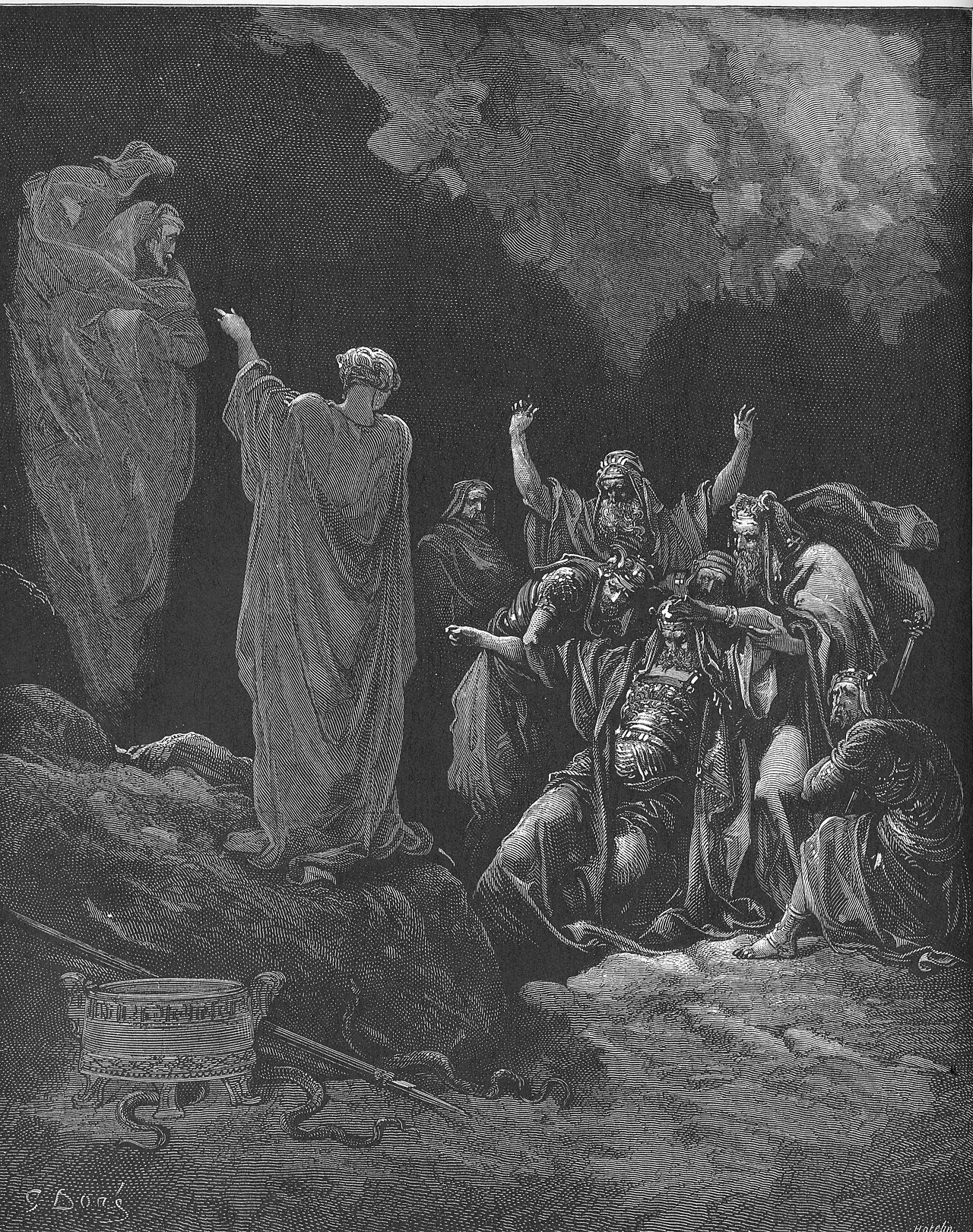
in 1 Samuel 28“What does he look like?” asked Saul. “An old man is coming up,” she replied. “And he is wearing a robe.” So Saul knew that it was Samuel, and he bowed facedown in reverence.
BSB
The same verse in ASV and KJV ▾
ASV
And he said unto her, What form is he of? And she said, An old man cometh up; and he is covered with a robe. And Saul perceived that it was Samuel, and he bowed with his face to the ground, and did obeisance.
KJV
And he said unto her, What form is he of? And she said, An old man cometh up; and he is covered with a mantle. And Saul perceived that it was Samuel, and he stooped with his face to the ground, and bowed himself.
⋯
This verse in 1 Samuel 28
Commentary
12 notes on this verseWhy, even now the followers of Simon [Magus] are so confident of their art that they undertake to bring back the souls of the prophets from hell. And this, I believe, because their power lies in their ability to deceive. This power was actually granted to the witch of Endor, who brought back the soul of Samuel after Saul had consulted God in vain. Apart from that case, God forbid we should believe that any soul, much less a prophet, could be called forth by a demon.
This site's exposition
Bring me up Samuel
on 1 Samuel 28:11-14
Saul names exactly who he wants, and the woman's own reaction settles a question the older commentaries return to: she cries out and immediately recognizes Saul, as though what appeared was not the sort of spirit her own art was used to raising. She first calls it gods ascending out of the earth, a general word for a supernatural being rather than a claim of deity, and only when Saul asks for a shape does she describe an old man covered with a mantle. That mantle is the detail that convinces Saul, the same garment Samuel wore when Saul tore it at 15:27 and heard the kingdom's rending read out of the tear. He falls with his face to the ground before the man whose robe had already carried this news to him once.
This site's exposition
An old man is coming up
The fathers divided over this old man coming up. Justin Martyr took him as the soul of Samuel called up by the woman, while Hippolytus denied that a demon could bring up the soul of any man. Augustine and Methodius of Olympus asked how Samuel could be seen wearing a robe.
The record, by era
The Church Fathers5 voices
A commentator
Augustine of HippoON THE SOUL AND ITS ORIGIN 4.29 · Written in the 5th century.
proposed
Why, then, did the rich man in hell crave for the drop of water? Why did holy Samuel appear after his death (as you have yourself noticed) clothed in his usual garments? Did the one wish to repair the ruins of the soul, as of the flesh, by the aliment of water? Did the other quit life with his clothes on him? Now in the former case there was a real suffering, which tormented the soul; but not a real body, such as required food. While the latter might have seemed to be clothed, not as being a veritable body, but a soul only, having the semblance of a body with a dress. For although the soul extends and contracts itself to suit the members of the body, it does not similarly adapt itself to the clothes, so as to fit its form to them.
I see no objection to saying that each mind has another body [sōma pneumatikos] when it leaves this solid one, and so the mind always has a body to animate, and in it crosses over, if there is any place to which necessity compels it to go, since, indeed, the angels themselves cannot be enumerated if they are not counted by bodies, as truth itself says in the Gospel: "I could ask my Father to send me twelve legions of angels"; and also since it is evident that Samuel was seen in the body when he was raised by the incantation of Saul, and since it is clear, according to the Gospel, that Moses, whose body was buried, came to the Lord on the mount when they stood together.
The question is raised, whether Samuel rose by the hand of the sorceress or not. And if, indeed, we were to allow that he did rise, we should be propounding what is false. For how could a demon call back the soul, I say not of a righteous man merely, but of any one whatever, when it had gone, and was tarrying one knew not where? But he says, how then was the woman dismayed, and how did she see in an extraordinary way men ascending? For if her vision had not been of an extraordinary kind, she would not have said, "I see gods ascending out of the earth." She invoked one, and how did there ascend many? What then? Shall we say that the souls of all who appeared ascended, and those, too, not invoked by the woman; or that what was seen was merely phantasms of them? Even this, however, will not suffice. How, he urges further, did Saul recognise (what appeared), and do obeisance? Well, Saul did not actually see, but only, on being told by the woman that the figure of one of those who ascended was the figure he desired, and taking it to be Samuel, he consulted it as such, and did it obeisance. And it could be no difficult matter for the demon to conjure up the form of Samuel, as it was known to him. How then, says he, did he foretell the calamities that were to befall Saul and Jonathan at the same time? He did foretell indeed the end of the war, and how Saul would be overcome, drawing that as an inference from the wrath of God against him. Just as a physician, who has no exact knowledge of the science, might yet, seeing a patient past cure, tell of his death, though he made an error as to the hour, so, too, the demon, knowing the wrath of God by Saul's deeds, and by this very attempt to consult the sorceress, foretells his defeat and his death at the same time, though in error as to the day of his death.
And, therefore, if we inquire regarding the "tongue," and the "finger," and "Abraham's bosom," and the reclining there, it may perhaps be that the soul receives a form similar in appearance to its earthly body in the change. If, then, any one of those who have fallen asleep is recorded as having reappeared, he is seen in the same way and in the form that he had when he was in the flesh. Besides, when Samuel appeared, it is clear that, being seen, he was clothed in a body; and this must especially be admitted, if we are pressed by arguments which prove that the essence of the soul is incorporeal and is manifested by itself.
And that the souls survive, I have shown to you from the fact that the soul of Samuel was called up by the witch, as Saul demanded. And it appears also, that all the souls of similar righteous men and prophets fell under the dominion of such powers, as is indeed to be inferred from the very facts in the case of that witch. Hence also God by His Son teaches us for whose sake these things seem to have been done, always to strive earnestly, and at death to pray that our souls may not fall into the hands of any such power.
4 more voices on this verse
The Puritans and the Awakening2 voices
A mantle - The usual habit of prophets, and particularly of Samuel, chap. xv, 27. If it was not Samuel, but an other spirit in his shape, it is not true, that Saul perceived it was Samuel.
And he said unto her, what form is he of?....
The Nineteenth Century2 voices
An old man cometh up, and he is covered with a mantle - This seems to have been a second apparition; she cannot mean that she had seen gods ascending out of the earth, and these gods were like an old man with a mantle. The angelic appearance first mentioned prepared the way for Samuel; and the whole was done so as to show to the woman that her art had not prevailed in the present instance, and that what was now taking place was wholly independent of her incantations.
A commentator
Jamieson, Fausset & Brown1802–1910
Commentary Critical and Explanatory on the Whole Bible (1871)
On the other hand, many eminent writers (considering that the apparition came before her arts were put in practice; that she herself was surprised and alarmed; that the prediction of Saul's own death and the defeat of his forces was confidently made), are of opinion that Samuel really appeared.
How the passage was read
What the Jewish commentators add
On the verses either side of this one
Have you disturbed me. You have frightened me. 14 The Midrash explains that Shmuel feared that his day of judgment had come. See above verse—Radak
This section is reception history: how the passage was read and kept in the Jewish tradition. Where a reading parts from an essential of the Christian faith, the section says so at that point.
Texts and citation data: Sefaria; each excerpt follows its version’s licence. 5 further sources are cited on this chapter that carry no English text this site may quote or only restate the verse.
The words behind it
20 Hebrew wordsEvery Hebrew word of this verse in the order it stands, with what it means and the door to its own study. The last column counts the times a word stands in the whole Bible: the rarer the word, the more the places it appears belong together.
| Hebrew | Sound | Meaning | Word study | In the Bible |
|---|---|---|---|---|
| וַיֹּ֤אמֶר | vaiyomer | and he said | H559 → | 5305 times |
| לָהּ֙ | lah | to <the> her | ||
| מַֽה־ | mah- | what? | H4100 → | 752 times |
| תָּאֳר֔וֹ | tooro | [is] appearance his | H8389 → | 15 times |
| וַתֹּ֗אמֶר | vatomer | and she said | H559 → | 5305 times |
| אִ֤ישׁ | ʾish | a man | H376 → | 1663 times |
| זָקֵן֙ | zaken | old | H2205 → | 178 times |
| עֹלֶ֔ה | ʾoleh | [is] coming up | H5927 → | 890 times |
| וְה֥וּא | vehu' | and he | H1931 → | 1879 times |
| עֹטֶ֖ה | ʾoteh | [is] wrapped | H5844 → | |
| מְעִ֑יל | meil | a robe | H4598 → | 28 times |
| וַיֵּ֤דַע | vaiyeda' | and he knew | H3045 → | 945 times |
| שָׁאוּל֙ | shaul | Saul | H7586 → | 402 times |
| כִּֽי־ | ki- | that | H3588 → | 4482 times |
| שְׁמוּאֵ֣ל | shemuel | [was] Samuel | H8050 → | 141 times |
| ה֔וּא | hu' | it | H1931 → | 1879 times |
| וַיִּקֹּ֥ד | vaiyikod | and he bowed low | H6915 → | |
| אַפַּ֛יִם | ʾapayim | face | H639 → | 276 times |
| אַ֖רְצָה | ʾartzah | [the] ground towards | H776 → | 2504 times |
| וַיִּשְׁתָּֽחוּ׃ ס | vaiyishtachu | and he bowed down | H7812 → | 172 times |
וַיֹּ֤אמֶרand he said
vaiyomerH559 →5305 times
לָהּ֙to <the> her
lah
מַֽה־what?
mah-H4100 →752 times
תָּאֳר֔וֹ[is] appearance his
tooroH8389 →15 times
וַתֹּ֗אמֶרand she said
vatomerH559 →5305 times
אִ֤ישׁa man
ʾishH376 →1663 times
זָקֵן֙old
zakenH2205 →178 times
עֹלֶ֔ה[is] coming up
ʾolehH5927 →890 times
וְה֥וּאand he
vehu'H1931 →1879 times
עֹטֶ֖ה[is] wrapped
ʾotehH5844 →
מְעִ֑ילa robe
meilH4598 →28 times
וַיֵּ֤דַעand he knew
vaiyeda'H3045 →945 times
שָׁאוּל֙Saul
shaulH7586 →402 times
כִּֽי־that
ki-H3588 →4482 times
שְׁמוּאֵ֣ל[was] Samuel
shemuelH8050 →141 times
ה֔וּאit
hu'H1931 →1879 times
וַיִּקֹּ֥דand he bowed low
vaiyikodH6915 →
אַפַּ֛יִםface
ʾapayimH639 →276 times
אַ֖רְצָה[the] ground towards
ʾartzahH776 →2504 times
וַיִּשְׁתָּֽחוּ׃ סand he bowed down
vaiyishtachuH7812 →172 times
A shaded row is a word that stands 400 times or fewer in the Bible.
The walk
8 stopsEach card is a verse this one points to, and under it the verses that one points to in turn. Where several paths arrive at the same place, that place is listed first: the text keeps returning to it.
Through
2 Kings 2:8And Elijah took his cloak, rolled it up, and struck the waters, which parted to the right and to the left, so that the two of them crossed over on dry ground.
it leads to
- 1 Kings 19:19
So Elijah departed and found Elisha son of Shaphat. He was plowing with twelve teams of oxen, and he was with the twelfth team. Elijah passed by him and threw his cloak around him.
- Exodus 14:21–22
Then Moses stretched out his hand over the sea, and all that night the LORD drove back the sea with a strong east wind that turned it into dry land. So the waters were…
- Joshua 3:14–17
So when the people broke camp to cross the Jordan, the priests carried the ark of the covenant ahead of them.
- 2 Kings 2:14
Then he took the cloak of Elijah that had fallen from him and struck the waters. “Where now is the LORD, the God of Elijah?” he asked. And when he had struck the waters,…
- 1 Kings 19:13
When Elijah heard it, he wrapped his face in his cloak and went out and stood at the mouth of the cave. Suddenly a voice came to him and said, “What are you doing…
- 1 Kings 19:19
Through
1 Samuel 24:8After that, David got up, went out of the cave, and called out to Saul, “My lord the king!” When Saul looked behind him, David bowed facedown in reverence
it leads to
- 1 Samuel 25:23–24
When Abigail saw David, she quickly got off the donkey, fell facedown, and bowed before him.
- Romans 13:7
Pay everyone what you owe him: taxes to whom taxes are due, revenue to whom revenue is due, respect to whom respect is due, honor to whom honor is due.
- 1 Samuel 26:17
Then Saul recognized David’s voice and asked, “Is that your voice, David my son?” “It is my voice, my lord and king,” David said.
- 1 Samuel 25:23–24
Where this verse is studied
On this page
Studies1
About 1 Samuel
Who and where
2 names in this verse with a page on the site.
- PersonJudges to monarchySamuelAsked of God by Hannah and lent to the LORD at Shiloh; the last judge and first of the prophets after Moses, who anointed both Sau…
- PersonUnited monarchySaulIsrael's first king, head and shoulders above the people; began in humility, ended in rejection — sparing what God devoted, consul…
This page draws on 11 works. Open the list of works
This page draws on Adam Clarke, Commentary on the Bible; Albert Barnes, Notes on the Old Testament; Augustine of Hippo, ON THE SOUL AND ITS ORIGIN 4.29; Augustine of Hippo, LETTER 158; Hippolytus of Rome, Hippolytus Exegetical Fragments; Jamieson, Fausset & Brown, Commentary Critical and Explanatory on the Whole Bible; John Gill, Exposition of the Old Testament (1748-1763); John Wesley, Explanatory Notes upon the Old Testament; Justin Martyr, Dialogue with Trypho, Chapter CV; Methodius of Olympus, ON THE RESURRECTION 3.2.19 and Tertullian, ON THE SOUL 57.7-9.