
Place
Gilgal
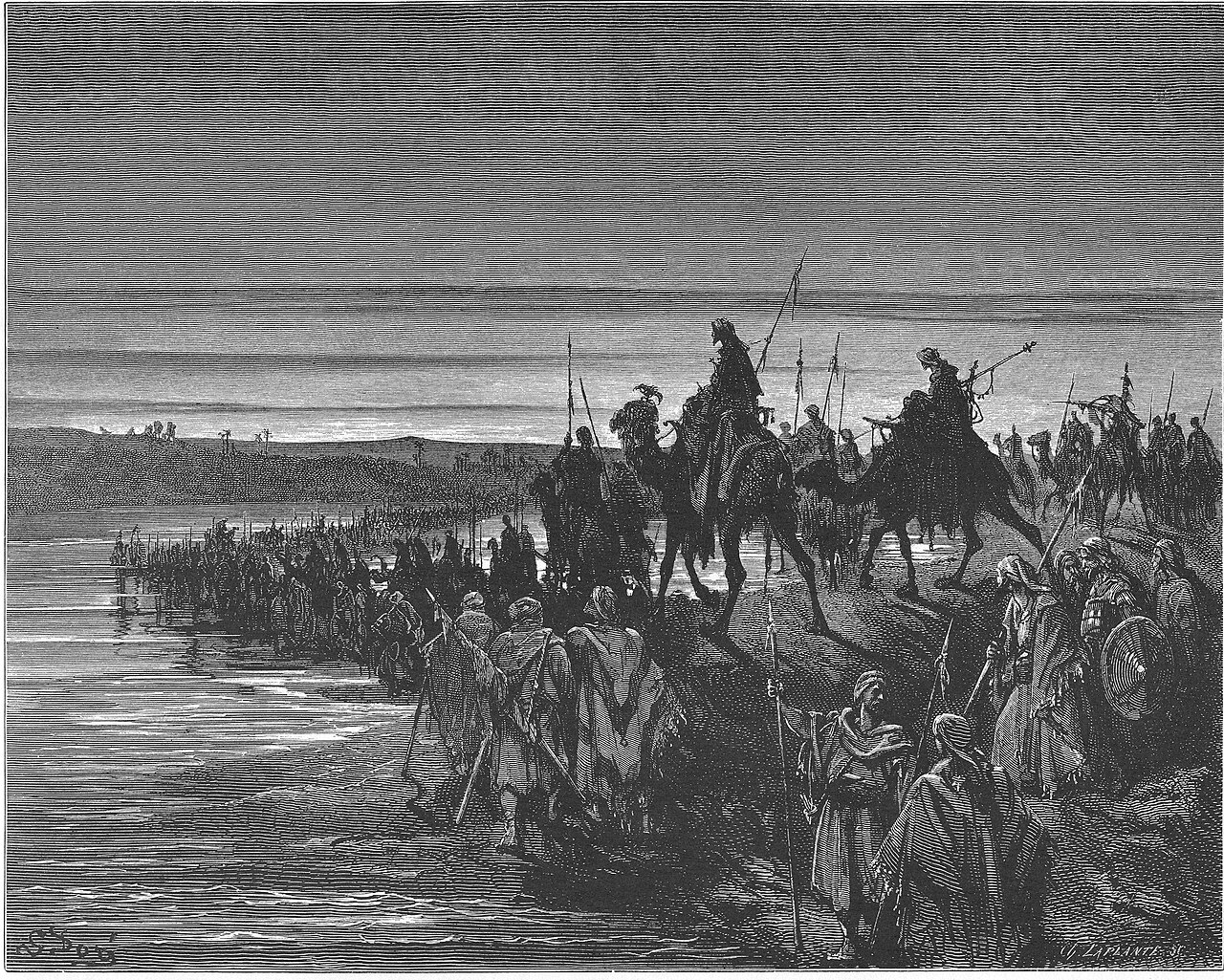
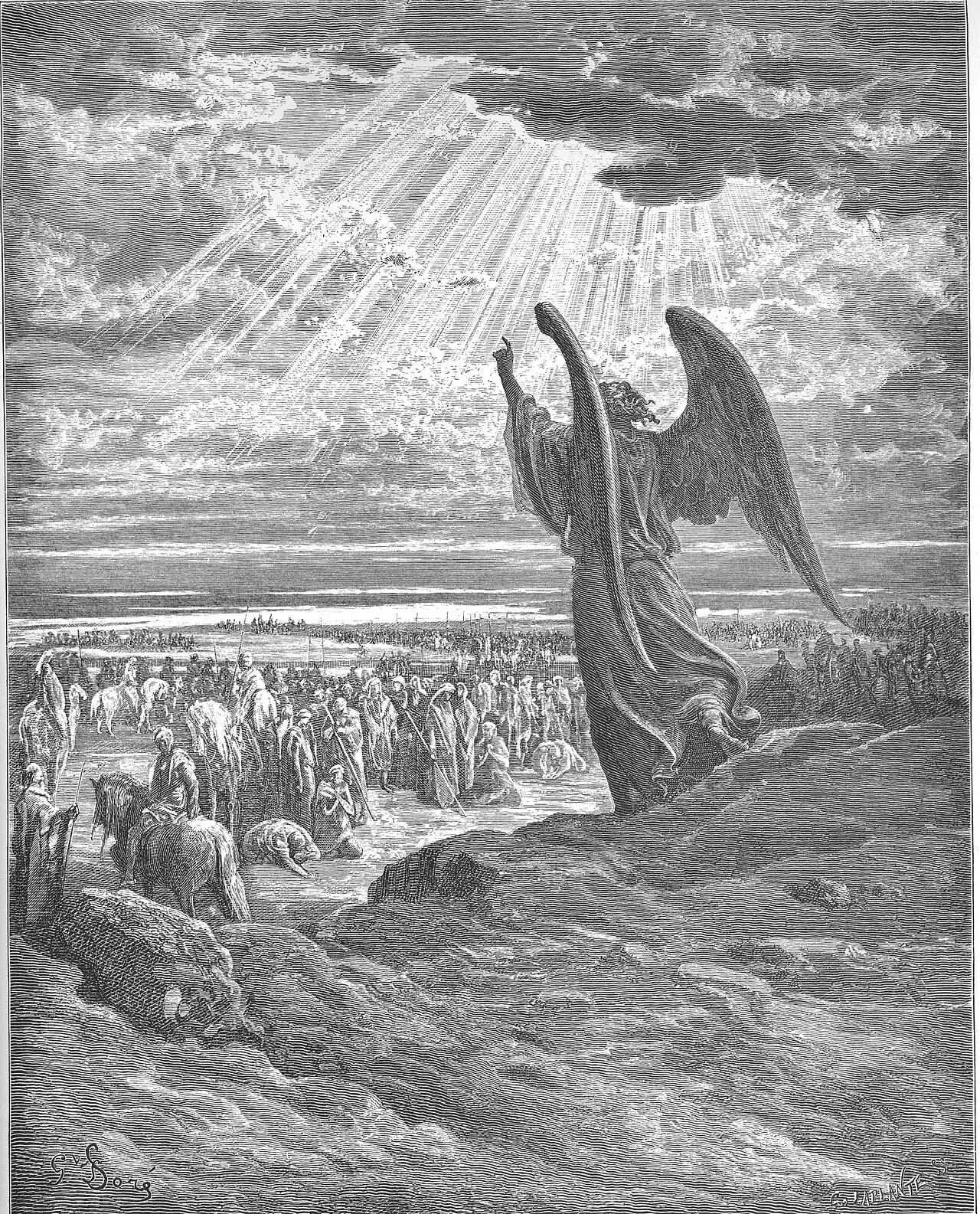
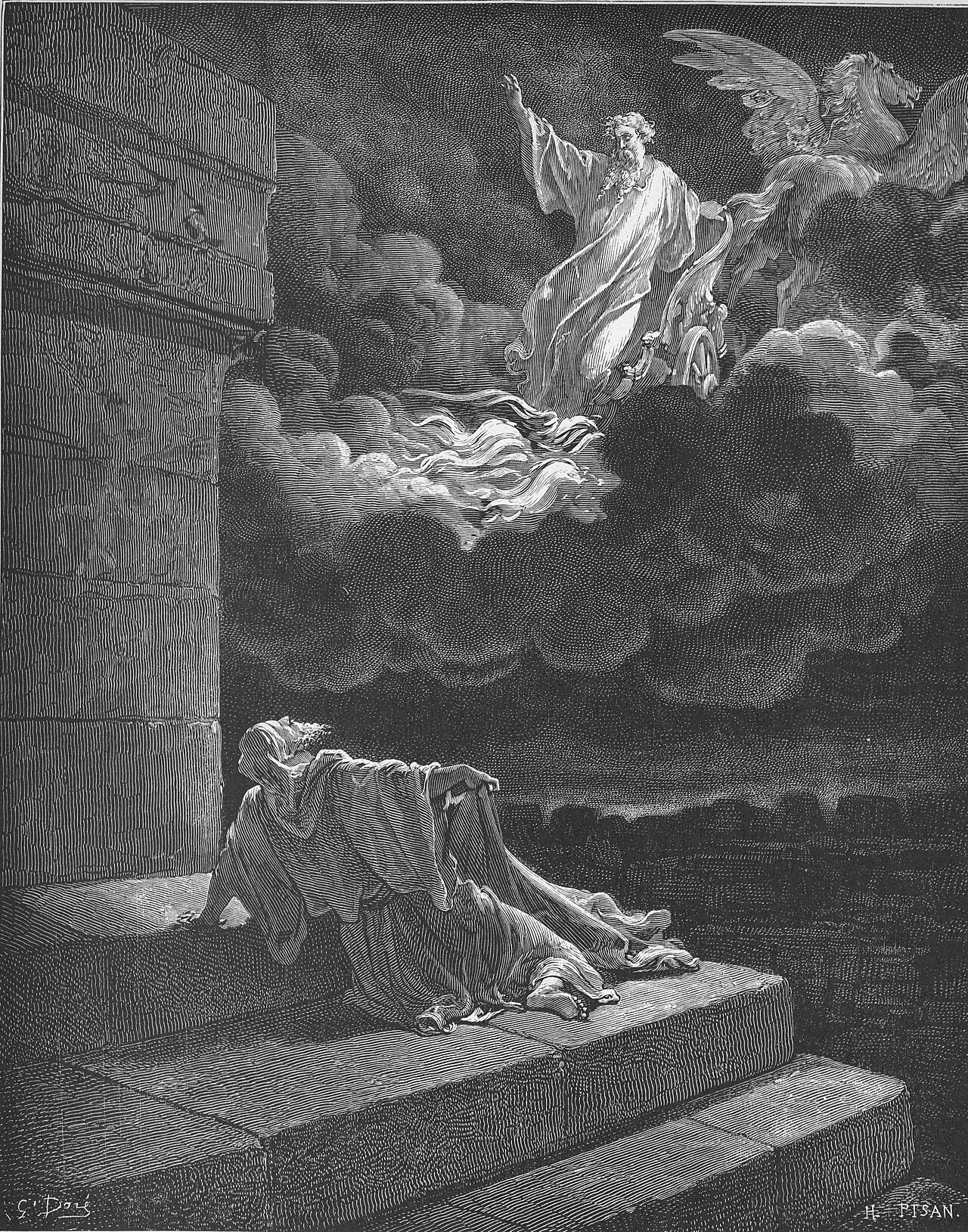
Gustave Doré, La Sainte Bible (Tours: Alfred Mame et fils, 1866). Public domain.
Summary
Israel's first Canaan camp where the stones were set and the reproach rolled away (Josh 4-5); later a corrupted shrine the prophets name with Bethel (Amos 4:4; Hos 4:15).
- Gilgal is the first camp Israel pitched inside Canaan, on the plain east of Jericho.
- Twelve stones came out of the Jordan riverbed and were set up here for children to ask about.
- The name is a sentence, not a shape: the LORD says He has rolled away the reproach of Egypt.
- Every campaign of the conquest went out from this camp and came back to it, and Saul was made king and rejected here.
- The site has never been identified, and Hosea, Amos and Micah name Gilgal six times, five of them as a charge.
On this page
In Scripture
- Verses
- 39
- Books
- 10
Near Gilgal
- Bethany beyond the Jordan4.4 km · 2.8 mi SE
- Jericho7.1 km · 4.4 mi W
- Ephraim23 km · 14 mi NW
- Mount Nebo24 km · 15 mi SE
- Ai25 km · 16 mi W
- Bethany26 km · 16 mi SW
Straight-line distances, computed from the gazetteer coordinates.
Where it is
the country around it
- Coordinates
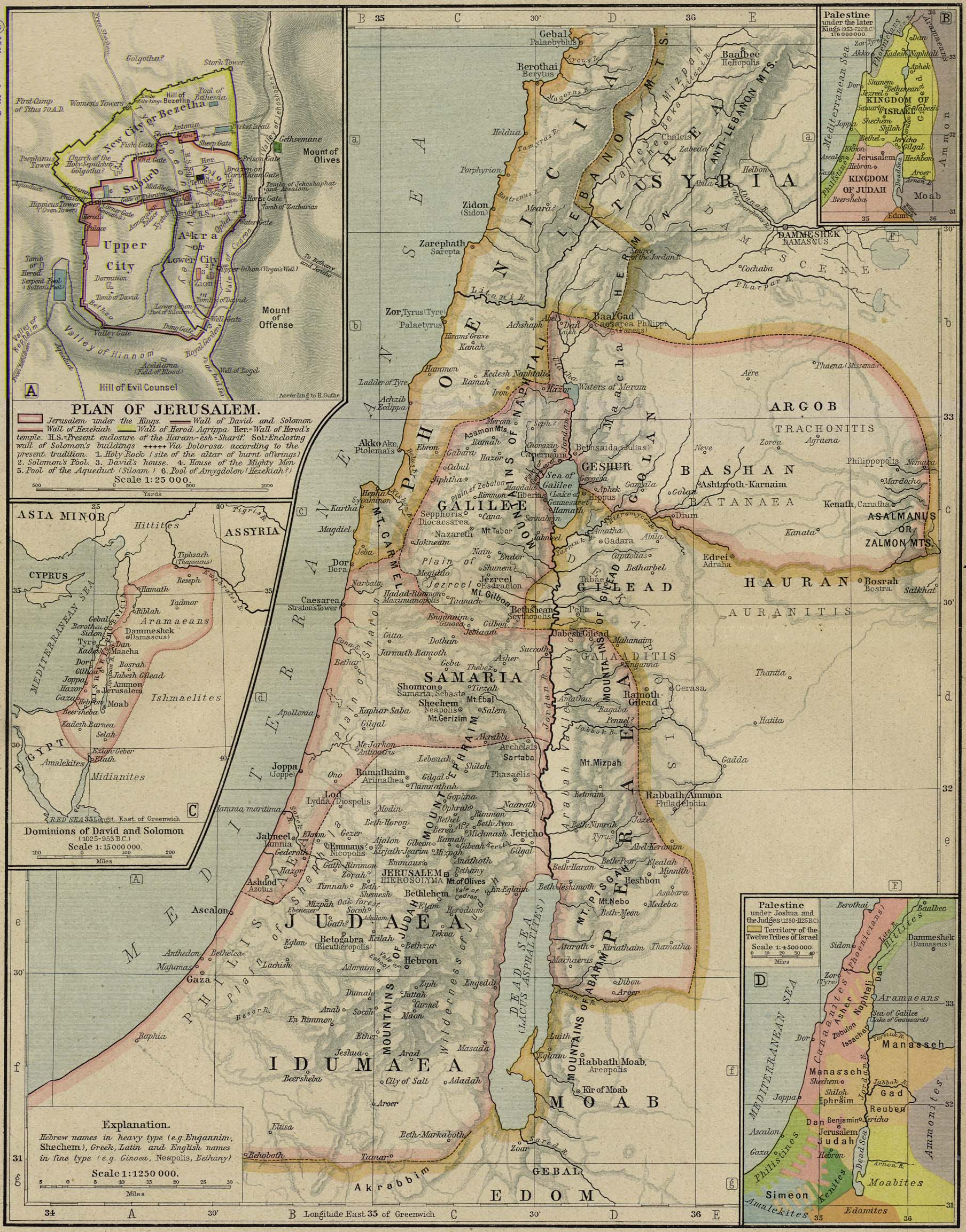
- 31.8638° N, 35.5185° Efind it on the Atlas →
- Region
- Jordan valley near Jericho
- Kind of place
- Town
1 place the record names with Gilgal, the farthest 29 km away
- Located: the gazetteer fixes one site
- ? Proposed: one candidate among several
- A dashed line ends at a place the gazetteer does not fix
Not located: Egypt, Moab. The gazetteer records no location for them, so they are not marked.
Why Gilgal matters
What has been found
the evidence, and where it is disputed
The five days at Gilgal, outlined
Joshua 4 and 5, in the order the text gives
Read Joshua 4 and 5, in the order the text gives
- Twelve stones lifted out of the riverbedJoshua 4:3and command them: ‘Take up for yourselves twelve stones from the middle of the Jordan where the priests were standing, carry them with you, and set them down in the place where you spend the night.’”
- The camp pitched at GilgalJoshua 4:19On the tenth day of the first month the people went up from the Jordan and camped at Gilgal on the eastern border of Jericho.
- The stones set up at GilgalJoshua 4:20And there at Gilgal Joshua set up the twelve stones they had taken from the Jordan.
- A marker built for a child's questionJoshua 4:21Then Joshua said to the Israelites, “In the future, when your children ask their fathers, ‘What is the meaning of these stones?’
- Flint knives for the new generationJoshua 5:2At that time the LORD said to Joshua, “Make flint knives and circumcise the sons of Israel once again.”
- The whole camp laid up until it healedJoshua 5:8And after all the nation had been circumcised, they stayed there in the camp until they were healed.
- The reproach rolled away, and the name givenJoshua 5:9Then the LORD said to Joshua, “Today I have rolled away the reproach of Egypt from you.” So that place has been called Gilgal to this day.
- The Passover kept on the plains of JerichoJoshua 5:10On the evening of the fourteenth day of the month, while the Israelites were camped at Gilgal on the plains of Jericho, they kept the Passover.
- The manna stops the day after the land's own grainJoshua 5:12And the day after they had eaten from the produce of the land, the manna ceased. There was no more manna for the Israelites, so that year they began to eat the crops of the land of Canaan.
- Holy ground before a single wall fallsJoshua 5:15The Commander of the LORD’s army replied, “Take off your sandals, for the place where you are standing is holy.” And Joshua did so.
Two sets of twelve stones stand in this account. Twelve were left in the middle of the Jordan (Joshua 4:9) and twelve came out and were set up at Gilgal (Joshua 4:20). Only the Gilgal set is the one the children ask about.
The book of Joshua: the full studyWhat happened here, in order
in the order the canon tells it
- The Gibeonites reach the camp at GilgalJoshua 9:6They went to Joshua in the camp at Gilgal and said to him and the men of Israel, “We have come from a distant land; please make a treaty with us.”
- Israel samples the bread and asks no counselJoshua 9:14Then the men of Israel sampled their provisions, but did not seek the counsel of the LORD.
- The night march out of Gilgal to save GibeonJoshua 10:9After marching all night from Gilgal, Joshua caught them by surprise.
- Caleb comes to Joshua at Gilgal for his inheritanceJoshua 14:6Then the sons of Judah approached Joshua at Gilgal, and Caleb son of Jephunneh the Kenizzite said to him, “You know what the LORD said to Moses the man of God at Kadesh-barnea about you and me.
- The angel of the LORD goes up from Gilgal to BochimJudges 2:1Now the angel of the LORD went up from Gilgal to Bochim and said, “I brought you up out of Egypt and led you into the land that I had promised to your fathers, and I said, ‘I will never break My covenant with you,
- Gilgal on Samuel's yearly circuit1 Samuel 7:16Every year he would go on a circuit from Bethel to Gilgal to Mizpah, judging Israel in all these places.
- Saul told to go down to Gilgal and wait seven days1 Samuel 10:8And you shall go before me to Gilgal, and surely I will come to you to offer burnt offerings and to sacrifice peace offerings. Wait seven days until I come to you and show you what you are to do.”
- Saul confirmed king at Gilgal1 Samuel 11:15So all the people went to Gilgal and confirmed Saul as king in the presence of the LORD. There they sacrificed peace offerings before the LORD, and Saul and all the Israelites rejoiced greatly.
- Saul offers the burnt offering himself1 Samuel 13:9So he said, “Bring me the burnt offering and the peace offerings.” And he offered up the burnt offering.
- Samuel's answer at Gilgal1 Samuel 13:13“You have acted foolishly,” Samuel declared. “You have not kept the command that the LORD your God gave you; if you had, the LORD would have established your kingdom over Israel for all time.
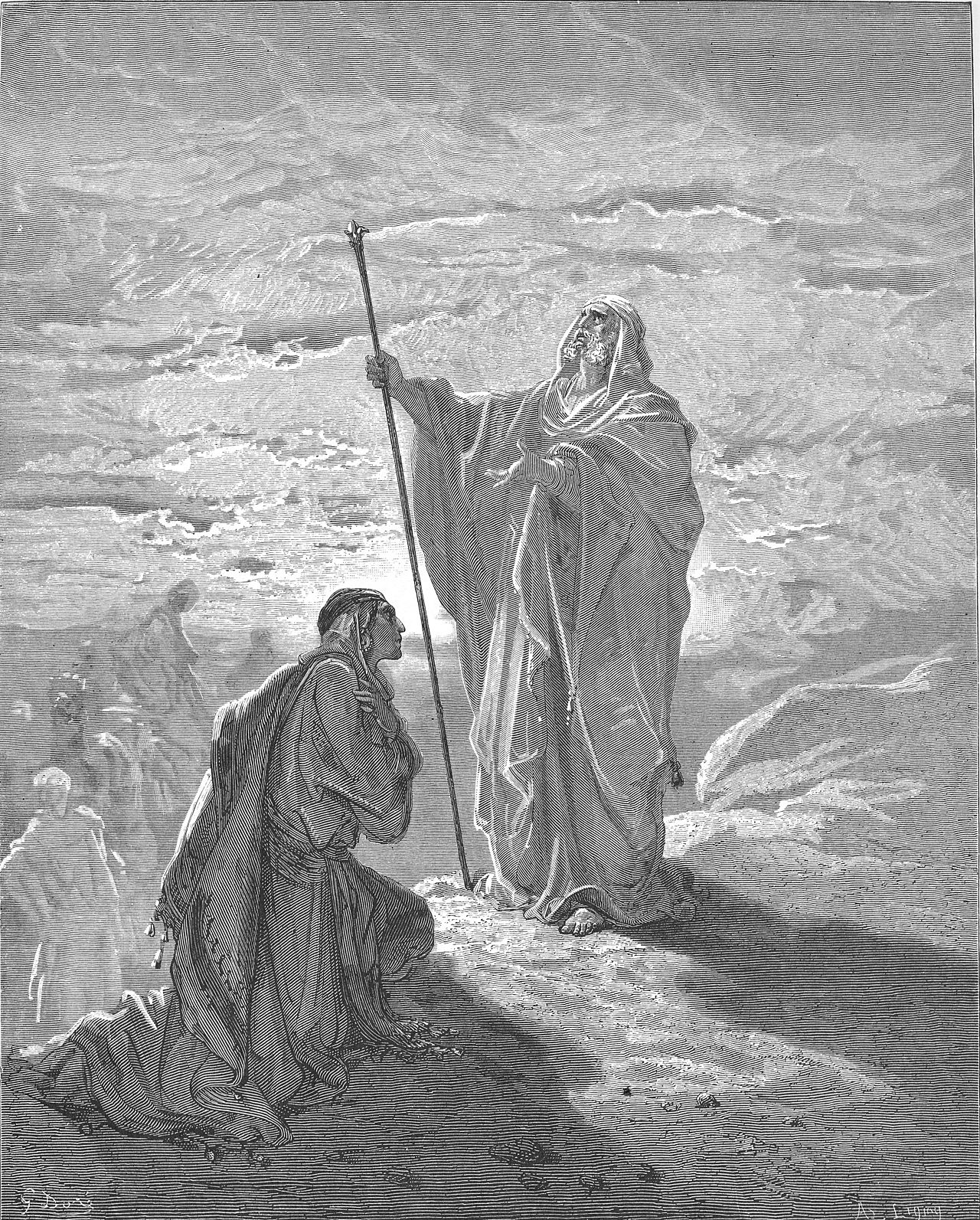
- Obedience is better than sacrifice1 Samuel 15:22But Samuel declared: “Does the LORD delight in burnt offerings and sacrifices as much as in obedience to His voice? Behold, obedience is better than sacrifice, and attentiveness is better than the fat of rams.
- Saul rejected as king, at the same place1 Samuel 15:23For rebellion is like the sin of divination, and arrogance is like the wickedness of idolatry. Because you have rejected the word of the LORD, He has rejected you as king.”
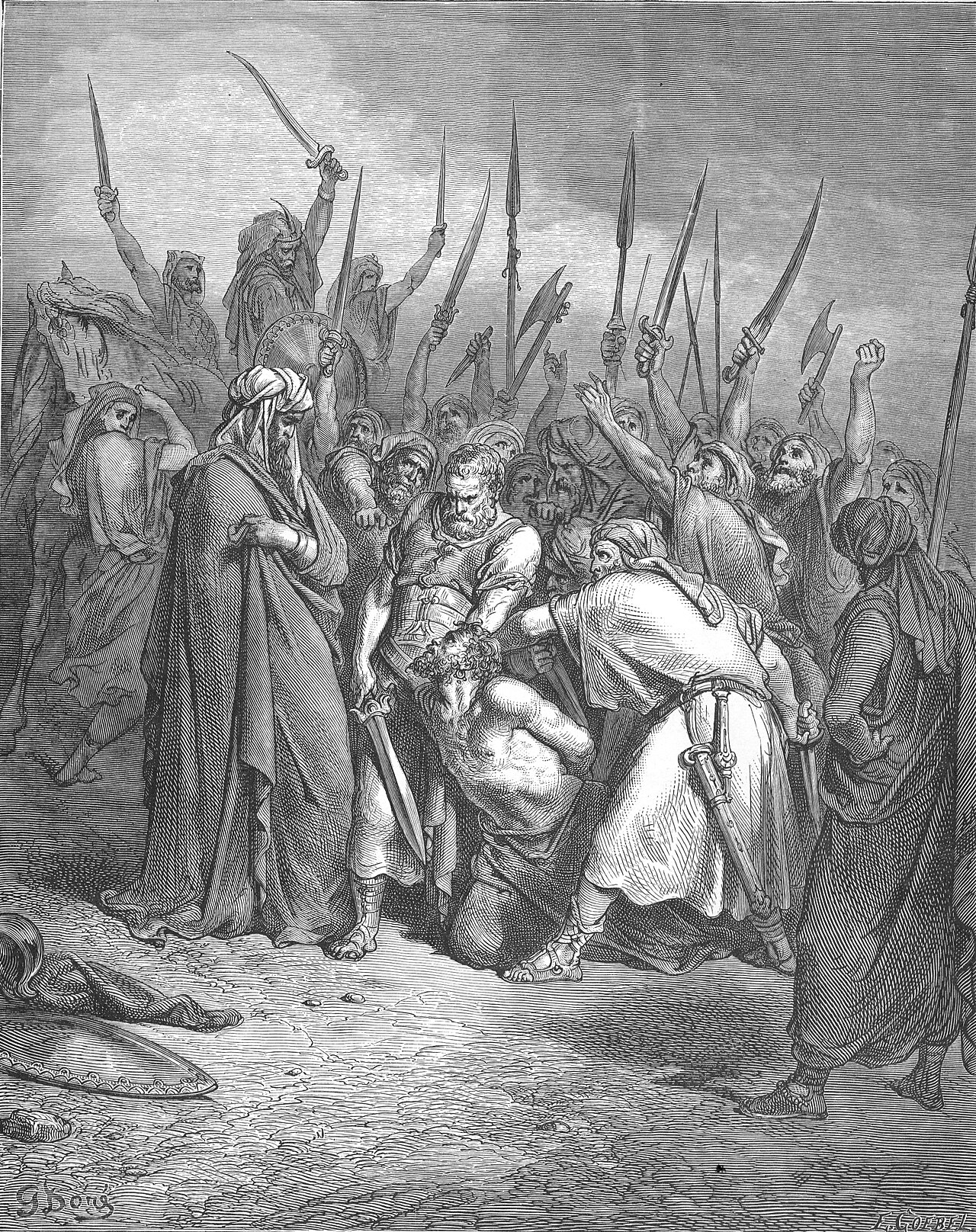
- Agag put to death before the LORD at Gilgal1 Samuel 15:33But Samuel declared: “As your sword has made women childless, so your mother will be childless among women.” And Samuel hacked Agag to pieces before the LORD at Gilgal.
- Judah meets David at Gilgal to bring him home2 Samuel 19:15So the king returned, and when he arrived at the Jordan, the men of Judah came to Gilgal to meet him and escort him across the Jordan.
- Elijah and Elisha set out from Gilgal2 Kings 2:1Shortly before the LORD took Elijah up to heaven in a whirlwind, Elijah and Elisha were on their way from Gilgal,
- Elisha back at Gilgal in a famine2 Kings 4:38When Elisha returned to Gilgal, there was a famine in the land. As the sons of the prophets were sitting at his feet, he said to his attendant, “Put on the large pot and boil some stew for the sons of the prophets.”
- The prophet names Gilgal as the place of the evilHosea 9:15All their evil appears at Gilgal, for there I hated them. I will drive them from My house for the wickedness of their deeds. I will no longer love them; all their leaders are rebellious.
- Go to Bethel and transgress, said in ironyAmos 4:4“Go to Bethel and transgress; rebel even more at Gilgal! Bring your sacrifices every morning, your tithes every three days.
- Gilgal will surely go into exileAmos 5:5Do not seek Bethel or go to Gilgal; do not journey to Beersheba, for Gilgal will surely go into exile, and Bethel will come to nothing.
- Micah recalls the road from Shittim to Gilgal as mercyMicah 6:5My people, remember what Balak king of Moab counseled and what Balaam son of Beor answered. Remember your journey from Shittim to Gilgal, so that you may acknowledge the righteousness of the LORD.’”
Where it points
The voices
each quoted from the work named
Gilgal, mentioned here by anticipation (compare Jos 5:9), the modern Jiljulieh (Conder), was on rising ground (compare Jos 5:3), and, according to Josephus, nearly five miles from the river, and consequently about two from the city itself. The site of the camp was no doubt fortified by Joshua, as it constituted for some time the abiding foothold in Canaan, from where he sallied forth to subdue the country. It was also the place of safety where the ark, and no doubt also the women, children, cattle, and other property of the people were left.
Gilgal--No trace either of the name or site is now to be found; but it was about two miles from Jericho [JOSEPHUS], and well suited for an encampment by the advantages of shade and water. It was the first place pronounced "holy" in the Holy Land
All persons, even if they come from the law, even if they have learned through Moses, still have the reproach of Egypt in them, the reproach of sins. Who will be like Paul even according to the observance of the law? Just hear him saying, "According to the righteousness based upon the law, I lived without blame." Nevertheless, he himself publicly announces and says, "For we were even ourselves at some time foolish, unbelieving, wandering, enslaved to desires and various forms of pleasure, in malice and envy, hateful, hating one another."
4 more teachers on these versesJohn Wesley · John Bevere · Adam Clarke · Jamieson, Fausset & Brown
The manna ceased - Which God now withheld, to shew that Manna was not an ordinary production of nature, but an extraordinary and special gift of God to supply their necessity. And because God would not be prodigal of his favours, by working miracles where ordinary means were sufficient. The morrow - That is, on the seventeenth day.
He probably did 99 percent of what he was told to do. Yet God called his nearly complete obedience—rebellion (1 Sam. 15:23)!
Come to Beth-el and transgress - Spoken ironically. Go on to worship your calves at Beth-el; and multiply your transgressions at Gilgal; the very place where I rolled away the reproach of your fathers, by admitting them there into my covenant by circumcision. A place that should have ever been sacred to me; but you have now desecrated it by enormous idolatries. Let your morning and evening sacrifices be offered still to your senseless gods; and continue to support your present vicious priesthood by the regular triennial tithes which should have been employed in my service; and: -
Gilgal shall surely go into captivity--a play on similar sounds in the Hebrew, Gilgal, galoh, yigleh: "Gilgal (the place of rolling) shall rolling be rolled away."
Gilgal in Scripture
39 verses name it, in 10 books
Open a book to read its mentions here. Text: Berean Standard Bible.
Old TestamentNew Testamentsegment width = share of mentions
Old Testament10 books · 39 mentions
Deuteronomy1 mention
Joshua13 mentions
- Joshua 4:19On the tenth day of the first month the people went up from the Jordan and camped at Gilgal on the eastern border of Jericho.
- Joshua 4:20And there at Gilgal Joshua set up the twelve stones they had taken from the Jordan.
- Joshua 5:9Then the LORD said to Joshua, “Today I have rolled away the reproach of Egypt from you.” So that place has been called Gilgal to this day.
- Joshua 5:10On the evening of the fourteenth day of the month, while the Israelites were camped at Gilgal on the plains of Jericho, they kept the Passover.
- Joshua 9:6They went to Joshua in the camp at Gilgal and said to him and the men of Israel, “We have come from a distant land; please make a treaty with us.”
- Joshua 10:6Then the men of Gibeon sent word to Joshua in the camp at Gilgal: “Do not abandon your servants. Come quickly and save us! Help us, because all the kings of the Amorites from the hill country have joined forces against us.”
- Joshua 10:7So Joshua and his whole army, including all the mighty men of valor, came from Gilgal.
- Joshua 10:9After marching all night from Gilgal, Joshua caught them by surprise.
5 further mentions in Joshua, read them in the book.
Judges2 mentions
- Judges 2:1Now the angel of the LORD went up from Gilgal to Bochim and said, “I brought you up out of Egypt and led you into the land that I had promised to your fathers, and I said, ‘I will never break My covenant with you,
- Judges 3:19But upon reaching the idols near Gilgal, he himself turned back and said, “I have a secret message for you, O king.” “Silence,” said the king, and all his attendants left him.
1 Samuel12 mentions
- 1 Samuel 7:16Every year he would go on a circuit from Bethel to Gilgal to Mizpah, judging Israel in all these places.
- 1 Samuel 10:8And you shall go before me to Gilgal, and surely I will come to you to offer burnt offerings and to sacrifice peace offerings. Wait seven days until I come to you and show you what you are to do.”
- 1 Samuel 11:14Then Samuel said to the people, “Come, let us go to Gilgal and renew the kingship there.”
- 1 Samuel 11:15So all the people went to Gilgal and confirmed Saul as king in the presence of the LORD. There they sacrificed peace offerings before the LORD, and Saul and all the Israelites rejoiced greatly.
- 1 Samuel 13:4And all Israel heard the news: “Saul has attacked an outpost of the Philistines, and now Israel has become a stench to the Philistines!” Then the people were summoned to join Saul at Gilgal.
- 1 Samuel 13:7Some Hebrews even crossed the Jordan into the land of Gad and Gilead. Saul, however, remained at Gilgal, and all his troops were quaking in fear.
- 1 Samuel 13:8And Saul waited seven days for the time appointed by Samuel, but Samuel did not come to Gilgal, and the troops began to desert Saul.
- 1 Samuel 13:12I thought, ‘Now the Philistines will descend upon me at Gilgal, and I have not sought the favor of the LORD.’ So I felt compelled to offer the burnt offering.”
4 further mentions in 1 Samuel, read them in the book.
2 Samuel2 mentions
- 2 Samuel 19:15So the king returned, and when he arrived at the Jordan, the men of Judah came to Gilgal to meet him and escort him across the Jordan.
- 2 Samuel 19:40Then the king went on to Gilgal, and Chimham crossed over with him. All the troops of Judah and half the troops of Israel escorted the king.
2 Kings2 mentions
- 2 Kings 2:1Shortly before the LORD took Elijah up to heaven in a whirlwind, Elijah and Elisha were on their way from Gilgal,
- 2 Kings 4:38When Elisha returned to Gilgal, there was a famine in the land. As the sons of the prophets were sitting at his feet, he said to his attendant, “Put on the large pot and boil some stew for the sons of the prophets.”
Nehemiah1 mention
Hosea3 mentions
- Hosea 4:15Though you prostitute yourself, O Israel, may Judah avoid such guilt! Do not journey to Gilgal, do not go up to Beth-aven, and do not swear on oath, ‘As surely as the LORD lives!’
- Hosea 9:15All their evil appears at Gilgal, for there I hated them. I will drive them from My house for the wickedness of their deeds. I will no longer love them; all their leaders are rebellious.
- Hosea 12:11Is there iniquity in Gilead? They will surely come to nothing. Do they sacrifice bulls in Gilgal? Indeed, their altars will be heaps of stones in the furrows of the field.
Amos2 mentions
The account
Read the account as one telling
Israel came up out of the Jordan on the tenth day of the first month and camped at Gilgal on the eastern border of Jericho. The camp sat on the plain between the river and the city, and it held the ark, the noncombatants and the supplies while the army worked. Joshua set up there the twelve stones the tribes had carried out of the riverbed.
Five days at that camp set the terms of everything after. The new generation was circumcised with flint knives and lay healing inside enemy country. The LORD told Joshua He had rolled away the reproach of Egypt, and the place has carried that sentence for its name ever since. Israel kept the Passover on the fourteenth day, ate roasted grain from the land the next day, and the manna stopped the day after that. Then Joshua met a man with a drawn sword who told him to take off his sandals.
From that camp the conquest ran. The Gibeonites arrived at Gilgal in worn-out clothes with dry bread and asked for a treaty, and Israel sampled the provisions and swore the oath without asking the LORD. When five Amorite kings moved against Gibeon three days later, Joshua marched all night out of Gilgal and caught them at dawn. Joshua 10 twice records him returning to the camp at Gilgal when a campaign was done.
Caleb came to Joshua here. He was eighty-five years old, he had brought back a minority report from Kadesh-barnea forty-five years earlier, and he asked at Gilgal for the hill country Moses had promised him.
In the judges era the place appears twice more. The angel of the LORD went up from Gilgal to Bochim to tell Israel plainly why the nations would not be driven out. Ehud, carrying tribute to Eglon of Moab, turned back at the idols near Gilgal and went in to the king alone.
Samuel included Gilgal on the yearly circuit he rode from Bethel to Gilgal to Mizpah. He told Saul to go down there and wait seven days, and at Gilgal the people confirmed Saul as king with peace offerings before the LORD. The same ground took the kingship back. Saul offered the burnt offering himself when Samuel was late and the troops were slipping away, and Samuel told him his kingdom would not endure. Later Saul came down to Gilgal from Carmel with Agag alive and the best of the Amalekite livestock, said he had carried out the LORD's instructions, and heard that obedience is better than sacrifice and that he was rejected as king. Samuel put Agag to death there.
After Absalom's revolt the men of Judah came to Gilgal to meet David at the Jordan and escort him back across it, and the quarrel between Judah and the rest of Israel over who had the right to bring the king home broke out at that same crossing.
Elijah and Elisha were on their way from Gilgal on the day of the whirlwind, and Elisha came back to a Gilgal in a famine, where a gathered herb turned a pot of stew poisonous and he made it safe with flour. Whether that is the Jordan-valley camp is genuinely open, because the text has the two prophets going down from it to Bethel, and Bethel stands higher than the plain. The positions are set out further down this page.
Common questions
Where was Gilgal?
Readers differ; the positions are named
The site has never been identified and there is no mound to excavate. The text puts it east of Jericho on the plain, on rising ground, and within a night's march of Gibeon. Josephus puts the camp ten furlongs from Jericho, Eusebius places it east of the city about AD 325, and the sixth-century Madaba Map shows a church there holding the twelve stones. Khirbet en-Nitla, excavated in 1950 by James L. Kelso and Dimitri Baramki, along with Khirbat al-Mafjar and Khirbet al-Athala, have all been proposed, and none is established.
What does the name Gilgal mean?
Scripture supplies its own answer and it is a verb. "Today I have rolled away the reproach of Egypt from you. So that place has been called Gilgal to this day" (Joshua 5:9), from the Hebrew root galal, to roll. A related noun, galgal, means a wheel, and that word lies behind the older explanation that Gilgal names a ring of stones. Josephus offers a third gloss, liberty. This site follows the text.
Why circumcise the whole army inside enemy territory?
Because the covenant sign had lapsed. Everyone born in the forty years of wandering was uncircumcised, so the generation about to receive the land carried no mark of the promise. Joshua 5:1 explains why the timing was survivable: the Amorite and Canaanite kings had already lost their nerve at the news of the Jordan. The text does not hide the cost either, and says the whole nation stayed in the camp until they were healed.
Why did the manna stop, and what does the timing mean?
It stopped one day after Israel ate the land's own grain, not on the day they crossed the river. The provision changed form when the promise arrived. Origen, writing about AD 250, called the produce of the land a food better than the manna, and Jesus takes the manna forward Himself: the fathers ate it and died, and He is the living bread.
Who was the Commander of the LORD's army?
Readers differ; the positions are named
He carries a drawn sword, refuses to take a side, receives Joshua's worship without correcting him, and tells him to take off his sandals because the ground is holy, which is Exodus 3:5 again. One long-held reading takes Him to be the pre-incarnate Christ, resting on the worship accepted and the holiness declared. Another takes Him to be a created angel of the highest rank. The full treatment sits on the Christophany study.
Why do the prophets attack Gilgal?
Because the shrine outlasted the meaning. By the eighth century BC Gilgal is paired with Bethel as a centre of the northern kingdom's worship, and Amos tells Israel to go to Bethel and transgress and to rebel even more at Gilgal, which is irony rather than instruction. Hosea says all their evil appears at Gilgal. Adam Clarke names the sting: it is the place where God had rolled away the reproach of their fathers.
Was Saul's rejection at Gilgal too harsh?
Readers differ; the positions are named
Readers have long divided on it, and the text does not soften it. He was rejected twice at the same place, first for offering the burnt offering rather than waiting the seven days Samuel had set, then for keeping Agag and the best of the Amalekite livestock while telling Samuel he had carried out the LORD's instructions. Samuel's answer is the line the whole episode turns on: obedience is better than sacrifice. Charles Spurgeon preached that verse in 1866 under that title.
Are there several Gilgals in the Bible?
Readers differ; the positions are named
Yes, and the lexicon says so: the entry for h1537 glosses the name "Gilgal, the name of three places in Palestine." Deuteronomy 11:30 uses a Gilgal near the Oak of Moreh as a landmark for Gerizim and Ebal, far from Jericho. Joshua 12:23 lists a king of Goiim in Gilgal among the defeated northern kings, and Joshua 15:7 puts a Gilgal on the Judah and Benjamin boundary. Whether the Gilgal of Elijah and Elisha is the Jordan-valley camp is genuinely open, since the two prophets go down from it to Bethel, and Albert Barnes still judged the valley site far more probably the one meant.
Notable art
4 verified pieces depicting Gilgal
Sources cited
- OpenBible.info Bible Geocoding: Gilgal 1read 2026-08-20The coordinates on this page. Used under CC-BY with attribution to OpenBible.info.
- Gustave Doré, La Sainte Bible (Tours: Alfred Mame et fils, 1866)The five engravings on this page. Public domain.
- Flavius Josephus, Antiquities of the Jews, Book V, chapters 1.4 and 1.11, trans. William WhistonThe ten furlongs from Jericho, and Josephus's own gloss of the name as liberty. Public domain.
- Eusebius of Caesarea, Onomasticon 64:24ff., c. AD 325 to 330Cited only for placing Gilgal east of Jericho, the earliest surviving Christian topographical notice of it.
- The Madaba Map, 6th-century mosaic floor, Saint George's church, Madaba, JordanLabels a Galgala with a church east of the tell of Jericho. A Byzantine pilgrimage tradition, cited as such.
- James L. Kelso and Dimitri C. Baramki, Excavations at New Testament Jericho and Khirbet en-Nitla (Annual of the American Schools of Oriental Research, 1955)The 1950 season at Khirbet en-Nitla, cited for the excavation and its publication.
- Yoel Elitzur, 2019, on Khirbet en-Nitla as the main biblical GilgalThe proposal, cited as a proposal.
- Adam Zertal, The Manasseh Hill Country Survey, volumes 1 to 7 (Leiden: Brill, 2004 to 2022)The foot-shaped enclosures at Bedhat esh-Sha'ab, Masua 4, Yafit 3, el-'Unuq and Mount Ebal, and the reading of gilgal as a kind of structure.
- Nadav Na'aman, in Tel Aviv, 2024The argument against reading gilgal as a category of structure. Cited by journal and year.
- Israel Finkelstein, 1989, and Aharon Kempinski, on the Mount Ebal structureThe two readings of Zertal's Ebal excavation that competed with his own.
- Claude R. Conder, The Survey of Western Palestine; Edward Robinson, Biblical Researches in Palestine (1841); Victor Guérin, Description de la Palestíne (1870)The Jiljulieh and Jiljilyya name proposals, north and south. W. F. Albright rejected the northern identification and Félix-Marie Abel accepted it.
- Origen of Alexandria, Homilies on Joshua 5.6 and 6.1, and Commentary on the Gospel of John, Book 6, c. AD 250The earliest surviving Christian readings of the reproach rolled away, the Passover at Gilgal and the manna ceasing. Public domain.
- John Wesley, Explanatory Notes upon the Old Testament (1765)Public domain, CCEL edition.
- Adam Clarke, Commentary on the Bible (1832)Public domain, CCEL edition.
- Albert Barnes, Notes, Explanatory and Practical, on the Old and New Testaments (1832 to 1869)Public domain.
- Jamieson, Fausset & Brown, Commentary Critical and Explanatory on the Whole Bible (1871)Public domain.
- Charles H. Spurgeon, The Metropolitan Tabernacle Pulpit, Sermon No. 686, “Obedience Better Than Sacrifice” (1866)The sermon on 1 Samuel 15 named on this page. Public domain, CCEL edition.
- John Bevere, The Fear of the Lord (1997), excerpted in Charisma Magazine as “Partial Obedience Is Disobedience”In copyright. Quoted cite-only, under fifty words.
- Berean Standard BiblePublic domain since 2023. Every verse on this page.
- STEPBible lexicon data, Tyndale House, CambridgeThe Hebrew entries h1537, h1556, h1534 and h4135 behind the name and the circumcision. CC BY 4.0.
- 1 Maccabees 9:2, King James ApocryphaThe one apocryphal mention of a Galgala, carried as a labelled study resource rather than as canon.
- 1 Enoch, R. H. Charles 1917 editionSearched on this site's own copy and found to contain no Gilgal material.
Keep studying
On this page
Studies7
Doorway2
Keep this page