

1 Maccabees 3–9 · Featured Study · A Labeled Study Resource, Not Canon
Judas Maccabeus, the Hammer
The revolt has its own study on this site: the kings, the battles, the feast it created. This page is about the man at its center. Judas ben Mattathias, called Maccabeus(most likely “the Hammer”), was a priest’s son with no army, no siege train, and no foreign ally, who beat professional Seleucid forces again and again for six years, and the book is careful to show us why he thought he could: “with the God of heaven it is all one, to deliver with a great multitude, or a small company.”That is not a general’s arithmetic; it is Jonathan’s creed at Michmash, quoted back into history by a man who had staked his life on it. This page walks the man’s arc: commission, creed, cleansing, and the last stand he refused to run from, and sets his faith beside the canon’s own.
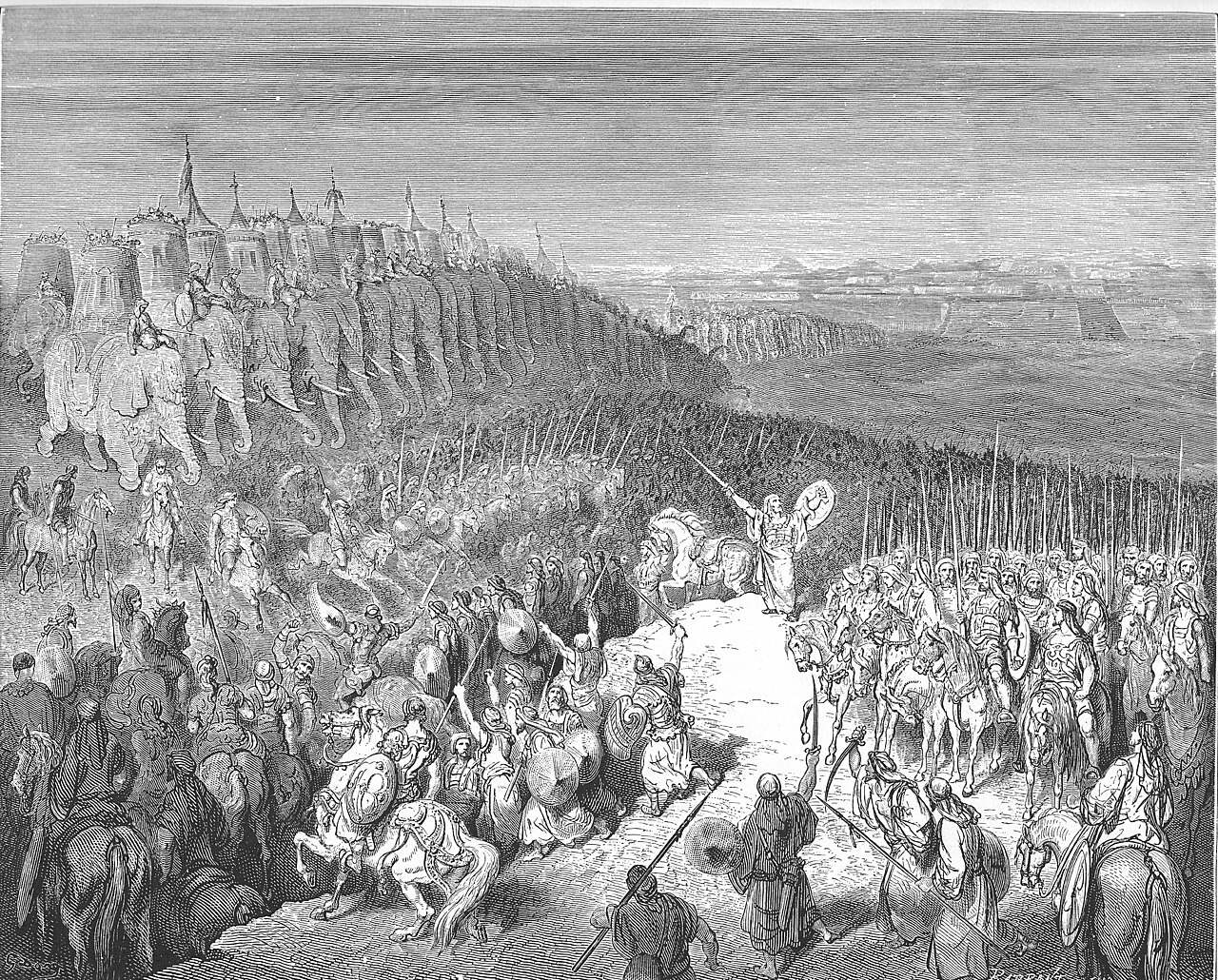
Peter Paul Rubens, The Triumph of Judas Maccabeus, c. 1635. Public domain.
Summary
Judas Maccabeus led an outnumbered guerrilla army for six years on the creed that with the God of heaven it is all one to deliver by many or by few, the same faith Jonathan spoke at Michmash. This page walks his arc from commission to his death at Elasa, where he refused to flee.
- Judas took command from his dying father Mattathias and fought Seleucid forces for six years without a standing army
- His creed before the battle of Beth-horon echoes Jonathan's words at Michmash in 1 Samuel 14:6, that God can save by many or by few
- He led the retaking and cleansing of the temple, the event that led to the feast of Hanukkah, told in full on the Hanukkah page
- He was killed at Elasa after choosing to fight on rather than retreat, and 1 Maccabees presents his creed as a statement about God's freedom, not a guarantee of victory
One Creed, Two Warriors
Judas at Beth-horon beside Jonathan at Michmash: verified verbatim
“It is no hard matter for many to be shut up in the hands of a few; and with the God of heaven it is all one, to deliver with a great multitude, or a small company: For the victory of battle standeth not in the multitude of an host; but strength cometh from heaven.”Judas, before Beth-horon — 1 Macc 3:18–19 (KJV Apocrypha), a labeled study resource
“Come, let us cross over to the outpost of these uncircumcised men. Perhaps the LORD will work on our behalf. Nothing can hinder the LORD from saving, whether by many or by few.”Jonathan, at Michmash — 1 Samuel 14:6 (BSB)
Five centuries apart, nearly the same sentence, because Judas was not inventing a theology on the morning of battle; he was standing in one. The book of the revolt shows a commander who had read his nation’s Scriptures and believed them at the point where believing costs: Gideon’s three hundred, Jonathan’s two, David’s sling, “by many or by few.” His whole improbable six years is that creed, worked out in hill country.
- 6 yrsof victories against professionals
- 3:18–19the creed
- 1 Sam 14:6its canon source
- 800men at the last stand (9:6)
The Man, in Five Beats
commission to last stand: the history's full telling lives on the revolt page
1 · THE COMMISSION
Dying Mattathias passes command over older brothers to Judas, “mighty and strong, even from his youth up: let him be your captain,” and the guerrilla war begins. (1 Macc 2:66)
2 · THE LION
“…put on a breastplate as a giant, and girt his warlike harness about him… In his acts he was like a lion, and like a lion's whelp roaring for his prey.” (3:3–4)
3 · THE CREED
Before Beth-horon, badly outnumbered: “with the God of heaven it is all one, to deliver with a great multitude, or a small company… strength cometh from heaven.” (3:18–19)
4 · THE CLEANSING
Mount Zion retaken; the defiled altar's stones laid aside “until there should come a prophet”; the rededication that made Hanukkah. (4:41–59; the revolt page tells it whole)
5 · THE LAST STAND
At Elasa, 800 men against thousands, urged to retreat: “God forbid that I should do this thing, and flee away from them: if our time be come, let us die manfully for our brethren.” (9:10)
The Death He Chose
Elasa, 160 BC, and what his story teaches
“God forbid that I should do this thing, and flee away from them: if our time be come, let us die manfully for our brethren, and let us not stain our honour.”1 Maccabees 9:10 (KJV Apocrypha) — a labeled study resource, not canon
The book that made him a lion does not spare us his end: most of his army melted away, his counselors begged him to withdraw, and he would not, and at Elasa he fell. It is the mark of 1 Maccabees’ sober honesty (Metzger) that the hero’s creed is never presented as a guarantee of victory. “By many or by few” is a statement about God’s freedom, not a formula for winning: Jonathan won at Michmash and Judas died at Elasa holding the same faith, and the book honors both. The New Testament’s hall of faith is built the same way: some “waxed mighty in war, turned to flight armies of aliens”, and others were slain, “of whom the world was not worthy” (Heb 11:34, 37–38). Faith’s measure was never the outcome. 1 Maccabees remains a labeled study resource beside the sixty-six, and Judas remains what his own book made him: a man who did his arithmetic in heaven’s numbers, to the last morning.
The Voices on the Hammer
with the work named
Daniel (Koinonia House commentary)
Marcus Brown's formative teacher. His Daniel teaching walks the very history Judas fought in, the Seleucid crisis of Daniel 8 and 11, the era's frame on this site's own shelves.
An Introduction to the Apocrypha (Oxford University Press, 1957)
The standard account of 1 Maccabees as restrained, sober historiography: the reason its portrait of Judas, glory and defeat alike, reads with such credibility.
in R. H. Charles (ed.), Apocrypha and Pseudepigrapha, vol. I (Oxford, 1913)
The standard early critical introduction to 1 Maccabees: its lost Hebrew original, its sources, and its portrait of the Hasmonean brothers.
Prologus Galeatus (c. AD 391)
Public domain, verified: “The first book of Maccabees is found in Hebrew…” The church's earliest textual witness to the book that carries Judas's story.
Marcus Brown's own commentary leads above all; within a tier, all voices are equal.
Read the Great Books
the works this study is built on
1 Maccabees 3–9
c. 100 BC: a labeled study resource, not canon
The whole arc of Judas, lion, creed, cleansing, Elasa, in MannaFest’s own reader.
READ IT →1 Samuel 14
Scripture: read it in MannaFest’s own reader
Jonathan at Michmash: the canon’s own “by many or by few,” the creed Judas inherited.
READ IT →Antiquities of the Jews, Book 12
Flavius Josephus, c. AD 94 · Whiston translation
The ancient historian’s independent account of Judas’s campaigns and death.
READ IT FREE →Keep studying
Read it4
On this page
Studies5
Doctrines1
Peoples and groups1
Go further1