
Joshua 4:19 to 24 · Place · Featured Study
Gilgal
Gilgal, on the eastern border of Jericho, was Israel's first camp west of the Jordan and later a place of assembly and sacrifice under Samuel and Saul.
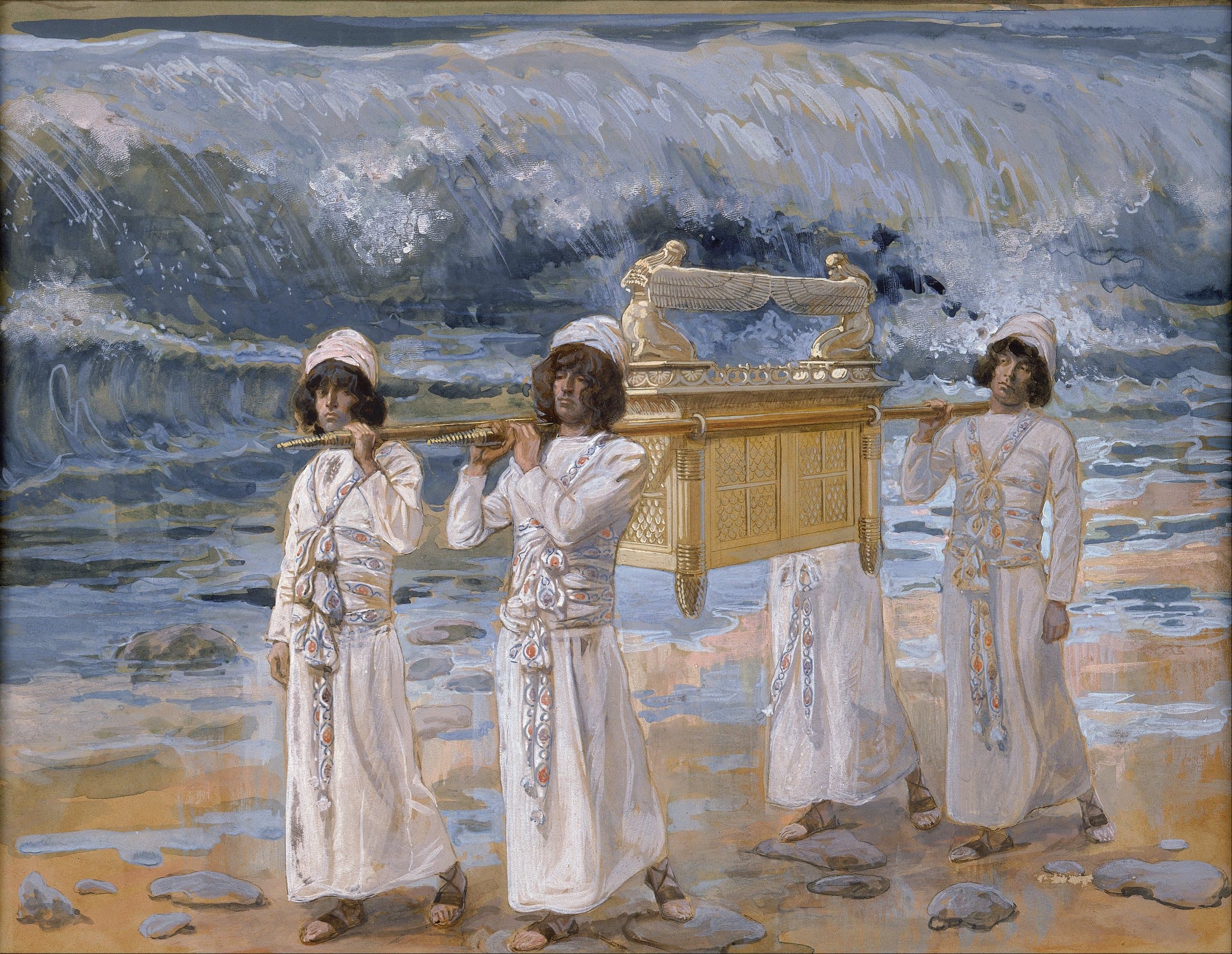
James Tissot, The Ark Passes Over the Jordan, about 1896 to 1902, Public domain by date, via Wikimedia Commons (File:James Jacques Joseph Tissot - The Ark Passes Over the Jordan - Google Art Project.jpg).
THE ARTWORKTissot painted the priests carrying the ark through the dry bed of the Jordan, the crossing that ended at the camp of Gilgal.
Israel's first night in the land was spent in a camp marked by twelve stones taken from a riverbed.
Summary
The people came up from the Jordan on the tenth day of the first month and camped at Gilgal, and the camp stayed there through the early wars of the conquest.
- Gibeon's envoys made their treaty with Joshua in the camp.
- The men born in the wilderness were circumcised there, and the LORD said He had rolled away the reproach of Egypt.
- Saul was confirmed as king at Gilgal and later rejected there.
The Camp on the Eastern Border of Jericho
Joshua 5:9 explains the name, and Josephus offered another meaning.
On the tenth day of the first month the people went up from the Jordan and camped at Gilgal on the eastern border of Jericho.The camp is dated four days before the Passover that Joshua 5:10 sets on the fourteenth.
And there at Gilgal Joshua set up the twelve stones they had taken from the Jordan.The order of Joshua 4:3 to set the stones down where the people spent the night was kept at this camp.
The name GilgalJoshua 5:9
Then the LORD said to Joshua, “Today I have rolled away the reproach of Egypt from you.” So that place has been called Gilgal to this day.This verse is the only explanation of the name Scripture gives.
John Wesley glosses the name as rolling, and Josephus says it denotes liberty, since Israel had passed out of the miseries of Egypt and the wilderness.
Smith's Dictionary of 1863 notes that this explanation cannot apply to the other places of the same name, and asks whether the name was older than Israel's arrival.
Gilgal and the Road into the Hills
Every campaign from the camp went up the same road into the hills.
Jericho stood beside the camp, and Ai, Bethel and Shiloh lay up the road to the west.
- Located: the site is known
- Proposed: one candidate among several
- The route, in the order the text gives
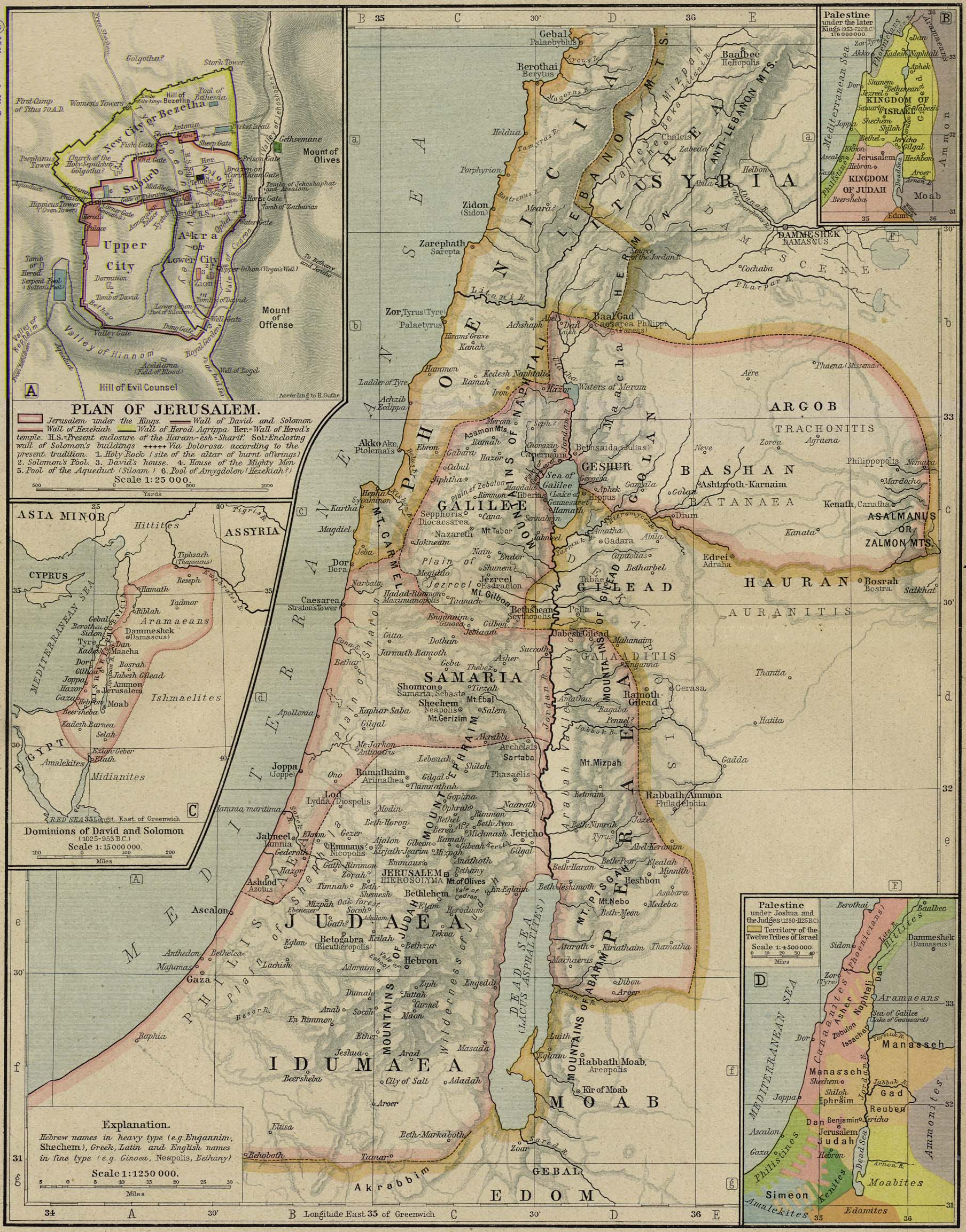
about 50 km (31 miles)
- 1Gilgal, Where the stones from the riverbed were set up. Joshua 4:20
- 2Jericho, The people marched around it and returned to the camp each night. Joshua 6:11
- 3Ai, The second city taken, in the hills above Jericho. Joshua 8:1
- 4Bethel, The first stop on Samuel's yearly circuit. 1 Samuel 7:16
- 5Shiloh, The congregation set up the Tent of Meeting there. Joshua 18:1
Base map: Reference map of ancient Palestine, Rand McNally reference map (1926), public domain. Each place stands at its place page's coordinates, set on the plate by Jerusalem and Damascus, as the plate prints them.
Five places in the order of the road, each with the verse that ties it to Gilgal.
What Happened at Gilgal, in Order
Scripture follows Gilgal through Joshua, Judges and the books of Samuel to the prophets of the northern kingdom.
Gilgal was Joshua's camp, Samuel's court and Saul's crowning place before the prophets condemned it.
- The tenth day of the first monthIsrael comes up from the Jordan and camps at GilgalJoshua 4:19
- The same dayThe memorial of the crossing is set upJoshua 4:20
- Before the PassoverThe men born in the wilderness are circumcisedJoshua 5:8
- The fourteenth dayIsrael keeps the Passover on the plains of JerichoJoshua 5:10
- The days afterIsrael eats the produce of the land, and the manna stopsJoshua 5:12
- During the conquestThe Gibeonites come to the camp and ask for a treatyJoshua 9:6
- The southern campaignJoshua marches all night from Gilgal to relieve GibeonJoshua 10:9
- After the warsCaleb speaks to Joshua at Gilgal about the promise of Kadesh-barneaJoshua 14:6
- After Joshua's deathThe angel of the LORD goes up from Gilgal to BochimJudges 2:1
- Samuel's judgeshipSamuel judges Israel at Gilgal on his yearly circuit1 Samuel 7:16
- After the rescue of JabeshAll the people confirm Saul as king at Gilgal1 Samuel 11:15
- Saul's Philistine warSaul offers the burnt offering before Samuel comes1 Samuel 13:9
- After the Amalekite warSamuel rejects Saul and puts Agag to death at Gilgal1 Samuel 15:33
- David's returnThe men of Judah meet David at Gilgal to bring him over the Jordan2 Samuel 19:15
- The days of Hosea and AmosHosea finds all Israel's evil at GilgalHosea 9:15
Fifteen events in order, each with its verse.
The circumcision at Gibeath-haaralothJoshua 5:2 to 9
At that time the LORD said to Joshua, “Make flint knives and circumcise the sons of Israel once again.” So Joshua made flint knives and circumcised the sons of Israel at Gibeath-haaraloth.The covenant sign was given again to a generation that had not received it in the wilderness.
The first Passover in the land and the end of the mannaJoshua 5:10 to 12
The day after the Passover, on that very day, they ate unleavened bread and roasted grain from the produce of the land. And the day after they had eaten from the produce of the land, the manna ceased. There was no more manna for the Israelites, so that year they began to eat the crops of the land of Canaan.The food of the wilderness stopped once the people could eat from the land God had promised.
Saul at Gilgal1 Samuel 13:8 to 14 and 1 Samuel 15:21 to 23
“You have acted foolishly,” Samuel declared. “You have not kept the command that the LORD your God gave you; if you had, the LORD would have established your kingdom over Israel for all time. But now your kingdom will not endure; the LORD has sought a man after His own heart and appointed him ruler over His people, because you have not kept the command of the LORD.”Samuel's rebuke ties the loss of the dynasty to the command Saul did not keep.
But Samuel declared: “Does the LORD delight in burnt offerings and sacrifices as much as in obedience to His voice? Behold, obedience is better than sacrifice, and attentiveness is better than the fat of rams.Samuel answered the plan to sacrifice the plunder at Gilgal with the rule of obedience.
Three Things the Text Says Plainly
Three plain statements of Joshua and 1 Samuel show what Gilgal was for.
THE STONES WERE A SIGN FOR THE CHILDREN
Joshua told Israel that their children would ask what the stones meant, and that the answer was the waters of the Jordan cut off before the ark.
THE ARMY CAME BACK TO THE CAMP
After the southern campaign Joshua returned with all Israel to the camp at Gilgal.
SAMUEL'S CIRCUIT PASSED THROUGH IT
Every year Samuel went from Bethel to Gilgal to Mizpah, judging Israel in each place.
The Plains of Jericho
Gilgal lay in the Jordan valley, far beneath Bethel in the hills.
Smith's Dictionary describes the plains of Jericho as the hot, low district of the Ghor between the town and the Jordan, and reads Joshua 5:3 as placing the camp on a rise in the ground.
The same article notes that the road from Gilgal to Bethel always goes up in Joshua and 1 Samuel, because the valley lies nearly 1,200 feet below Bethel.
Gilgal in the Written Record
Josephus, the pilgrims and the surveyors of the nineteenth century each tried to fix where the camp stood.
| Writer | Date | Gilgal from Jericho | Gilgal from the Jordan |
|---|---|---|---|
| Josephus, Antiquities 5.1.4 | first century AD | 10 furlongs | 50 furlongs |
| The Onomasticon of Eusebius and Jerome | fourth century | 2 miles east | not given |
| Arculf, as Adamnan records him | about AD 700 | 5 miles | not given |
| Willibald | about AD 724 | 2 miles | 5 miles |
| The Survey of Western Palestine, Birket Jiljulieh | 1873 | a little over a mile from Eriha | between 4 and 5 miles |
The pilgrims and the twelve stonesSmith's Dictionary, volume 1, the article Gilgal
Smith's Dictionary reports that in Jerome's time the site of the camp and the twelve stones could still be made out, and that the people of the region held the spot in great reverence.
Arculf, at the end of the seventh century, found a large church over the site with the twelve stones ranged inside it, and Willibald saw the church and stones about thirty years later. Thietmar mentions the stones in AD 1217, and Ludolf of Suchem a century after him.
Robinson finds no trace in 1838Robinson, Biblical Researches, volume 2, page 287
Edward Robinson found no trace of the name or the site near Jericho, and no one in the valley had heard of the name. He placed it near the village of Riha from Josephus's measures.
Birket Jiljulieh in 1873The Survey of Western Palestine, volume 3, pages 173 to 175
The Survey of Western Palestine records that the name Birket Jiljulieh was recovered in 1873 from three local men, for a walled reservoir east of Jericho near a lone tamarisk. C. F. Tyrwhitt Drake gives its size as about 40 paces by 30, with walls of rolled pebbles some 2 feet 6 inches thick, and counts about a dozen low mounds nearby.
Drake proposed the mounds as traces of the Israelite camp, and called the proposal bold. The Survey judged that nothing stood against the site being the original one.
What the Text Leaves Unsaid
Scripture gives Gilgal one bearing and never says how its holy place became a place of false worship.
The same article says the text does not tell how the sanctity of Gilgal passed to a false worship by the time of Hosea and Amos.
But upon reaching the idols near Gilgal, he himself turned back and said, “I have a secret message for you, O king.” “Silence,” said the king, and all his attendants left him.Ehud turned back at the idols near Gilgal, the first mention of idols beside the place.
Where Scripture Returns to Gilgal
Scripture names Gilgal in ten books, and the prophets turn the name into a warning.
| Book | Verses that name Gilgal | What the book records there |
|---|---|---|
| Deuteronomy | 1 | the mountains across the Jordan, in the land of the Canaanites, opposite Gilgal |
| Joshua | 13 | the first camp, the twelve stones, the circumcision, the Passover and the southern wars |
| Judges | 2 | the angel who went up to Bochim, and the idols where Ehud turned back |
| 1 Samuel | 12 | Samuel's yearly circuit and the two sacrifices that cost Saul his throne |
| 2 Samuel | 2 | the men of Judah coming to escort the king across the Jordan |
| 2 Kings | 2 | Elijah and Elisha, at a Gilgal Smith's Dictionary sets in the hills |
| Nehemiah | 1 | Beth-gilgal, among the villages the singers built around Jerusalem |
| Hosea | 3 | the sacrifices condemned and the altars made heaps of stones |
| Amos | 2 | the call not to go to Gilgal, which will go into exile |
| Micah | 1 | the road from Shittim to Gilgal remembered as the LORD's righteousness |
Amos and Hosea against GilgalAmos 4:4, Amos 5:5 and Hosea 12:11
“Go to Bethel and transgress; rebel even more at Gilgal! Bring your sacrifices every morning, your tithes every three days.Amos mocks pilgrims who multiplied sacrifices at Gilgal and multiplied their sin with them.
Is there iniquity in Gilead? They will surely come to nothing. Do they sacrifice bulls in Gilgal? Indeed, their altars will be heaps of stones in the furrows of the field.Hosea foresees the altars of Gilgal as heaps of stones in a ploughed field.
The other Gilgal of Elijah and Elisha2 Kings 2:1 to 2 and 2 Kings 4:38
and Elijah said to Elisha, “Please stay here, for the LORD has sent me on to Bethel.” But Elisha replied, “As surely as the LORD lives and as you yourself live, I will not leave you.” So they went down to Bethel.Elijah and Elisha went down to Bethel, which Smith's Dictionary takes as a sign that their Gilgal stood higher than Bethel.
The article proposes the ruins named Jiljilia for it, and prefers a place of that name four miles from Shiloh, beside the main road north.
Two Voices on Gilgal
A teacher of the third century reads the reproach rolled away, and one of the eighteenth reads the later worship at Gilgal.
Origen applies the reproach of Egypt to every believer, even one trained in the law.
“All persons, even if they come from the law, even if they have learned through Moses, still have the reproach of Egypt in them, the reproach of sins. Who will be like Paul even according to the observance of the law? Just hear him saying, ‘According to the righteousness based upon the law, I lived without blame.’ Nevertheless, he himself publicly announces and says, ‘For we were even ourselves at some time foolish, unbelieving, wandering, enslaved to desires and various forms of pleasure, in malice and envy, hateful, hating one another.’”
Origen of Alexandria · Homilies on Joshua 5.6 · on Joshua 5:9Patristic
Matthew Henry explains why the worshippers chose Gilgal.
“They had sought to Bethel, where one of the golden calves was; they had frequented Gilgal, a place which they chose to set up idols in, because it had been made famous in the days of Joshua by God's wonderful appearances to and for his people.”
Matthew Henry · Commentary on the Whole Bible · on Amos 5:5Puritan
Was Samuel's Gilgal the Old Camp?
Smith's Dictionary sets Samuel's Gilgal at Joshua's camp, and Tyrwhitt Drake looked for it in the hills.
The same place as Joshua's campSmith's Dictionary, 1863
The objection: the article itself finds no sign of a town at Gilgal in Samuel's day, no building and no allotment to priests or Levites.
A Gilgal in the hillsDrake's report in The Survey of Western Palestine, volume 3
C. F. Tyrwhitt Drake's report, printed in The Survey of Western Palestine, volume 3, doubts that Samuel's Gilgal was the camp by Jericho. It proposes the modern Jiljilia in the hills, south of Selfit.
The objection: 1 Samuel 13:7 and 2 Samuel 19:15 tie Saul's Gilgal and David's to the Jordan, and Samuel's circuit names no second Gilgal.
Some Hebrews even crossed the Jordan into the land of Gad and Gilead. Saul, however, remained at Gilgal, and all his troops were quaking in fear.Saul's troops crossing the river show how near the Jordan his camp stood.
Books on Gilgal
All four of these works can be read free online.
A Dictionary of the Bible, volume 1, the article Gilgal
William Smith, editor · 1863
The article sets out the places of the name and the pilgrims' reports of the camp.
Read at archive.orgBiblical Researches in Palestine, Mount Sinai and Arabia Petraea, volume 2
Edward Robinson · 1841
Robinson's account of the plain of Jericho records his search for Gilgal in 1838.
Read at archive.orgThe Survey of Western Palestine, Memoirs, volume 3
Claude R. Conder and H. H. Kitchener · 1881
It gives Drake's report of Birket Jiljulieh and the mounds beside it.
Read at archive.orgThe Antiquities of the Jews
Flavius Josephus, translated by William Whiston · 1737
Book 5 gives the oldest measure of the camp's distance from Jericho and the Jordan.
Read at gutenberg.orgThe Reproach Rolled Away
At Gilgal the covenant sign was cut in the flesh, and Paul writes of a circumcision that no hand performs.
In Him you were also circumcised, in the putting off of your sinful nature, with the circumcision performed by Christ and not by human hands.The believer receives in Christ what the flint knives of Gilgal signified.
Keep studying
Read it4
People3
Peoples and groups2