
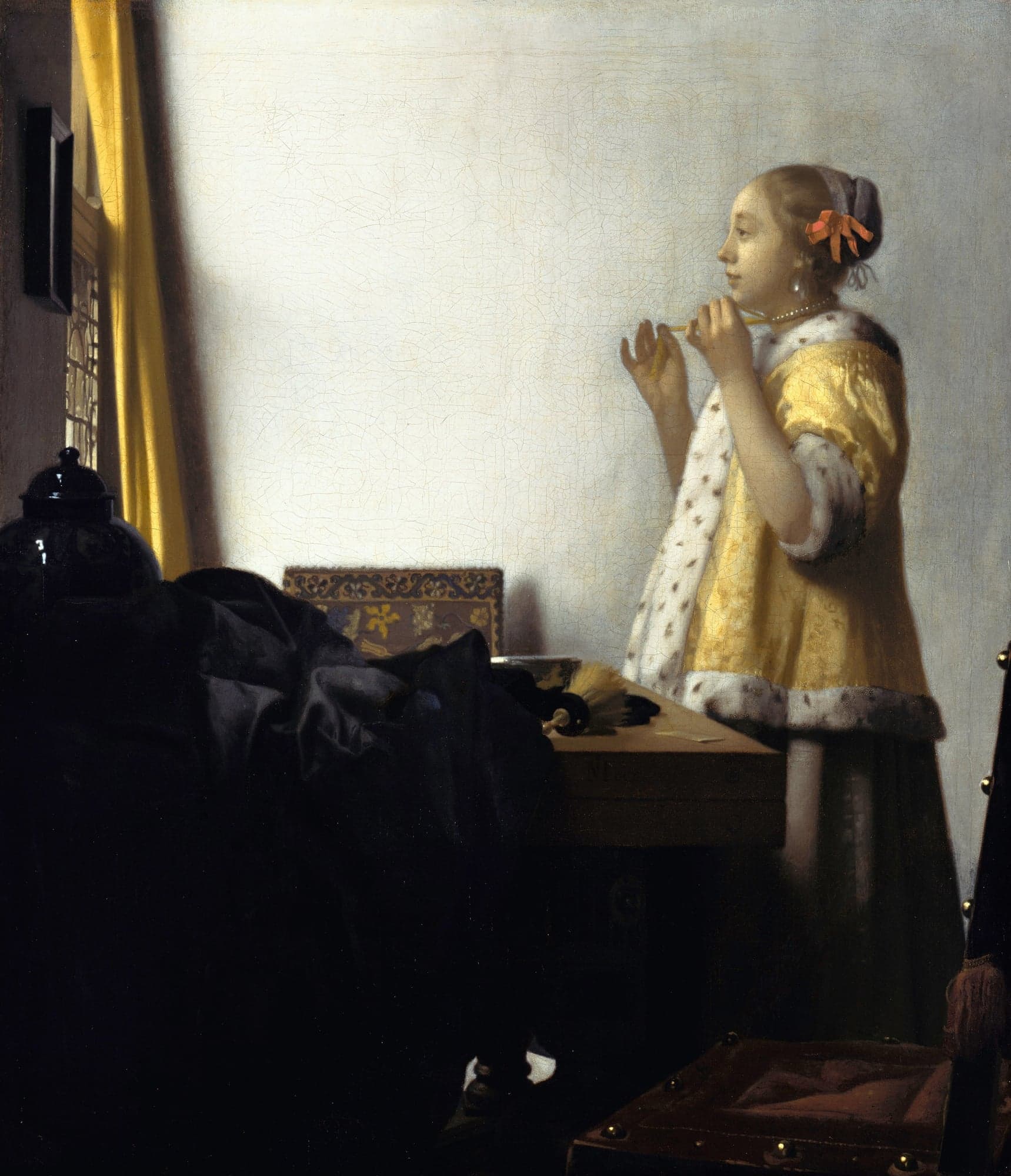
1 Peter 3:3 to 4 · Passage · Modesty and Simplicity
The Hidden Person of the Heart
1 Peter 3:1 to 6 and 1 Timothy 2:9 to 10 are the New Testament's two charges on how Christian women adorn themselves.
Peter expected a believing wife's conduct to win an unbelieving husband before any word of hers did.
but from the inner disposition of your heart, the unfading beauty of a gentle and quiet spirit, which is precious in God’s sight.
- The passage
- 1 Peter 3:1 to 6, 1 Timothy 2:9 to 10
- Books
- 1 Peter, 1 Timothy
- Hold in memory
- 1 Peter 3:4, 1 Timothy 2:10
Summary
Both apostles set aside the ornaments of their day and name a better adornment in their place. Peter wrote to exiles scattered through five provinces of Asia Minor, and Paul wrote to Timothy, whom he had left at Ephesus. Each charge belongs to a larger call to live in a way that commends the gospel to those who watch.
- Peter places a woman's true beauty in the inner self, whose gentle and quiet spirit God counts precious.
- Peter's pattern is Sarah and the holy women of the past, whose adorning grew from their trust in God.
- Paul ties a woman's apparel to two virtues of the heart, modesty and self-control.
- Isaiah had already set the finery of Jerusalem's women under the LORD's judgment.
Where the Two Charges Stand
Peter's charge follows a word on slander and on Christ's example, and Paul's follows a word to the men.
Modesty is the value of a life kept plain and fitting before God. Its teaching on dress comes from Peter's charge to wives and Paul's charge to the women of the church more than from any other texts. This study asks what each apostle says, clause by clause, and why both set the heart's adorning above the body's. It reads each charge in its letter and teaches the Greek words of each clause, Sarah and the holy women, and the Old Testament behind both letters. Three voices of the early church show how the texts were first read, and two readings answer whether the charges forbid the ornaments.
Peter's household code follows his call to live so that unbelievers “may see your good deeds and glorify God on the day He visits us” (1 Peter 2:12).
For to this you were called, because Christ also suffered for you, leaving you an example, that you should follow in His footsteps:Peter sets Christ's example over every command that follows, the wives' charge among them.
Paul's charge stands in his instructions for public prayer. He first tells the men “to pray, lifting up holy hands, without anger or dissension” (1 Timothy 2:8), and then turns to the women with the word “Likewise” (1 Timothy 2:9).
Seven Clauses in Two Letters
The clauses move from conduct to the inner person, to the women of old and to good deeds.
Both apostles name what to set aside and then the adornment God values, and Peter adds the women who lived it.
| Rung | Verse | Words of the clause | What the clause teaches |
|---|---|---|---|
| Conduct | 1 Peter 3:1 to 2 | “your pure and reverent demeanor” | The charge begins in the home, with a wife's submission to her husband. |
| Set aside | 1 Peter 3:3 | “braided hair or gold jewelry” | Beauty is not to be drawn from what is worn on the body. |
| The heart | 1 Peter 3:4 | “a gentle and quiet spirit” | The beauty God looks for lies within and does not fade with age. |
| The holy women | 1 Peter 3:5 | “They put their hope in God” | Israel's mothers in the faith are the first examples Peter gives. |
| Sarah | 1 Peter 3:6 | “refuse to give way to fear” | Sarah's respect for Abraham is the pattern for the wives Peter addresses. |
| Apparel | 1 Timothy 2:9 | “with respectable apparel” | Dress at public worship is to be orderly and free of display. |
| Good deeds | 1 Timothy 2:10 | “as is proper for women” | What a woman does for others is the finest thing she can wear. |
1 Peter 3:1 to 6, the Inner Self and the Holy Women
Peter asks for conduct that speaks, sets three ornaments aside, names the beauty that lasts and grounds it in Sarah.
Wives, in the same way, submit yourselves to your husbands, so that even if they refuse to believe the word, they will be won over without words by the behavior of their wives when they see your pure and reverent demeanor.Peter opens with “in the same way” (1 Peter 3:1), which joins the wives' charge to the servants' charge just before it (1 Peter 2:18).
Your beauty should not come from outward adornment, such as braided hair or gold jewelry or fine clothes,Peter sets outward adornment first in his sentence so that the inner beauty of the next verse can answer it.
The Greek of 1 Peter 3:3 uses three nouns of action, braiding, putting around and putting on. Its last word is kosmos, the adornment of the Berean text, and Abbott-Smith's lexicon gives kosmos the sense “ornament, adornment” and names this verse.
In 1 Peter 3:4 the Greek phrase is ho kryptos tēs kardias anthrōpos, which the Berean text renders as “the inner disposition of your heart” (1 Peter 3:4). The word for hidden is kryptos, and the word for quiet is hēsychios. The word for gentle is praus, the word of meekness.
The Greek word behind “precious in God’s sight” (1 Peter 3:4) is polytelēs, the word behind “expensive clothes” (1 Timothy 2:9). Its one other use in the New Testament is the “expensive perfume” a woman poured on Jesus' head at Bethany (Mark 14:3).
For this is how the holy women of the past adorned themselves. They put their hope in God and were submissive to their husbands,Peter makes hope in God the mark of the holy women, so the adornment he asks for begins in faith.
just as Sarah obeyed Abraham and called him lord. And you are her children if you do what is right and refuse to give way to fear.Peter turns from the holy women as a group to one of them, so his readers have a named pattern whose children they can become.
1 Peter 3:5, 1 Peter 3:6
The Old Testament behind the Apostles
Isaiah, Samuel and the Proverbs had already weighed ornament against the heart.
Isaiah saw “the daughters of Zion” as “haughty” (Isaiah 3:16), and he listed the finery the Lord would take away, from “anklets and headbands” (Isaiah 3:18) to “mirrors, linen garments, tiaras, and shawls” (Isaiah 3:23). Peter's three ornaments and Paul's four belong to the same world of display.
But the LORD said to Samuel, “Do not consider his appearance or height, for I have rejected him; the LORD does not see as man does. For man sees the outward appearance, but the LORD sees the heart.”The LORD's word to Samuel sets the eye of God on the heart, the place where Peter puts the adornment God values.
Strength and honor are her clothing, and she can laugh at the days to come.The woman of Proverbs 31 is clothed with strength and honour, the inward clothing the apostles ask for.
1 Timothy 2:9 to 10, Respectable Apparel and Good Deeds
Paul names the apparel, the two virtues that go with it, four ornaments and the adornment of good deeds.
Likewise, I want the women to adorn themselves with respectable apparel, with modesty, and with self-control, not with braided hair or gold or pearls or expensive clothes,Paul names the virtues that go with the apparel before he lists any ornament, so the inward comes first in his sentence as well.
The word for apparel is katastolē, and Abbott-Smith's lexicon gives it both “a garment, dress, attire” and “steadiness, quietness in demeanour”. Paul's adjective for it is kosmios, and the Greek nouns behind “modesty” and “self-control” (1 Timothy 2:9) are aidōs and sōphrosynē. Paul's list adds pearls to Peter's three ornaments.
but with good deeds, as is proper for women who profess to worship God.This verse completes Paul's sentence, so his charge ends on what a woman does.
How the Early Church Read the Texts
Cyprian, Ambrose and Chrysostom, three bishops of the early church, each took one line of the charges and taught it.
died 258 · Cyprian
Treatise II On the Dress of Virgins
The two apostles were read as giving one rule, the adorning of the heart.
The quotation1 quotation
“Also Peter consents to these same precepts, and says, ‘Let there be in the woman not the outward adorning of array, or gold, or apparel, but the adorning of the heart.’”
Cyprian · Treatise II On the Dress of Virgins · on 1 Peter 3:3Patristic
died 397 · Ambrose of Milan
Letter 38
Peter's teaching on true riches was read as holding for men and women alike.
The quotation1 quotation
Read the page on Ambrose of Milan
“But afterwards, in reading the epistle of the Apostle Peter, I perceived that every wise man is also rich: and this he says without distinction of sex, for he writes that all a woman's ornaments consist in a virtuous life, not in costly jewels, Whose adorning, he says, is not that outward adorning of plaiting the hair, and, of wearing of gold, or of putting on of apparel, but the hidden man of the heart.”
Ambrose of Milan · Letter 38 · on 1 Peter 3:4Patristic
died 407 · John Chrysostom
Homily on 1 Timothy 8
Modest apparel was read as clothing that covers decently and carries nothing superfluous.
The quotation1 quotation
Read the page on John Chrysostom
“Paul however requires something more of women, that they adorn themselves ‘in modest apparel, with shamefacedness and sobriety; not with broidered hair or gold or pearls or costly array; But (which becometh women professing godliness) with good works.’ But what is this ‘modest apparel’? Such attire as covers them completely, and decently, not with superfluous ornaments, for the one is becoming, the other is not.”
John Chrysostom · Homily on 1 Timothy 8 · on 1 Timothy 2:10Patristic
Whether the Charges Forbid or Rank
Two readings answer whether the ornaments are forbidden outright, and each has its holder and the objection to it.
Peter's sentence on beauty turns from what it should not come from to what it should come from, and Paul's turns from what the women should not wear to good deeds. Readers have asked whether that turn forbids the ornaments or ranks them below the heart.
The ornaments are forbiddenJohn Wesley
John Wesley read the four things of 1 Timothy 2:9 as forbidden outright. His Explanatory Notes upon the New Testament (1755) reads, "These four are expressly forbidden by name to all women (here is no exception) professing godliness".
The objection: a sentence that turns from one thing to a better one can set the second above the first without forbidding the first, and Peter's sentence has that shape.
The heart comes first, and measure is left to judgmentAugustine of Hippo
Augustine of Hippo, in Letter 245 to Possidius (translated by J. G. Cunningham, 1887), allowed married women to adorn themselves for their husbands "according to the toleration, not the injunction, of Scripture".
The objection: Paul lists the four things one by one after the word not, and his charge in 1 Timothy 2:9 makes no exception for the married.
The Adorning God Values
Both apostles turned the eye from what is put on to what is lived. Both named an adornment that God values and that others can see in conduct.
Sources
Scripture is the Berean Standard Bible.
- STEP Bible, Translators Brief lexicon of Extended Strongs for Greek (Tyndale House, Cambridge), CC BY 4.0, with the Greek brief lexicon based on Abbott-Smith (1922)
- STEP Bible, Translators Amalgamated Greek New Testament, the tagged text (Tyndale House, Cambridge), CC BY 4.0.
- Cyprian, On the Dress of Virgins, on 1 Peter 3:3.
- Ambrose of Milan, Letter 38, on 1 Peter 3:4.
- John Chrysostom, Homilies on 1 Timothy, homily 8, on 1 Timothy 2:10.
- John Wesley, Explanatory Notes upon the New Testament (1755), on 1 Timothy 2:9.
- Augustine of Hippo, Letter 245, to Possidius, translated by J. G. Cunningham, Nicene and Post-Nicene Fathers, first series, volume 1 (1887)
Keep Studying
Studies6
In this value2
People and groups12
Doctrines1