
1 Samuel 1 to 28 · Person · Featured Study
Samuel
The prophet and judge of 1 Samuel 1 to 28, who anointed Israel's first two kings.
Samuel was promised to the LORD before he was born, and he served Him until the day of his death.
- The name means
- heard of God, in Albert Barnes's reading
- Born
- at Ramah
- Died
- at Ramah, in the years David fled from Saul
- Family
- father: Elkanah; mother: Hannah; son: Joel; son: Abijah; grandson: Heman the singer
- Places
- Ramah, Shiloh, Mizpah, Bethel, Gilgal, Bethlehem, Endor
- First named
- 1 Samuel 1:20
- Last named
- Hebrews 11:32
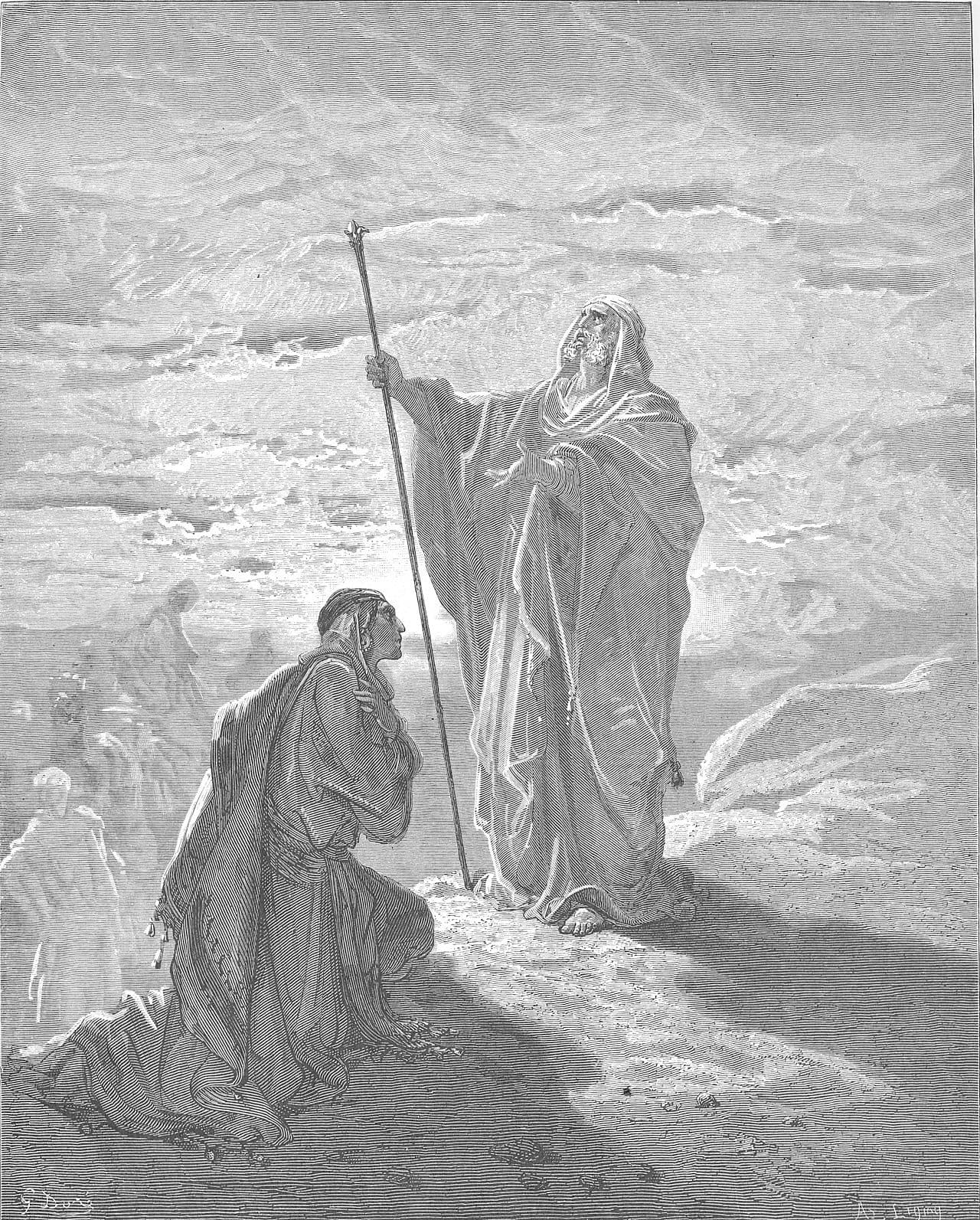
Gustave Doré, Samuel Blesses Saul, La Sainte Bible, 1866. Public domain, via Wikimedia Commons.
THE ARTWORKDoré drew Samuel looking up to heaven over Saul, the man he had just anointed king.
Summary
Samuel was the last of the judges, and he led Israel from the loss of the ark to the reign of Saul.
- The LORD called him four times in one night at Shiloh, and the first word He gave him was judgment on the house of Eli.
- He told Saul that obedience is better than sacrifice.
- Psalm 99:6 and Jeremiah 15:1 set him beside Moses as a man of prayer.
Where Samuel Stands in Scripture
Sixteen chapters of 1 Samuel name him, from his birth to Endor.
Beyond 1 Samuel, his name stands in 1 Chronicles, the Psalms, Jeremiah, Acts and Hebrews.
All this took about 450 years. After this, God gave them judges until the time of Samuel the prophet.Paul ends the era of the judges with Samuel, so he stands at the turn from the judges to the kings.
And what more shall I say? Time will not allow me to tell of Gideon, Barak, Samson, Jephthah, David, Samuel, and the prophets,Hebrews names Samuel last before the prophets, among those who acted by faith.
The Life, Turn by Turn
Eighteen turns from Hannah's vow to the night at Endor
- Hannah vows her son to the LORDShiloh, 1 Samuel 1:11
- Born and named SamuelRamah, 1 Samuel 1:20
- Brought to the house of the LORD once weanedShiloh, 1 Samuel 1:24
- Ministers before the LORD in a linen ephodShiloh, 1 Samuel 2:18
- The LORD calls him in the nightShiloh, 1 Samuel 3:10
- Known as a prophet from Dan to Beershebaall Israel, 1 Samuel 3:20
- Calls Israel to put away its foreign godsall the house of Israel, 1 Samuel 7:3
- Sets up the stone Ebenezerbetween Mizpah and Shen, 1 Samuel 7:12
- Judges Israel on a yearly circuitBethel, Gilgal, Mizpah and Ramah, 1 Samuel 7:16
- Hears the elders ask for a kingRamah, 1 Samuel 8:5
- Anoints Saul with a flask of oila town in the land of Zuph, 1 Samuel 10:1
- Writes the rights of kingship on a scrollMizpah, 1 Samuel 10:25
- Calls the people to witness against himbefore all Israel, 1 Samuel 12:3
- Tells Saul his kingdom will not endureGilgal, 1 Samuel 13:14
- Puts Agag to death before the LORDGilgal, 1 Samuel 15:33
- Anoints David with a horn of oilBethlehem, 1 Samuel 16:13
- Dies, and all Israel mourns himRamah, 1 Samuel 25:1
- Brought up before Saul by a mediumEndor, 1 Samuel 28:14
Eight of the eighteen turns belong to the years of Saul.
From Shiloh to Ramah
The life in four parts, from the boy at the sanctuary to the old man at Ramah
He grew up in the sanctuary beside Hophni and Phinehas, priests who had no regard for the LORD.
After 1 Samuel 4:1 the narrative leaves him unnamed until he gathers Israel at Mizpah in chapter 7.
In his old age the elders asked him for a king, and the LORD told him to give them one.
He lived to see Saul turn against David, and David fled to him at Ramah.
The boy at Shiloh1 Samuel 1 to 3
And she made a vow, pleading, “O LORD of Hosts, if only You will look upon the affliction of Your maidservant and remember me, not forgetting Your maidservant but giving her a son, then I will dedicate him to the LORD all the days of his life, and no razor shall ever come over his head.”The razor clause of Hannah's vow is the mark of the Nazirite in Numbers 6:5, laid on Samuel for life.
And the boy Samuel continued to grow in stature and in favor with the LORD and with man.The boy grows in favor while Eli's sons are condemned, and Luke uses the same words of Jesus.
Then the LORD came and stood there, calling as before, “Samuel! Samuel!” And Samuel answered, “Speak, for Your servant is listening.”Samuel answers with the words Eli taught him, and the LORD's first message follows.
And Samuel grew, and the LORD was with him, and He let none of Samuel’s words fall to the ground.Deuteronomy 18:22 tests a prophet by whether his word comes to pass, and this verse says of Samuel that none of his words fell.
The judge at Mizpah1 Samuel 7
Then Samuel said to all the house of Israel, “If you are returning to the LORD with all your hearts, then rid yourselves of the foreign gods and Ashtoreths among you, prepare your hearts for the LORD, and serve Him only. And He will deliver you from the hand of the Philistines.”Samuel sets the return of the heart before any battle, and the people answer it at once in the next verse.
As the Philistines drew near to fight against Israel, Samuel was sacrificing the burnt offering. But that day the LORD thundered loudly against the Philistines and threw them into such confusion that they fled before Israel.The battle was won by the LORD's thunder while Samuel was still at the burnt offering.
Afterward, Samuel took a stone and set it up between Mizpah and Shen. He named it Ebenezer, saying, “Thus far the LORD has helped us.”The name of the stone gives the victory to the LORD and none of it to Israel.
“The place where this memorial was set up was the same where, twenty years before, the Israelites were smitten before the Philistines, for that was beside Eben-ezer, ch. iv. The sin which procured that defeat formerly being pardoned upon their repentance, the pardon was sealed by this glorious victory in the very same place where they then suffered loss; see Hos. i.”
Matthew Henry · Commentary on the Whole Bible · on 1 Samuel 7:12Puritan
The maker of kings1 Samuel 8 to 16
Then Samuel took a flask of oil, poured it on Saul’s head, kissed him, and said, “Has not the LORD anointed you ruler over His inheritance?Samuel anoints Saul in private, before Saul is selected in front of the people at Mizpah.
Here I am. Bear witness against me before the LORD and before His anointed: Whose ox or donkey have I taken? Whom have I cheated or oppressed? From whose hand have I accepted a bribe and closed my eyes? Tell me, and I will restore it to you.” “You have not wronged us or oppressed us,” they replied, “nor have you taken anything from the hand of man.” Samuel said to them, “The LORD is a witness against you, and His anointed is a witness today, that you have not found anything in my hand.” “He is a witness,” they replied.Before the new king, the people find no bribe and no theft in Samuel's whole rule.
“You have acted foolishly,” Samuel declared. “You have not kept the command that the LORD your God gave you; if you had, the LORD would have established your kingdom over Israel for all time. But now your kingdom will not endure; the LORD has sought a man after His own heart and appointed him ruler over His people, because you have not kept the command of the LORD.”Saul offered the burnt offering at Gilgal without Samuel, and the sentence names a man after the LORD's own heart before David appears.
But Samuel declared: “Does the LORD delight in burnt offerings and sacrifices as much as in obedience to His voice? Behold, obedience is better than sacrifice, and attentiveness is better than the fat of rams. For rebellion is like the sin of divination, and arrogance is like the wickedness of idolatry. Because you have rejected the word of the LORD, He has rejected you as king.”The second sentence on Saul passes from his house to Saul himself, rejected as king.
But the LORD said to Samuel, “Do not consider his appearance or height, for I have rejected him; the LORD does not see as man does. For man sees the outward appearance, but the LORD sees the heart.”The LORD corrects Samuel himself, who had judged Eliab by his height.
The last years1 Samuel 19 and 25
he sent messengers to capture him. But when they saw the group of prophets prophesying, with Samuel leading them, the Spirit of God came upon them, and Saul’s messengers also began to prophesy.This is the last scene in which 1 Samuel shows him alive and at work.
When Samuel died, all Israel gathered to mourn for him; and they buried him at his home in Ramah. Then David set out and went down to the Wilderness of Paran.All Israel mourned him, and the burial at Ramah is told again in 1 Samuel 28:3 before Endor.
Jamieson, Fausset and Brown take the company of prophets for the pupils of a school that Samuel had probably founded, where the law and psalmody were taught.
What the Text Says and What Is Often Said
Three things often said of Samuel, each with the verse that answers it
HIS AGE AT THE CALL
He is often pictured as a small child; 1 Samuel 3 calls him a boy and gives no age.
HIS OFFICE AFTER SAUL
He is often thought to have stepped down when Saul was made king; 1 Samuel 7:15 sets no end to his judging but his death.
OBEDIENCE AND SACRIFICE
His words on obedience are often read as a rule against offerings; they answer a king who kept back plunder to offer it.
Between the Judges and the Kings
Shiloh, the ark at Kiriath-jearim, the book of Sirach and the older word for a prophet
The house of the LORD stood at Shiloh in the days of Eli, and Eli had judged Israel forty years when the ark was taken.
The ark came back from the Philistines to the house of Abinadab at Kiriath-jearim, and it stayed there twenty years. Scripture gives no year for any event of Samuel's life.
Sirach on SamuelSirach 46:13 to 20
The book of Sirach praises Samuel in eight verses. It recalls the sucking lamb, the thunder and the farewell, and it adds that he destroyed the rulers of the Tyrians, which 1 Samuel does not record.
It also says that after his death he prophesied and showed the king his end. The book stands among the Apocrypha, outside the Hebrew canon.
Seer and prophet1 Samuel 9:9
(Formerly in Israel, a man on his way to inquire of God would say, “Come, let us go to the seer.” For the prophet of today was formerly called the seer.)The narrator explains an older word for the reader, and Samuel uses it of himself ten verses later.
The Family of Samuel
Eight ties, each with its verse
| Person | Tie to Samuel | Verse |
|---|---|---|
| Levi and Kohath | His forefathers in the Chronicler's line. | 1 Chronicles 6:38 |
| Elkanah | His father, of Ramathaim-zophim. | 1 Samuel 1:1 |
| Hannah | His mother, who made him a robe each year. | 1 Samuel 2:19 |
| Peninnah | His father's other wife, who had children before him. | 1 Samuel 1:2 |
| Three brothers and two sisters | Born to Hannah after him. | 1 Samuel 2:21 |
| Joel | His firstborn, a judge at Beersheba. | 1 Samuel 8:2 |
| Abijah | His second son, a judge at Beersheba. | 1 Samuel 8:2 |
| Heman the singer | His grandson, the son of Joel. | 1 Chronicles 6:33 |
- Person
- Levi and Kohath
- Tie to Samuel
- His forefathers in the Chronicler's line.
- Verse
- 1 Chronicles 6:38
- Person
- Elkanah
- Tie to Samuel
- His father, of Ramathaim-zophim.
- Verse
- 1 Samuel 1:1
- Person
- Hannah
- Tie to Samuel
- His mother, who made him a robe each year.
- Verse
- 1 Samuel 2:19
- Person
- Peninnah
- Tie to Samuel
- His father's other wife, who had children before him.
- Verse
- 1 Samuel 1:2
- Tie to Samuel
- Born to Hannah after him.
- Verse
- 1 Samuel 2:21
- Person
- Joel
- Tie to Samuel
- His firstborn, a judge at Beersheba.
- Verse
- 1 Samuel 8:2
- Person
- Abijah
- Tie to Samuel
- His second son, a judge at Beersheba.
- Verse
- 1 Samuel 8:2
- Person
- Heman the singer
- Tie to Samuel
- His grandson, the son of Joel.
- Verse
- 1 Chronicles 6:33
An Ephraimite and a Levite1 Samuel 1:1; 1 Chronicles 6; John Wesley
1 Samuel 1:1 calls Elkanah an Ephraimite.
John Wesley, on 1 Samuel 2:18, says that Samuel was no Levite but a Nazirite from his birth.
These are the men who served, together with their sons. From the Kohathites: Heman the singer, the son of Joel, the son of Samuel, the son of Elkanah, the son of Jeroham, the son of Eliel, the son of Toah,The Chronicler sets Samuel's line among the Kohathites whom David put over the music of the house of the LORD.
The sons of two houses1 Samuel 3:13 and 8:1 to 5; Rashi
Samuel's first message judged Eli's house for the sins of Eli's sons, and the elders later named the conduct of Samuel's own sons.
The rabbinic commentator Rashi cites the Babylonian Talmud, tractate Shabbat 56a, for the reading that Samuel's sons did not sin. They settled at Beersheba instead of riding a circuit, and the cost of the journey drove litigants to drop their claims.
But his sons did not walk in his ways; they turned aside toward dishonest gain, accepting bribes and perverting justice.The Berean text names bribes and perverted justice, so the rabbis' reading stands against the plain words.
The Places of His Life
Eight places in the order 1 Samuel reaches them
| Place | What happened there | Verse |
|---|---|---|
| Ramah | His home, where he judged, built an altar and was buried. | 1 Samuel 7:17 |
| Shiloh | He served there under Eli, and the LORD called him there. | 1 Samuel 3:21 |
| Mizpah | He gathered Israel to pray, and later presented Saul to the people. | 1 Samuel 7:5 |
| Bethel | The first town of his yearly circuit. | 1 Samuel 7:16 |
| Gilgal | He renewed the kingship there and rebuked Saul twice. | 1 Samuel 11:14 |
| Bethlehem | He anointed David among his brothers. | 1 Samuel 16:13 |
| Naioth in Ramah | He led the company of prophets there. | 1 Samuel 19:20 |
| Endor | Saul went to a medium there and asked for Samuel. | 1 Samuel 28:7 |
- Place
- Ramah
- What happened there
- His home, where he judged, built an altar and was buried.
- Verse
- 1 Samuel 7:17
- Place
- Shiloh
- What happened there
- He served there under Eli, and the LORD called him there.
- Verse
- 1 Samuel 3:21
- Place
- Mizpah
- What happened there
- He gathered Israel to pray, and later presented Saul to the people.
- Verse
- 1 Samuel 7:5
- Place
- Bethel
- What happened there
- The first town of his yearly circuit.
- Verse
- 1 Samuel 7:16
- Place
- Gilgal
- What happened there
- He renewed the kingship there and rebuked Saul twice.
- Verse
- 1 Samuel 11:14
- Place
- Bethlehem
- What happened there
- He anointed David among his brothers.
- Verse
- 1 Samuel 16:13
- Place
- Naioth in Ramah
- What happened there
- He led the company of prophets there.
- Verse
- 1 Samuel 19:20
- Place
- Endor
- What happened there
- Saul went to a medium there and asked for Samuel.
- Verse
- 1 Samuel 28:7
Questions the Life Raises
Three questions, each answered from Scripture and its commentators
Was Samuel a priest?1 Samuel 7; Albert Barnes
Albert Barnes, on 1 Samuel 7:3, names him prophet, judge and acknowledged leader of the whole people.
Then Samuel took a suckling lamb and offered it as a whole burnt offering to the LORD. He cried out to the LORD on behalf of Israel, and the LORD answered him.Samuel offers the lamb with his own hands, and the LORD answers his cry.
What did the request for a king reject?Augustine of Hippo
And the LORD said to Samuel, “Listen to the voice of the people in all that they say to you. For it is not you they have rejected, but they have rejected Me as their king.The answer turns Samuel's grievance from himself to the LORD.
“To some, indeed, who lack patience, the Lord God, in his wrath, grants them what they ask, just as, on the other hand, he refused it to his apostle, in his mercy. We read what and how the Israelites asked and received, but, when their lust had been satisfied, their lack of patience was severely punished. And when they asked, he gave them a king, as it is written, according to their heart, but not according to his heart.… These things are written that no one may think well of himself if his prayer is heard, when he has asked impatiently for what it would be better for him not to receive, and that no one may be cast down and may despair of the divine mercy toward him if his prayer has not been heard, when he has, perhaps, asked for something which would bring him more bitter suffering if he received it or would cause his downfall if he were ruined by prosperity. In such circumstances, then, we know not what we should pray for as we ought.”
Augustine of Hippo · LETTER 130 · on 1 Samuel 8:7Patristic
Did God change His mind about Saul?1 Samuel 15; Gregory of Nyssa
1 Samuel 15:11 and 1 Samuel 15:35 set the LORD's regret over Saul on either side of Samuel's words to him.
Moreover, the Glory of Israel does not lie or change His mind, for He is not a man, that He should change His mind.”Samuel speaks this to Saul as the reason the sentence on him will stand.
“Holy Scripture is often accustomed to attributing expressions to God such that seem quite like our own, for example, ‘The Lord was angry, and he was grieved because of their sins’; and again, ‘He repented that he had anointed Saul king’ … and besides this, it makes mention of his sitting, and standing, and moving, and the like, which are not as a fact connected with God but are not without their use as an accommodation to those who are under teaching. For in the case of the too unbridled, a show of anger restrains them by fear. And to those who need the medicine of repentance, it says that the Lord repents along with them of the evil, and those who grow insolent through prosperity it warns, by God's repentance in respect to Saul, that their good fortune is no certain possession, though it seems to come from God.”
Gregory of Nyssa · Answer to Eunomius's Second Book · on 1 Samuel 15:35Patristic
What the Text Leaves Unsaid
Four things 1 Samuel does not record
Where Samuel Points
The first of the prophets, the intercessor and the stone of help
Indeed, all the prophets from Samuel on, as many as have spoken, have proclaimed these days.Peter places Samuel first in the line of prophets whose word Jesus fulfills.
As for me, far be it from me that I should sin against the LORD by ceasing to pray for you. And I will continue to teach you the good and right way.Samuel counts it a sin against the LORD to stop praying for the people who set him aside.
What his prayers achievedGregory the Dialogist; John Chrysostom
“What then is it that Moses and Samuel are preferred to the other fathers in petition, except that these two alone in the entire sequence of the Old Testament are read to have prayed even for their enemies? One is assailed with stones by the people, and yet he entreats the Lord for the one who stoned him; the other is cast down from leadership, and yet when asked to pray, he confesses saying: ‘Far be this sin from me against the Lord, that I should cease to pray for you.’”
Gregory the Dialogist · Forty Gospel Homilies, Homily 27 · on 1 Samuel 12:23Patristic
“What did Samuel profit Saul? Did he not mourn for him even to his last day, and not merely pray for him only? What did he profit the Israelites? Did he not say, ‘God forbid that I should sin in ceasing to pray for you’? Did they not all perish? Do prayers then, you say, profit nothing? They profit even greatly: but it is when we also do something. For prayers indeed coöperate and assist, but a man coöperates with one that is operating, and assists one that is himself also working. But if thou remainest idle, thou wilt receive no great benefit.”
John Chrysostom · Homilies on 1 Thessalonians 1 · on 1 Samuel 12:23Patristic
The stone of helpJerome
“‘That stone which the builders rejected has become the cornerstone.’ That is the stone that is called Ebenezer in the book of Kings [Samuel]. That stone is Christ. The name Ebenezer, moreover, means ‘the stone of help.’”
Jerome · Homilies on the Psalms 46 (Ps 133) · on 1 Samuel 7:12Patristic
Voices on Samuel
Four teachers in their own words, from Irenaeus to Matthew Henry
“In this way, too, Samuel, who judged the people so many years, and bore rule over Israel without any pride, in the end cleared himself, saying, ‘I have walked before you from my childhood even unto this day: answer me in the sight of God, and before His anointed; whose ox or whose ass of yours have I taken, or over whom have I tyrannized, or whom have I oppressed? or if I have received from the hand of any a bribe or [so much as] a shoe, speak out against me, and I will restore it to you.’”
Irenaeus · Against Heresies 4.26.4 · on 1 Samuel 12:3 to 5Patristic
“Samuel, that great man, no less clearly reproved Saul, saying, ‘Is not the word better than a gift?’ For hereby one fulfills the law and pleases God, as he says, ‘The sacrifice of praise shall glorify me.’ Let one ‘learn what this means, I will have mercy, and not sacrifice,’ and I will not condemn the adversaries.”
Athanasius of Alexandria · Letter 19.5 · on 1 Samuel 15:22Patristic
“But possibly you flatter yourself that since the bishop who has made you a deacon is a holy man, his merits will atone for your transgressions. I have already told you that the father is not punished for the son or the son for the father. ‘The soul that sins shall itself die.’ Samuel too had sons who forsook the fear of the Lord and ‘turned aside after lucre’ and iniquity.”
Jerome · LETTER 147.10 · on 1 Samuel 8:3Patristic
“He sends him to Bethlehem, to anoint one of the sons of Jesse, a person probably not unknown to Samuel. Saul was anointed with a glass vial of oil, scanty and brittle, David with a horn of oil, which was more plentiful and durable; hence we read of a horn of salvation in the house of his servant David, Luke i.”
Matthew Henry · Commentary on the Whole Bible · on 1 Samuel 16:1Puritan
What Came Up at Endor?
Two readings of 1 Samuel 28:11 to 19, each with its holders
Saul had driven the mediums from the land, and then he went to one by night in disguise.
“What does he look like?” asked Saul. “An old man is coming up,” she replied. “And he is wearing a robe.” So Saul knew that it was Samuel, and he bowed facedown in reverence.Saul sees nothing himself and knows the figure only from the woman's words.
Samuel himself, by God's leaveOrigen; Augustine of Hippo
This reading rests on the figure's word to Saul that he and his sons would be with Samuel the next day, which came true on Mount Gilboa. The objection: the LORD had refused Saul by dreams, by Urim and by prophets, and the Law forbids the medium's art.
“Is a little demon capable of prophesying concerning the entire people of God that the Lord is about to deliver Israel?…Can also a little demon know this, that after a king has been appointed with the anointing oil of a prophet, that tomorrow Saul and his sons with him will forfeit their lives?… But I cannot give to a little demon such a great power that he can prophesy concerning Saul and the people of God and he can prophesy concerning David that he will become king.”
Origen of Alexandria · Homilies on 1 Kings 5.5, 5.8 · on 1 Samuel 28:17 to 19Patristic
“Also, some can be sent to the living from the dead, just as in the opposite direction divine Scripture testifies that Paul was snatched from the living into paradise. Samuel the prophet, although dead, predicted future events to King Saul, who was alive, although some think that it was not Samuel himself who was able to be called forth by some magic, but that some spirit so allied with evil works had feigned a likeness to him—yet the book of Ecclesiasticus, which Jesus the son of Sirach is said to have written, but because of some similarity of style is thought to be the work of Solomon, contains in praise of the fathers the fact that Samuel prophesied even though dead. If there is objection to this book on the ground that it is not in the canon of ancient Hebrew Scripture, what are we going to say of Moses, who in Deuteronomy is certainly recorded as dead and again in the Gospel of Matthew is reported to have appeared to the living along with Elijah who did not die.”
Augustine of Hippo · On the Care of the Dead 15.18 · on 1 Samuel 28:17Patristic
A spirit in his likenessTertullian; Matthew Henry
This reading rests on the ban on mediums and on the power to deceive. The objection: the narrator calls the figure Samuel, and its words came true.
“Why, even now the followers of Simon [Magus] are so confident of their art that they undertake to bring back the souls of the prophets from hell. And this, I believe, because their power lies in their ability to deceive. This power was actually granted to the witch of Endor, who brought back the soul of Samuel after Saul had consulted God in vain. Apart from that case, God forbid we should believe that any soul, much less a prophet, could be called forth by a demon.”
Tertullian · On the Soul 57.7-9 · on 1 Samuel 28:14Patristic
“Yet, to make him believe that he was Samuel, the apparition affirmed that it was God who spoke by him. The devil knows how to speak with an air of religion, and can teach false apostles to transform themselves into the apostles of Christ and imitate their language.”
Matthew Henry · Commentary on the Whole Bible · on 1 Samuel 28:17Puritan
Books to Read Next
Four works, from the second century to the eighteenth
Against Heresies
Irenaeus of Lyons · second century
Irenaeus holds up Samuel's farewell in Book 4 as the pattern of a ruler without pride.
The City of God
Augustine of Hippo · fifth century
Augustine reads the stone Ebenezer of 1 Samuel 7 in Book 17, chapter 7.
Commentary on the Whole Bible
Matthew Henry · 1710
Henry comments on all thirty-one chapters of 1 Samuel, verse by verse.
Explanatory Notes upon the Old Testament
John Wesley · 1765
Wesley comments on every chapter of 1 Samuel in shorter notes.
Speak, for Your Servant Is Listening
Samuel's first answer to the LORD set the course of his life: he listened, he told the word he was given, and he kept praying for those who refused it.
The life asks the reader to listen to Christ as Samuel listened at Shiloh, and to obey Him when it costs.
On many past occasions and in many different ways, God spoke to our fathers through the prophets. But in these last days He has spoken to us by His Son, whom He appointed heir of all things, and through whom He made the universe.Hebrews sets the prophets beside the Son, so the word Samuel carried leads to Christ.
Keep studying
Studies8
Peoples and groups2