
Judges 21:8 to 14 · Place · Featured Study
Jabesh-gilead
Jabesh-gilead, a town of Gilead east of the Jordan, is named in Judges, in 1 and 2 Samuel and in 1 Chronicles.
The town Saul saved in the first battle of his reign was the town that buried him.
- Today
- Tell el-Maqlub or Tell Abu al-Kharaz, in Jordan (proposed)
- Region
- Gilead, east of the Jordan
- Site
- 32.399, 35.680 (proposed)
- First named
- Judges 21:8
- Last named
- 1 Chronicles 10:12
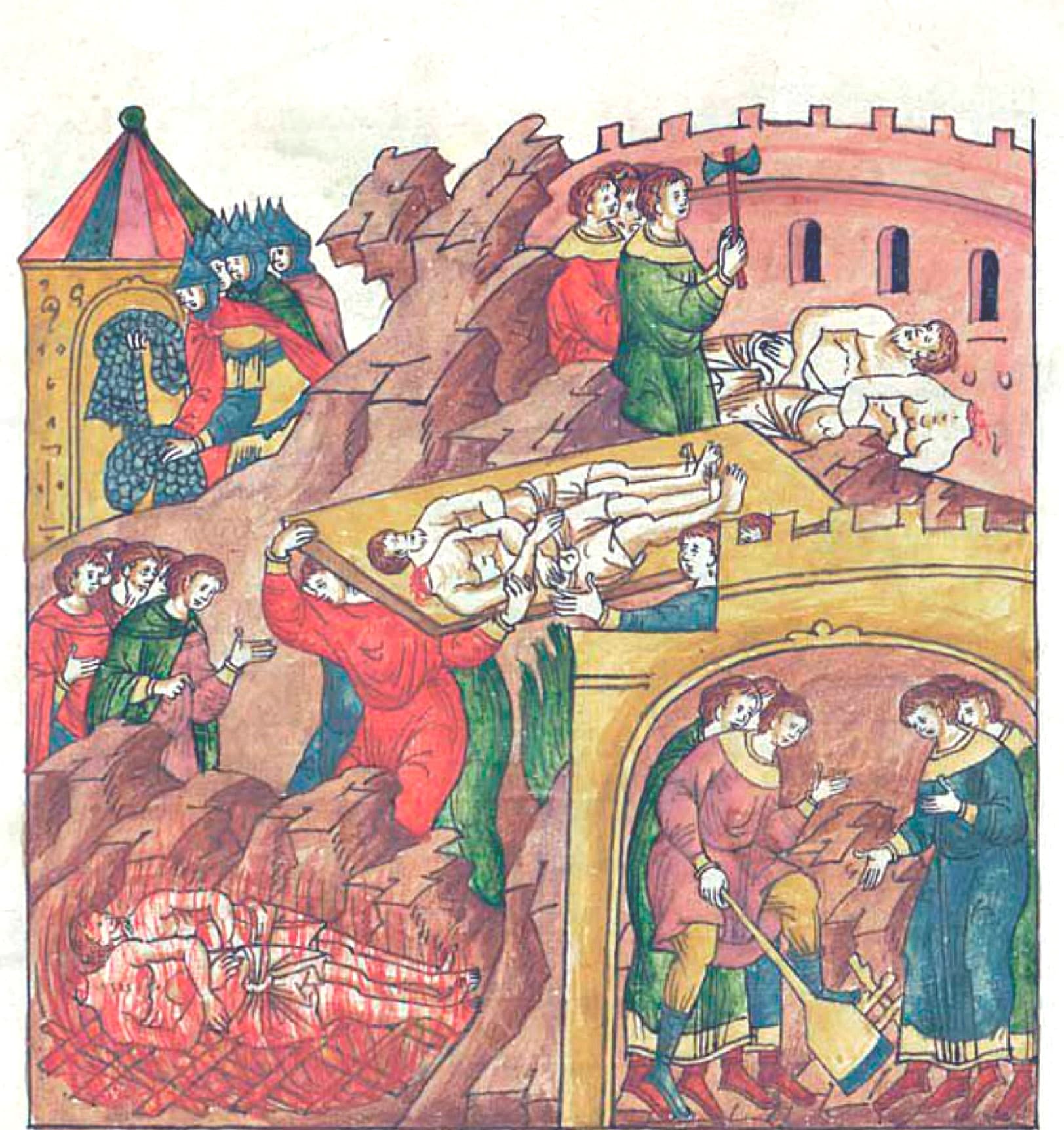
Anonymous Russian illuminators, The Cremation of Saul's Body, from the Illustrated Chronicle of Ivan the Terrible, the 1560s. Public domain, via Wikimedia Commons (File:Facial Chronicle - b.03, p.159 - Cremation of Saul's body.jpg); the line of text under the painted frame is trimmed.
THE ARTWORKThe illuminators painted 1 Samuel 31:11 to 13 as three tasks in one picture: lifting two dead men down from a city wall, burning them, and digging the grave.
Summary
Scripture names Jabesh-gilead in four episodes, and each one binds the town to Benjamin or to Saul.
- In the days of the judges the town sent no one to the assembly at Mizpah, and Israel took four hundred of its young women for the surviving Benjamites.
- Nahash the Ammonite besieged it and offered terms that would put out every right eye, and Saul broke the siege in the morning watch.
- When the Philistines hung Saul's body on the wall of Beth-shan, the men of Jabesh journeyed all night, brought the bodies home, burned them and buried the bones under the tamarisk.
- David blessed the town for that kindness, and later moved the bones of Saul and Jonathan to the tomb of Kish at Zela.
A Town of Gilead in Judges and Samuel
The town is first named at the close of Judges and last named in the burial of Saul.
So the congregation sent 12,000 of their most valiant men and commanded them: “Go and put to the sword those living in Jabesh-gilead, including women and children.Albert Barnes reads the 12,000 as a thousand from each tribe, after the war on Midian in Numbers 31:4.
Soon Nahash the Ammonite came up and laid siege to Jabesh-gilead. All the men of Jabesh said to him, “Make a treaty with us, and we will serve you.”Nahash is named again in 2 Samuel 10:2, where David speaks of the kindness Nahash had shown him.
all their men of valor set out, journeyed all night, and retrieved the bodies of Saul and his sons from the wall of Beth-shan. When they arrived at Jabesh, they burned the bodies there.These are the only men in the chapter who act for Saul after his death.
The oath at Mizpah and the raidJudges 21:5 to 14
The Israelites asked, “Who among all the tribes of Israel did not come to the assembly before the LORD?” For they had taken a solemn oath that anyone who failed to come up before the LORD at Mizpah would surely be put to death.The oath of death on any town that stayed away is the ground on which the congregation moved against Jabesh.
So they found among the inhabitants of Jabesh-gilead four hundred young women who had not had relations with a man, and they brought them to the camp at Shiloh in the land of Canaan.The camp stood at Shiloh, where Israel had set up the Tent of Meeting in Joshua 18:1.
And at that time the Benjamites returned and were given the women who were spared from Jabesh-gilead. But there were not enough women for all of them.Four hundred women were too few for the six hundred men, which leads to the second plan at Shiloh.
Jabesh East of the Jordan, Opposite Beth-shan
George Adam Smith's atlas plate prints Jabesh Gilead with a query, and Bezek and Beth-shean across the river.
Saul's army crossed the Jordan eastward to save the town, and its men crossed westward to take his body.
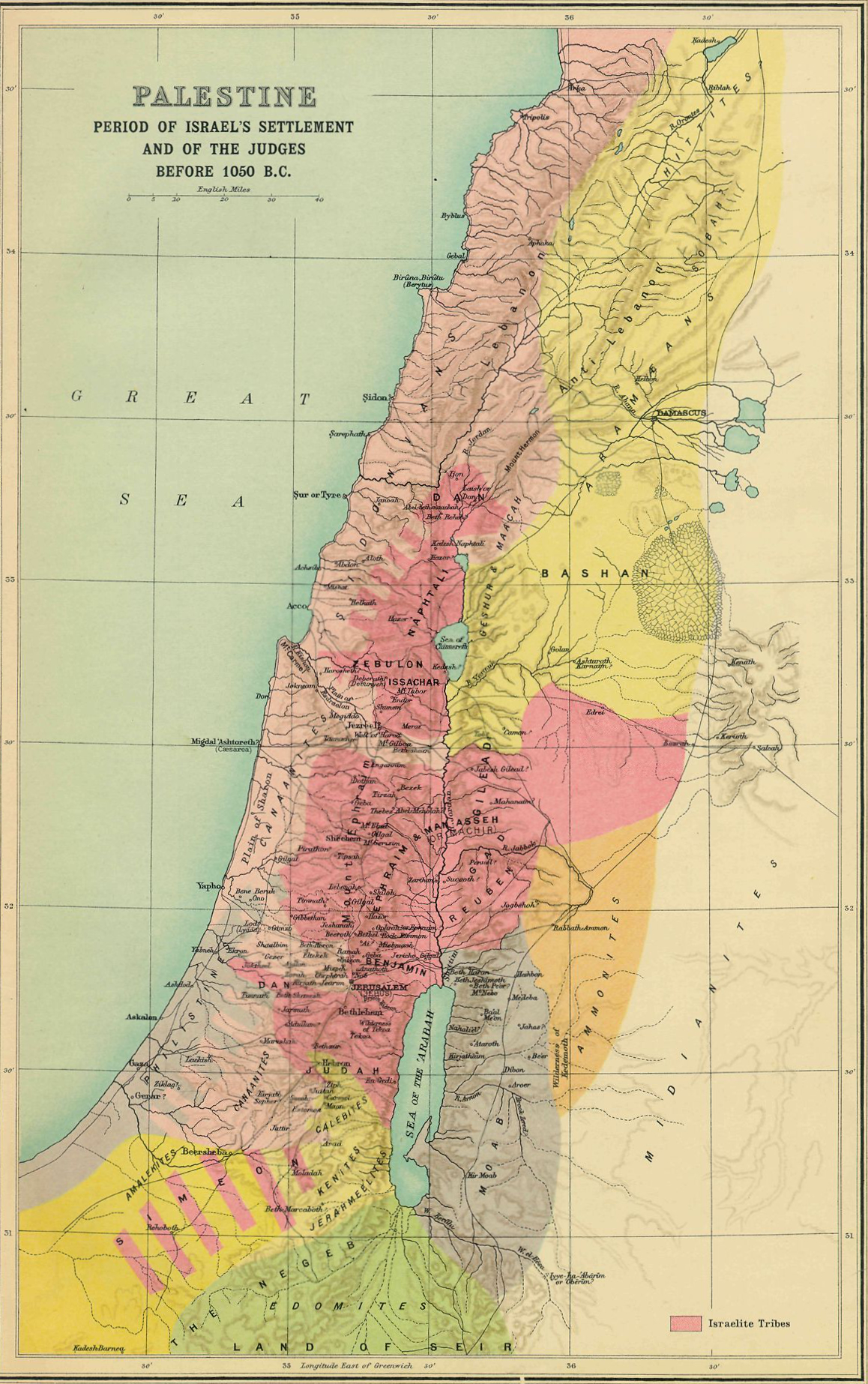
- MizpahWhere the tribes assembled after the war with Benjamin.Judges 21:1
- ShilohThe camp of Israel in the land of Canaan, west of the Jordan.Judges 21:12
- BezekSaul numbered the army there before the march to Jabesh.1 Samuel 11:8
- Jabesh-gileadThe town Nahash besieged, east of the Jordan.1 Samuel 11:11
- Beth-shanThe city of the Philistines' trophy, a night's march from Jabesh.1 Samuel 31:10
George Adam Smith, Atlas of the Historical Geography of the Holy Land (1915), plate Palestine, Period of Israel's Settlement and of the Judges. Public domain.
Five places of the town's story, each numbered where the plate prints it.
Albert Barnes puts the distance from Bezek to Jabesh at perhaps twenty miles.
The Town in Scripture, in Order
The town's story runs from Judges 21 to 2 Samuel 21.
Jabesh enters Scripture in the war with Benjamin and leaves it with the burial of Saul's bones.
- After the war with BenjaminNo one from Jabesh-gilead comes to the assembly at MizpahJudges 21:9
- The same daysFour hundred young women of Jabesh are brought to the camp at ShilohJudges 21:12
- Soon after Saul is chosenNahash the Ammonite lays siege to Jabesh-gilead1 Samuel 11:1
- The siegeThe elders ask for seven days to send messengers through Israel1 Samuel 11:3
- The musterSaul numbers the army at Bezek1 Samuel 11:8
- The next morningSaul strikes the Ammonite camp in the morning watch1 Samuel 11:11
- After the victoryThe people confirm Saul as king at Gilgal1 Samuel 11:15
- The night after GilboaThe town's men of valor bring the bodies home1 Samuel 31:12
- The burialThey bury the bones under the tamarisk and fast seven days1 Samuel 31:13
- David's reign at HebronDavid, newly anointed at Hebron, answers the town's loyalty2 Samuel 2:5
- After the famineDavid moves the bones of Saul and Jonathan to Zela2 Samuel 21:14
Eleven events in order, each with its verse.
The terms of Nahash1 Samuel 11:2
But Nahash the Ammonite replied, “I will make a treaty with you on one condition, that I may put out everyone’s right eye and bring reproach upon all Israel.”The right eye is the price of the treaty, and the reproach was meant to fall on all Israel.
The news reaches Gibeah1 Samuel 11:4 to 7
When the messengers came to Gibeah of Saul and relayed these words in the hearing of the people, they all wept aloud.The messengers went to Saul's own town in Benjamin, the tribe that had taken its wives from Jabesh.
When Saul heard their words, the Spirit of God rushed upon him, and he burned with great anger.The Spirit's coming and Saul's anger stand together in one verse, before any word of a plan.
“This time the Spirit of God came upon him, as upon the Judges before him, as a Spirit of supernatural energy and power.”
Albert Barnes · Notes, Explanatory and Practical, on the Old and New Testaments (1832-1869) · on 1 Samuel 11:6Evangelical
He took a pair of oxen, cut them into pieces, and sent them by messengers throughout the land of Israel, proclaiming, “This is what will be done to the oxen of anyone who does not march behind Saul and Samuel.” Then the terror of the LORD fell upon the people, and they turned out as one man.The threat against every man's oxen is what brought all the tribes to Bezek.
The morning watch and the kingship1 Samuel 11:11 to 15
The next day Saul organized the troops into three divisions, and during the morning watch they invaded the camp of the Ammonites and slaughtered them, until the hottest part of the day. And the survivors were so scattered that no two of them were left together.The message of 1 Samuel 11:9 promised deliverance by the time the sun was hot, and the attack came before dawn.
So all the people went to Gilgal and confirmed Saul as king in the presence of the LORD. There they sacrificed peace offerings before the LORD, and Saul and all the Israelites rejoiced greatly.Gilgal, where Israel first camped in the land, is where the kingship was renewed after Jabesh.
The night march to Beth-shan1 Samuel 31:11 to 13
When the people of Jabesh-gilead heard what the Philistines had done to Saul,Chronicles tells the same news in nearly the same words at 1 Chronicles 10:11, so both histories keep the deed.
Then they took their bones and buried them under the tamarisk tree in Jabesh, and they fasted seven days.The seven days' fast is longer than the mourning of David's men, who fasted until evening in 2 Samuel 1:12.
Three Things the Text Says Plainly
Judges 21:12 places Shiloh in the land of Canaan, and Samuel calls the rescue the LORD's salvation and the burial a kindness.
GILEAD AND THE LAND OF CANAAN
MacDonald reads Judges 21:12 as counting Gilead outside the land of Canaan.
THE VICTORY WAS THE LORD'S SALVATION
Saul said on the day of the rescue that the LORD had worked salvation in Israel.
DAVID CALLED THE BURIAL A KINDNESS
David's messengers told the men of Jabesh that the LORD would bless them for the kindness they showed to Saul their lord.
Gilead beyond the Jordan
Smith's Dictionary calls Jabesh the chief of the cities of Gilead, and Josephus calls it the metropolis of the Gileadites.
The name Jabesh means dry, and Smith's Dictionary of 1863 explains the full name as Jabesh in the territory of Gilead. In its widest sense Gilead took in the half tribe of Manasseh with Gad and Reuben, east of the Jordan.
Josephus says Nahash had already put out the right eyes of the Israelites beyond the Jordan before he camped at Jabesh.
Jabesh in the Written Record
Josephus and Eusebius each add a detail of the town.
Josephus tells both storiesAntiquities of the Jews 6.5.1 to 3 and 6.14.8
Josephus has Saul promise the messengers help on the third day, cross the Jordan and fall on the Ammonites from every side. His muster numbers seven hundred thousand men of Israel and seventy thousand of Judah, where 1 Samuel 11:8 reads 300,000 and 30,000.
In his account of Saul's death the bodies hang on the walls of Bethshun, and the people of Jabesh mourn seven days with their wives and children.
Eusebius and the Wadi YabisSmith's Dictionary, volume 1, article Jabesh-gilead
Eusebius, in his Onomasticon, placed the town beyond the Jordan, six miles from Pella on the mountain road to Gerasa. Smith's Dictionary takes the name to be kept in the Wady Yabes, which flows from the east into the Jordan below Beth-shan.
What the Text Leaves Unsaid
Scripture gives no site for the town and no reason for its absence from Mizpah.
Burton MacDonald, in East of the Jordan (2000), writes that the biblical texts give no precise location for the town. No verse says why the town sent no one to Mizpah, and none explains why the bodies were burned.
all their men of valor set out and retrieved the bodies of Saul and his sons and brought them to Jabesh. And they buried their bones under the oak in Jabesh and fasted seven days.Chronicles names an oak where 1 Samuel 31:13 names a tamarisk, and neither book describes the tree further.
David's Blessing and Saul's Bones
David blessed the town for its loyalty and brought Saul's bones home to Benjamin.
First Samuel names Jabesh-gilead in eight verses, more than any other book.
The 4 books and their verse counts as a table
| Book | Books and their verse counts | What the book records there | Verse |
|---|---|---|---|
| Judges | 5 | the absence from Mizpah and the four hundred young women | Judges 21:14 |
| 1 Samuel | 8 | the siege by Nahash and the burial of Saul | 1 Samuel 11:10 |
| 2 Samuel | 3 | the blessing on the town and the second burial of Saul | 2 Samuel 2:5 |
| 1 Chronicles | 2 | the burial under the oak | 1 Chronicles 10:11 |
The Berean verses that print the town's name, counted by book, number 18 in four books. Three more verses, in 2 Kings 15, name a man called Jabesh.
Now may the LORD show you loving devotion and faithfulness, and I will also show you the same favor because you have done this.This message is the first act the text records of David as king in Hebron.
The bones brought home to Zela2 Samuel 21:12 to 14
And they buried the bones of Saul and his son Jonathan in Zela in the land of Benjamin, in the tomb of Saul’s father Kish. After they had done everything the king had commanded, God answered their prayers for the land.The burial in Benjamin closes the story of Saul's bones and the famine of 2 Samuel 21 together.
Matthew Henry on Saul's Anger and the Town's Gratitude
Henry comments on Saul's anger at the news from Jabesh and on the town's conduct at his death.
He names what roused Saul to act.
“He was angry at the insolence of the Ammonites, angry at the mean and sneaking spirit of the men of Jabesh-Gilead, angry that they had not sent him notice sooner of the Ammonites' descent and the extremity they were likely to be reduced to. He was angry to see his neighbours weeping, when it was fitter for them to be preparing for war.”
Matthew Henry · Commentary on the Whole Bible · on 1 Samuel 11:6Puritan
He finds the reason for the night march in the rescue of chapter 11.
“Out of a particular sense of gratitude to Saul, for his zeal and forwardness to rescue them from the Ammonites when he first came to the throne, ch. xi. It is an evidence of a generous spirit and an encouragement to beneficence when the remembrance of kindnesses is thus retained, and they are thus returned in an extremity.”
Matthew Henry · Commentary on the Whole Bible · on 1 Samuel 31:11 to 13Puritan
Where the Town Stood
Scholars propose three sites on the Wadi Yabis, two of them tells of the Iron Age and one a ruin of the Roman period.
The proposed sites lie on the Wadi Yabis, east of the Jordan and south of Pella.
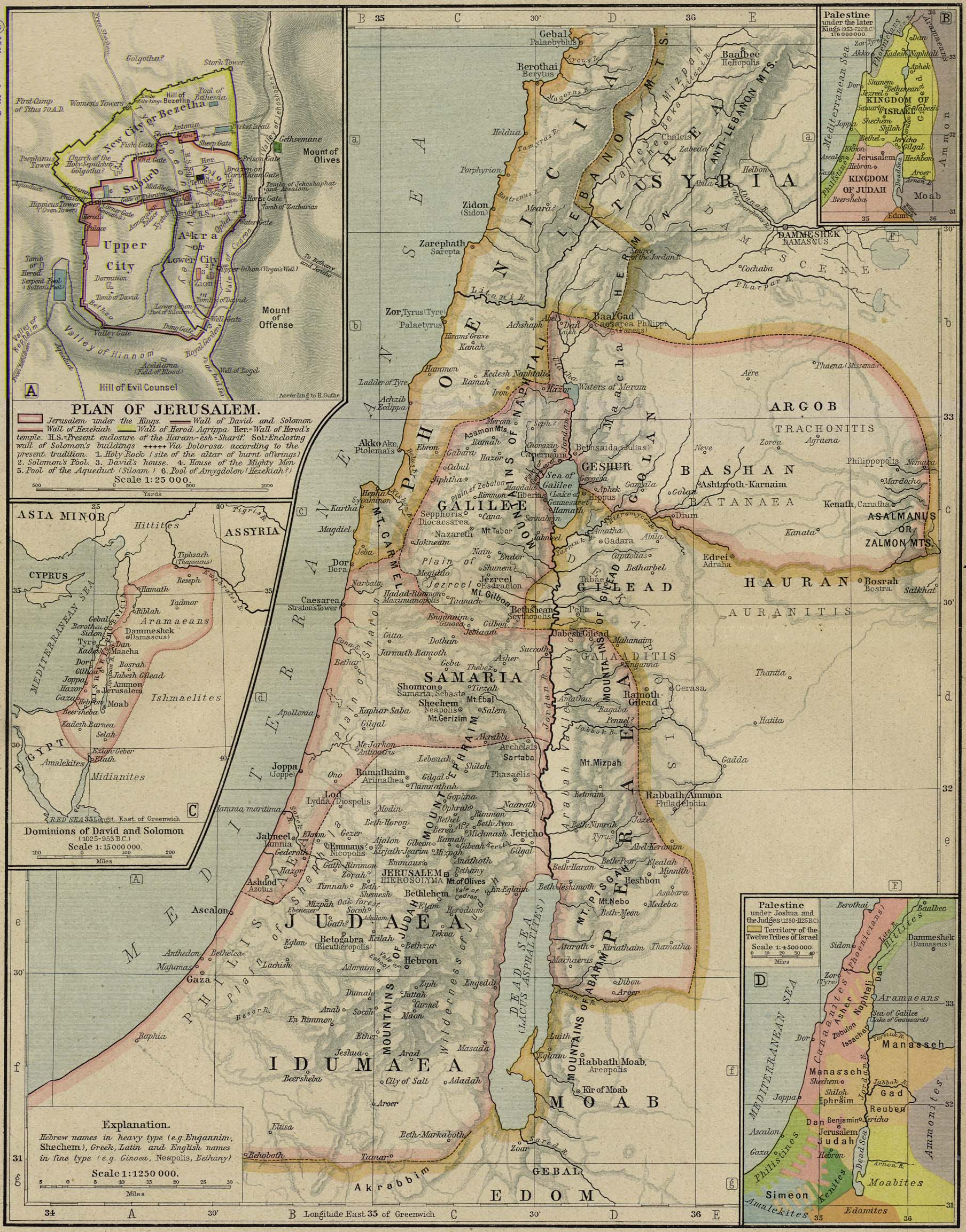
- Beth-shanThe city west of the Jordan, printed on the plate as Bethshean.1 Samuel 31:10
- GilboaThe ridge where Saul and his sons fell.1 Samuel 31:8
- PellaThe nearest city the plate names to the two tells.
- Tell Abu al-KharazGlueck's site, 4 km east of the Jordan, in sight of Beth-shan.
- Tell el-MaqlubThe site of Noth, Simons and Aharoni, where the plate prints Jabesh-Gilead.
Rand McNally atlas reference map, 1926. Public domain.
Beth-shan, Gilboa and Pella stand where the Rand McNally plate prints them, and the two tells are placed from their coordinates.
Tell el-MaqlubNoth 1953, Simons 1959, Aharoni 1979
Martin Noth in his article Jabesh-gilead (1953), Jan Simons in The Geographical and Topographical Texts of the Old Testament (1959) and Yohanan Aharoni in The Land of the Bible (1979) place Jabesh at Tell el-Maqlub. The site fits the distance from Pella that Eusebius gives, and it was a large walled town in the Iron Age.
The objection: MacDonald notes that the identification stands or falls with Eusebius, since the other tells were also lived in during the Iron Age.
Tell Abu al-KharazGlueck 1943 and 1951
Nelson Glueck, in Some Ancient Towns in the Plains of Moab (1943) and Explorations in Eastern Palestine (1951), placed Jabesh at Tell al-Meqbereh and its twin, Tell Abu al-Kharaz. The higher tell looks across to Beth-shan, which suits the night's march of 1 Samuel 31:12, and Peter M. Fischer's excavations from 1989 to 2001 found Late Bronze and Iron Age towns there.
The objection: MacDonald notes that commentators place the town there despite Eusebius's statements on its location.
The ruin of ad-DayrRobinson 1856
Edward Robinson, in the 1856 edition of his Biblical Researches, took the ruin of ad-Dayr, on the hill just west-southwest of Tell el-Maqlub above the south side of the wadi, for the site.
The objection: Glueck (1951) and the Wadi al-Yabis Survey of Mabry and Palumbo (1988) report no remains there earlier than the Roman period.
Books on Jabesh-gilead
All three of these works can be read free online.
East of the Jordan: Territories and Sites of the Hebrew Scriptures
Burton MacDonald · 2000
The entry on Jabesh-gilead sets out every proposed site with its holders and the finds at each.
Read at bu.eduA Dictionary of the Bible, volume 1, the article Jabesh-gilead
William Smith, editor · 1863
Its article follows the town from Judges to 2 Samuel and reports what Eusebius and Robinson said of the site.
Read at archive.orgThe Antiquities of the Jews, book 6
Flavius Josephus, translated by William Whiston · 1737
Josephus retells the siege by Nahash and the night march to Bethshun.
Read at gutenberg.orgFaithfulness beyond the Grave
The men of Jabesh kept faith with a dead king.
Then Naomi said to her daughter-in-law, “May he be blessed by the LORD, who has not withdrawn His kindness from the living or the dead.” Naomi continued, “The man is a close relative. He is one of our kinsman-redeemers.”Naomi's words give the same name, kindness, to a faithfulness shown to the dead.
Keep studying
Read it4