
Romans 12:19 · Passage · Injustice
Vengeance Is Mine
Romans 12:17 to 21 closes Paul's commands in Romans 12 with what a believer is to do when others do him evil.
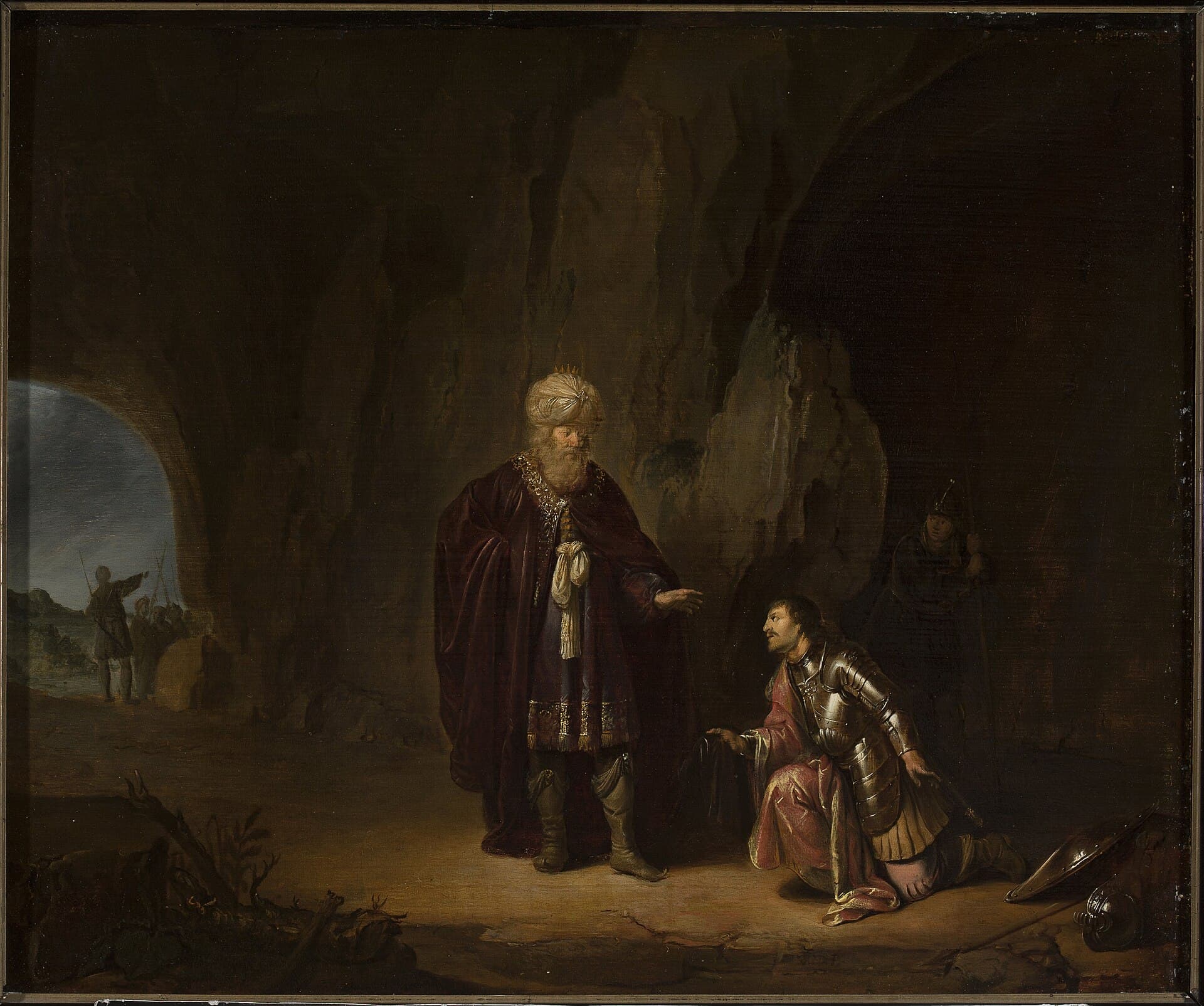
In 1 Samuel 25 David set out to avenge an insult, and a woman bringing food met him on the road and turned him back.
Do not avenge yourselves, beloved, but leave room for God’s wrath. For it is written: “Vengeance is Mine; I will repay, says the Lord.”
- The passage
- Romans 12:17 to 21, 1 Samuel 25:10 to 33, Romans 13:3 to 4, Deuteronomy 32:35 to 36, 1 Samuel 25:32 to 33, 1 Peter 2:23
- Books
- Romans, 1 Samuel, Deuteronomy, 1 Peter
- Hold in memory
- Romans 12:21, 1 Peter 2:23
Summary
Paul wrote these verses for believers who would be wronged. They are not to pay back evil with evil. They are to leave room for God's wrath, because the Lord has said He will repay. In place of revenge they are to feed a hungry enemy and give him a drink.
- Paul's reason in verse 19 is a line of the Song of Moses, in which the LORD claims vengeance and repayment as His own.
- The Law, the Psalms and Revelation also leave vengeance with God and call the wronged to wait for Him.
- Readers have taken the burning coals of verse 20 as the shame that brings an enemy to repent and as the judgment that waits for him.
A Word to the Wronged
Paul's last commands in Romans 12 speak to believers whom others have harmed.
Vengeance Is Mine reads Romans 12:17 to 21 as Paul's word to the person who has been wronged. It belongs to the trial of injustice, the wrong done to a person who has done no wrong, and it takes up the hardest part of that trial, the wish to pay the wrong back.
The question it answers is what Paul forbids the wronged person to do, what he leaves in God's hands, and what remains open to the one who was harmed. It gives the Greek of verse 19, the Old Testament texts behind the command and the place of the governing authority in Romans 13:4. It also weighs two old questions, whose wrath verse 19 means and what the coals of verse 20 are.
Do not repay anyone evil for evil. Carefully consider what is right in the eyes of everybody.The verse stands first because it names the answer a wronged person is most drawn to, paying evil back in kind.
What the Wronged Give Up and What God Keeps
Six texts from the Law to Revelation take vengeance out of the hand of the wronged and leave it with God.
In each text the wronged person lets go of vengeance, and God takes up the judging, the repaying or the relief.
| The wronged | God | The Berean words |
|---|---|---|
| Seeks no revenge and bears no grudge | Gives the command in His own name | Do not seek revenge or bear a grudge against any of your people, but love your neighbor as yourself. I am the LORD. |
| Does not vow to avenge the evil | Saves the one who waits for Him | Do not say, “I will avenge this evil!” Wait on the LORD, and He will save you. |
| Keeps his hand from his enemy | Judges between them and takes vengeance | May the LORD judge between you and me, and may the LORD take vengeance on you, but my hand will never be against you. |
| Calls on God to act | Rises as Judge of the earth | O LORD, God of vengeance, O God of vengeance, shine forth. Rise up, O Judge of the earth; render a reward to the proud. |
| Cries out to God and waits | Tells the slain to rest a little longer | How long, O Lord, holy and true, until You avenge our blood and judge those who dwell upon the earth? |
| Receives relief | Repays affliction to those who afflict | After all, it is only right for God to repay with affliction those who afflict you, and to grant relief to you who are oppressed and to us as well. |
Leave Room for the Wrath
Verse 19 gives the reason for the ban on revenge in the LORD's own words.
Paul gives the reason for the command in the words of the Lord, with an emphatic pronoun before the verb. Ego antapodoso reads, word for word, I myself will repay.
Vengeance is Mine; I will repay. In due time their foot will slip; for their day of disaster is near, and their doom is coming quickly.” For the LORD will vindicate His people and have compassion on His servants when He sees that their strength is gone and no one remains, slave or free.The verse stands here as the source of Paul's quotation, and the verse after it turns from the LORD's enemies to His compassion on His servants.
The Song ends with the promise that “He will avenge the blood of His children” (Deuteronomy 32:43). Hebrews 10:30 quotes the line of Deuteronomy 32:35 and joins to it the verse after, “The Lord will judge His people”. So the Song reaches the church as a warning as well as a comfort.
The Song, its outline and its use in the New Testament are taught on The Song of Moses.
Why God's wrath and His patience belong to one character is taught on The Patience and the Wrath of God.
God's Servant, the Avenger
Six verses after the ban on revenge, Paul gives the ruler the office of punishing wrong.
For rulers are not a terror to good conduct, but to bad. Do you want to be unafraid of the one in authority? Then do what is right, and you will have his approval. For he is God’s servant for your good. But if you do wrong, be afraid, for he does not carry the sword in vain. He is God’s servant, an agent of retribution to the wrongdoer.The verses stand here because their Greek takes up the two words of Romans 12:19, vengeance and wrath.
The Berean's “agent of retribution” renders ekdikos, an avenger, a word of the same family as ekdikesis, the vengeance of Romans 12:19. Paul adds eis orgen, for wrath, with the noun of Romans 12:19. The only other use of ekdikos in the New Testament is 1 Thessalonians 4:6, where “the Lord will avenge all such acts”.
Albert Barnes, in his Notes on Romans 12:19, drew the line between the two. “To take such satisfaction for injuries done to society, is lawful and proper for a magistrate”, he wrote, while Paul's command is “addressing private individual Christians”.
Paul himself asked a centurion whether it was lawful to flog a Roman citizen without a trial (Acts 22:25), and before Festus he appealed to Caesar (Acts 25:11).
How Christians have weighed the sword of the ruler against the call to nonresistance is taught on War and Peace.
The Command Lived
David was kept from revenge by another's counsel, and Christ left His cause with God.
When Nabal refused David's men any food, David strapped on his sword and about four hundred men followed him (1 Samuel 25:10 to 13).
Then David said to Abigail, “Blessed be the LORD, the God of Israel, who sent you to meet me this day! Blessed is your discernment, and blessed are you, because today you kept me from bloodshed and from avenging myself by my own hand.David's blessing gives the LORD the credit for his restraint.
When they heaped abuse on Him, He did not retaliate; when He suffered, He made no threats, but entrusted Himself to Him who judges justly.Peter gives Christ's silence under abuse as the pattern for believers who suffer unjustly, and names the One to whom He entrusted Himself.
How the Passage Has Been Taught
Two North African writers of the third century on patience under wrong.
died 258 · Cyprian
Cyprian told a persecutor why Christians did not resist arrest.
The reading1 paragraph
Cyprian, in his Address to Demetrianus, told a persecutor why no Christian resisted arrest though Christians were many. “Our certainty of a vengeance to follow makes us patient. The innocent give place to the guilty.”
In Of Patience
Tertullian read the promise of vengeance as a promise to reward patience.
The reading1 paragraph
In Of Patience, Tertullian read the promise of repayment as a pledge to the patient. He glossed the Lord's promise as “Leave patience to me, and I will reward patience”.
Whose Wrath, and What Coals
Readers differ over the wrath of verse 19 and the coals of verse 20, and each reading meets an objection.
On the contrary, “If your enemy is hungry, feed him; if he is thirsty, give him a drink. For in so doing, you will heap burning coals on his head.”The verse joins the command to feed an enemy to the burning coals that readers have taken in more than one way.
The wrath of verse 19 is God'sJohn Wesley
John Wesley, in his Explanatory Notes upon the New Testament (1755), read the phrase as “leave room for wrath; that is, the wrath of God, to whom vengeance properly belongs”.
The objection is that Paul's Greek says only “the wrath”, so the words “of God” are the reader's.
The wrath of verse 19 is the wrongdoer'sOrigen of Alexandria; Ambrose of Milan
Origen, in his Commentary on the Epistle to the Romans, gave this reading first. The one who does not return blow for blow, he wrote, has “given place to the wrath of him who did the injury to pass over and vanish away”. He allowed the other reading as well. Ambrose of Milan wrote in a letter that the verse was given “lest another's wrath draw you into sin”.
The objection is that Paul grounds the command at once in the Lord's own repaying, which points the wrath to God.
The coals are the groans of penitenceAugustine of Hippo
Augustine, in On Christian Doctrine (book 3, chapter 16), read the coals as a figure. He told the reader to “interpret the coals of fire as the burning groans of penitence by which a man's pride is cured”.
The objection is that Augustine reached the reading by his rule that a command which seems to enjoin malice must be a figure, and the verse itself names no penitence.
The coals are a vengeance promised to the feebleJohn Chrysostom
John Chrysostom, in his Homily 22 on Romans, held that Paul spoke of the coals “both to humble the one by fear, and to make the other more ready-minded through hope of a recompense”. The wronged man, he reasoned, would first be drawn by the promise and then feed his enemy until he no longer wanted him punished.
The objection comes from Chrysostom's own next lines, where verse 21 gives “a kind of gentle hint, that one is not to do it with that intention”.
The Repaying Is His
The passage ends the wronged person's revenge and leaves the case with God.
The one who was wronged lays down the right to repay and keeps the right to be heard. God has kept the repaying for Himself.
Sources
Scripture is the Berean Standard Bible.
- STEP Bible, Translators Amalgamated Greek New Testament (Tyndale House, Cambridge), CC BY 4.0.
- STEP Bible brief lexicons of Extended Strongs for Greek (Tyndale House, Cambridge), CC BY 4.0, with the Strong's glosses.
- John Wesley, Explanatory Notes upon the New Testament (1755), on Romans 12:19.
- Albert Barnes, Notes, Explanatory and Practical, on the Old and New Testaments (1832 to 1869), on Romans 12:19.
- Origen of Alexandria (died 253), Commentary on the Epistle to the Romans, on Romans 12:19.
- Ambrose of Milan (died 397), Letter 63, section 100.
- Tertullian (died 220), Of Patience.
- Cyprian (died 258), Treatise V, An Address to Demetrianus.
- John Chrysostom, Homily 22 on Romans, trans. J. Walker, J. Sheppard and H. Browne, rev. George B. Stevens, Nicene and Post-Nicene Fathers, First Series, vol. 11 (Buffalo: Christian Literature Publishing Co., 1889)
- Augustine of Hippo, On Christian Doctrine, book 3, chapter 16, section 24, trans. James Shaw, Nicene and Post-Nicene Fathers, First Series, vol. 2 (Buffalo: Christian Literature Publishing Co., 1887)
Keep Studying
Studies7
In this trial6
People and groups15
Show the next 6 titles
Doctrines1
Values1