
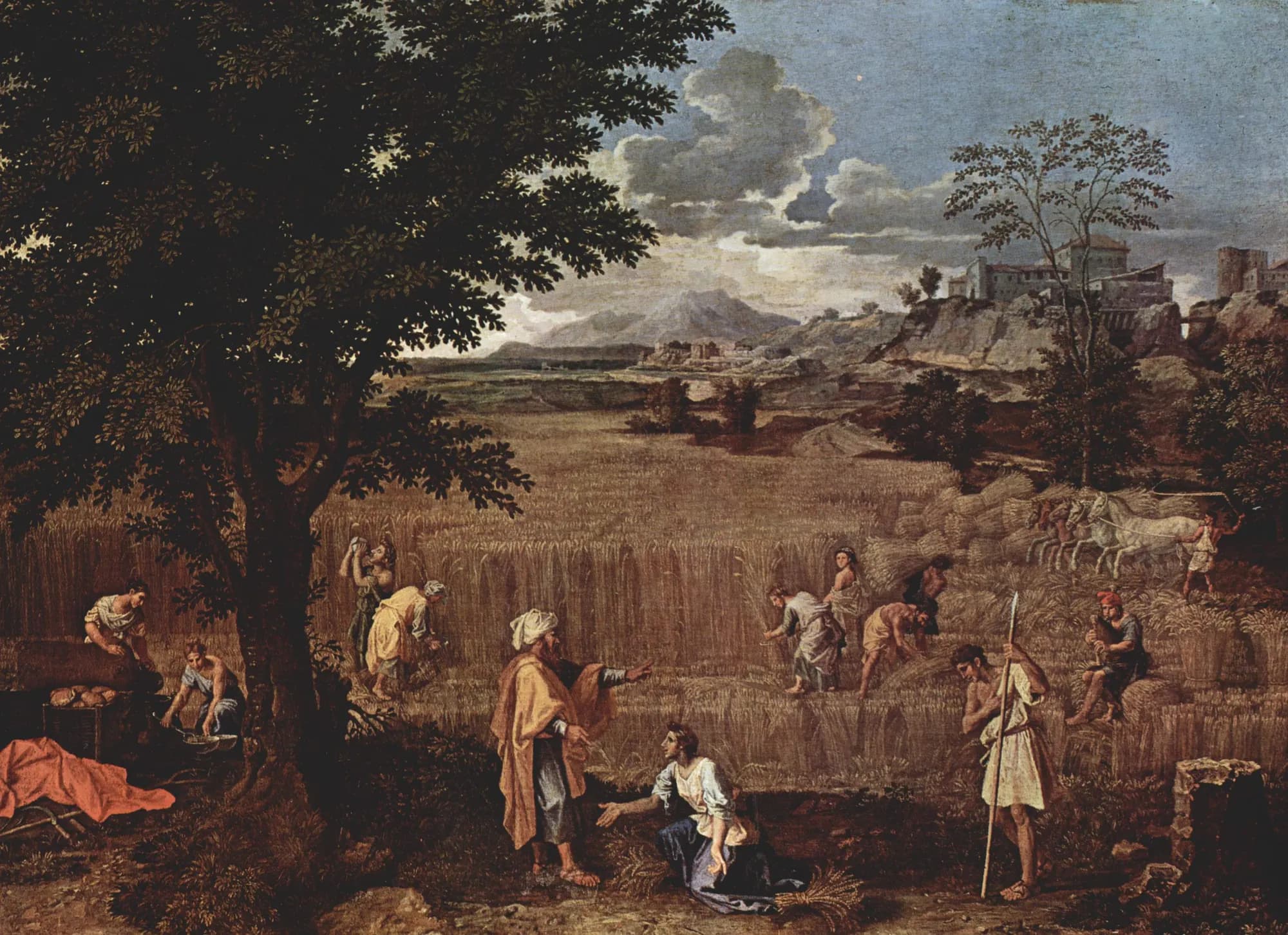
Summer, or Ruth and Boaz, Nicolas Poussin, 1660 to 1664. Public domain.
Old Testament · Book 8 of 66
Ruth
Ruth tells how a Moabite widow stayed loyal to Naomi, her Israelite mother-in-law, in the days of the judges. Boaz marries her in Bethlehem, and their son Obed becomes the grandfather of King David.
Ruth tells how a Moabite widow stayed loyal to Naomi, her Israelite mother-in-law, in the days of the judges. Boaz marries her in Bethlehem, and their son Obed becomes the grandfather of King David.
What is Ruth about?
Ruth is a short story set in the days when the judges ruled. A famine drives a family of Bethlehem to Moab, and there Naomi loses her husband and both her sons. Her Moabite daughter-in-law Ruth will not leave her and comes home with her to Bethlehem at the barley harvest. Ruth gleans in the field of Boaz, a relative of Naomi's husband, and one night at the threshing floor she asks him to act as their redeemer. In the morning at the town gate Boaz buys the family's land and marries Ruth. Their son Obed is laid in Naomi's lap, and his grandson is David.
All 4 chapters
Every chapter of the book, in one grid. Each cell opens that chapter.
- The road homeRuth 1
- The fieldRuth 2
- The threshing floorRuth 3
- The gateRuth 4
The colour is the scene of the story the chapter tells, and every cell opens that chapter's Study level.
Who wrote it, where, when, for whom, and why?
The book names no writer. It explains the custom of the sandal as the way things were done in former times in Israel (4:7), and it ends on the name David (4:17 and 4:22). The rest of Scripture keeps the same line: 1 Chronicles lists Salmon, Boaz, Obed and Jesse (1 Chronicles 2:11 to 12), and Matthew and Luke carry it in their genealogies of Jesus (Matthew 1:5, Luke 3:32). David later asks the king of Moab to shelter his father and mother (1 Samuel 22:3).
The neighbor women said, “A son has been born to Naomi,” and they named him Obed. He became the father of Jesse, the father of David.
Ruth 4:17, Berean Standard Bible.
The story opens in Bethlehem in Judah and moves to the land of Moab across the Jordan (1:2). From the return at 1:19 every scene stands in and around Bethlehem: the field of Boaz (2:3), the threshing floor (3:2 to 3) and the town gate (4:1).
The book sets its story in the days when the judges ruled. The family lives in Moab about ten years (1:4). Naomi and Ruth come back at the beginning of the barley harvest (1:22), and Ruth gleans until the barley and wheat harvests are finished (2:23). The readings on when the book was written are set out under Where do readers disagree.
The book is written for readers who needed the custom at the gate explained (4:7) and who knew the name of David, since it ends by telling them whose family this was (4:17).
The book shows its purpose through what its people bless. Naomi asks the LORD's blessing on Boaz and names the LORD as the one who has not withdrawn his kindness from the living or the dead (2:20), and the women of Bethlehem bless the LORD, who has not left Naomi without a kinsman-redeemer (4:14).
Ruth stands in the era that Judges closes on, when there was no king in Israel and everyone did what was right in his own eyes (Judges 21:25). The harvest law left the edges of a field and its gleanings for the poor and the foreigner (Leviticus 19:9 to 10) and a forgotten sheaf for the foreigner, the fatherless and the widow (Deuteronomy 24:19). Moab lay across the Dead Sea from Judah, and the law barred Moabites from the assembly of the LORD to the tenth generation (Deuteronomy 23:3).
Sources. Ruth 1:2, 1:4, 1:19, 1:22, 2:3, 2:20, 2:23, 3:2 to 3, 4:1, 4:7, 4:14, 4:17 and 4:22; Leviticus 19:9 to 10; Deuteronomy 23:3 and 24:19; Judges 21:25; 1 Samuel 22:3; 1 Chronicles 2:11 to 12; Matthew 1:5; Luke 3:32. Every verse is read in the Berean Standard Bible.
How is Ruth arranged, and what is it for?
The four scenes the book is told in, one to a chapter, then what it teaches and what it was written to do.
- The road homeRuth 1, 22 verses, turning at 1:16
A famine, ten years in Moab, three deaths, and two widows on the road back to Bethlehem.
- The fieldRuth 2, 23 verses, turning at 2:20
Ruth gleans in the field of Boaz, and Naomi learns that he is one of their kinsman-redeemers.
- The threshing floorRuth 3, 18 verses, turning at 3:9
At night on the threshing floor Ruth asks Boaz to act as redeemer, and he promises to settle it.
- The gateRuth 4, 22 verses, turning at 4:10
Boaz redeems the land and marries Ruth before the elders, and their son Obed is the grandfather of David.
The theme
The LORD's kindness reaches the living and the dead through the loyalty of ordinary people. Ruth keeps faith with Naomi when nothing binds her, Boaz gives past what the harvest law requires, and at the gate he takes on a redeemer's cost that the nearer man refuses. The narrator ascribes two acts to the LORD: he gives his people food (1:6) and enables Ruth to conceive (4:13).
The purpose
Ruth was written to show how the family of David came to be: through a Moabite widow who took the God of Israel as her own and a man of Bethlehem who redeemed her. It answers Naomi's complaint that the LORD brought her back empty by filling her house again, and it closes on the name David, whose anointing 1 Samuel tells.
Naomi goes out full, comes back empty, and is filled again
- Ruth 1, The road home
- Ruth 2, The field
- Ruth 3, The threshing floor
- Ruth 4, The gate
- Ruth 1:1A family of four leaves Bethlehem, full by her own word at 1:21. Fullness 9 of 10.
- Ruth 1:5Her husband and both her sons are dead. Fullness 2 of 10.
- Ruth 1:20Call me Mara, she says at Bethlehem. Fullness 0 of 10.
- Ruth 2:17 to 18An ephah of barley, and the food Ruth saved for her. Fullness 3 of 10.
- Ruth 2:20A kinsman-redeemer is named. Fullness 5 of 10.
- Ruth 3:17Six measures of barley: do not go back empty-handed. Fullness 6 of 10.
- Ruth 4:16A son is laid in her lap. Fullness 9 of 10.
- Ruth 4:17A son has been born to Naomi, say the women. Fullness 10 of 10.
- Ruth 1:1A family of four leaves Bethlehem, full by her own word at 1:21. Fullness 9 of 10.
- Ruth 1:5Her husband and both her sons are dead. Fullness 2 of 10.
- Ruth 1:20Call me Mara, she says at Bethlehem. Fullness 0 of 10.
- Ruth 2:17 to 18An ephah of barley, and the food Ruth saved for her. Fullness 3 of 10.
- Ruth 2:20A kinsman-redeemer is named. Fullness 5 of 10.
- Ruth 3:17Six measures of barley: do not go back empty-handed. Fullness 6 of 10.
- Ruth 4:16A son is laid in her lap. Fullness 9 of 10.
- Ruth 4:17A son has been born to Naomi, say the women. Fullness 10 of 10.
The road home, Ruth 1
What the text says in these 22 verses, and the pages they open on.
In the days when the judges ruled, a famine drives Elimelech of Bethlehem to Moab with his wife Naomi and their two sons. Elimelech dies, the sons marry Moabite women named Orpah and Ruth, and after about ten years both sons die too. When Naomi hears that the LORD has given his people food, she sets out for Judah and urges her daughters-in-law to go home to their mothers. Orpah kisses her and goes back, and Ruth clings to her and takes Naomi's people and Naomi's God as her own. The two women reach Bethlehem at the beginning of the barley harvest, and Naomi tells the town to call her Mara, because she went away full and the LORD has brought her back empty.
But Ruth replied: “Do not urge me to leave you or to turn from following you. For wherever you go, I will go, and wherever you live, I will live; your people will be my people, and your God will be my God.
- Study
Ruth 1the famine, three deaths, the parting on the road and the return emptyShow the summary and 5 pagesShow summary, 5 pagesHide the summary
A famine drives a family of Bethlehem to Moab, where Naomi's husband and both her sons die. Naomi turns for home, Orpah goes back to her people, and Ruth vows to go with Naomi and take her God as her own.
- Elimelech dies, and after about ten years Mahlon and Chilion die too (1:3 to 5).
- Naomi hears that the LORD has given his people food and sets out for Judah (1:6 to 7).
- Ruth answers: your people will be my people, and your God will be my God (1:16).
- At Bethlehem Naomi asks to be called Mara and says the LORD brought her back empty (1:20 to 21).
On this chapter (5)
- Naomi
Her life from Bethlehem to Moab and back, and the name Mara.
- Ruth
The Moabite widow who becomes the great-grandmother of David.
- Moab
The land across the Jordan where the family lives ten years.
- How does a Moabite enter David's line?
Answered under Where do readers disagree, lower on this page, with each reading and who holds it.
- Ruth 1:16
The verse on its own page, with the commentators on it by era.
The road runs from Bethlehem in Judah to the land of Moab and back
The road, in the order of the story
- The way out: a man of Bethlehem goes with his wife and two sons to live in Moab. Ruth 1:1
- The way back: Naomi sets out on the road leading back to Judah with her two daughters-in-law. Ruth 1:7
- 1 The turning: Orpah goes back to her people and her gods Ruth 1:15, and Ruth goes on with Naomi and takes her people and her God Ruth 1:16
- Naomi comes home to Bethlehem at the beginning of the barley harvest. Ruth 1:22
- Dashed grey arrow: the way out, schematic.
- Solid indigo arrow: the way back, schematic.
- Filled circle: an identified site. Dashed ring 1: the turning, placed by the story.
Characters (5)
Who the text follows. A name with a page carries its door.
- Naomi
Elimelech's widow, who goes out full and comes back empty.
- Ruth
The Moabite widow of Mahlon, who will not leave her mother-in-law.
- Orpah
Ruth's sister-in-law, who kisses Naomi and goes back to her people and her gods.
- Elimelech
Naomi's husband, who takes the family to Moab and dies there.
Show the next 1
- Mahlon and Chilion
Naomi's two sons, who marry in Moab and die there without children.
Places (2)
Where the chapter stands.
Themes (2)
What the chapter raises, each on its own page through the Hebrew word.
- shuv, to return
The verb of the chapter: Naomi returns, Orpah goes back, Ruth turns toward Judah.
- chesed, kindness
Loyalty no law compels, at 1:8, 2:20 and 3:10.
The field, Ruth 2
What the text says in these 23 verses, and the pages they open on.
Ruth goes out to glean after the harvesters and happens on the part of the field that belongs to Boaz, a man of noble character from Elimelech's clan. Boaz has heard what she did for her mother-in-law. He keeps her near his servant girls, gives her water and a place at his meal, and blesses her as one who has come to take refuge under the wings of the LORD. He tells his men to pull out stalks for her from the bundles, and by evening she beats out about an ephah of barley. When Naomi hears the name Boaz, she says that the LORD has not withdrawn his kindness from the living or the dead, and tells Ruth that the man is one of their kinsman-redeemers. Ruth gleans in his fields until the barley and wheat harvests are finished.
May the LORD repay your work, and may you receive a rich reward from the LORD, the God of Israel, under whose wings you have taken refuge.”
- Study
Ruth 2the field of Boaz, the meal and a kinsman-redeemer namedShow the summary and 4 pagesShow summary, 4 pagesHide the summary
Ruth goes out to glean and happens on the part of the field that belongs to Boaz, a man of Elimelech's clan. He protects her, feeds her and leaves grain for her, and Naomi tells her that he is one of their kinsman-redeemers.
- Boaz blesses Ruth as one who has taken refuge under the wings of the LORD (2:12).
- At the meal she eats roasted grain until she is satisfied and has some left over (2:14).
- She beats out about an ephah of barley by evening (2:17).
- She gleans in his fields until the barley and wheat harvests are finished (2:23).
On this chapter (4)
- The kinsman-redeemer
Boaz as redeemer, the law behind him, and how Christians have read him.
- Boaz
The landowner of Bethlehem who becomes Ruth's husband.
- kanaph, wing or corner
The word behind the LORD's wings at 2:12.
- Ruth 2:12
The verse on its own page, with the commentators on it by era.
One day in the field of Boaz, from morning to evening
- MorningRuth goes out and happens on the part of the field that belongs to Boaz.Ruth 2:3The gleaner's right
- LaterBoaz arrives from Bethlehem and asks whose young woman she is.Ruth 2:4 to 5
- The fieldHe tells her to stay near his servant girls, drink from the jars, and not be touched.Ruth 2:8 to 9Beyond the law
- MealtimeShe eats bread and roasted grain beside the harvesters and has some left over.Ruth 2:14Beyond the law
- AfternoonHe orders his men to let her glean among the sheaves and pull out stalks for her.Ruth 2:15 to 16Beyond the law
- EveningShe beats out what she gleaned, about an ephah of barley, and carries it to Naomi.Ruth 2:17 to 18The gleaner's right
The law's floor: Leviticus 19:9 to 10 leaves the edges and the gleanings for the poor and the foreigner, and Deuteronomy 24:19 leaves a forgotten sheaf for the foreigner, the fatherless and the widow.
Characters (4)
Who the text follows. A name with a page carries its door.
Places (2)
Where the chapter stands.
- The field of Boaz
The part of the field belonging to Boaz, where Ruth gleans through the harvest.
- Bethlehem
The town in Judah the family leaves in the famine and Naomi comes home to.
Themes (3)
What the chapter raises, each on its own page through the Hebrew word.
- kanaph, wing or corner
The LORD's wings at 2:12 and the corner of Boaz's garment at 3:9.
- chesed, kindness
Loyalty no law compels, at 1:8, 2:20 and 3:10.
- chayil, noble character
Said of Boaz at 2:1 and of Ruth at 3:11.
The threshing floor, Ruth 3
What the text says in these 18 verses, and the pages they open on.
Naomi looks for a resting place for Ruth and sends her, washed and dressed in her best, to the threshing floor where Boaz is winnowing barley. When he lies down at the end of the heap of grain, Ruth uncovers his feet and lies down. At midnight he wakes, and she asks him to spread the corner of his garment over her, because he is a kinsman-redeemer. The word for the corner of his garment is kanaph, the word for the wings of the LORD in his own blessing at 2:12, so Ruth asks Boaz to be the answer to his own prayer. Boaz calls her a woman of noble character, tells her of a redeemer nearer than he, and sends her home before dawn with six measures of barley, so that she does not go back to Naomi empty-handed.
“Who are you?” he asked. “I am your servant Ruth,” she replied. “Spread the corner of your garment over me, for you are a kinsman-redeemer.”
- Study
Ruth 3the night at the threshing floor and the request under his garmentShow the summary and 4 pagesShow summary, 4 pagesHide the summary
Naomi sends Ruth to the threshing floor at night to lie at Boaz's feet. Ruth asks him to spread the corner of his garment over her, and he promises to redeem her if a nearer redeemer will not.
- Ruth tells Boaz that he is a kinsman-redeemer (3:9).
- Boaz calls her a woman of noble character and names a redeemer nearer than he (3:11 to 12).
- He sends her home with six measures of barley, so that she is not empty-handed (3:15 to 17).
On this chapter (4)
- The kinsman-redeemer
Boaz as redeemer, the law behind him, and how Christians have read him.
- ga'al, to redeem
The verb of the kinsman-redeemer's duty.
- What happened at the threshing floor?
Answered under Where do readers disagree, lower on this page, with each reading and who holds it.
- Ruth 3:9
The verse on its own page, with the commentators on it by era.
Characters (4)
Who the text follows. A name with a page carries its door.
Places (1)
Where the chapter stands.
- The threshing floor
The open floor where Boaz winnows barley and sleeps beside the heap.
Themes (3)
What the chapter raises, each on its own page through the Hebrew word.
- kanaph, wing or corner
The LORD's wings at 2:12 and the corner of Boaz's garment at 3:9.
- ga'al, to redeem
The kinsman's duty to buy back land and keep a dead man's name.
- chayil, noble character
Said of Boaz at 2:1 and of Ruth at 3:11.
The gate, Ruth 4
What the text says in these 22 verses, and the pages they open on.
Boaz sits down at the town gate, calls the nearer redeemer over, and seats ten elders as witnesses. The man will buy Naomi's land, but when he hears that he must also take Mahlon's widow, he gives up his right, and a sandal handed from one man to the other confirms the sale. Boaz buys all that belonged to Elimelech and his sons and takes Ruth as his wife, to raise up the name of the dead on his inheritance, and the elders bless the marriage by Rachel, Leah and the house of Perez. Ruth bears a son, the women bless the LORD for Naomi's redeemer, and Naomi takes the child into her lap. His name is Obed, the father of Jesse, the father of David, and the book closes with ten generations from Perez to David.
Moreover, I have acquired Ruth the Moabitess, Mahlon’s widow, as my wife, to raise up the name of the deceased through his inheritance, so that his name will not disappear from among his brothers or from the gate of his home. You are witnesses today.”
- Study
Ruth 4the elders at the gate, the sandal, the marriage and the birth of ObedShow the summary and 6 pagesShow summary, 6 pagesHide the summary
At the town gate, before ten elders, the nearer redeemer gives up his right, and Boaz buys Elimelech's land and takes Ruth as his wife. Their son Obed is laid in Naomi's lap, and the book closes with ten generations from Perez to David.
- The nearer redeemer says he cannot redeem it without harm to his own inheritance (4:6).
- A sandal passed from one man to the other confirms the sale (4:7 to 8).
- The women bless the LORD, who has not left Naomi without a kinsman-redeemer (4:14).
- Obed is the father of Jesse, the father of David (4:17).
On this chapter (6)
- The kinsman-redeemer
Boaz as redeemer, the law behind him, and how Christians have read him.
- The genealogy of Jesus
Matthew's line from Abraham to Jesus, with Ruth in it.
- David
The king whose name closes the book.
- Which law is Boaz keeping?
Answered under Where do readers disagree, lower on this page, with each reading and who holds it.
- Why does the sandal change hands at 4:7?
Answered under Where do readers disagree, lower on this page, with each reading and who holds it.
- Ruth 4:10
The verse on its own page, with the commentators on it by era.
Ten names from Perez to David close the book
- 1PerezGenesis 38:29
- 2Hezron
- 3Ram
- 4Amminadab
- 5Nahshon
- 6Salmon
- 7BoazRuth's husband
- 8ObedRuth's son
- 9Jesse
- 10David
Characters (6)
Who the text follows. A name with a page carries its door.
- Boaz
A man of noble character from the clan of Elimelech, and a kinsman-redeemer.
- The nearer redeemer
The kinsman closer than Boaz, who gives up his right at the gate.
- Ruth
The Moabite widow of Mahlon, who will not leave her mother-in-law.
- Naomi
Elimelech's widow, who goes out full and comes back empty.
Show the next 2
- Obed
The son of Ruth and Boaz, laid in Naomi's lap, and the grandfather of David.
- David
The king whose name is the last word of the book.
Places (2)
Where the chapter stands.
- The town gate
Where the elders sit and the redemption is witnessed.
- Bethlehem
The town in Judah the family leaves in the famine and Naomi comes home to.
Themes (1)
What the chapter raises, each on its own page through the Hebrew word.
- ga'al, to redeem
The kinsman's duty to buy back land and keep a dead man's name.
Where the New Testament uses these chapters (2)each marked as a quotation or an allusion, with the evidence
- Probable allusionRuth 4:18 to 22 at Matthew 1:3 to 6. Matthew's genealogy of Jesus runs the same names from Perez to David and adds that Boaz was the father of Obed by Ruth. The ten names stand in the order of Ruth 4:18 to 22, and Ruth is named as Obed's mother (Matthew 1:5); the line also stands at 1 Chronicles 2:5 to 15.
- Probable allusionRuth 4:18 to 22 at Luke 3:31 to 33. Luke's genealogy runs the line back from David through Jesse, Obed and Boaz to Perez and Judah. The names stand in reverse order. Luke reads Sala for Salmon and has two names, Admin and Arni, where Ruth has Ram (Luke 3:32 to 33).
- Author
- Anonymous; rabbinic tradition attributes to Samuel
- Date
- Events in the days of the judges (1:1); compilation likely in the Davidic period (given the closing genealogy)
- Audience
- Israel under the monarchy, tracing the Davidic line; all readers weighing the breadth of covenant mercy
Where do readers disagree?
One list: the readings with their holders, and what the evidence does not settle.
Who wrote Ruth?
- Samuel. Held by Bava Batra 14b in the Babylonian Talmud, which lists Samuel as the writer of Judges, Ruth and his own book.
- A writer the book does not name. Held by Edward F. Campbell Jr. in his Anchor Bible Ruth and by Robert L. Hubbard Jr. in his Book of Ruth.
What the evidence does not settle: How much of the closing genealogy stood in Samuel's lifetime, since the book ends on the name of the king Samuel anointed.
The argument in full
Samuel. Samuel anointed David and would have had reason to record the line David came from.
A writer the book does not name. The book makes no claim about its writer, and its last word is David's name.
When was Ruth written?
- In the monarchy, close to David's own generation. Held by Campbell in his Anchor Bible Ruth and by Hubbard in his Book of Ruth, both placing it in the monarchy.
- After the exile. Held by Frederic W. Bush (Word Biblical Commentary, 1996), from the book's Hebrew, and by André LaCocque (Ruth: A Continental Commentary, 2004).
What the evidence does not settle: Which features of the Hebrew are late, and whether the book answers Ezra and Nehemiah or only reads well beside them.
The argument in full
In the monarchy, close to David's own generation. The aside at 4:7 explains a custom already out of use, and the genealogy ends on David rather than on a later king.
After the exile. Some features of the Hebrew are read as late, and LaCocque reads the book as an answer to the dissolving of foreign marriages under Ezra and Nehemiah (Ezra 9 to 10; Nehemiah 13:23 to 27).
The witnesses to the text, 4
The Masoretic Text (c. AD 900 (Leningrad and Aleppo Codices)). The standard Hebrew text of Ruth's 85 verses, and the base of every English translation of the book. The Qumran Ruth fragments (2QRuth-a, 2QRuth-b, 4QRuth-a, 4QRuth-b) (c. 1st century BC). Four fragmentary copies from Caves 2 and 4, covering parts of all four chapters between them. They agree closely with the Masoretic Text and push the witness for this short book back roughly a thousand years. The Septuagint (LXX) (c. 2nd century BC). The Greek translation that places Ruth after Judges, the order the Latin and English canons inherited, and the text behind Matthew's spelling of the names in his genealogy. Targum Ruth (Aramaic, compiled in the talmudic period). An expansive Aramaic rendering that reads Ruth's confession at 1:16-17 as a formal conversion, spelling out commandments the Hebrew leaves unstated. Reception history rather than the text itself.
The finds, 2
The Mesha Stele (the Moabite Stone) (c. 840 BC, discovered 1868 at Dhiban, Jordan). A royal inscription of Mesha king of Moab, written in a language close to Hebrew, describing his wars with Israel. It establishes Moab as a real, literate kingdom east of the Dead Sea with a long history of conflict with Israel, which is the border Ruth crosses in chapter 1. The Bethlehem bulla (City of David excavations) (7th century BC, excavated 2012). A clay seal impression from an administrative shipment carrying the name Bethlehem, the earliest reference to the town outside the Bible. Ruth's Bethlehem is a real place in the fiscal records of Judah.
What happened at the threshing floor?
- A legal appeal, made at night for privacy. Held by Hubbard in his Book of Ruth and by Campbell in his Anchor Bible Ruth.
- A scene written to be charged. Held by Danna Nolan Fewell and David M. Gunn (Compromising Redemption, 1990).
What the evidence does not settle: How much the narrator's reserve conceals; the text gives Boaz's answer, a woman of noble character (3:11), her leaving before dawn (3:14), and a public settlement the same morning.
The argument in full
A legal appeal, made at night for privacy. Ruth's act is a formal request for the protection and marriage duty of a near kinsman, made to a man asleep beside his grain at harvest.
A scene written to be charged. The night, the wine and the vocabulary carry a deliberate tension, and the risk Ruth takes is the literary point.
How does a Moabite enter David's line?
- The bar falls on Moabite men. Held by Yevamot 76b to 77a in the Babylonian Talmud and by Yevamot 8:3 in the Mishnah.
- Her confession changes her standing. Held by Hubbard in his Book of Ruth, who reads 1:16 as a covenant confession, and by John Wesley in his Explanatory Notes upon the Old Testament at 4:13, who restrains the bar to those who stay heathen.
What the evidence does not settle: Whether the statute was read narrowly in Ruth's own day, since the book never cites it; Ruth is still called the Moabitess at 4:10.
The argument in full
The bar falls on Moabite men. The Hebrew forms of Deuteronomy 23:3 are masculine, and 23:4 grounds the bar in what Moab's men did on Israel's road out of Egypt.
Her confession changes her standing. Ruth takes Naomi's God as her own, and the book carries her from that sentence into the royal line.
Which law is Boaz keeping?
- The redemption of land. Held by Matthew Henry in his Commentary on the Whole Bible at 4:5, who reads the inquiry as one for a redeemer under the law of Leviticus 25:25 and the marriage as Naomi's own condition of sale.
- The duty of the brother-in-law. Albert Barnes's Notes, Explanatory and Practical, on the Old and New Testaments reads the levirate law at 4:5 as applying through Ruth's share in the land.
What the evidence does not settle: How the two were joined in one transaction: a wider kinsman custom of which Deuteronomy keeps only the brother's case, an extension of the brother's duty where no brother lives, or a local practice the book reports. Keil and Delitzsch work the question in their Joshua, Judges, Ruth volume.
The argument in full
The redemption of land. Boaz buys the land that belonged to Elimelech from Naomi (4:9), the duty Leviticus 25:25 puts on the nearest kinsman.
The duty of the brother-in-law. Boaz marries Mahlon's widow to raise up the name of the dead on his inheritance (4:10), the duty Deuteronomy 25:5 to 6 puts on the dead man's brother, though Boaz is a kinsman and not a brother.
The neighbours' own laws, 3
The Middle Assyrian Laws (Tablet A), Assyrian, surviving copies c. 1100 BC, laws older. Provisions binding a dead man's family to a surviving widow, including obligations that fall on the father-in-law and the brothers rather than leaving the widow to her own household. A genuine parallel at the level of custom. Israel's levirate law sits inside a wider ancient Near Eastern practice of keeping a widow and a dead man's name inside his family, which is background for Ruth 4 rather than a source for it. The Hittite Laws, Hittite, c. 1650-1500 BC, copies later. A levirate provision extending the duty for a dead man's widow beyond the brother to the father and other kin. Directly relevant to the legal question in chapter 4, since it shows a neighboring culture applying the same duty to kin more distant than a brother, which is the step Deuteronomy 25 leaves unstated and Boaz takes. The Nuzi tablets, Hurrian, from Nuzi, c. 1500-1400 BC. Property transfers arranged to keep land inside a family, including sale-adoption contracts that work around the rule that family land could not simply be sold away. Supports the picture of a real legal culture in which land carried family obligations, the assumption Ruth 4 works from when Naomi's parcel has to be bought by a kinsman or by nobody.
Why does the sandal change hands at 4:7?
- A conveyance of the land. Held by Matthew Henry in his Commentary on the Whole Bible at 4:7, who reads the shoe as the seller's right to tread the land passed to the buyer.
- A milder form of the shaming in Deuteronomy. Held by Adam Clarke in his Commentary on the Bible at 4:7, who reads it as the ceremony of Deuteronomy 25:9 with the shaming left out because the man had a reasonable excuse.
What the evidence does not settle: Whether the two customs are one practice in two stages or two practices that share an object; the book says only that its custom belonged to former times.
The argument in full
A conveyance of the land. The narrator explains it as the way a matter was made binding in former times in Israel (4:7), and the nearer redeemer hands it over with the words, buy it for yourself (4:8).
A milder form of the shaming in Deuteronomy. Deuteronomy 25:9 has the widow pull the sandal off the brother who refuses her and spit in his face; in Ruth the man who refuses stays unnamed while Boaz's name is kept.
Is Boaz a type of Christ?
The kinsman-redeemer→- A type of the redeemer. Held by Patrick Fairbairn in The Typology of Scripture.
- A figure of Christ receiving the Church. Held by John Chrysostom in his Homilies on Matthew, Homily 3, who reads Boaz taking the poor foreign widow as Christ taking the Church.
What the evidence does not settle: What makes a type: the New Testament names Boaz only in the genealogies of Matthew and Luke and draws no type from him, and readers differ on whether a pattern it does not draw may be read from the Old Testament.
The argument in full
A type of the redeemer. Boaz is near by blood, willing where the nearer man declines, and able to bear the cost, and Christ redeems on the same three terms.
A figure of Christ receiving the Church. Ruth leaves her people and her father's house before the marriage, as the Church leaves the customs of its fathers.
Is the book built as a ring?
- Paired scenes around a centre. Proposed by Stephen Bertman in the Journal of Biblical Literature (1965).
What the evidence does not settle: Whether the pairing is the writer's design or a pattern a reader brings; the book's own divisions are its four scenes, one to a chapter, and this page marks the ring as a proposal.
The argument in full
Paired scenes around a centre. The famine and three deaths answer the genealogy to David, Naomi's return empty answers her son at the gate, and the field by day answers the floor by night.
The pages Ruth opens on
Studies34
- The Kinsman-Redeemer
- The Genealogy of Jesus
- The Historical Books
- A Day in the Life
- Chesed, the Loyalty No Law Compels
- Esther: the Study Guide
Show the next 6 titles
- Gleaning and the corner of the field
- Hannah: 1 Samuel 1:1-2:21
- Hannah's Prayer: 1 Samuel 2:1-10
- Ruth's Kindness to Naomi
- Mary Magdalene: the Witness at the Tomb
- Moab and Ammon
Show the next 6 titles
Sources for this page
The painting in the band is Summer, or Ruth and Boaz, Nicolas Poussin, 1660 to 1664. Public domain. The scenes, the chapter entries, the graphics and the Context are read off the text of Ruth. The works behind the readings under Where do readers disagree are the Babylonian Talmud, Bava Batra 14b and Yevamot 76b to 77a; the Mishnah, Yevamot 8:3; Edward F. Campbell Jr., Ruth, Anchor Bible (1975); Robert L. Hubbard Jr., The Book of Ruth, New International Commentary on the Old Testament (1988); Frederic W. Bush, Ruth, Esther, Word Biblical Commentary (1996); André LaCocque, Ruth: A Continental Commentary (2004); Danna Nolan Fewell and David M. Gunn, Compromising Redemption: Relating Characters in the Book of Ruth (1990); C. F. Keil and F. Delitzsch, Biblical Commentary on the Old Testament, Joshua, Judges, Ruth; Matthew Henry, Commentary on the Whole Bible (1710); Adam Clarke, Commentary on the Bible (1832); Albert Barnes, Notes, Explanatory and Practical, on the Old and New Testaments (1832 to 1869); John Wesley, Explanatory Notes upon the Old Testament (1765); John Chrysostom, Homilies on Matthew; Patrick Fairbairn, The Typology of Scripture (1845 to 1847); and Stephen Bertman, Journal of Biblical Literature (1965). Every verse quoted on this page is the Berean Standard Bible, read from the store.