
Genesis 35:16 to 20 · Place · Featured Study
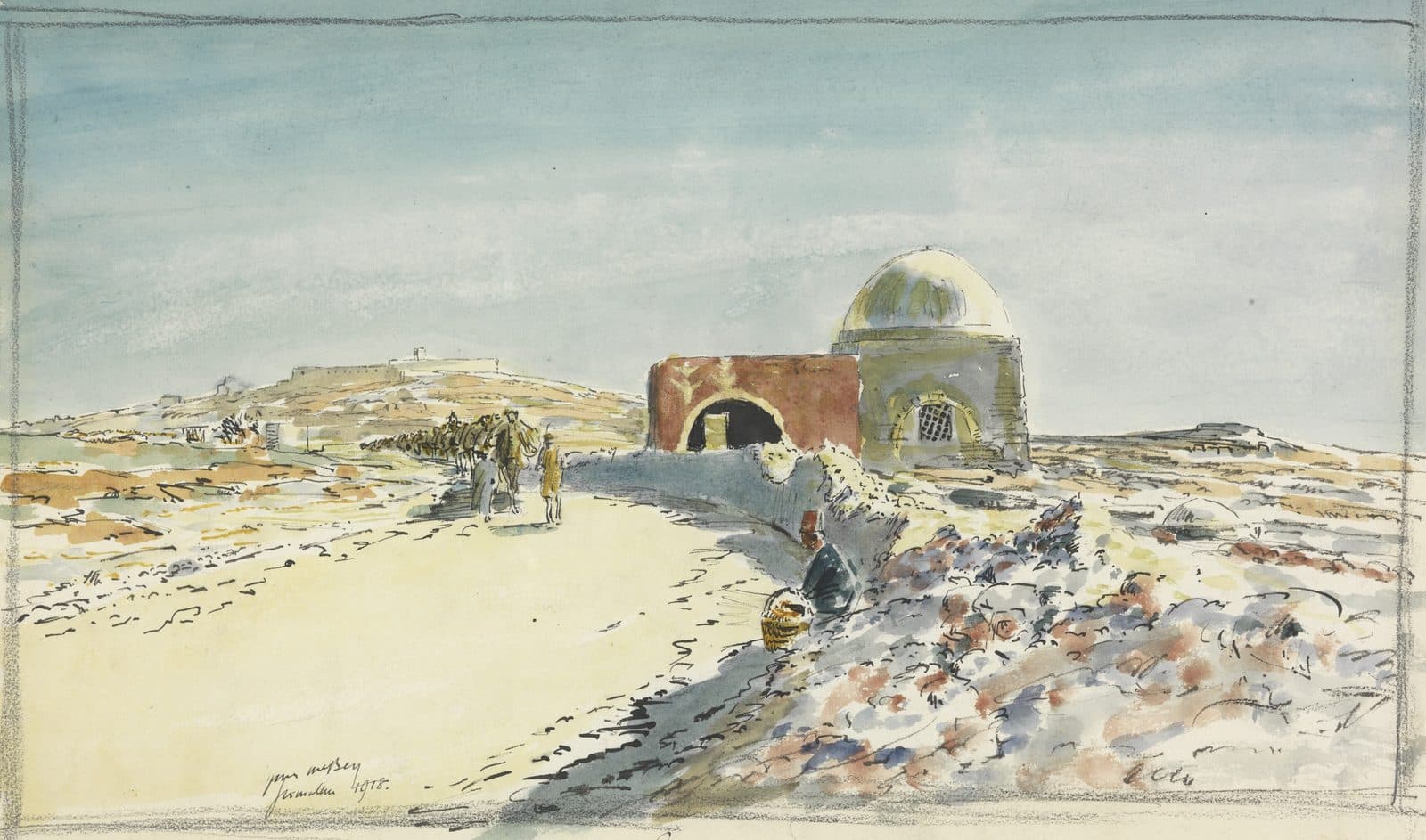
Rachel's Tomb on the Bethlehem Road
Jacob marked Rachel's grave with a pillar on the way to Bethlehem, and Scripture returns to her in Jeremiah 31:15 and Matthew 2:18.
James McBey, Rachel's Tomb, on the road between Bethlehem and Jerusalem, 1918, Imperial War Museums (Art.IWM ART 3842). Public domain, via Wikimedia Commons.
THE ARTWORKMcBey painted the domed tomb beside the road from Jerusalem to Bethlehem in 1918, with a camel train passing it, and tradition shows this building as Rachel's grave.
Rachel named her last son Ben-oni as she died on the road, and Jacob named him Benjamin.
Summary
Rachel's tomb is the grave of Jacob's wife Rachel, who died giving birth on the road from Bethel to Bethlehem, and Scripture names it from Genesis to 1 Samuel.
- Genesis 35:20 says the stone still stood when the book was written.
- Genesis 49:31 lists Leah among the dead of the cave of Machpelah and leaves Rachel by the road.
- Samuel's first sign to Saul places the tomb in Zelzah on the border of Benjamin, and readers dispute how that agrees with Bethlehem.
- Jeremiah hears Rachel weeping at Ramah for her children, and Matthew cites the verse for the boys Herod killed in Bethlehem.
The Death on the Road
Genesis 35 tells of Benjamin's birth, Rachel's death and the pillar Jacob set on her grave.
Later, they set out from Bethel, and while they were still some distance from Ephrath, Rachel began to give birth, and her labor was difficult. During her severe labor, the midwife said to her, “Do not be afraid, for you are having another son.”The labour comes on the road, and the midwife's word answers the prayer Rachel made at Joseph's birth for another son.
And with her last breath—for she was dying—she named him Ben-oni. But his father called him Benjamin.The verse holds the only words Genesis gives the dying mother, and the father answers them at once.
So Rachel died and was buried on the way to Ephrath (that is, Bethlehem). Jacob set up a pillar on her grave; it marks Rachel’s tomb to this day.These verses set the grave on a road, where later travellers from Saul to the pilgrims of AD 333 would pass it.
Israel again set out and pitched his tent beyond the Tower of Eder.Jacob moves on from the grave, and the next place Genesis names is the Tower of Eder.
The names Ben-oni and BenjaminRashi, Jerome, Keil and Delitzsch
Rashi, the eleventh-century Jewish commentator of France, gives Ben-oni as son of my sorrow, after Genesis Rabbah. Jerome, in his Hebrew Questions on Genesis, reads Benjamin as son of the right hand, that is, of strength. Keil and Delitzsch prefer son of good fortune, and they read the name as Jacob's comfort in the son for the wife he lost.
The pillar on the graveGenesis 35:20
The word for pillar is matsevah, a memorial stone, and the lexicon counts it 32 times. Jacob had set up the same kind of stone at Bethel, once as he fled from Esau and again when he came back to it.
Keil and Delitzsch hold that the words to this day need not point past the time of Moses. A gravestone kept on a high road in a foreign land, they write, was worth remarking even ten or twenty years after it was set.
John Wesley notes that the pillar kept the grave known long after, as 1 Samuel 10:2 shows, and that the place later fell in the lot of Benjamin. Adam Clarke asks whether Jacob's pillar was the origin of funeral monuments.
From Bethel to Mamre
Genesis, 1 Samuel and Jeremiah name eight places on and beside the road from Bethel to Mamre.
20 km (12 miles)
- 1Bethel, The place where God spoke with Jacob before the household set out Genesis 35:15
- 2Ramah, A town of Benjamin on the road north from Jerusalem Joshua 18:25
- 3Gibeah, Saul's own town, where the men whose hearts God had touched went with him 1 Samuel 10:26
- 4Zelzah, The Septuagint reads the word as dancing greatly, as Adam Clarke notes 1 Samuel 10:2
- 5Jerusalem, Its captives were taken in chains to Ramah on the way to Babylon Jeremiah 40:1
- 6Bethlehem, The town at the end of the road from Bethel, where Jacob was heading Genesis 35:19
- 7Tower of Eder, Jacob pitched his tent beyond it after the burial Genesis 35:21
- 8Mamre, The field of the cave where Leah was buried Genesis 49:30 to 31
Not located: Zelzah, Tower of Eder.
The coastline is simplified; each place stands at its place page's coordinates.
Each place in the key carries what the text says of it and the verse that says it.
The Tomb in Scripture
Scripture returns to Rachel's grave from Jacob's last days to the reign of Herod.
Centuries later, on the day Saul was anointed, Samuel gave him three signs, and the first was to be met at the tomb.
When you leave me today, you will find two men at Rachel’s tomb in Zelzah on the border of Benjamin. They will say to you, ‘The donkeys you seek have been found, and now your father has stopped worrying about the donkeys and started worrying about you, asking, “What should I do about my son?”’This is the one verse outside Genesis that names the tomb, and Samuel names it to Saul as a landmark on his way home.
Jeremiah 31 sets Rachel's voice at Ramah, a town of Benjamin, among the LORD's words of comfort for Israel's exiles.
This is what the LORD says: “A voice is heard in Ramah, mourning and great weeping, Rachel weeping for her children, and refusing to be comforted, because they are no more.”In Jeremiah the verse opens the LORD's word to Rachel about her children, a word that runs on to their return.
When Herod saw that he had been outwitted by the Magi, he was filled with rage. Sending orders, he put to death all the boys in Bethlehem and its vicinity who were two years old and under, according to the time he had learned from the Magi. Then what was spoken through the prophet Jeremiah was fulfilled: “A voice is heard in Ramah, weeping and great mourning, Rachel weeping for her children, and refusing to be comforted, because they are no more.”This is the last place Scripture names Rachel, and the only one in the New Testament.
Two Things Often Said of the Tomb
Each saying stands beside the verse that answers it.
RACHEL WAS BURIED IN BETHLEHEM
Jacob says he buried her beside the road to Ephrath, some distance from the town.
JEREMIAH'S VERSE SPEAKS ONLY OF HEROD'S DEED
The LORD's answer to Rachel promises that her children will return from the land of the enemy. Adam Clarke notes that the murdered children of Bethlehem never came again, while the exiles did.
Ephrath, Which Is Bethlehem
Ephrath is another name for Bethlehem, and the town's later history runs back to Rachel.
When Boaz took Ruth as his wife at Bethlehem, the elders blessed her by the names of Rachel and Leah.
“We are witnesses,” said the elders and all the people at the gate. “May the LORD make the woman entering your home like Rachel and Leah, who together built up the house of Israel. May you be prosperous in Ephrathah and famous in Bethlehem.The blessing joins Rachel to Ephrathah and Bethlehem, the town where David's line begins.
Theodoret of Cyrus, in his Questions on Ruth, heard in the elders' blessing a word of the birth that made Bethlehem famous among all people.
But you, Bethlehem Ephrathah, who are small among the clans of Judah, out of you will come forth for Me One to be ruler over Israel—One whose origins are of old, from the days of eternity.Micah gives the coming ruler's town the double name the elders used for Boaz's town.
Josephus, in his Antiquities of the Jews, calls Rachel the only one of Jacob's kindred who had not the honour of burial at Hebron.
There Abraham and his wife Sarah are buried, there Isaac and his wife Rebekah are buried, and there I buried Leah.Jacob gives this list as he asks his sons to bury him with his fathers.
The Tower of EderGenesis 35:21 and Micah 4:8
Adam Clarke reads the Tower of Eder as the tower of the flock, the words of Micah 4:8. He cites the Targum of Jonathan, which names it as the place where the King Messiah will be revealed at the end of days.
Jerome, in his Hebrew Questions on Genesis, records that the Hebrews placed the tower where the temple was later built.
And you, O watchtower of the flock, O stronghold of the Daughter of Zion—the former dominion will be restored to you; sovereignty will come to the Daughter of Jerusalem.”Micah calls the stronghold of Zion the watchtower of the flock, and Clarke and Jerome read Genesis 35:21 by this verse.
The Tomb in the Record
Pilgrims and travellers describe a tomb on the Bethlehem road from AD 333 onward.
The Bordeaux Pilgrim and PaulaThe fourth century
Jerome tells how Paula, on her way to Bethlehem, stood beside the tomb of Rachel on the right side of the road.
Keil and Delitzsch note that after 1 Samuel 10:2 the monument is next named by these two witnesses.
The domed tomb of the nineteenth centuryKeil and Delitzsch, Biblical Commentary on the Old Testament, on Genesis 35:20
Keil and Delitzsch, quoting Robinson's account of Palestine, describe the tomb shown in their day, the Kubbet Rahil, as a small square building of stone with a dome over an ordinary Muslim tomb.
It stood about half an hour on foot north of Bethlehem, to the right of the road from Jerusalem to Hebron. They add that it had lately been enlarged by a square court with high walls and arches on its eastern side, and that the building itself is not ancient.
What the Text Leaves Unsaid
Genesis and 1 Samuel leave three questions about the grave open.
Rachel Weeping for Her Children
Jeremiah sets Rachel's weeping in Israel's exile, and Matthew sets it in Herod's Bethlehem.
Albert Barnes reads Rachel as the mother of Benjamin, Ephraim and Manasseh, and so as the mother of the ten northern tribes. He places Ramah about five miles from Jerusalem.
Keil hears the weeping at Ramah because it was the highest border town of the two kingdoms, from which the cry carried into Judah. Rashi reads the voice as Israel weeping when Nebuzaradan sent Jeremiah from Ramah, and Delitzsch, on Genesis 35:20, ties the weeping to the exiles gathered there.
This is the word that came to Jeremiah from the LORD after Nebuzaradan captain of the guard had released him at Ramah, having found him bound in chains among all the captives of Jerusalem and Judah who were being exiled to Babylon.The verse tells what Ramah saw when Judah fell, and that is why a cry of exile can be heard there.
Jamieson, Fausset & Brown hear a double lament in Matthew's verse, first for the children lost to captivity and then for those lost to death.
John Wesley pictures Rachel risen from her grave near Bethlehem to mourn her lost children, and he reads the preservation of Jesus as a figure of God's care over His children in their greatest danger.
What Matthew means by fulfilledAlbert Barnes, C. F. Keil, and Jamieson, Fausset & Brown
Albert Barnes takes Matthew's word fulfilled to mean that Jeremiah's words aptly express the grief Matthew records. Keil calls Herod's deed a new fulfilment, and he joins the two events by a cause. The sin that sent Israel into exile, he writes, led to an Idumean king over the Jews who sought to destroy their true King.
Jamieson, Fausset & Brown cite Bengel, that a lesser and a greater event of different times may answer to one passage of Scripture until the prophecy is exhausted.
Voices on Rachel and the Boys of Bethlehem
Two commentators of the eighteenth century write on Rachel's death and on the boys Herod killed.
John Wesley sets Rachel's death beside her cry to Jacob in Genesis 30:1.
“We are apt in extreme perils to comfort ourselves and our friends with the hopes of a temporal deliverance, in which we may be disappointed; we had better ground our comforts on that which cannot fail us, the hope of eternal life. Rachel had passionately said, Give me children, or else I die; and now she had children (for this was her second) she died.”
John Wesley · Explanatory Notes upon the Old Testament · on Genesis 35:17Evangelical
Matthew Henry counts the boys of Bethlehem as the first to die for Christ.
“The diseases and deaths of little children are proofs of original sin. But we must look upon this murder of the infants under another character: it was their martyrdom. How early did persecution commence against Christ and his kingdom!”
Matthew Henry · Commentary on the Whole Bible · on Matthew 2:16Puritan
Where Rachel Was Buried
Readers divide over whether the grave lay near Bethlehem in Judah or in the land of Benjamin.
Near Bethlehem, at the site the pilgrims knewKeil and Delitzsch, Biblical Commentary on the Old Testament; Adam Clarke; John Gill
Keil and Delitzsch hold that Genesis places the grave on the way to Bethlehem, a short distance from the town. They also hold that the tradition fixing it at the Kubbet Rahil cannot on the whole be disputed.
On 1 Samuel 10:2 Keil argues that the border of Benjamin is not to be pressed, since Samuel names Zelzah to fix the meeting place more exactly. He supposes that Zelzah lay between the tomb and the spring of Rogel on Benjamin's southern border.
Adam Clarke on Samuel's verse and John Gill on the verse of the burial also set the tomb near Bethlehem.
The objection is that Keil must place an unknown Zelzah between the tomb and Benjamin's border to keep the tomb near Bethlehem.
In Benjamin, north of JerusalemThenius, Kurtz, Nägelsbach, Knobel and Graf, as Keil reports them (1876 and 1880)
Keil reports that most expositors of his day placed the tomb near Ramah because of 1 Samuel 10:2, and he names Nägelsbach among them.
Thenius took the Ephratah of Genesis 35 for a place near Bethel and the words that is Bethlehem in 35:19 and 48:7 for a gloss. Knobel and Graf with him identified that Ephratah with the Ephron near Bethel, and Kurtz moved the tomb toward Bethel.
Gibeon, Ramah, Beeroth,Ramah stands in the list of Benjamin's towns, and the northern reading sets Jeremiah's Ramah and Samuel's border of Benjamin together.
The objection is that the reading must strike Bethlehem from two verses of Genesis as a gloss.
At the tomb, and then at ZelzahRashi on 1 Samuel 10:2, after the Tosefta of Sotah
The objection is that Samuel's sentence sets the tomb and Zelzah together as one place of meeting.
Hope for Your Future
The LORD did not leave Rachel's weeping without an answer.
So there is hope for your future, declares the LORD, and your children will return to their own land.The LORD's last word to Rachel in this passage is hope for her future.
Keep studying
Studies7
People10