
1 Samuel 1 · Subject · Waiting
The Closed Womb
Sarah, Rebekah, Rachel, the wife of Manoah, Hannah, the Shunammite and Elizabeth each waited for a child, and each in the end bore a son.
Sarah was about ninety years old when she bore Isaac, the son God had promised Abraham decades before.
I prayed for this boy, and since the LORD has granted me what I asked of Him, I now dedicate the boy to the LORD. For as long as he lives, he is dedicated to the LORD.” So they worshiped the LORD there.
- Books
- Genesis, 1 Samuel, Luke
- Hold in memory
- Genesis 30:2
Summary
Scripture tells of women who longed for a child for years and of the God who opened their wombs. In these accounts it never names the woman's sin as the cause. Their sorrow comes through in Rachel's cry to Jacob, in Hannah's tears at Shiloh and in Elizabeth's word about her disgrace. The sons born to them include Isaac, Jacob, Joseph, Samson, Samuel and John, each with a part in God's dealings with Israel.
- Genesis 29:31, Genesis 30:22 and 1 Samuel 1:5 to 6 name the LORD as the One who opened or closed a woman's womb.
- John Chrysostom and Bede read the barren mothers as a preparation for faith in the virgin birth, and Augustine marked the difference between the two kinds of birth.
- The barren woman of Isaiah 54:1 becomes in Galatians 4:27 a figure of the church.
The Closed Womb in Scripture
Some of the longest waits in Scripture are the waits of women for a child.
Waiting, the trial this study belongs to, takes one of its hardest forms in the longing for a child that does not come. Scripture returns to this trial many times, and it lets the women speak their sorrow for themselves.
The question this study answers is what the Bible teaches about the closed womb and about the women who longed for a son. It sets seven women side by side, tells four of their accounts in brief, and reads what the texts say of the cause. It gives one study of the weight of infertility, and it weighs two questions readers ask: whether these births point to the virgin birth, and how a childless reader should read the answered prayers.
Seven Women Who Waited for a Child
The women stand in the Law, the Former Prophets and the Gospel of Luke.
Seven women without a child each bore a son, and the texts set each birth after a prayer, a promise or God's remembering.
| Woman | Her grief, or the text about her | The answer |
|---|---|---|
| Sarah | "the LORD has prevented me from bearing children" (Genesis 16:2) | "So Sarah conceived and bore a son" (Genesis 21:2) |
| Rebekah | "Isaac prayed to the LORD on behalf of his wife" (Genesis 25:21) | "his wife Rebekah conceived" (Genesis 25:21) |
| Rachel | "Give me children, or I will die!" (Genesis 30:1) | "Then God remembered Rachel" (Genesis 30:22) |
| The wife of Manoah | "whose wife was barren and had no children" (Judges 13:2) | "you will conceive and give birth to a son" (Judges 13:3) |
| Hannah | "Hannah prayed to the LORD and wept" (1 Samuel 1:10) | "and the LORD remembered her" (1 Samuel 1:19) |
| The Shunammite | "she has no son" (2 Kings 4:14) | "But the woman did conceive" (2 Kings 4:17) |
| Elizabeth | "because Elizabeth was barren" (Luke 1:7) | "his wife Elizabeth became pregnant" (Luke 1:24) |
Four Accounts in Brief
Sarah, Rachel, Hannah and Elizabeth each have a longer account in Scripture.
SarahGenesis 11:30 to 21:2
Genesis names Sarah's barrenness in its first words about her: "But Sarai was barren; she had no children" (Genesis 11:30).
RachelGenesis 30:1 to 24
Hannah1 Samuel 1:1 to 28
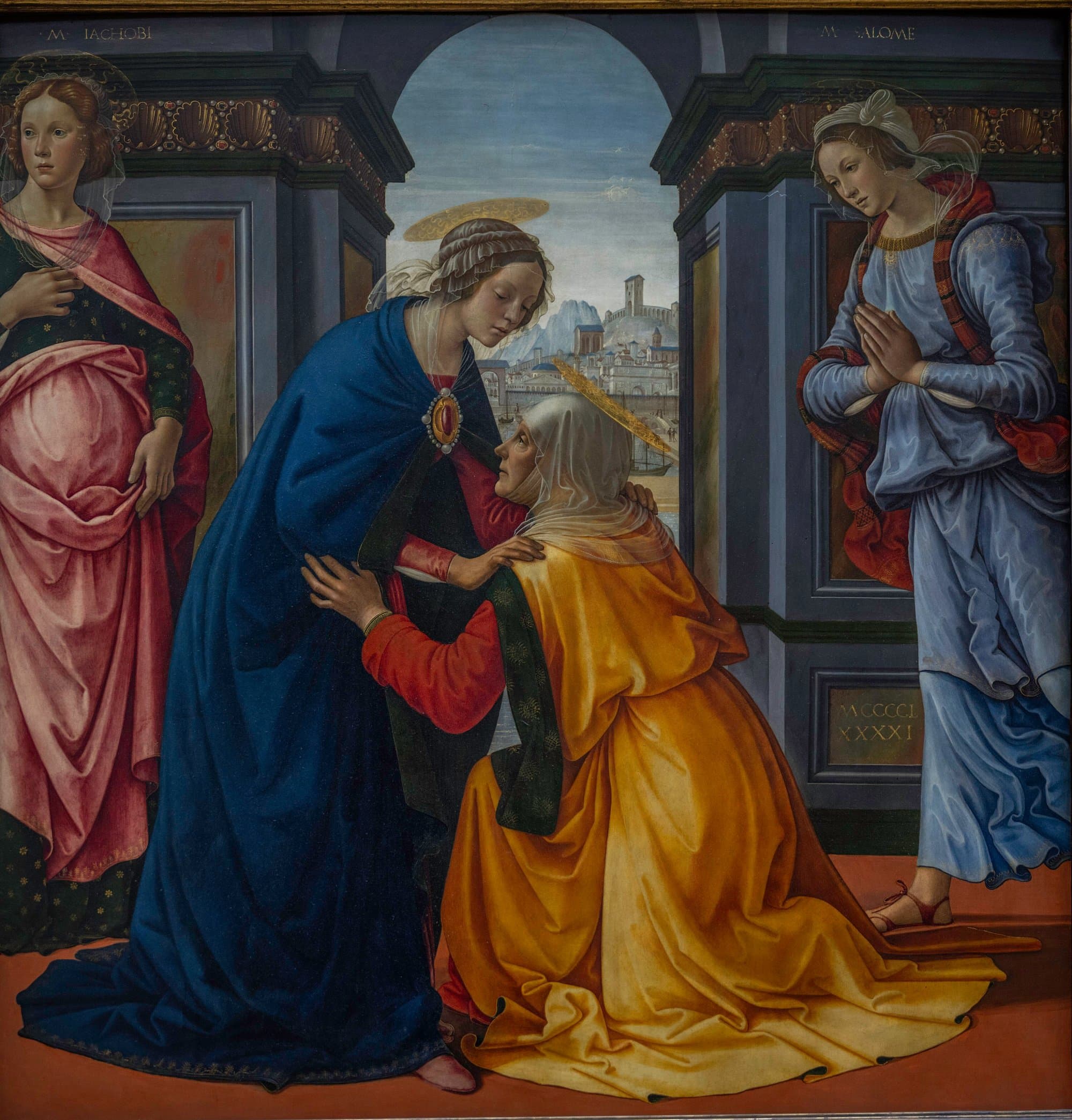
ElizabethLuke 1:5 to 58
The angel told Zechariah that his prayer had been heard and that Elizabeth would bear him a son named John (Luke 1:13). Gabriel gave her pregnancy to Mary as a sign, "For no word from God will ever fail" (Luke 1:36 to 37). At John's birth her neighbours and relatives "heard that the Lord had shown her great mercy" (Luke 1:58).
What the Texts Say of the Cause
The texts give the closing and the opening of the womb to the LORD.
When the LORD saw that Leah was unloved, He opened her womb; but Rachel was barren.The verse sets the sisters' rivalry under the LORD's hand from its first line.
Because the LORD had closed Hannah’s womb, her rival would provoke her and taunt her viciously.The narrator says twice in two verses that the LORD had closed Hannah's womb, and he lays no blame on her.
Of Elizabeth and Zechariah Luke writes, "Both of them were righteous in the sight of God, walking blamelessly in all the commandments and decrees of the Lord" (Luke 1:6).
The texts also record the shame these women carried. Rachel said at Joseph's birth that God had taken away her shame, and Elizabeth said, "In these days He has shown me favor and taken away my disgrace among the people" (Luke 1:25).
The Weight of the Trial
A study of 1993 measured the distress of women facing infertility beside patients with other illnesses.
A. D. Domar, P. C. Zuttermeister and R. Friedman published "The psychological impact of infertility: a comparison with patients with other medical conditions" in the Journal of Psychosomatic Obstetrics and Gynaecology in 1993 (volume 14, supplement, pages 45 to 52). They gave one symptom checklist to 149 women with infertility and to women with chronic pain, cancer, hypertension, HIV and those in cardiac rehabilitation.
The women with infertility scored at levels similar to the women with cancer, those in cardiac rehabilitation and those with hypertension. The authors concluded that the psychological symptoms of infertility are similar to those of other serious medical conditions.
A couple facing infertility can seek medical care and pray, and neither takes the place of the other.
Two Questions Readers Ask
Teachers of the church have read these births as a sign, and childless readers have asked what the births mean for them.
Do these births point to the virgin birth?Luke 1:7 and Luke 1:36
John Chrysostom, in a homily on Genesis that Thomas Aquinas gathered into his Catena Aurea on Luke 1:7, saw a purpose in the barren mothers that pointed ahead to Mary. Their barrenness was "ordained rather for your benefit, that when you saw a virgin giving birth to the Lord, you might not be faithless". Bede, in the same Catena on Luke 1:36, said Mary was given Elizabeth's pregnancy "lest the virgin should despair of being able to bear a son".
In his Sermon 293 Augustine set the two births side by side and wrote, "Barrenness gives birth to John, virginity to Christ". A barren woman conceived by her husband, and Mary conceived as a virgin by the power of the Holy Spirit (Luke 1:34 to 35).
Another reading takes the barren woman as a figure of God's people. Paul applies Isaiah 54:1 to the Jerusalem above in Galatians 4:27, and Jamieson, Fausset and Brown wrote on Psalm 113:9 that barrenness "is a type of a deserted Church."
“Shout for joy, O barren woman, who bears no children; break forth in song and cry aloud, you who have never travailed; because more are the children of the desolate woman than of her who has a husband,” says the LORD.The prophet calls the barren woman to sing because the LORD will give her more children than the married woman, the verse Paul applies to the church.
How should a childless reader read these answered prayers?1 Samuel 1:11 and Isaiah 56:3 to 5
The strongest pastoral objection is that these stories, told one after another, seem to promise a child to every woman who prays as Hannah prayed. A woman who has prayed for years without a child can hear them turned against her.
Matthew Henry, writing on the birth of Samuel (1 Samuel 1:19 to 20), held to God's care for every praying believer. God may "seem long to forget his people's burdens, troubles, cares, and prayers", he wrote, "yet he will at length make it to appear that they are not out of his mind".
I will give them, in My house and within My walls, a memorial and a name better than that of sons and daughters. I will give them an everlasting name that will not be cut off.The verse stands in this question because its promise to the one without children rests on keeping God's covenant.
Jamieson, Fausset and Brown read the promise this way: "Though the eunuch is barren of children ... I will give him a more lasting name than that of being father of sons and daughters."
The Barren Woman Settled in Her Home
The psalm that praises God for lifting the poor ends with the barren woman.
The women who waited for a child show that God hears the prayer of the childless and acts in His own time. Their stories place the grief of waiting before God, where Hannah poured it out, and they leave the gift of children in His hands.
He settles the barren woman in her home as a joyful mother to her children. Hallelujah!The verse stands last because it turns the grief of the barren into praise, the end these women's stories reached.
Sources
Scripture is the Berean Standard Bible.
- John Chrysostom, a homily on Genesis, as Thomas Aquinas gathers it in the Catena Aurea on Luke 1:7.
- Bede, on Luke 1:36, in the Catena Aurea of Thomas Aquinas.
- Augustine of Hippo, Sermon 293.
- Jamieson, Fausset and Brown, Commentary Critical and Explanatory on the Whole Bible (1871), on Psalm 113:9 and Isaiah 56:5.
- Matthew Henry, Commentary on the Whole Bible (1710), on 1 Samuel 1:19 to 20.
- A. D. Domar, P. C. Zuttermeister and R. Friedman, The psychological impact of infertility: a comparison with patients with other medical conditions, Journal of Psychosomatic Obstetrics and Gynaecology 14, supplement (1993): 45 to 52, PubMed 8142988.
Keep Studying
Read it1
People and groups10