
Shiloh
Summary
Where the tabernacle rested through the judges' era; Hannah prayed here, Samuel heard his name in the night, and its later ruin became Jeremiah's warning to the temple city.
- Shiloh held the tent of meeting for the whole period of the judges, and the land was divided by lot at its door.
- Hannah prayed here for a son, and the boy Samuel heard his name called in the room where the ark was kept.
- Israel carried the ark out to battle, the Philistines took it, and a dying woman named her son Ichabod, the glory has departed.
- The ark never came back. Psalm 78 says God abandoned the tabernacle of Shiloh and chose Zion instead.
- Jeremiah pointed a temple crowd at what happened here, and they demanded his death for saying it.
On this page
In Scripture
- Verses
- 32
- Books
- 7
Near Shiloh
- Ephraim11 km · 7.1 mi S
- Bethel15 km · 9.5 mi SW
- Ai16 km · 9.7 mi S
- Mount Gerizim16 km · 10.0 mi N
- Sychar17 km · 10 mi N
- Shechem18 km · 11 mi N
Straight-line distances, computed from the gazetteer coordinates.
Where it is
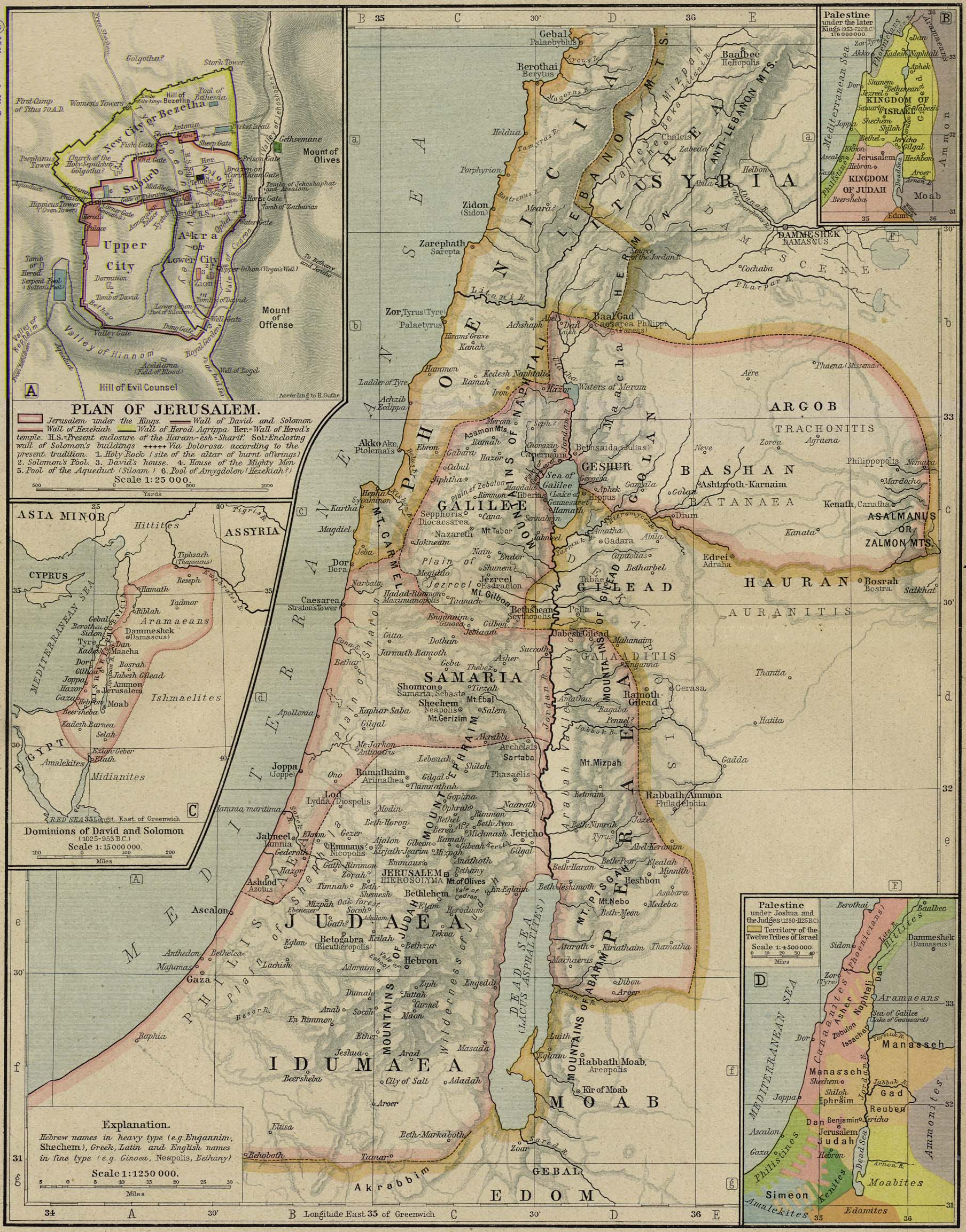
the country around it
- Coordinates
- 32.0557° N, 35.2895° Efind it on the Atlas →
- Region
- Ephraim
- Kind of place
- Town
2 places the record names with Shiloh, the farthest 18 km away
- 1The yearly feast, and the town located by three bearingsJudges 21:19 · 15 km“But look,” they said, “there is a yearly feast to the LORD in Shiloh, which is north of Bethel east of the road that goes up from Bethel to Shechem, and south of Lebonah.”
- 2Men of Shiloh still walking south with offeringsJeremiah 41:5 · 18 kmeighty men who had shaved off their beards, torn their garments, and cut themselves came from Shechem, Shiloh, and Samaria, carrying grain offerings and frankincense for the house of the LORD.
- Located: the gazetteer fixes one site
- Placed: the point stands for an area, or is rounded
- ? Proposed: one candidate among several
- A dashed line ends at a place the gazetteer does not fix
Why Shiloh matters
What has been found
the evidence, and where it is disputed
The glory departs from Shiloh
1 Samuel 1 to 4, in the order it happens
Read 1 Samuel 1 to 4, in the order it happens
- A family goes up to Shiloh year after year1 Samuel 1:3Year after year Elkanah would go up from his city to worship and sacrifice to the LORD of Hosts at Shiloh, where Eli’s two sons, Hophni and Phinehas, were priests to the LORD.
- Hannah's vow at the doorpost1 Samuel 1:11And she made a vow, pleading, “O LORD of Hosts, if only You will look upon the affliction of Your maidservant and remember me, not forgetting Your maidservant but giving her a son, then I will dedicate him to the LORD all the days of his life, and no razor shall ever come over his head.”
- The boy is brought back and left there1 Samuel 1:24Once she had weaned him, Hannah took the boy with her, along with a three-year-old bull, an ephah of flour, and a skin of wine. Though the boy was still young, she brought him to the house of the LORD at Shiloh.
- The priests in charge of the place1 Samuel 2:12Now the sons of Eli were wicked men; they had no regard for the LORD
- Samuel sleeping where the ark was kept1 Samuel 3:3Before the lamp of God had gone out, Samuel was lying down in the temple of the LORD, where the ark of God was located.
- Speak, for Your servant is listening1 Samuel 3:10Then the LORD came and stood there, calling as before, “Samuel! Samuel!” And Samuel answered, “Speak, for Your servant is listening.”
- The ark fetched from Shiloh to the battle line1 Samuel 4:3When the troops returned to the camp, the elders of Israel asked, “Why has the LORD brought defeat on us before the Philistines today? Let us bring the ark of the covenant of the LORD from Shiloh, so that it may go with us to save us from the hand of our enemies.”
- The ark captured, the two priests dead1 Samuel 4:11The ark of God was captured, and Eli’s two sons, Hophni and Phinehas, died.
- Eli falls backward at the news1 Samuel 4:18As soon as the ark of God was mentioned, Eli fell backward from his chair by the city gate, and being old and heavy, he broke his neck and died. And Eli had judged Israel forty years.
- Ichabod, the glory has departed1 Samuel 4:21And she named the boy Ichabod, saying, “The glory has departed from Israel,” because the ark of God had been captured and her father-in-law and her husband had been killed.
Scripture never narrates the burning of Shiloh. Jeremiah 7:12 assumes a reader knows what happened here, and Psalm 78:60 says God abandoned the place. The destruction is an inference from those verses and from the burn layer in the ground, not a scene the Bible reports.
The Glory Departed: the full studyWhat happened here, in order
in the order the canon tells it
- Jacob blesses Judah, and the word Shiloh is spokenGenesis 49:10The scepter will not depart from Judah, nor the staff from between his feet, until Shiloh comes and the allegiance of the nations is his.
- The Tent of Meeting is set up at ShilohJoshua 18:1Then the whole congregation of Israel assembled at Shiloh and set up the Tent of Meeting there. And though the land was subdued before them,
- Joshua casts lots for seven tribes at the tent doorJoshua 18:10And Joshua cast lots for them in the presence of the LORD at Shiloh, where he distributed the land to the Israelites according to their divisions.
- The land finishes being divided at ShilohJoshua 19:51These are the inheritances that Eleazar the priest, Joshua son of Nun, and the heads of the families distributed by lot to the tribes of Israel at Shiloh before the LORD at the entrance to the Tent of Meeting. So they finished dividing up the land.
- Israel musters at Shiloh over a rival altarJoshua 22:12And when they heard this, the whole congregation of Israel assembled at Shiloh to go to war against them.
- A rival shrine runs in the north the whole timeJudges 18:31So they set up for themselves Micah’s graven image, and it was there the whole time the house of God was in Shiloh.
- The yearly feast, and the town located by three bearingsJudges 21:19“But look,” they said, “there is a yearly feast to the LORD in Shiloh, which is north of Bethel east of the road that goes up from Bethel to Shechem, and south of Lebonah.”
- Elkanah's family comes up to sacrifice1 Samuel 1:3Year after year Elkanah would go up from his city to worship and sacrifice to the LORD of Hosts at Shiloh, where Eli’s two sons, Hophni and Phinehas, were priests to the LORD.
- The LORD keeps appearing at Shiloh to Samuel1 Samuel 3:21And the LORD continued to appear at Shiloh, because there He revealed Himself to Samuel by His word.
- The ark is captured at Ebenezer1 Samuel 4:11The ark of God was captured, and Eli’s two sons, Hophni and Phinehas, died.
- Ichabod is named as his mother dies1 Samuel 4:21And she named the boy Ichabod, saying, “The glory has departed from Israel,” because the ark of God had been captured and her father-in-law and her husband had been killed.
- Eli's great-grandson serves Saul, still named for Shiloh1 Samuel 14:3including Ahijah, who was wearing an ephod. He was the son of Ichabod’s brother Ahitub son of Phinehas, the son of Eli the priest of the LORD in Shiloh. But the troops did not know that Jonathan had left.
- The word spoken at Shiloh lands on Abiathar1 Kings 2:27So Solomon banished Abiathar from the priesthood of the LORD and thus fulfilled the word that the LORD had spoken at Shiloh against the house of Eli.
- Ahijah the Shilonite meets Jeroboam on the road1 Kings 11:29During that time, the prophet Ahijah the Shilonite met Jeroboam on the road as he was going out of Jerusalem. Now Ahijah had wrapped himself in a new cloak, and the two of them were alone in the open field.
- Jeroboam's wife comes to Shiloh in disguise1 Kings 14:4Jeroboam’s wife did as instructed; she arose and went to Shiloh and arrived at Ahijah’s house. Now Ahijah could not see, for his eyes were dim because of his age.
- God abandons the tabernacle of ShilohPsalms 78:60He abandoned the tabernacle of Shiloh, the tent He had pitched among men.
- The same psalm turns to Judah and Mount ZionPsalms 78:68But He chose the tribe of Judah, Mount Zion, which He loved.
- Jeremiah sends a temple crowd to look at ShilohJeremiah 7:12But go now to the place in Shiloh where I first made a dwelling for My Name, and see what I did to it because of the wickedness of My people Israel.
- The sentence that nearly cost Jeremiah his lifeJeremiah 26:6then I will make this house like Shiloh, and I will make this city an object of cursing among all the nations of the earth.’”
- Men of Shiloh still walking south with offeringsJeremiah 41:5eighty men who had shaved off their beards, torn their garments, and cut themselves came from Shechem, Shiloh, and Samaria, carrying grain offerings and frankincense for the house of the LORD.
Where it points
The voices
each quoted from the work named
THE dying Patriarch was speaking of his own son, Judah, but while speaking of Judah, he had a special eye to our Lord, who sprang from the tribe of Judah. Everything, therefore, which he says of Judah, the type, he means with regard to our greater Judah, the Antitype, our Lord Jesus Christ.
After all overt resistance was overcome, the tabernacle with its sacred contents was removed from its place of safety at Gilgal, in a corner of the land near the Jordan, to a central place, Shiloh, the modern Scilun, which is two or three miles east of the main road, and rather more than half way between Jerusalem and Nablous.
The special cause of Hannah's sorrow arose from the institution of polygamy, which, although it was tolerated under the old Law, is always exhibited to us in practical action as a most fruitful source of sorrow and sin. In no one recorded instance in Holy Scripture is it set forth as admirable.
4 more teachers on these versesJohn Wesley · Charles Spurgeon · Albert Barnes · Jerome
Doors - Altho' the tabernacle, whilst it was to be removed from place to place in the wilderness, had no doors, but consisted only of curtains, and had hangings before the entrance, instead of doors; yet when it was settled in one place, as now it was in Shiloh, it was enclosed within some solid building, which had doors and posts, and other parts belonging to it.
THESE MEN made a great mistake: what they wanted was the Lord in their midst; whereas they imagined that the symbol of God’s presence, the ark of the covenant, would be amply sufficient to bestow upon them the assistance which they required in the day of battle.
The ark, after it was taken by the Philistines, was never returned to Shiloh, but was deposited successively at Nob 1Sa 21:1-6, and at Gibeon 1Ki 3:4, until David pitched a tabernacle for it on Mount Zion 1Ch 15:1. The meaning here is, that in consequence of the sins of the people, the place of worship was finally and forever removed from the tribe of Ephraim, within whose limits Shiloh was, to the tribe of Judah, and to Mount Zion.
The present teaches from the past: and to those who say, 'The temple of the Lord, the temple of the Lord, the temple of the Lord,' and who rejoice in the splendor of the precious house, Shiloh, where the tabernacle of God was first, recalls a history, about which it is written in the psalm: 'And he rejected the tabernacle of Shiloh' (Psalm 78:60).
Shiloh in Scripture
32 verses name it, in 7 books
Open a book to read its mentions here. Text: Berean Standard Bible.
Old TestamentNew Testamentsegment width = share of mentions
Old Testament7 books · 32 mentions
Genesis1 mention
Joshua9 mentions
- Joshua 16:6and out toward the Sea. From Michmethath on the north it turned eastward toward Taanath-shiloh and passed by it to Janoah on the east.
- Joshua 18:1Then the whole congregation of Israel assembled at Shiloh and set up the Tent of Meeting there. And though the land was subdued before them,
- Joshua 18:8As the men got up to go out, Joshua commanded them to map out the land, saying, “Go and survey the land, map it out, and return to me. Then I will cast lots for you here in Shiloh in the presence of the LORD.”
- Joshua 18:9So the men departed and went throughout the land, mapping it city by city into seven portions. Then they returned with the document to Joshua at the camp in Shiloh.
- Joshua 18:10And Joshua cast lots for them in the presence of the LORD at Shiloh, where he distributed the land to the Israelites according to their divisions.
- Joshua 19:51These are the inheritances that Eleazar the priest, Joshua son of Nun, and the heads of the families distributed by lot to the tribes of Israel at Shiloh before the LORD at the entrance to the Tent of Meeting. So they finished dividing up the land.
- Joshua 21:2at Shiloh in the land of Canaan and said to them, “The LORD commanded through Moses that we be given cities in which to live, together with pasturelands for our livestock.”
- Joshua 22:9So the Reubenites, the Gadites, and the half-tribe of Manasseh left the Israelites at Shiloh in the land of Canaan to return to their own land of Gilead, which they had acquired according to the command of the LORD through Moses.
1 further mention in Joshua, read them in the book.
Judges4 mentions
- Judges 18:31So they set up for themselves Micah’s graven image, and it was there the whole time the house of God was in Shiloh.
- Judges 21:12So they found among the inhabitants of Jabesh-gilead four hundred young women who had not had relations with a man, and they brought them to the camp at Shiloh in the land of Canaan.
- Judges 21:19“But look,” they said, “there is a yearly feast to the LORD in Shiloh, which is north of Bethel east of the road that goes up from Bethel to Shechem, and south of Lebonah.”
- Judges 21:21and watch. When you see the daughters of Shiloh come out to perform their dances, each of you is to come out of the vineyards, catch for himself a wife from the daughters of Shiloh, and go to the land of Benjamin.
1 Samuel9 mentions
- 1 Samuel 1:3Year after year Elkanah would go up from his city to worship and sacrifice to the LORD of Hosts at Shiloh, where Eli’s two sons, Hophni and Phinehas, were priests to the LORD.
- 1 Samuel 1:9So after they had finished eating and drinking in Shiloh, Hannah stood up. Now Eli the priest was sitting on a chair by the doorpost of the temple of the LORD.
- 1 Samuel 1:24Once she had weaned him, Hannah took the boy with her, along with a three-year-old bull, an ephah of flour, and a skin of wine. Though the boy was still young, she brought him to the house of the LORD at Shiloh.
- 1 Samuel 2:14and plunge it into the pan or kettle or cauldron or cooking pot. And the priest would claim for himself whatever the meat fork brought up. This is how they treated all the Israelites who came to Shiloh.
- 1 Samuel 3:21And the LORD continued to appear at Shiloh, because there He revealed Himself to Samuel by His word.
- 1 Samuel 4:3When the troops returned to the camp, the elders of Israel asked, “Why has the LORD brought defeat on us before the Philistines today? Let us bring the ark of the covenant of the LORD from Shiloh, so that it may go with us to save us from the hand of our enemies.”
- 1 Samuel 4:4So the people sent men to Shiloh, and they brought back the ark of the covenant of the LORD of Hosts, who sits enthroned between the cherubim. And the two sons of Eli, Hophni and Phinehas, were there with the ark of the covenant of God.
- 1 Samuel 4:12That same day a Benjamite ran from the battle line all the way to Shiloh, with his clothes torn and dirt on his head.
1 further mention in 1 Samuel, read them in the book.
1 Kings3 mentions
- 1 Kings 2:27So Solomon banished Abiathar from the priesthood of the LORD and thus fulfilled the word that the LORD had spoken at Shiloh against the house of Eli.
- 1 Kings 14:2and Jeroboam said to his wife, “Now get up, disguise yourself so they will not recognize you as my wife, and go to Shiloh. For Ahijah the prophet is there; it was he who spoke about my kingship over this people.
- 1 Kings 14:4Jeroboam’s wife did as instructed; she arose and went to Shiloh and arrived at Ahijah’s house. Now Ahijah could not see, for his eyes were dim because of his age.
Psalms1 mention
Jeremiah5 mentions
- Jeremiah 7:12But go now to the place in Shiloh where I first made a dwelling for My Name, and see what I did to it because of the wickedness of My people Israel.
- Jeremiah 7:14therefore what I did to Shiloh I will now do to the house that bears My Name, the house in which you trust, the place that I gave to you and your fathers.
- Jeremiah 26:6then I will make this house like Shiloh, and I will make this city an object of cursing among all the nations of the earth.’”
- Jeremiah 26:9How dare you prophesy in the name of the LORD that this house will become like Shiloh and this city will be desolate and deserted!” And all the people assembled against Jeremiah in the house of the LORD.
- Jeremiah 41:5eighty men who had shaved off their beards, torn their garments, and cut themselves came from Shechem, Shiloh, and Samaria, carrying grain offerings and frankincense for the house of the LORD.
The account
Read the account as one telling
The hill was fortified long before Israel came to it. Excavators found a city wall of the Middle Bronze Age still standing 7.3 metres high and up to 5.5 metres thick, with an earthen bank piled against its outer face. Israel did not build that wall. The tent was pitched inside defenses that were already centuries old.
Joshua set up the Tent of Meeting at Shiloh once the fighting was over, and the town became the address of Israel's worship. Seven tribes still had no inheritance, so Joshua sent men to walk the country and write it down in seven portions, then cast lots for them at Shiloh in the presence of the LORD. Joshua 19:51 closes the division at the entrance to the tent, and the Levites came to the same door to ask for the cities they had been promised.
Joshua 22 shows what the one altar meant. The eastern tribes went home from Shiloh and built a large altar by the Jordan, and when Israel heard of it the whole congregation assembled at Shiloh to go to war over it. The crisis ended when the builders explained that the altar was a witness and not a place of sacrifice, and Witness is the name they gave it.
Through the judges period the tent stayed here while the country came apart. Judges 18:31 dates the Danite shrine in the north by this place: Micah's carved image stood there the whole time the house of God was in Shiloh. The book's last chapter brings the tribes back to Shiloh for a yearly feast, where the surviving Benjamites were told to hide in the vineyards and seize wives from the girls who came out to dance. The narrator records the plan without approving it, and the book's closing verdict falls two verses later.
Elkanah came up from Ramah year after year to sacrifice at Shiloh, and his wife Hannah had no child. She prayed at the doorpost without making a sound, Eli accused her of being drunk, and when she explained he blessed her. She bore Samuel, weaned him, and brought him back to the house of the LORD at Shiloh, where he served in a linen ephod. The word of the LORD was rare in those days, and when it came it came to the boy rather than to the priest.
The house of Eli fell in a single day. Israel lost a battle to the Philistines at Ebenezer, sent to Shiloh for the ark, and lost the second battle worse than the first. The ark was captured, Hophni and Phinehas died, and a runner carried the news back to town. Eli fell backward off his seat and broke his neck at the word that the ark was taken, and his daughter-in-law went into labor at the same news and named her son Ichabod before she died. The ark never came back to Shiloh.
The line of Eli was cut down and not erased. In Saul's reign the priest carrying the ephod is Ahijah, Eli's great-grandson, and 1 Samuel 14:3 still identifies the family by this town. The word spoken at Shiloh landed about a century later, when Solomon sent Abiathar back to his fields at Anathoth and removed the last of Eli's house from the priesthood.
- tenth century
The town outlived its sanctuary. Ahijah the Shilonite was living at Shiloh in the tenth century, old and blind, when Jeroboam's wife came to the door in disguise to ask about her sick son. Ahijah had already torn a new cloak into twelve pieces on the road out of Jerusalem and handed ten of them to Jeroboam. The prophet who tore a kingdom in two lived in the place God had left.
Common questions
Does “until Shiloh comes” in Genesis 49:10 mean this town?
Readers differ; the positions are named
The Hebrew word in Genesis 49:10 is spelled the same as this town's name, and four readings of it are held. The Messianic reading takes it as a title of the coming one, and it is the reading of the Targums, of the Babylonian Talmud at Sanhedrin 98b, of Rashi in the eleventh century, of Justin Martyr and Irenaeus in the second, and of Wesley, of Jamieson, Fausset and Brown, and of Spurgeon, who preached a whole sermon under the title in 1874. The tribute reading repoints the consonants as shai lo, tribute to him, which fits the second half of the verse. The relative reading takes the word as until he comes to whom it belongs, which is how the Septuagint, the Syriac and the Latin fathers understood it. The place-name reading takes it as this town and ties it to the assembly of Joshua 18:1.
Where the readings part from Christ, this page says so at the point of contact. The Targums, the Talmud and Rashi read the verse as pointing to a Messiah still awaited rather than to Jesus of Nazareth, and that difference is stated plainly and without disparagement. The verse itself is about Judah's scepter, and this town sits in Ephraim.
How long did the tabernacle stand at Shiloh?
Scripture does not give a number. Judges 18:31 marks the span as the whole time the house of God was in Shiloh, and 1 Samuel 4 ends it. Commentators have estimated differently from the same silence: Adam Clarke reckoned about 130 years and John Wesley put it above three hundred. Both figures are their own estimates, and the Bible does not date it.
Was the tabernacle at Shiloh a tent or a building?
Both descriptions are in the text. Joshua 18:1 calls it the Tent of Meeting, while 1 Samuel 1:9 has Eli sitting by the doorpost of the temple of the LORD and 1 Samuel 3:15 has Samuel opening the doors of the house of the LORD. Adam Clarke and John Wesley both concluded that some solid structure had been built around the curtains once the tent stopped moving. No sanctuary building of that period has been identified in the excavations, so their conclusion rests on the wording of the text rather than on anything dug up.
Why did God let the ark be captured?
The text puts the answer before the battle. Eli's sons were wicked men who had no regard for the LORD and were treating the LORD's offering with contempt, and judgment on the house had already been announced. Israel then fetched the ark to the front as a device after they had already lost one battle. Psalm 78 gives God's own reason for the outcome: He abandoned the tabernacle of Shiloh and delivered His strength to captivity.
Was Samuel a small child when God called him in the night?
He was old enough to serve. Hannah brought him only after he was weaned, and by 1 Samuel 2:18 he is ministering before the LORD in a linen ephod. In the call scene he sleeps in the house where the ark was kept and opens the doors of the house in the morning, which is a servant's duty. The text calls him a boy and gives him a job.
Was Shiloh destroyed by the Philistines?
Readers differ; the positions are named
The excavations found a heavy destruction by fire and an abandonment that Israel Finkelstein dated to about 1050 BC on pottery and radiocarbon, and he connected it to the aftermath of the Philistine victory in 1 Samuel 4. That the settlement burned in the middle of the eleventh century is not seriously disputed. Who burned it is an inference. No inscription names an attacker, and the Bible never narrates the destruction, though Jeremiah 7:12 and Psalm 78:60 both assume the reader knows something happened here.
Where exactly did the tabernacle stand on the site?
Readers differ; the positions are named
Three proposals are held and none has been demonstrated. Israel Finkelstein found no cultic building of the period and holds that the summit has been stripped by erosion and later building, so nothing of the sanctuary survives. Asher Kaufman argued in Biblical Archaeology Review in 1988 that a levelled rock surface on the north of the tell was a prepared platform sized for the tabernacle. Scott Stripling and the Associates for Biblical Research propose the plateau north of the tell, on the strength of monumental Iron Age I architecture and a very large quantity of butchered animal bone.
What does Ichabod mean, and did the glory ever come back to Shiloh?
The dying wife of Phinehas named her son Ichabod because the ark of God had been captured, and the name is explained in the next breath: the glory has departed from Israel. Adam Clarke notes that the ancient versions struggled with the word and that its force is caught by the question, Where is the glory? The ark never returned to Shiloh. Albert Barnes traces it from Philistia to Nob, then Gibeon, and finally to Mount Zion under David.
Why did Jeremiah's Shiloh sermon nearly get him killed?
Because it took away the one thing the crowd counted on. They were chanting that this is the temple of the LORD, and Jeremiah told them to go and look at what God had done to His own first sanctuary. Albert Barnes puts the reaction exactly: they assumed it was absolutely impossible that Jerusalem ever could become like Shiloh. Priests and prophets seized him and demanded his death, and the officials spared him by citing Micah, who had said worse and lived.
Sources cited
- OpenBible.info Bible Geocoding: Shilohread 2026-08-20The coordinates on this page. Used under CC-BY with attribution to OpenBible.info.
- Berean Standard BiblePublic domain since 2023. All Scripture quoted on this page, from the site's own verse store.
- Edward Robinson, Biblical Researches in Palestine, Mount Sinai and Arabia Petraea (1841)The 1838 identification of Khirbet Seilun with Shiloh. Public domain.
- Marie-Louise Buhl and Svend Holm-Nielsen, Shiloh: The Danish Excavations at Tall Sailun, Palestine, in 1926, 1929, 1932 and 1963 (Copenhagen: The National Museum of Denmark, 1969)The four Danish seasons, published together.
- Israel Finkelstein, Shiloh: The Archaeology of a Biblical Site (Tel Aviv University, Institute of Archaeology Monograph Series 10, 1993)The 1981 to 1984 seasons, the Middle Bronze fortification, the Iron Age I storage buildings and the destruction date.
- Asher S. Kaufman, article on fixing the site of the tabernacle at Shiloh, Biblical Archaeology Review (1988)Cited for the position it argues. The year and the journal are given; the issue number was not confirmed, so none is printed.
- Associates for Biblical Research, Shiloh Excavation Project, directed by Scott Stripling, from 2017The season reports, the northern plateau proposal and the finds attributed to ABR on this page.
- Charles H. Spurgeon, The Metropolitan Tabernacle Pulpit, sermons 1157 and 1515, and The New Park Street Pulpit, sermon 186The three sermons quoted on this page. Public domain, CCEL editions.
- Albert Barnes, Notes, Explanatory and Practical, on the Old and New Testaments (1832 to 1869)Quoted on Joshua 18:1 and Psalm 78:60, and cited on Jeremiah 7:12 and Jeremiah 26:9. Public domain.
- John Wesley, Explanatory Notes upon the Old Testament (1765)Quoted on 1 Samuel 3:15, and cited for the estimate of above three hundred years. Public domain.
- Adam Clarke, Commentary on the Bible (1832)Cited on Joshua 18:1 for the estimate of about 130 years, on 1 Samuel 3:2, and on 1 Samuel 4:21 for the versions of Ichabod. Public domain.
- Robert Jamieson, A. R. Fausset and David Brown, Commentary Critical and Explanatory on the Whole Bible (1871)Named among the holders of the Messianic reading of Genesis 49:10. Public domain.
- Jerome, Commentary on Jeremiah, c. AD 420Quoted on Jeremiah 7:12. Public domain in translation. Jerome's separate remark about the foundation of an altar at Shiloh is given on this page as Albert Barnes quotes it, because no edition of Jerome was checked for it.
- Tyrannius Rufinus, The Blessings of the Patriarchs, AD 411The early Latin reading of Genesis 49:10, named on this page as a reading. Public domain in translation.
- Justin Martyr and Irenaeus of Lyons on Genesis 49:10, second centuryBoth applied the verse to Christ. Named here by author and period, with no chapter citation, because the chapter references were not confirmed.
- Targum Onkelos and Targum Pseudo-Jonathan on Genesis 49:10, Babylonian Talmud Sanhedrin 98b, and Rashi on Genesis 49:10Named, dated and placed as holders of the Messianic reading. No wording is quoted from any of them here, because none was checked against Sefaria.
Keep studying
On this page
Studies11
- The glory departs from Shiloh
- Judges: the Study Guide
- Samuel Hears His Name: 1 Samuel 3
- The Ark and Dagon: 1 Samuel 4-6
- Hannah: 1 Samuel 1:1-2:21
- Hannah's Prayer: 1 Samuel 2:1-10
- Type-Scenes: the Stories Scripture Tells Twice
- The Historical Books
- Judas Maccabeus, the Hammer
- The King
- Archaeology and the Bible (the Evidence Ledger)
Doorway2
Keep this page