
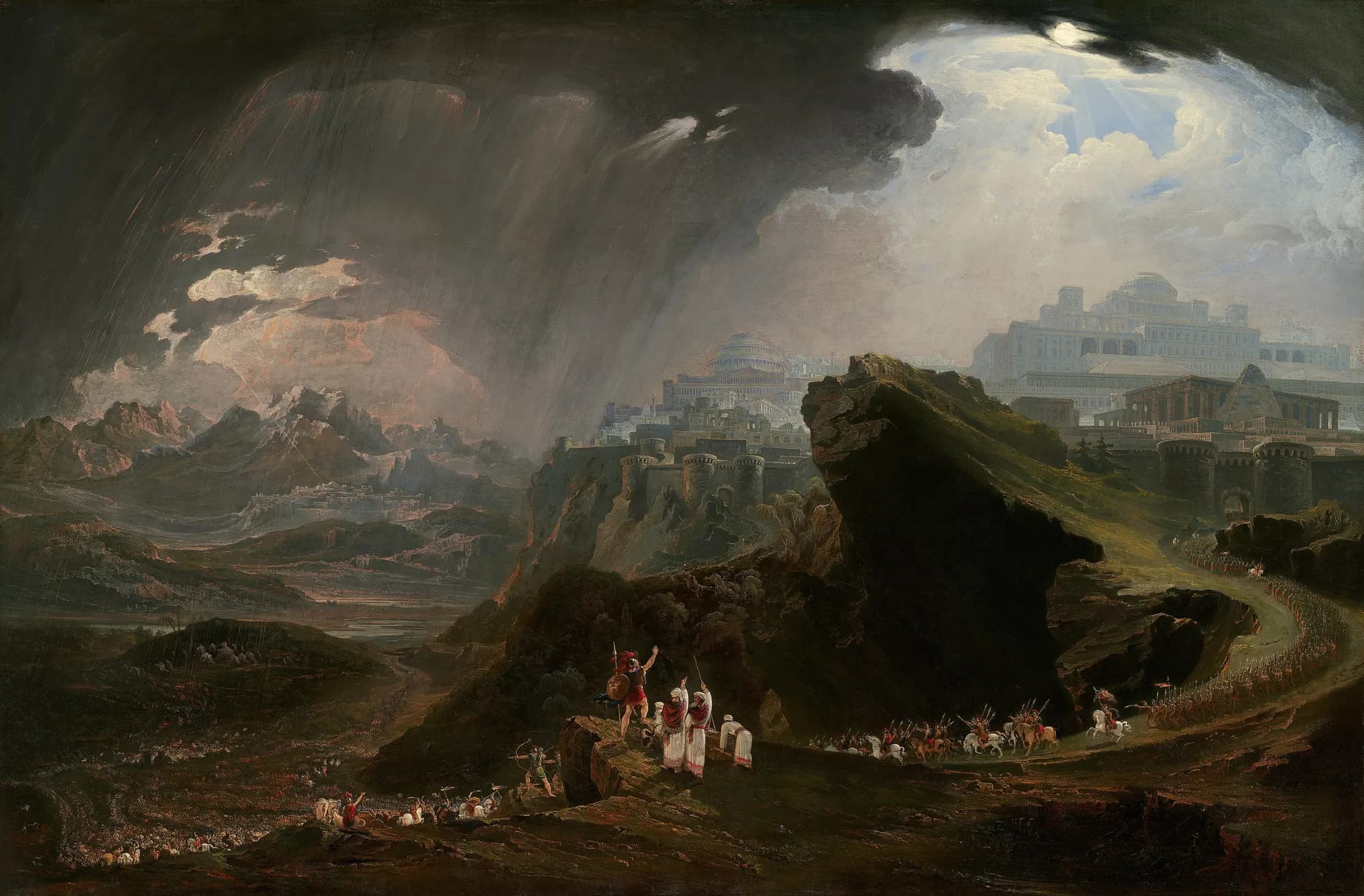
Joshua Commanding the Sun to Stand Still upon Gibeon, John Martin, 1816, National Gallery of Art. Public domain.
Old Testament · Book 6 of 66
Joshua
Joshua records how Israel crossed the Jordan under Joshua and took the land of Canaan. The land is divided among the twelve tribes, and the book closes as the people renew the covenant at Shechem.
Joshua records how Israel crossed the Jordan under Joshua and took the land of Canaan. The land is divided among the twelve tribes, and the book closes as the people renew the covenant at Shechem.
What is Joshua about?
Joshua opens with Moses dead and the LORD telling Joshua to cross the Jordan into the land he is giving Israel (1:1 to 2). Two spies are hidden by Rahab in Jericho, and the river stops while all Israel crosses on dry ground. Jericho falls at a shout, and the land is taken in three campaigns, through the centre, the south and the north. Then it is given out to the tribes by lot, and when the giving is done the book says, “Not one of all the LORD’s good promises to the house of Israel had failed; everything was fulfilled.” (21:45). At the end Joshua gathers the tribes at Shechem and calls them to choose whom they will serve.
All 24 chapters
Every chapter of the book, in one grid. Each cell opens that chapter.
- EnteringJoshua 1 to 5
- TakingJoshua 6 to 12
- DividingJoshua 13 to 21
- ServingJoshua 22 to 24
The colour is the state of the land the chapter stands in, from light to deep, and every cell opens that chapter's Study level.
Who wrote it, where, when, for whom, and why?
The book says that Joshua recorded these things in the Book of the Law of God at Shechem (24:26). It also records his death and burial (24:29 and 30), and it speaks of things that remain to this day, such as the Jebusites living in Jerusalem (15:63). The rest of Scripture tells who he was. Joshua first appears leading Israel against Amalek, and Moses is told to write that victory down and recite it to Joshua (Exodus 17:9 and 14). The LORD tells Moses to lay his hands on him (Numbers 27:18), Moses charges him before all Israel (Deuteronomy 31:7), and after Moses dies he is filled with the spirit of wisdom (Deuteronomy 34:9). Judges tells his death again (Judges 2:8).
Joshua recorded these things in the Book of the Law of God. Then he took a large stone and set it up there under the oak that was near the sanctuary of the LORD.
Joshua 24:26, Berean Standard Bible.
The book opens on the plains east of the Jordan, at Shittim (2:1 and 3:1). Across the river Israel camps at Gilgal on the eastern border of Jericho (4:19), and Gilgal is the camp the southern campaign returns to (10:43). The whole congregation later sets up the Tent of Meeting at Shiloh (18:1), and the book closes with the tribes gathered at Shechem (24:1).
On the tenth day of the first month the people went up from the Jordan and camped at Gilgal on the eastern border of Jericho.
Joshua 4:19, Berean Standard Bible.
The book keeps its own count of time. Israel had wandered forty years in the wilderness before the crossing (5:6), and it crosses on the tenth day of the first month (4:19). Caleb was forty when Moses sent him from Kadesh-barnea and is eighty-five when he receives Hebron (14:7 and 10). Joshua dies at 110 (24:29). The book names no year, and how its events are dated is set out under Where do readers disagree.
Some time later, Joshua son of Nun, the servant of the LORD, died at the age of 110.
Joshua 24:29, Berean Standard Bible.
Joshua is written for Israel in the land. It closes by saying that Israel served the LORD throughout the days of Joshua and of the elders who outlived him (24:31), and Judges opens on the generation after them, who did not know the LORD or the works he had done (Judges 2:10).
Israel had served the LORD throughout the days of Joshua and of the elders who outlived him and who had experienced all the works that the LORD had done for Israel.
Joshua 24:31, Berean Standard Bible.
The book gives its own reasons. The river was stopped so that all the peoples of the earth may know that the hand of the LORD is mighty, and so that Israel may always fear him (4:24). The giving of the land ends with the verdict that not one of the LORD's good promises had failed (21:45). Later Scripture reads the book the same way. Nehemiah's prayer says that God subdued the Canaanites before Israel (Nehemiah 9:24), and the psalmist says that Israel did not take the land by its own sword (Psalm 44:3). Stephen says the fathers brought the tabernacle in with Joshua (Acts 7:45). Hebrews says that Joshua did not give the last rest (Hebrews 4:8) and names the walls of Jericho and Rahab among the acts of faith (Hebrews 11:30 and 31), and James names Rahab too (James 2:25).
He did this so that all the peoples of the earth may know that the hand of the LORD is mighty, and so that you may always fear the LORD your God.”
Joshua 4:24, Berean Standard Bible.
Joshua stands in a Canaan of walled cities and their kings. The book names Gibeon, a great city like one of the royal cities (10:2), the five Amorite kings of the south (10:5), and Hazor, formerly the head of all the northern kingdoms (11:10). It counts thirty-one kings defeated west of the Jordan (12:24), and it notes the peoples left in the land, the Jebusites in Jerusalem (15:63) and the Canaanites in Gezer (16:10). Centuries later Hiel of Bethel rebuilt Jericho at the cost Joshua had sworn (1 Kings 16:34, and Joshua 6:26).
Sources. Joshua 1:1 and 2, 2:1, 3:1, 4:19, 4:24, 5:6, 6:26, 10:2, 10:5, 10:43, 11:10, 12:24, 14:7 and 10, 15:63, 16:10, 18:1, 21:45, 24:1, 24:26, 24:29 to 31; Exodus 17:9 and 14; Numbers 27:18; Deuteronomy 31:7 and 34:9; Judges 2:8 and 10; 1 Kings 16:34; Nehemiah 9:24; Psalm 44:3; Acts 7:45; Hebrews 4:8 and 11:30 and 31; James 2:25. Every verse is read in the Berean Standard Bible.
How is Joshua arranged, and what is it for?
The four states of the land the book moves through, then what it teaches and what it was written to do.
- EnteringJoshua 1 to 5, 98 verses
Joshua is charged, the spies are hidden by Rahab, and all Israel crosses the Jordan on dry ground to camp at Gilgal.
Turns at 3:17
- TakingJoshua 6 to 12, 205 verses
Jericho falls, Achan's sin brings defeat at Ai, and three campaigns break the kings of the centre, the south and the north.
Turns at 11:23
- DividingJoshua 13 to 21, 272 verses
The land is given out by lot at Gilgal and at Shiloh, with cities of refuge and cities for the Levites.
Turns at 21:45
- ServingJoshua 22 to 24, 83 verses
The eastern tribes go home, Joshua charges the people twice, and Israel binds itself by covenant at Shechem.
Turns at 24:15
The theme
The book is about a promise kept on the ground. The LORD swore the land to the fathers, and here he gives it: Israel lives in cities it did not build (24:13) and receives its portions by lot (14:2). The gift ends in rest from war (11:23 and 21:44), and the book says plainly that every promise was fulfilled, while it also records that much land remained to be possessed (13:1).
The purpose
Joshua was written so that Israel in the land would know that the LORD kept his word and would choose to serve him there. It sets up memorials for children to ask about (4:6 and 7), reads the law at Ebal (8:34 and 35), makes a covenant at Shechem (24:25), and ends with the charge to keep the Book of the Law (23:6). Judges takes up the story of the generation that forgot it.
The land in four states: crossed, taken, divided and held under covenant
The sites in the order the text meets them (15)
- 1Shittim Joshua 3:1probable
- 2Gilgal Joshua 4:19disputed
- 3Jericho Joshua 6:20identified
- 4Ai Joshua 8:28disputed
- 5Mount Ebal Joshua 8:30identified
- 6Gibeon Joshua 10:10identified
- 7Beth-horon Joshua 10:11probable
- 8Makkedah Joshua 10:28disputed
- 9Lachish Joshua 10:31 to 32identified
- 10Hebron Joshua 10:36 to 37identified
- 11Debir Joshua 10:38 to 39probable
- 12Waters of Merom Joshua 11:5disputed
- 13Hazor Joshua 11:10identified
- 14Shiloh Joshua 18:1identified
- 15Shechem Joshua 24:1identified
- The crossing, 3 to 4
- The central campaign, 6 to 8
- The southern campaign, 9 to 10
- The northern campaign, 11
- Shiloh and Shechem, the two assemblies (18:1, 24:1)
- A tribe, set in its region with no border drawn
- Identified: the site is known
- Probable: the usual identification, with some doubt
- Disputed: two or more candidate sites
Entering, Joshua 1 to 5
What the text says in these 5 chapters, and the pages they open on.
Moses is dead, and the LORD tells Joshua to cross the Jordan with all the people and promises to be with him as he was with Moses. Two spies go into Jericho and are hidden by Rahab, who confesses that the LORD is God in heaven and on earth. The priests carry the ark into the river at flood, the water stops, and all Israel crosses on dry ground. At Gilgal the people set up twelve stones from the riverbed, the men born in the wilderness are circumcised, and Israel keeps the Passover in the land. The next day the manna stops, and near Jericho Joshua meets the Commander of the LORD's army.
Have I not commanded you to be strong and courageous? Do not be afraid; do not be discouraged, for the LORD your God is with you wherever you go.”
- Study
Joshua 1the charge to Joshua and the order to prepareShow the summary and 4 pagesShow summary, 4 pagesHide the summary
After the death of Moses the LORD tells Joshua to cross the Jordan and promises to be with him as he was with Moses. Joshua orders the people to prepare, and the eastern tribes promise to fight beside their brothers.
- The land promised from the wilderness to the Euphrates (1:4).
- Be strong and courageous, and keep the Book of the Law (1:7 to 9).
- Three days to prepare for the crossing (1:11).
On this chapter (4)
- Joseph and Joshua
Joseph's charge about his bones, and the man who led Israel into the land.
- The land covenant
The land promised to Abraham and how Scripture follows it.
- Who wrote Joshua, and when?
Answered under Where do readers disagree, lower on this page, with each reading and who holds it.
- Joshua 1:9
The verse on its own page, with the commentators on it by era.
- Study
Joshua 2the spies, Rahab and the scarlet cordShow the summary and 4 pagesShow summary, 4 pagesHide the summary
Two spies sent from Shittim are hidden by Rahab in Jericho. She confesses that the LORD is God in heaven and on earth, and they swear to spare her household under the scarlet cord.
- Rahab hides the spies on her roof (2:6).
- Her confession of the LORD (2:11).
- The scarlet cord in the window as the sign (2:18).
On this chapter (4)
- Rahab and the scarlet cord
The spies, the cord in the window and the household spared.
- The fall of Jericho
The march, the walls and the ban, from Joshua 2 to 7.
- Was Rahab right to lie?
Answered under Where do readers disagree, lower on this page, with each reading and who holds it.
- Joshua 2:11
The verse on its own page, with the commentators on it by era.
- Study
Joshua 3the ark in the river and the crossing on dry groundShow the summary and 2 pagesShow summary, 2 pagesHide the summary
The priests carry the ark into the Jordan at flood and the flowing water stops and backs up as far as Adam. The priests stand on dry ground in the riverbed until the whole nation has crossed.
- The ark goes first, and the people follow at a distance (3:4).
- The water cut off at Adam (3:16).
- All Israel crosses on dry ground (3:17).
On this chapter (2)
- The ark of the covenant
The chest the priests carried into the river first.
- Joshua 3:17
The verse on its own page, with the commentators on it by era.
- Study
Joshua 4the twelve stones and the camp at GilgalShow the summary and 2 pagesShow summary, 2 pagesHide the summary
Twelve men carry twelve stones from the riverbed, and Joshua sets them up at Gilgal as a memorial. When the priests come up out of the Jordan the river returns to its banks.
- The stones answer the children's question (4:6 to 7).
- The people camp at Gilgal on the tenth day of the first month (4:19).
- So that all the peoples of the earth may know the hand of the LORD (4:24).
On this chapter (2)
- The stone
Stones set up as witnesses and memorials across Scripture.
- Joshua 4:24
The verse on its own page, with the commentators on it by era.
- Study
Joshua 5circumcision, Passover and the CommanderShow the summary and 4 pagesShow summary, 4 pagesHide the summary
The men born in the wilderness are circumcised at Gilgal and Israel keeps the Passover in the land. The manna stops, and the Commander of the LORD's army meets Joshua near Jericho.
- The reproach of Egypt rolled away (5:9).
- The Passover on the fourteenth day (5:10) and the manna ceasing (5:12).
- Take off your sandals, for the place is holy (5:15).
On this chapter (4)
- Christophany
The appearances of God in human form, the Commander at Jericho among them.
- Manna
The bread from heaven, and the day it stopped.
- Who is the commander of the LORD's army at Jericho?
Answered under Where do readers disagree, lower on this page, with each reading and who holds it.
- Joshua 5:14
The verse on its own page, with the commentators on it by era.
From the order to prepare to the first Passover in the land, in nine dated steps
- 1. The orderPrepare provisions, for within three days you will crossJoshua 1:11
- 2. From ShittimTwo spies are sent to Jericho and hidden by RahabJoshua 2:1
- 3. At the riverIsrael leaves Shittim and camps at the JordanJoshua 3:1
- 4. After three daysThe officers go through the campJoshua 3:2
- 5. The crossingThe priests stand on dry ground while all Israel crossesJoshua 3:17
- 6. Tenth day, first monthThe people camp at Gilgal and set up the twelve stonesJoshua 4:19 to 20
- 7. At GilgalThe men born in the wilderness are circumcisedJoshua 5:2
- 8. Fourteenth day, eveningIsrael keeps the Passover on the plains of JerichoJoshua 5:10
- 9. The next dayThey eat the produce of the land, and the manna ceasesJoshua 5:11 to 12
Characters (5)
Who the text follows. A name with a page carries its door.
- Joshua
Son of Nun, Moses' assistant, charged to lead Israel into the land.
- Rahab
The woman of Jericho who hid the spies and confessed the LORD.
- The two spies
Sent secretly from Shittim, hidden on Rahab's roof (2:1, 2:6).
- The priests with the ark
They stand in the riverbed until the whole nation has crossed (3:17).
Show the next 1
- The Commander of the LORD's army
The man with the drawn sword who tells Joshua the ground is holy (5:14 to 15).
Places (4)
Where the chapters stand.
- Shittim
The last camp east of the Jordan, where the spies set out (2:1).
- The Jordan
The river at flood in harvest, stopped as far upstream as Adam (3:15 to 16).
- Jericho
The walled city at the foot of the ascent from the Jordan.
- Gilgal
The first camp west of the Jordan, and the base of the campaigns.
Themes (4)
What these chapters raise, each on its own page.
- Rahab and the scarlet cord
The confession, the cord and the household spared.
- The ark of the covenant
The ark that goes into the river first.
- Christophany
The Commander at Jericho, and who he has been taken to be.
- Manna
The bread that ceased the day after Israel ate the crops of the land.
Where the New Testament uses these chapters (4)each marked as a quotation or an allusion, with the evidence
- Explicit quotationI will never leave you nor forsake you, Joshua 1:5 at Hebrews 13:5. Hebrews gives the words as what God has said. The same promise stands at Deuteronomy 31:6 and 8, so the writer may be quoting either place.
- Named referenceRahab and the spies, Joshua 2:1 to 21 at Hebrews 11:31. By faith Rahab did not perish with the disobedient, because she welcomed the spies in peace.
- Named referenceRahab and the spies sent another way, Joshua 2:1 to 21 at James 2:25. James names Rahab as justified by her actions when she welcomed the spies and sent them off on another route.
- Named referenceThe tabernacle brought in with Joshua, Joshua 3 to 12 at Acts 7:45. Stephen says the fathers brought the tabernacle in with Joshua when they took the land from the nations God drove out.
Taking, Joshua 6 to 12
What the text says in these 7 chapters, and the pages they open on.
Israel marches around Jericho for seven days, and at the shout the wall collapses; Rahab and her household are brought out alive. Achan takes some of the devoted things and Israel is routed at Ai, until he is found by lot and judged, and then Ai falls to an ambush. Joshua builds an altar on Mount Ebal and reads the whole law to the people. The men of Gibeon deceive Israel into a treaty made without asking the LORD, and when five kings attack Gibeon, Joshua defends it, hailstones fall and the sun stands still. A northern alliance under Jabin of Hazor is broken at the waters of Merom, and the section closes with the list of thirty-one kings defeated west of the Jordan.
So Joshua took the entire land, in keeping with all that the LORD had spoken to Moses. And Joshua gave it as an inheritance to Israel according to the allotments to their tribes. Then the land had rest from war.
- Study
Joshua 6the march, the shout and the fallen wallShow the summary and 5 pagesShow summary, 5 pagesHide the summary
Israel marches around Jericho once a day for six days and seven times on the seventh, and at the shout the wall collapses. The city is devoted to the LORD, and Rahab and her household are brought out alive.
- The ark and the seven rams' horns (6:4).
- The wall collapses at the shout (6:20).
- Rahab spared and living among Israel (6:25).
On this chapter (5)
- The fall of Jericho
The march, the walls and the ban, from Joshua 2 to 7.
- Rahab and the scarlet cord
The spies, the cord in the window and the household spared.
- The Canaanite conquest
The commands, the reasons Scripture gives, and the readings of them.
- When did Jericho fall, and does the archaeology fit?
Answered under Where do readers disagree, lower on this page, with each reading and who holds it.
- Joshua 6:20
The verse on its own page, with the commentators on it by era.
- Study
Joshua 7Achan's sin and the defeat at AiShow the summary and 3 pagesShow summary, 3 pagesHide the summary
Achan takes some of the devoted things, and Israel is routed at Ai. The lot finds him out, he confesses, and he and his household are stoned in the Valley of Achor.
- Israel acted unfaithfully in the devoted things (7:1).
- About thirty-six men die at Ai (7:5).
- The cloak, the silver and the gold hidden in the tent (7:21).
On this chapter (3)
- The fall of Jericho
The march, the walls and the ban, from Joshua 2 to 7.
- The Canaanite conquest
The commands, the reasons Scripture gives, and the readings of them.
- Joshua 7:1
The verse on its own page, with the commentators on it by era.
- Study
Joshua 8Ai taken, and the altar on Mount EbalShow the summary and 3 pagesShow summary, 3 pagesHide the summary
Joshua takes Ai by an ambush the LORD sets out and burns it. He then builds an altar on Mount Ebal and reads the whole law to the assembly between Ebal and Gerizim.
- The ambush behind the city (8:2).
- Ai made a heap of ruins (8:28).
- The law written on the stones and read to all (8:32 to 35).
On this chapter (3)
- The altar
The altars of Scripture, the altar of uncut stones on Ebal among them.
- When did Jericho fall, and does the archaeology fit?
Answered under Where do readers disagree, lower on this page, with each reading and who holds it.
- Joshua 8:30
The verse on its own page, with the commentators on it by era.
- Study
Joshua 9the Gibeonites and the treatyShow the summary and 2 pagesShow summary, 2 pagesHide the summary
The people of Gibeon come in worn clothes with dry bread and pretend to be from a far country. Israel makes a treaty without asking the LORD, and when the fraud is found the oath is kept.
- They did not seek the counsel of the LORD (9:14).
- The treaty and the oath (9:15).
- The Gibeonites made woodcutters and water carriers (9:27).
On this chapter (2)
- The Canaanite conquest
The commands, the reasons Scripture gives, and the readings of them.
- Joshua 9:14
The verse on its own page, with the commentators on it by era.
- Study
Joshua 10five kings, the hailstones and the long dayShow the summary and 3 pagesShow summary, 3 pagesHide the summary
Five Amorite kings attack Gibeon, and Joshua marches all night to defend it. The LORD throws the kings into confusion, hailstones kill more than the sword, and the sun stands still until the battle is won.
- O sun, stand still over Gibeon (10:12).
- The five kings taken at the cave of Makkedah (10:16 to 27).
- The southern cities taken one by one (10:28 to 39).
On this chapter (3)
- The Canaanite conquest
The commands, the reasons Scripture gives, and the readings of them.
- What happened on the long day of Joshua 10?
Answered under Where do readers disagree, lower on this page, with each reading and who holds it.
- Joshua 10:12
The verse on its own page, with the commentators on it by era.
- Study
Joshua 11the northern kings and Hazor burnedShow the summary and 5 pagesShow summary, 5 pagesHide the summary
Jabin king of Hazor gathers the northern kings at the waters of Merom, and Joshua defeats them there. Hazor alone is burned, and the chapter closes with the whole land taken and at rest from war.
- The kings at the waters of Merom (11:5).
- Hazor, the head of all these kingdoms (11:10).
- The land had rest from war (11:23).
On this chapter (5)
- The Canaanite conquest
The commands, the reasons Scripture gives, and the readings of them.
- The land covenant
The land promised to Abraham and how Scripture follows it.
- Was the land taken, or was much of it left?
Answered under Where do readers disagree, lower on this page, with each reading and who holds it.
- How should the conquest commands be read?
Answered under Where do readers disagree, lower on this page, with each reading and who holds it.
- Joshua 11:23
The verse on its own page, with the commentators on it by era.
- Study
Joshua 12Thirty-one kingsShow the summary and 2 pagesShow summary, 2 pagesHide the summary
A ledger of victory. First the eastern conquests under Moses: Sihon king of the Amorites at Heshbon and Og king of Bashan at Ashtaroth and Edrei, the remnant of the Rephaim, whose land went to Reuben, Gad, and half Manasseh. Then the kings west of Jordan whom Joshua smote, listed one after another from Jericho and Ai through Jerusalem, Hebron, Lachish, Megiddo, Hazor, Dor, and Tirzah: thirty-one kings in all. The bare roll call is itself an argument, each name a place where a promise made to Abraham about this land became a fact on the ground.
On this chapter (2)
- The Canaanite conquest
The commands, the reasons Scripture gives, and the readings of them.
- Joshua 12:24
The verse on its own page, with the commentators on it by era.
- The Canaanite conquest
Three campaigns in eleven stations, and the thirty-one kings the book counts
The central campaign, Joshua 6 to 8
- 3 JerichoThe wall collapses at the shoutJoshua 6:20
- 4 AiDefeat for Achan's sin, then the ambushJoshua 7:5, 8:28
- 5 Mount EbalThe altar and the law read to allJoshua 8:30 to 35
The southern campaign, Joshua 9 to 10
- 6 GibeonThe treaty, then five kings attackJoshua 9:15, 10:10
- 7 Beth-horonHailstones on the descentJoshua 10:11
- 8 MakkedahThe five kings in the caveJoshua 10:16, 10:28
- 9 LachishTaken on the second dayJoshua 10:32
- 10 HebronTaken with its kingJoshua 10:37
- 11 DebirThe last city of the campaignJoshua 10:39
The northern campaign, Joshua 11
- 12 Waters of MeromThe northern kings gathered and routedJoshua 11:5 to 8
- 13 HazorThe head of the kingdoms, alone burnedJoshua 11:10 to 13
The kings west of the Jordan, Joshua 12:9 to 24 (31)
| 1. Jericho | 2. Ai | 3. Jerusalem |
| 4. Hebron | 5. Jarmuth | 6. Lachish |
| 7. Eglon | 8. Gezer | 9. Debir |
| 10. Geder | 11. Hormah | 12. Arad |
| 13. Libnah | 14. Adullam | 15. Makkedah |
| 16. Bethel | 17. Tappuah | 18. Hepher |
| 19. Aphek | 20. Lasharon | 21. Madon |
| 22. Hazor | 23. Shimron-meron | 24. Achshaph |
| 25. Taanach | 26. Megiddo | 27. Kedesh |
| 28. Jokneam | 29. Dor | 30. Goiim |
| 31. Tirzah |
Characters (3)
Who the text follows. A name with a page carries its door.
- Achan
The man of Judah who took from the devoted things and hid them in his tent (7:1, 7:21).
- Adoni-zedek
King of Jerusalem, who calls the five kings against Gibeon (10:1 to 5).
- Jabin
King of Hazor, who gathers the northern kings (11:1).
Places (4)
Where the chapters stand.
- Ai
The city near Bethel where Israel was routed and then won (7:2, 8:28).
- Mount Ebal
Where Joshua built the altar and read the law (8:30).
- Gibeon
The city that made a treaty with Israel by deceit (9:3).
- Hazor
The head of the northern kingdoms, the one city burned (11:10 to 13).
Themes (3)
What these chapters raise, each on its own page.
- The fall of Jericho
The march, the walls and the ban.
- The Canaanite conquest
The commands, the reasons given and the readings of them.
- The altar
The altar of uncut stones on Ebal.
Where the New Testament uses these chapters (2)each marked as a quotation or an allusion, with the evidence
- Named referenceRahab in the line of David, Joshua 6:25 at Matthew 1:5. Matthew's genealogy names Salmon as the father of Boaz by Rahab.
- Named referenceThe walls of Jericho, Joshua 6:20 at Hebrews 11:30. By faith the walls of Jericho fell after the people had marched around them for seven days.
Dividing, Joshua 13 to 21
What the text says in these 9 chapters, and the pages they open on.
Joshua is old, and the LORD tells him that much land remains to be taken, and orders him to divide it anyway. The land east of the Jordan stands as Moses gave it, and at Gilgal the lots fall for Judah and for Joseph's two tribes; Caleb, eighty-five, asks for the hill country of the Anakim and receives Hebron. The congregation sets up the Tent of Meeting at Shiloh, surveys what remains, and casts lots there for the other seven tribes. Six cities of refuge are set apart, and the Levites receive forty-eight cities in place of land. The section closes with rest on every side and the verdict that not one of the LORD's good promises had failed.
Not one of all the LORD’s good promises to the house of Israel had failed; everything was fulfilled.
- Study
Joshua 13land still to take, and the portions east of the JordanShow the summary and 3 pagesShow summary, 3 pagesHide the summary
The LORD tells the old Joshua that much land remains to be taken, and names it. The chapter then sets out what Moses gave Reuben, Gad and half of Manasseh east of the Jordan.
- Very much of the land remains (13:1).
- The inheritance east of the Jordan (13:8).
- Levi given no land, for the LORD is their inheritance (13:33).
On this chapter (3)
- The land covenant
The land promised to Abraham and how Scripture follows it.
- Was the land taken, or was much of it left?
Answered under Where do readers disagree, lower on this page, with each reading and who holds it.
- Joshua 13:1
The verse on its own page, with the commentators on it by era.
- Study
Joshua 14the lot at Gilgal and Caleb's HebronShow the summary and 3 pagesShow summary, 3 pagesHide the summary
The allotment begins at Gilgal, by lot, as the LORD commanded through Moses. Caleb, eighty-five years old, asks for the hill country where the Anakim were, and Joshua gives him Hebron.
- Forty years old at Kadesh-barnea (14:7).
- Eighty-five and as strong as then (14:10 to 11).
- Hebron given to Caleb (14:13).
On this chapter (3)
- Caleb and the twelve spies
The report from Kadesh and the promise kept forty-five years later.
- The land covenant
The land promised to Abraham and how Scripture follows it.
- Joshua 14:13
The verse on its own page, with the commentators on it by era.
- Study
Joshua 15Judah's lotShow the summary and 4 pagesShow summary, 4 pagesHide the summary
Judah's lot is surveyed in full, south from the wilderness of Zin and the Salt Sea, up past the ascent of Akrabbim, along the Jordan to the north. Inside the border list sits a family story: Caleb drives out the three sons of Anak from Hebron, offers his daughter to whoever takes Kiriath-sepher, and Othniel (the coming first judge), wins Achsah. She lights from her ass to ask her father a blessing: 'give me also springs of water,' and receives the upper and the nether springs. The city lists run on by district, ending on a sober note: Judah could not drive out the Jebusites from Jerusalem.
On this chapter (4)
- Caleb and the twelve spies
The report from Kadesh and the promise kept forty-five years later.
- The land covenant
The land promised to Abraham and how Scripture follows it.
- Was the land taken, or was much of it left?
Answered under Where do readers disagree, lower on this page, with each reading and who holds it.
- Joshua 15:63
The verse on its own page, with the commentators on it by era.
- Caleb and the twelve spies
- Study
Joshua 16EphraimShow the summary and 2 pagesShow summary, 2 pagesHide the summary
The lot of the children of Joseph runs from the Jordan at Jericho up through the hill country to Bethel, Ataroth, and the sea, and within it Ephraim's border is traced east and west, with separate cities set apart for Ephraim inside the inheritance of Manasseh. The chapter ends with one of the refrains that will govern the book of Judges: they did not drive out the Canaanites that dwelt in Gezer, but the Canaanites dwell among the Ephraimites to this day, put to taskwork rather than removed. Compromise is recorded without comment, and it will cost the next generation dearly.
On this chapter (2)
- The land covenant
The land promised to Abraham and how Scripture follows it.
- Joshua 16:10
The verse on its own page, with the commentators on it by era.
- The land covenant
- Study
Joshua 17Joseph's portionShow the summary and 2 pagesShow summary, 2 pagesHide the summary
Manasseh's portion covers Gilead and Bashan for Machir's line and ten shares west of Jordan, including, notably, the daughters of Zelophehad, who come before Eleazar and Joshua and receive an inheritance among their father's brethren, exactly as Numbers 27 promised. Again the failure is recorded: Manasseh could not drive out the inhabitants of Beth-shean and the valley towns, for they had chariots of iron. When the house of Joseph complains that one lot is too small for so great a people, Joshua sends them up to clear the forest and take the valleys too, you can drive out the Canaanites, though they have iron chariots.
On this chapter (2)
- The land covenant
The land promised to Abraham and how Scripture follows it.
- Joshua 17:4
The verse on its own page, with the commentators on it by era.
- The land covenant
- Study
Joshua 18the Tent at Shiloh and the surveyShow the summary and 2 pagesShow summary, 2 pagesHide the summary
The congregation sets up the Tent of Meeting at Shiloh. Joshua sends men to survey the rest of the land in writing and casts lots for the seven remaining tribes.
- How long will you put off possessing the land? (18:3).
- The land mapped city by city into seven portions (18:9).
- The lots cast before the LORD at Shiloh (18:10).
On this chapter (2)
- The land covenant
The land promised to Abraham and how Scripture follows it.
- Joshua 18:10
The verse on its own page, with the commentators on it by era.
- Study
Joshua 19The last lotsShow the summary and 2 pagesShow summary, 2 pagesHide the summary
The remaining lots fall. Simeon's inheritance lies inside Judah's portion, which was too large for Judah alone: Jacob's word about scattering Simeon in Israel quietly coming true. Zebulun, Issachar, Asher, and Naphtali receive the north; Dan receives a small coastal portion, loses ground to its neighbors, and goes up to take Leshem, renaming it Dan. Last of all, when the whole land has been divided, Israel gives Joshua his own inheritance: Timnath-serah in the hill country of Ephraim, the city he asked for. The leader is served last, and the allotment ends at the door of the tent of meeting in Shiloh.
On this chapter (2)
- The land covenant
The land promised to Abraham and how Scripture follows it.
- Joshua 19:50
The verse on its own page, with the commentators on it by era.
- The land covenant
- Study
Joshua 20the six cities of refugeShow the summary and 2 pagesShow summary, 2 pagesHide the summary
The LORD tells Joshua to appoint the cities of refuge that he had spoken of through Moses. Six cities are set apart, three west of the Jordan and three east of it.
- Refuge for one who kills unintentionally (20:3).
- Kedesh, Shechem and Hebron (20:7).
- Bezer, Ramoth and Golan (20:8).
On this chapter (2)
- Cities of refuge
The six cities, who could flee to them, and the law behind them.
- Joshua 20:3
The verse on its own page, with the commentators on it by era.
- Study
Joshua 21the Levites' cities and every promise keptShow the summary and 4 pagesShow summary, 4 pagesHide the summary
The Levites ask for the cities Moses promised them, and forty-eight cities with their pasturelands are given out by lot. The chapter closes on the LORD's promises kept, every one.
- Forty-eight cities in all (21:41).
- Rest on every side (21:44).
- Not one good promise failed (21:45).
On this chapter (4)
- The land covenant
The land promised to Abraham and how Scripture follows it.
- Cities of refuge
The six cities, who could flee to them, and the law behind them.
- Sabbath rest
The rest God gives, from creation to the rest that remains.
- Joshua 21:45
The verse on its own page, with the commentators on it by era.
The land given out: 14 rows in the book's order, with the 6 cities of refuge
| Tribe | Joshua | Given at | City of refuge | Note |
|---|---|---|---|---|
| Reuben | 13:15 to 23 | Given at: Moses, east of the Jordan | Refuge: Bezer | Given by Moses before the crossing (13:8). |
| Gad | 13:24 to 28 | Given at: Moses, east of the Jordan | Refuge: Ramoth in Gilead | Given by Moses before the crossing (13:8). |
| Manasseh, east | 13:29 to 31 | Given at: Moses, east of the Jordan | Refuge: Golan | Half the tribe, in Bashan and Gilead. |
| Judah | 14:6 to 15:63 | Given at: Gilgal | Refuge: Hebron | Caleb given Hebron (14:13); the Jebusites still in Jerusalem (15:63). |
| Ephraim | 16:1 to 10 | Given at: Gilgal | Refuge: Shechem | One of Joseph's two tribes; the Canaanites left in Gezer (16:10). |
| Manasseh, west | 17:1 to 18 | Given at: Gilgal | Refuge: none | Joseph's other tribe asks for more than one portion (17:14). |
| Benjamin | 18:11 to 28 | Given at: Shiloh | Refuge: none | The first lot at Shiloh, between Judah and Joseph. |
| Tribe | Joshua | Given at | City of refuge | Note |
|---|---|---|---|---|
| Simeon | 19:1 to 9 | Given at: Shiloh | Refuge: none | The second lot, given within Judah's portion (19:9). |
| Zebulun | 19:10 to 16 | Given at: Shiloh | Refuge: none | The third lot. |
| Issachar | 19:17 to 23 | Given at: Shiloh | Refuge: none | The fourth lot. |
| Asher | 19:24 to 31 | Given at: Shiloh | Refuge: none | The fifth lot. |
| Naphtali | 19:32 to 39 | Given at: Shiloh | Refuge: Kedesh in Galilee | The sixth lot. |
| Dan | 19:40 to 48 | Given at: Shiloh | Refuge: none | Loses its territory and takes Leshem in the north (19:47). |
| Levi | 13:14, 13:33; 21 | Given at: No land | Refuge: none | The LORD is their inheritance; forty-eight cities with pasturelands (21:41). |
Characters (4)
Who the text follows. A name with a page carries its door.
- Caleb
The spy who brought back an honest report, and at eighty-five asked for Hebron.
- Eleazar the priest
Aaron's son, who with Joshua gives out the land by lot (14:1, 19:51).
- Othniel
Caleb's nephew, who takes Debir and marries Acsah (15:17).
- The daughters of Zelophehad
They claim the portion Moses promised them, and receive it (17:3 to 4).
Places (3)
Where the chapters stand.
Themes (4)
What these chapters raise, each on its own page.
- The land covenant
The land sworn to the fathers and given by lot.
- Caleb and the twelve spies
The honest report and the promise kept.
- Cities of refuge
The six cities and the law of the manslayer.
- Sabbath rest
The rest the land was given, and the rest still ahead.
Where the New Testament uses these chapters (2)each marked as a quotation or an allusion, with the evidence
- Named referenceSeven nations overthrown and the land given, Joshua 12 to 19 at Acts 13:19. Paul at Pisidian Antioch says God overthrew seven nations in Canaan and gave their land to Israel as an inheritance.
- Named referenceThe rest Joshua gave, Joshua 21:44 and 23:1 at Hebrews 4:8. Hebrews says that if Joshua had given them rest, God would not have spoken later about another day.
Serving, Joshua 22 to 24
What the text says in these 3 chapters, and the pages they open on.
Joshua sends the tribes from east of the Jordan home with his blessing, and they build a great altar by the river. The other tribes gather for war until Phinehas hears that the altar is a witness and not a place of sacrifice, and it is named Witness. Joshua, old, charges the leaders to keep the law and warns that the nations left will become a snare. At Shechem he tells the whole history from Terah to the land, and asks the people to choose whom they will serve. They choose the LORD, he makes a covenant, writes it in the Book of the Law of God and sets up a stone under the oak. Joshua dies, and the bones of Joseph are buried at Shechem.
But if it is unpleasing in your sight to serve the LORD, then choose for yourselves this day whom you will serve, whether the gods your fathers served beyond the Euphrates, or the gods of the Amorites in whose land you are living. As for me and my house, we will serve the LORD!”
- Study
Joshua 22the eastern tribes and the altar named WitnessShow the summary and 2 pagesShow summary, 2 pagesHide the summary
The eastern tribes go home with Joshua's blessing and build a great altar by the Jordan. The other tribes gather for war, and Phinehas hears that the altar is a witness and not a place of sacrifice.
- Joshua sends the eastern tribes home (22:6).
- The embassy of Phinehas and the ten leaders (22:13 to 14).
- The altar named Witness (22:34).
On this chapter (2)
- The altar
The altars of Scripture, the altar named Witness among them.
- Joshua 22:34
The verse on its own page, with the commentators on it by era.
- Study
Joshua 23Joshua's charge to the leadersShow the summary and 3 pagesShow summary, 3 pagesHide the summary
Joshua, old, calls the leaders of Israel and reminds them that the LORD fought for them. He charges them to keep the law and to love the LORD, and warns that the nations left will be a snare.
- The LORD fought for you (23:3).
- Not one good promise has failed (23:14).
- A snare and a trap if you turn away (23:13).
On this chapter (3)
- The land covenant
The land promised to Abraham and how Scripture follows it.
- Was the land taken, or was much of it left?
Answered under Where do readers disagree, lower on this page, with each reading and who holds it.
- Joshua 23:14
The verse on its own page, with the commentators on it by era.
- Study
Joshua 24the covenant at Shechem and three burialsShow the summary and 4 pagesShow summary, 4 pagesHide the summary
At Shechem Joshua tells the history from Terah to the land and asks the people to choose whom they will serve. They choose the LORD, he makes a covenant and writes it down, and Joshua, Joseph's bones and Eleazar are buried.
- Choose for yourselves this day (24:15).
- The words written and the stone set up under the oak (24:26).
- Joseph's bones buried at Shechem (24:32).
On this chapter (4)
- The Mosaic covenant
The covenant of Sinai, renewed by Joshua at Shechem.
- The stone
The great stone set up under the oak as a witness.
- Joseph and Joshua
Joseph's bones buried at Shechem, closing Genesis 50:25.
- Joshua 24:15
The verse on its own page, with the commentators on it by era.
Characters (2)
Who the text follows. A name with a page carries its door.
- Phinehas
Eleazar's son, sent to the eastern tribes about their altar (22:13).
- Joseph
Whose bones, carried out of Egypt, are buried at Shechem (24:32).
Places (3)
Where the chapters stand.
- Shechem
Between Ebal and Gerizim, where Israel made covenant.
- Geliloth by the Jordan
Where the eastern tribes built their altar (22:10).
- Timnath-serah
The city the people gave Joshua (19:50), where he is buried (24:30).
Themes (3)
What these chapters raise, each on its own page.
- The Mosaic covenant
The covenant of Sinai, renewed at Shechem.
- The stone
The stone set up under the oak as a witness.
- Joseph and Joshua
The bones of Joseph brought home.
- Author
- Joshua himself at least in part (24:26: ‘Joshua wrote these words in the book of the law of God’); later editorial framing traditional
- Date
- Events c. 1400 BC (early) or 1230 BC (late); compilation across the early-monarchy period
- Audience
- Israel settling the Land; later readers weighing covenant faithfulness against covenant blessing
Where do readers disagree?
One list: the readings with their holders, and what the evidence does not settle.
Who wrote Joshua, and when?
- Joshua wrote the book, with a short later supplement. Held by John Wesley, Explanatory Notes upon the Old Testament (1765), who writes on chapter 4 that Joshua probably wrote the book and on chapter 15 that a clause such as 'to this day' may have been added after his death by some other man of God; and the Babylonian Talmud at Bava Batra 14b and 15a, which assigns the book to Joshua and the closing verses about his death to Eleazar and Phinehas.
- Joshua is the second volume of the Deuteronomistic History. Held by Martin Noth (Uberlieferungsgeschichtliche Studien, 1943), who proposed Deuteronomy through Kings as one exilic work shaped by a single editorial hand, and the critical tradition following him.
What the evidence does not settle: How much of the book the notice at 24:26 covers, since the same book records Joshua's own death and speaks of things that remain to this day.
The argument in full
Joshua carries no superscription naming its writer. The book reports that Joshua himself wrote at least part of it, 'Joshua recorded these things in the Book of the Law of God' (24:26), and the rabbinic tradition assigns him the whole. The text also carries marks of later hands: it records Joshua's own death and burial (24:29-31), and it repeats the phrase 'to this day' in a way that looks back from a later vantage. Both facts sit in the same book, and the positions below weigh them differently.
Joshua wrote the book, with a short later supplement. Supported by details a later writer would have had no reason to invent, including the note that the Jebusites still hold Jerusalem (15:63), which David captured, and the description of Rahab living 'among the Israelites to this day' (6:25), written while she was still known.
Joshua is the second volume of the Deuteronomistic History. Reads Joshua's covenant language, its charge to keep the book of the law, and its summarizing formulas as the work of an editor writing after the fall of Jerusalem, using older material.
When did the conquest happen?
- The fifteenth century: conquest beginning c. 1406 BC. Held by 1 Kings 6:1's own four hundred and eightieth year from the exodus to Solomon's temple, Judges 11:26's three hundred years of Israelite occupation, and scholars including Bryant Wood and John Bimson (Redating the Exodus and Conquest, 1978).
- The thirteenth century: conquest beginning c. 1230-1200 BC. Held by Kenneth Kitchen (On the Reliability of the Old Testament, 2003) and the majority of current archaeologists, reading the store cities of Exodus 1:11, the destruction layers at Hazor and Lachish, and the Merneptah Stele's mention of Israel in Canaan by 1208 BC.
What the evidence does not settle: Whether the 480 years of 1 Kings 6:1 are counted as arithmetic or as schematic generations, which is the same question as the date of the exodus.
The argument in full
The conquest is dated by the exodus, and the exodus date is itself the argued question. The two readings differ by roughly two centuries, and every archaeological argument about Jericho, Ai, and Hazor depends on which one a reader starts from.
How should the conquest commands be read?
The Canaanite Conquest, argued in full→- Judgment on a ripened wickedness, delayed four centuries. Held by Matthew Henry, Commentary on the Whole Bible (1710), who writes on 6:21 that Israel was appointed to the work by the righteous Judge of heaven and earth, and Adam Clarke, Commentary on the Bible (1832), who writes on the same verse that an act ordered by the Judge of all the earth must be right; both rest on the reasons the text gives (Genesis 15:16; Leviticus 18:24 to 28; Deuteronomy 9:5).
- Campaigns against fortified military centers, told in the summarizing rhetoric of ancient conquest reports. Held by K. Lawson Younger Jr. (Ancient Conquest Accounts, 1990), who set Joshua beside Egyptian, Hittite, and Assyrian campaign texts, and Kenneth Kitchen (On the Reliability of the Old Testament, 2003).
What the evidence does not settle: How far a summary such as 10:40 counts the dead and how far it uses the idiom of victory, since the same book records peoples who remained (13:1 to 6, 15:63).
The argument in full
Joshua reports campaigns fought under the ban, with summaries as blunt as 'leaving no survivors. He devoted to destruction everything that breathed' (10:40). Scripture gives the ground for it plainly and it is moral rather than ethnic. God delayed the judgment four hundred years because 'the iniquity of the Amorites is not yet complete' (Genesis 15:16), and Moses told Israel the reason was 'their wickedness' and specifically 'not because of your righteousness' (Deuteronomy 9:5). Leviticus 18:24-28 lists what that wickedness was and warns Israel the same land would vomit them out for the same practices, which is what later happened. The exemptions prove the point: Rahab confesses the God of Israel and lives, the Gibeonites ask for terms and get them, and the sojourner is protected by the same law that protects the born Israelite. The evidence also carries a second thread. The spies had reported Anak's descendants in the land (Numbers 13:33), Og of Bashan is named as a survivor of the Rephaim (Deuteronomy 3:11), and Joshua's own campaign summary tracks the giant clans by city (11:21-22).
Campaigns against fortified military centers, told in the summarizing rhetoric of ancient conquest reports. On this reading the totalizing language reports decisive victory in the standard idiom of the period, which is why the same book can say the land was taken (11:23) and that much of it remains (13:1).
Was the land taken, or was much of it left?
- The coalitions broken, and the districts still to be held. Held by Albert Barnes, who writes on 11:23 that Joshua had overcome all overt resistance while many districts were not yet subdued (13:1 to 6), and by K. Lawson Younger Jr. in Ancient Conquest Accounts, who reads the summary in the idiom of ancient conquest reports.
- The whole land taken by the greater Joshua. Held by Origen in Homilies on Joshua (15.7), who writes that Joshua son of Nun did not take possession of all the earth, and that the Lord Jesus truly did.
What the evidence does not settle: Which districts of 13:2 to 6 Israel ever held, since the lists record what was allotted and, only in places, what was not taken (15:63, 16:10, 17:12).
The argument in full
The campaign summaries are absolute: Joshua 'took the entire land' and 'the land had rest from war' (11:23). Four chapters later the LORD tells him 'very much of the land remains to be possessed' (13:1), and the allotment lists record failures, including that 'to this day the Jebusites live there among the descendants of Judah' (15:63). Judges then opens with the same peoples still in place. Read together, the two kinds of statement describe two different things: the decisive defeat of organized Canaanite coalitions, which Joshua's generation accomplished, and the tribe-by-tribe occupation of the territory, which it did not finish. Joshua's own farewell assumes the unfinished work and warns what the remaining nations will become, 'a snare and a trap, a scourge in your sides and thorns in your eyes' (23:13).
What happened on the long day of Joshua 10?
- A miracle of prolonged daylight. Held by Augustine in City of God (21.8), who writes that the sun itself stood still until a battle already begun ended in victory, and Matthew Henry, who reads the words as fulfilled in the letter.
- Victory poetry quoted from the book of Jashar, in the idiom of a war song. Held by Albert Barnes, who reads 10:12 and the first half of 10:13 as poetry quoted from the Book of Jashar and the rest of the passage as prose, so that its language works the way a psalm's language works.
- A request about celestial signs rather than about daylight. Held by John H. Walton and J. Harvey Walton (The Lost World of the Israelite Conquest, 2017), reading the words against Mesopotamian omen texts in which the sun and moon at particular positions carry a message about the battle's outcome.
What the evidence does not settle: What was seen in the sky, since the text reports that the sun stopped and that no day was like it (10:13 to 14) and does not say how.
The argument in full
In the middle of the southern campaign Joshua speaks a line of poetry quoted from an older collection: 'O sun, stand still over Gibeon, O moon, over the Valley of Aijalon' (10:12). The narrator adds, 'Is this not written in the Book of Jashar?' (10:13), and then, in his own voice, 'There has been no day like it before or since, when the LORD listened to the voice of a man, because the LORD fought for Israel' (10:14). Whatever the mechanism, the text's own point is the last clause.
Who is the commander of the LORD's army at Jericho?
Christophany, argued in full→- The Lord himself, appearing before the incarnation. Held by John Wesley, Explanatory Notes upon the Old Testament (1765), who writes on 5:14 that a created angel would not have accepted the worship Joshua gave; Justin Martyr in Dialogue with Trypho, which reads the Angel of the LORD as the Son before the incarnation; Matthew Henry; and Keil and Delitzsch in their Joshua volume (1863).
- A created angel, the chief of the LORD's armies. Held by John Damascene in On Divine Images (1.8), who writes that Joshua bowed in veneration before an angel of God but did not adore him.
What the evidence does not settle: Whether Joshua's falling facedown (5:14) is the worship owed to God alone or honour given to a high messenger; the text records the act and not its kind.
The argument in full
The figure who meets Joshua with a drawn sword refuses both sides of Joshua's question, accepts Joshua's worship, and declares the ground holy in the words spoken from the burning bush. Two readings have stood in the church, and this dossier names both under their holders rather than stamping a verdict on the question.
The Lord himself, appearing before the incarnation. Rests on the worship Joshua offers and the figure accepts, and on the holy-ground command, which in Exodus 3:5 comes from the LORD himself.
A created angel, the chief of the LORD's armies. Rests on the plain sense of 'Commander of the LORD’s army' as a commander under God rather than God himself.
When did Jericho fall, and does the archaeology fit?
- The destruction Garstang found is Joshua's Jericho, c. 1400 BC. Held by John Garstang (excavations 1930-1936) and Bryant Wood (Biblical Archaeology Review, 1990).
- The destruction dates to c. 1550 BC and predates any conquest. Held by Kathleen Kenyon (excavations 1952-1958), Piotr Bienkowski's reply to Wood in the same magazine, and the radiocarbon results of Bruins and van der Plicht (Radiocarbon, 1995).
What the evidence does not settle: The date of the destruction layers at Jericho, and at Ai and Hazor beside it.
The argument in full
Joshua 6 reports that 'the wall collapsed' (6:20) and that the city was burned, with Joshua swearing an oath against whoever rebuilt it (6:26). The excavation history is genuinely disputed and the dispute is about dating a destruction, not about whether one happened. John Garstang, digging at Tell es-Sultan from 1930 to 1936, found a violently destroyed city with collapsed walls and dated it to roughly 1400 BC, which matches a fifteenth-century conquest. Kathleen Kenyon re-excavated the site from 1952 to 1958 with tighter stratigraphic method and re-dated that destruction to about 1550 BC, concluding the site was largely unoccupied when a thirteenth-century Israel would have arrived. Bryant Wood re-examined Kenyon's own pottery evidence and argued for a date near 1400 BC in Biblical Archaeology Review ('Did the Israelites Conquer Jericho? A New Look at the Archaeological Evidence,' 1990), pointing to local Cypriot-ware distributions, storage jars still full of grain (a short siege at harvest), and collapsed mudbrick forming a ramp at the base of the retaining wall. Piotr Bienkowski answered him in the same magazine that year, defending Kenyon's chronology, and radiocarbon results published by Hendrik Bruins and Johannes van der Plicht in Radiocarbon (1995) supported the earlier destruction date.
Was Rahab right to lie?
- The lie was itself sinful, and what is praised is her faith. Held by Augustine in De Mendacio and Contra Mendacium, who writes that no lie is just, and Jamieson, Fausset and Brown, Commentary Critical and Explanatory on the Whole Bible (1871), who call her answer a sinful expedient pardoned because faith was joined to it.
- Protecting innocent life outranked the duty to speak to a murderer's face. Held by Norman Geisler, Christian Ethics: Options and Issues (1989), whose graded absolutism holds that where two commands conflict, keeping the higher one is obedience, and before him John Cassian in his Conferences (17.17), who writes that for her lie she deserved to share an eternal blessing.
What the evidence does not settle: Whether Hebrews 11:31 and James 2:25 commend the deception or only the welcome she gave, since neither verse names the lie.
The argument in full
Rahab hides the spies and misdirects their pursuers, and the New Testament commends her twice, for faith (Hebrews 11:31) and for works (James 2:25). What Scripture commends in both places is the receiving and protecting of the messengers. Whether the deception itself is approved is a separate question, and the answer has divided serious readers.
The pages Joshua opens on
Studies97
- The Fall of Jericho
- Rahab and the Scarlet Cord
- The Canaanite Conquest
- Christophany
- Caleb and the Twelve Spies
- Cities of Refuge
Show the next 6 titles
Show the next 6 titles
Show the next 6 titles
- Caleb
- Courage
- Be Strong and Courageous
- Exodus: the Study Guide
- Gerizim and Ebal: the blessing and the curse
- Gilgal
Show the next 6 titles
- Hard Questions in the Old Testament
- Hazor
- Hebron
- Jebusite Jerusalem before David
- Joshua son of Nun
- The Nephilim and the Giants
Show the next 6 titles
- Shiloh
- The covenant at Shechem
- The Crossing of the Jordan
- The devoted thing (herem)
- The Haftarah
- The land Israel did not take
Show the next 6 titles
- The lot in Israel
- The nations left in the land
- The Philistines
- The Register of the Thirty-One Kings
- The rules of war
- The Tribal Allotments
Show the next 6 titles
- The Twelve Tribes
- Who Wrote the Pentateuch
- Seed Promise
- The Tabernacle
- Faith and Works: James and Paul on the Same Abraham
- Typology of Christ
Show the next 6 titles
- The Kings of Israel & Judah
- The Words Chazaq, Amats and Parrhesia
- The Sabbath Rest That Remains
- The death of Moses
- Blue, Purple and Scarlet
- The Words Tiqvah and Elpis
Show the next 6 titles
- Sihon and Og
- Is a Lie Ever Right?
- The Jordan
- The Tent of Meeting Outside the Camp
- Bread
- The Passover and the First Month
Show the next 6 titles
- The sign of circumcision
- The Sevens of Scripture
- The Trumpet & the Shofar
- You Shall Not Covet
- Generational Curses
- Nimrod and the First Kingdoms
Show the next 6 titles
- Ananias and Sapphira
- Shechem
- A Costly Oath Kept
- The Giants of 1 Enoch
- Mount Hermon: the Oath
- David and Goliath
Show the next 6 titles
- The Hardening of the Heart
- Ammon
- Balaam
- The Blessing of Jacob: Genesis 49 Tribe by Tribe
- Ephraim and Manasseh, the two tribes of Joseph
- Mourning and Burial in Israel
Show the next 6 titles
Books beside it2
Sources for this page
The painting in the band is Joshua Commanding the Sun to Stand Still upon Gibeon, John Martin, 1816, National Gallery of Art. Public domain. The states of the land, the chapter entries, the figures and the Context are read off the text of Joshua. The works behind the readings under Where do readers disagree are the Babylonian Talmud, Bava Batra 14b and 15a; Martin Noth, Uberlieferungsgeschichtliche Studien (1943); John Bimson, Redating the Exodus and Conquest (1978); Kenneth A. Kitchen, On the Reliability of the Old Testament (2003); K. Lawson Younger Jr., Ancient Conquest Accounts (1990); John H. Walton and J. Harvey Walton, The Lost World of the Israelite Conquest (2017); Justin Martyr, Dialogue with Trypho; Matthew Henry, Commentary on the Whole Bible (1710); C. F. Keil and F. Delitzsch, Joshua (1863); Bryant G. Wood, Biblical Archaeology Review (1990); John Wesley, Explanatory Notes upon the Old Testament (1765); Adam Clarke, Commentary on the Bible (1832); Albert Barnes, Notes, Explanatory and Practical, on the Old and New Testaments, 1832 to 1869; Jamieson, Fausset and Brown, Commentary Critical and Explanatory on the Whole Bible (1871); Augustine, City of God; Origen, Homilies on Joshua; John Damascene, On Divine Images; John Cassian, Conferences; Piotr Bienkowski, Biblical Archaeology Review (1990); Hendrik Bruins and Johannes van der Plicht, Radiocarbon (1995); Augustine, De Mendacio and Contra Mendacium; and Norman Geisler, Christian Ethics: Options and Issues (1989). The excavations named are those of John Garstang, Kathleen Kenyon, Yigael Yadin, Amnon Ben-Tor, Adam Zertal and Joseph Callaway. Every verse quoted on this page is the Berean Standard Bible, read from the store.