
Judges 8:29 to 9:57 · 2 Samuel 11:21 · Story · Featured Study
Abimelech and Jotham's Fable
Gideon's son Abimelech killed seventy brothers to become king at Shechem and died three years later at Thebez.
Jotham told Shechem of trees that crowned a thornbush, and the fire he foretold burned the tower of Shechem and ended with a millstone at Thebez.
- Where
- Shechem, Mount Gerizim
- Who
- Gideon, Jotham
- When
- three years of Abimelech's rule (Judges 9:22); the years BC are disputed (proposed)
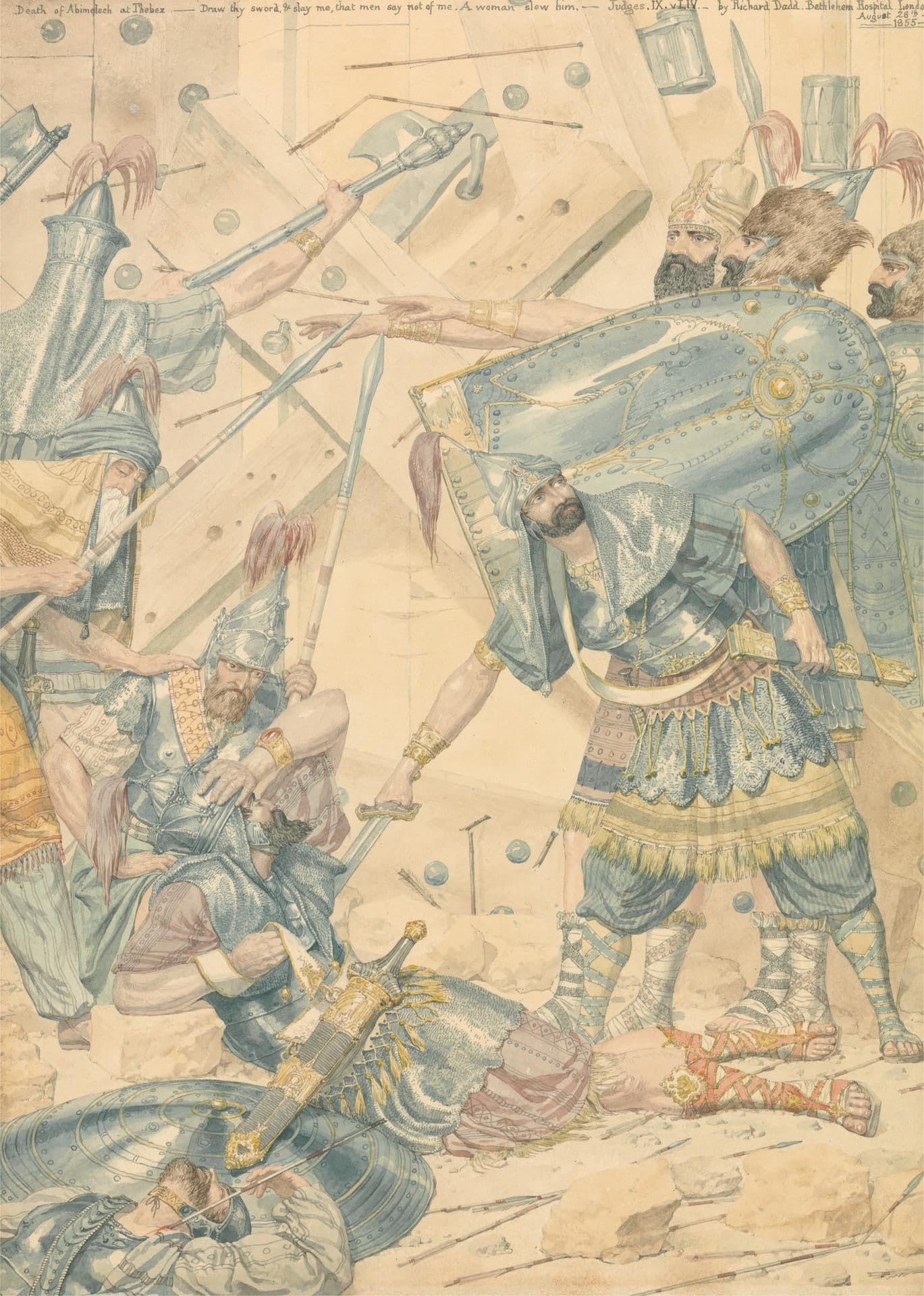
Richard Dadd, Death of Abimelech at Thebez, 1855, Yale Center for British Art. Public domain (CC0), via Wikimedia Commons.
THE ARTWORKDadd painted the fallen king beneath the tower at Thebez, with a warrior bent over him and soldiers raising their shields against the stones thrown from the wall.
Summary
Judges 9 shows a king and the city that crowned him destroying each other within a few years.
- Abimelech, the son of Gideon's concubine in Shechem, paid hired men with seventy shekels from the temple of Baal-berith.
- Jotham, the youngest son of Jerubbaal, hid and survived, and from the top of Mount Gerizim he told of the olive, the fig and the grapevine refusing to reign and the thornbush accepting.
- After three years God sent a spirit of animosity between Abimelech and the leaders of Shechem.
- Abimelech destroyed Shechem and burned the people who had fled to the temple of El-berith.
- At Thebez a woman dropped an upper millstone on his head, and his armor-bearer killed him at his own order.
The Story in the Book's Words
Judges 8:31 to 9:57, from the son born at Shechem to the curse fulfilled
His concubine, who dwelt in Shechem, also bore him a son, and he named him Abimelech.Abimelech's mother belonged to Shechem, and his whole claim on the city rests on that tie.
He went to his father’s house in Ophrah, and on one stone murdered his seventy brothers, the sons of Jerubbaal. But Jotham, the youngest son of Jerubbaal, survived, because he hid himself.The murder of the seventy is the crime the rest of the chapter repays, and Jotham's escape leaves one witness alive.
Then all the leaders of Shechem and Beth-millo gathered beside the oak at the pillar in Shechem and proceeded to make Abimelech their king.The leaders of the city made the king, so the curse that follows falls on them as well as on him.
And God also brought all the wickedness of the men of Shechem back upon their own heads. So the curse of Jotham son of Jerubbaal came upon them.The narrator closes by naming the curse, so the whole account is read as Jotham's words coming true.
Where it stands in the bookJudges 8:22 to 10:1
The account closes the story of Gideon's house that opens in Judges 6 and comes before Tola rose to save Israel in Judges 10:1.
Jotham's flight to BeerJudges 9:21
Then Jotham ran away, escaping to Beer, and he lived there for fear of his brother Abimelech.Jotham spoke and fled, and the fulfilment of Judges 9:56 to 57 comes without any act of his.
The Fable, the Three Years and the Places
The four trees in the order Jotham named them, the events in order and the places on the 1915 plate
An outline of Jotham's fable in the order of Judges 9:8 to 15, with its application in Judges 9:20 and its fulfilment in Judges 9:49 to 53.
The text counts three years of Abimelech's rule and gives days only for the fighting at Shechem.
- Gideon diesAt a ripe old age, buried at Ophrah of the AbiezritesJudges 8:32
- Baal-berith set upAs soon as Gideon was dead, and Israel turns to the BaalsJudges 8:33
- Abimelech at ShechemNot given, one man set against seventyJudges 9:2
- The seventy killedNot given, by hired men at OphrahJudges 9:5
- The crowningNot given, at the oak of the pillarJudges 9:6
- Jotham's fableWhen the news reached him, from Mount GerizimJudges 9:7
- Abimelech's ruleThree years, the only span the text countsJudges 9:22
- Gaal's feastAfter the grape harvest, Abimelech cursed in the house of their godJudges 9:27
- The night marchOne night and the next morning, four companies lie in waitJudges 9:34
- Shechem fallsThe next day, all that day, three companies take the cityJudges 9:45
- The tower of ShechemNot given, branches from Mount Zalmon piled and litJudges 9:48
- ThebezNot given, he is struck down at the towerJudges 9:53
A timeline of twelve events from Judges 8:32 to 9:53; where the text gives no time, the cell says so.
Thebez lay in the hills north-east of Shechem, across the valley from Mount Ebal and Mount Gerizim.
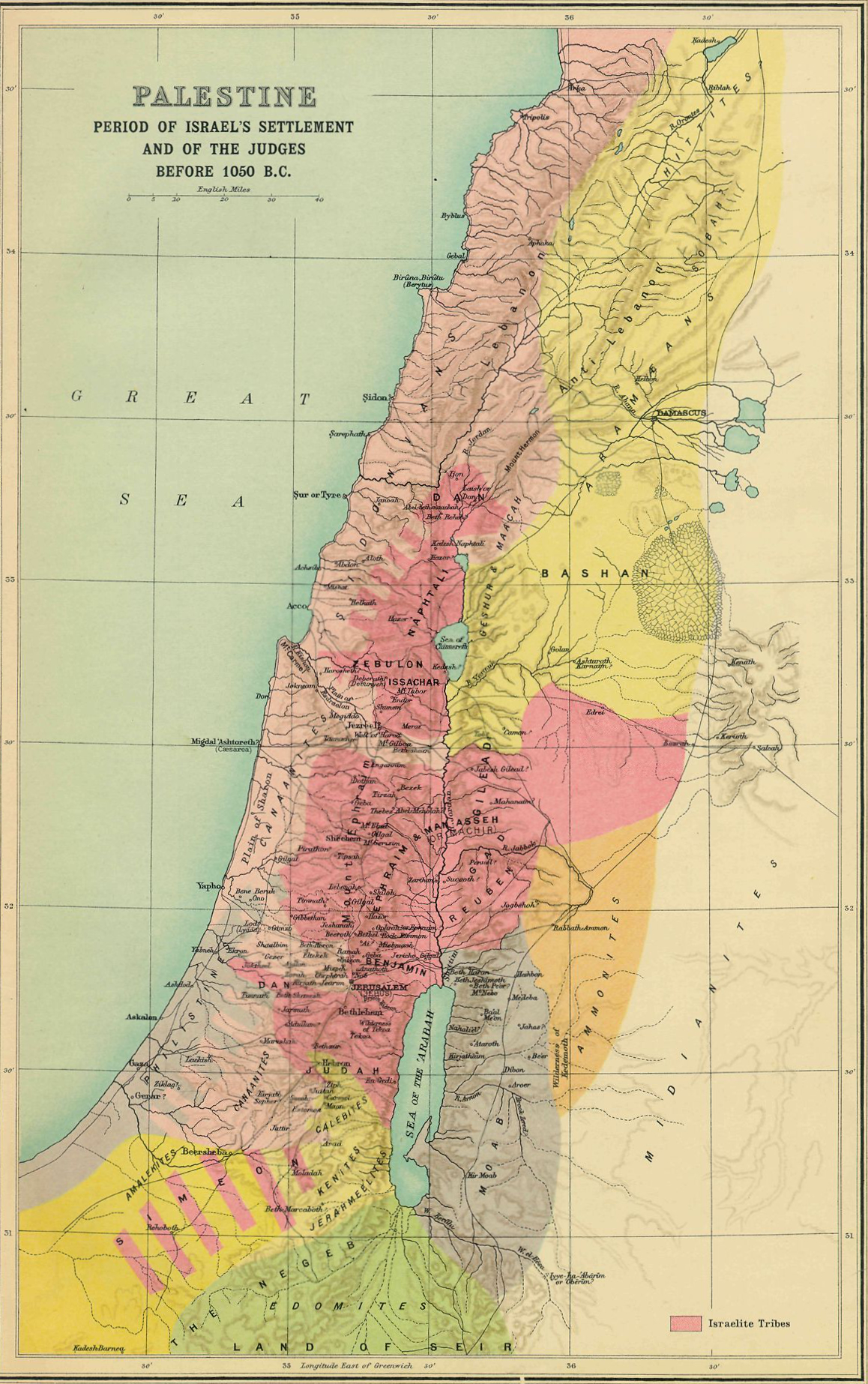
- ShechemThe leaders of the city made Abimelech king by the oak of the pillar.Judges 9:6
- Mount GerizimJotham spoke his fable from its top.Judges 9:7
- Mount EbalOpenBible takes it for Mount Zalmon, where Abimelech cut the branches.Judges 9:48
- ThebezA woman dropped a millstone on Abimelech from its tower.Judges 9:53
George Adam Smith, Atlas of the Historical Geography of the Holy Land, 1915, plate: Palestine, Period of Israel's Settlement and of the Judges. Public domain.
Each number stands where George Adam Smith's 1915 plate prints the name; the plate prints neither Arumah nor Gideon's Ophrah.
How sure each place isMoore 1895; Robinson 1841
George Foot Moore set the city in the valley between the two mountains, where the road from Jerusalem met the road to the Jordan. OpenBible's geocoding puts it at Tell Balata and takes Mount Zalmon for Mount Ebal, as Albert Barnes suggested.
Edward Robinson proposed in 1841 that the village of Tubas is Thebez, and Eusebius and Jerome had placed Thebez thirteen Roman miles from Neapolis on the road to Scythopolis. Arumah is named only in this chapter, and El-Ormeh, two hours south-east of the city, is proposed for it on the likeness of the name alone.
“The men of Thebez (modern Tubas) had, doubtless, joined the Shechemites in their rebellion against Abimelech.”
Albert Barnes · Notes, Explanatory and Practical, on the Old and New Testaments (1832-1869) · on Judges 9:50Evangelical
From the Oak at Shechem to the Tower at Thebez
Judges 9:23 to 55, from the spirit of animosity to the death at Thebez
God sent a spirit of animosity between Abimelech and the leaders of Shechem and caused them to treat Abimelech deceitfully,The narrator gives the cause before the first blow falls, and the cause is God's own act.
The leaders of Shechem turned on their king, set men in ambush on the hilltops and robbed all who passed. When a newcomer stirred the city against him, Abimelech came by night and beat the rebels back to the gate.
The next day Abimelech took Shechem, demolished it and sowed it with salt. The last of its leaders fled to the stronghold of their god, and Abimelech set it alight. He went on to Thebez, took the city and came to the door of its last stronghold to burn it, and he died there.
He quickly called his armor-bearer, saying, “Draw your sword and kill me, lest they say of me, ‘A woman killed him.’” So Abimelech’s armor-bearer ran his sword through him, and he died.Abimelech's last order was meant to keep his name from shame, and 2 Samuel 11:21 shows that it failed.
God and the spirit of animosityJudges 9:23 to 24
in order that the crime against the seventy sons of Jerubbaal might come to justice and their blood be avenged on their brother Abimelech and on the leaders of Shechem, who had helped him murder his brothers.The narrator ties the quarrel to the murder at Ophrah, so the war that follows is read as judgment for it.
“Their own lusts were evil spirits; they are devils in men's own hearts; from them come wars and fightings. These God gave them up to, and so might be said to send the evil spirits between them. When men's sin is made their punishment, though God is not the author of the sin, yet the punishment is from him.”
Matthew Henry · Commentary on the Whole Bible · on Judges 9:23Puritan
Gaal son of EbedJudges 9:28
Then Gaal son of Ebed said, “Who is Abimelech, and who is Shechem, that we should serve him? Is he not the son of Jerubbaal, and is not Zebul his officer? You are to serve the men of Hamor, the father of Shechem. Why should we serve Abimelech?Gaal turns the city's old line, the men of Hamor, against the son of an Israelite father.
Moore reads Gaal and his kinsmen as newcomers who stirred the revolt by appealing to the pride of Shechem's old families.
The salt on ShechemJudges 9:45
Albert Barnes reads the salt as Abimelech's wish that the ruined city should not even become a fruitful field, since salt stands for barrenness.
The Fable Beside Its Application
What the trees say in Judges 9:8 to 15, set beside what Jotham says to the leaders in Judges 9:16 to 20
Now if you have acted faithfully and honestly in making Abimelech king, if you have done well by Jerubbaal and his family, and if you have done to him as he deserves—The verse opens the long condition that Judges 9:19 completes, and each of its clauses measures Shechem by its debt to Gideon.
Moore notes that the application does not match the fable at every point. In Judges 9:15 the question is whether the trees deal in good faith with the thornbush, and in Judges 9:16 whether Shechem dealt in good faith with Jerubbaal's house. He finds such looseness common in the moral of a fable and holds that the fable and the speech come from one author.
The word for Abimelech's ruleJudges 9:22
Albert Barnes renders the verb "had ruled" and notes that it is not the phrase of Judges 9:6, as if Shechem alone had made Abimelech king.
“None could ‘reign’ in Israel, except by rebellious usurpation; and hence the reign of Abimelech is expressed in the original by a word signifying ‘despotism,’ not that which describes the mild and divinely authorized rule of the judge.”
Jamieson, Fausset & Brown · Commentary Critical and Explanatory on the Whole Bible · on Judges 9:22Reformed
A fable among the parablesJudges 9:8 and 2 Kings 14:9
Albert Barnes counts this fable and one other as the only two of their kind in Scripture and sets them apart from the parable of 2 Samuel 12:1 to 4. Adam Clarke calls it the oldest fable in the world, and Keil the earliest he knew.
But Jehoash king of Israel replied to Amaziah king of Judah: “A thistle in Lebanon sent a message to a cedar in Lebanon, saying, ‘Give your daughter to my son in marriage.’ Then a wild beast in Lebanon came along and trampled the thistle.Jehoash answers Amaziah with plants that speak, and again a lowly plant presumes upon a cedar of Lebanon.
Shechem, Its Temple and Its Tower
The city of Abimelech's mother, its god Baal-berith and the tower of Judges 9:46
Moore describes Shechem in Abimelech's day as a Canaanite town in which Israelites lived as sojourners rather than as citizens. Its god is Baal-berith in Judges 8:33 and 9:4, a name Jamieson, Fausset and Brown render "god of the covenant", and El-berith in Judges 9:46.
So they gave him seventy shekels of silver from the temple of Baal-berith, with which Abimelech hired some worthless and reckless men to follow him.The money for the murder came out of the temple treasury, so the city's god paid for the crime.
The oak of the pillarJudges 9:6 and Joshua 24:26
Keil and Delitzsch take the pillar for the large stone Joshua set up under the oak at Shechem, so that Abimelech was crowned where Israel had renewed its covenant with the LORD.
Joshua recorded these things in the Book of the Law of God. Then he took a large stone and set it up there under the oak that was near the sanctuary of the LORD.The next verse makes this stone a witness against the people if they ever deny their God.
A town or a citadelJudges 9:46 to 49
Moore holds that the tower of Shechem was an unwalled place near the city, named from a tower that stood there, and not a citadel inside the walls.
Gideon's House and the Crown
Gideon's refusal to rule, the ephod at Ophrah, Josephus's retelling and Moore's reading of the chapter
But Gideon replied, “I will not rule over you, nor will my son. The LORD shall rule over you.”Gideon's answer leaves the throne to the LORD, and one chapter later his son takes a crown.
Judges 8:27 says that the ephod Gideon placed at Ophrah became a snare to him and to his household, and Ophrah is where his sons died.
Josephus's retellingAntiquities of the Jews 5.7
Josephus names Abimelech's mother Drumah and sets the trees in the order fig, vine, olive. He counts about fifteen hundred who died at the rock, besides many others, and says that Jotham lived privately in the mountains for three years.
Moore on the chapter's place in the bookCommentary on Judges, 1895
Moore finds no mark of the Deuteronomic editor in the chapter and judges the story one of the oldest in the book. He also finds two accounts of how the war began woven into the one chapter.
What the Text Leaves Unsaid
The site of Ophrah, the town of Beer, the years before the murder, the woman's name and the size of the towers
Where was Ophrah?Judges 8:32
The text calls it Ophrah of the Abiezrites and gives no direction from Shechem. Moore reckons it lay not far from Shechem and calls its site unknown.
Where was Beer?Judges 9:21
The text names the town Jotham fled to and does not say where it lay. Moore records Beersheba and Beeroth as the guesses of earlier scholars.
How long after Gideon's death did it begin?Judges 9:1
“We are not told how soon after the death of Gideon these events happened. There must have been time for the apostacy and establishment of Baal-worship, and for the development of ill-will between Abimelech and his brethren.”
Albert Barnes · Notes, Explanatory and Practical, on the Old and New Testaments (1832-1869) · on Judges 9:1Evangelical
Who was the woman at Thebez?Judges 9:53
The text does not name her, and Joab's question in 2 Samuel 11:21 calls her only a woman.
How large were the two towers?Judges 9:46 and 9:51
The text gives no measure of the tower of Shechem or of the strong tower at Thebez, only that the people of Thebez went up to its roof.
The Fable in the Rest of Scripture
Joab's words to David's messenger and the mountain of blessing
Who was the one to strike Abimelech son of Jerubbesheth? Was it not a woman who dropped an upper millstone on him from the wall, so that he died in Thebez? Why did you get so close to the wall?’ If so, then you are to say, ‘Your servant Uriah the Hittite is dead as well.’”Joab expected David to cite Thebez as a warning against coming near a wall.
Deuteronomy 11:29 set the blessing on Mount Gerizim and the curse on Mount Ebal, and Jotham spoke his curse from the top of Gerizim.
How the Fable Has Been Taught
Three teachers from the fourth and fifth centuries
Methodius of OlympusBanquet of the Ten Virgins, fourth century
“But lest I should appear to some to be sophistical, and to conjecture these things from mere probabilities, and to babble, I will bring forward to you, O virgins, from the Old Testament, written prophecy from the book of Judges, to show that I speak the truth, where the future reign of chastity was already clearly foretold.…Now it is clear that these things are not said of trees growing out of the earth. Inanimate trees cannot be assembled in council to choose a king since they are firmly fixed to the earth by deep roots.”
Methodius of Olympus · Banquet of the Ten Virgins 10.2 · on Judges 9:8 to 15Patristic
Basil of CaesareaOn Humility, fourth century
“The homicide Abimelech, bastard son of Gideon, killed the seventy legitimate sons, and, thinking he had hit upon a ruse for securing his grasp on the royal power, he destroyed his accomplices in the crime. He, however, was in turn destroyed by them and in the end was slain with a stone cast by a woman's hand.… In short, countless examples teach us that the profit of human wisdom is illusory, for it is a meager and lowly thing and not a great and preeminent good.”
Basil of Caesarea · On Humility · on Judges 9:53Patristic
Augustine of HippoAgainst Lying, fifth century
“And no one has been so illiterate as to think that similar fables of Aesop, related for the same purpose, ought to be called lies. But also in the sacred writings such passages are found, as in the book of Judges the trees look for a king to rule over them and speak to the olive and the fig and the vine and the bramble. Surely, all this is invented in order that we may reach the matter intended by means of a narrative [that is] fictitious, to be sure, but bearing a true and not a false signification.”
Augustine of Hippo · Against Lying 13.28 · on Judges 9:8 to 15Patristic
Where Readers Differ
Two questions the fable raises, with the readers who hold each answer
What the three fruitful trees stand forRashi; Keil and Delitzsch; Moore
One reading names a judge in each tree. Rashi, after the Yalkut, reads the fig tree as Deborah and the vine as Gideon, and Keil reports the rabbis' reading of the olive as Othniel. Rashi joins the vine to Gideon through Joseph, whom Genesis 49:22 calls a fruitful vine.
The other side answers that Jotham applies the fable to Abimelech and to Jerubbaal's house alone (Judges 9:16).
The other reading finds no single persons in the trees. Keil and Delitzsch, in their Biblical Commentary of 1865, take the olive, the fig and the vine for the nobler persons who bear fruit in the calling God gave them.
George Foot Moore answers that, whatever the fable's origin, in its present place it sets Gideon's refusal against Abimelech's ready acceptance.
Whether the fable judges kingship itselfKeil and Delitzsch; Moore
Keil and Delitzsch hold that the fable judges the kind of crown Abimelech sought, a kingship given by the will of the people and not by the grace of God. Such a king, they write, is a tree without a firm root in fruitful soil.
The other side answers that the fable's last word is the fire of one thornbush, and Judges 9:56 to 57 applies it to one king and one city.
Moore holds that the author had one case in mind and passes no judgment on monarchy as a form of government. He names Reuss, Wildeboer, Budde and Smend as the critics who find such a judgment, and he calls the dating of the fable by its view of kingship precarious.
The first side points to Judges 9:23, where God sends the spirit of animosity that ends the reign.
Books on Abimelech and Jotham
A Critical and Exegetical Commentary on Judges
George Foot Moore · 1895
Moore takes Judges 9 verse by verse, with the sources of the chapter, the fable's application and the sites.
Read it free at archive.orgBiblical Commentary on the Old Testament: Joshua, Judges, Ruth
C. F. Keil and F. Delitzsch, translated by James Martin · 1865
Keil reads the fable clause by clause, with the Hebrew forms of its verbs.
Read it free at archive.orgThe Antiquities of the Jews
Flavius Josephus, translated by William Whiston · 1737
Josephus retells Abimelech's rise and fall in book 5, chapter 7.
Read it free at Project GutenbergBiblical Researches in Palestine, volume 3
Edward Robinson · 1841
Robinson's third volume records the villages of the hills north of Nablus as he found them in 1838.
Read it free at archive.orgThe Thornbush and Its Fire
Abimelech gained a crown by blood and lost it to a millstone, and the leaders who paid for the murder died in the fire at their own temple. The account asks the reader to know that God sees the blood of the innocent and repays it, even in a chapter where no judge is raised up.
Keep studying
Read it1