
Joshua 11:1 to 15 · Place · Featured Study
Hazor
Hazor led the kingdoms of Canaan's north, was built again under Solomon and fell to Assyria in 732 BC.
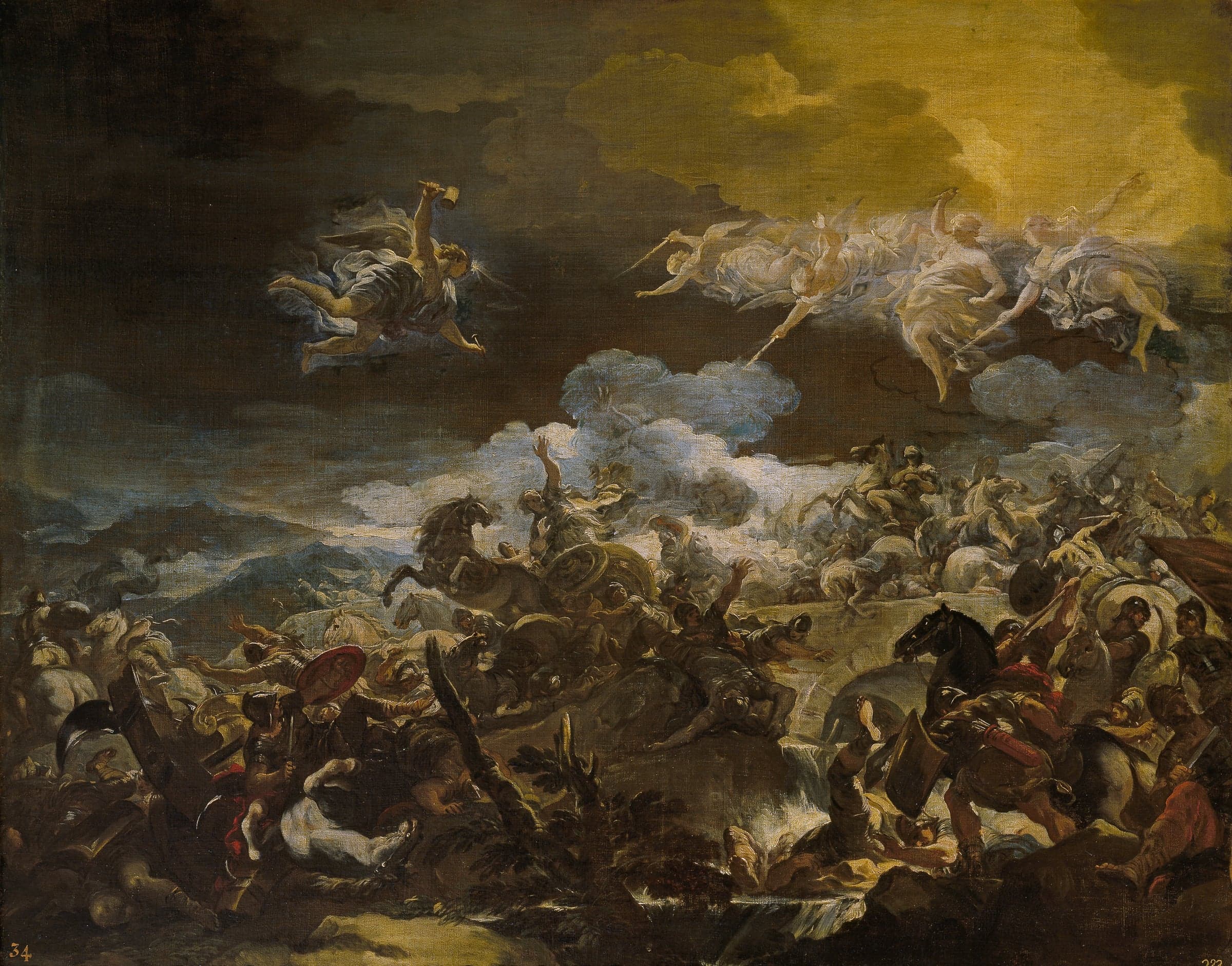
Luca Giordano, The Defeat of Sisera, 1692, Museo del Prado, Madrid. Public domain, via Wikimedia Commons.
THE ARTWORKGiordano painted the rout of the army of Jabin, who reigned in Hazor, with angels fighting from the clouds over the River Kishon. This battle broke the power of the king who ruled the city.
Of all the northern cities Joshua took, he burned Hazor alone.
Summary
When Joshua came north, Jabin of Hazor led the kings who gathered against him, and the city stands in Scripture from Joshua to the fall of Israel.
- Joshua routed the northern armies and pursued them as far as Greater Sidon.
- Jabin king of Hazor gathered the northern kings against Israel.
- In the days of Deborah a later Jabin reigned in Hazor, and Sisera commanded his army.
- The tell north of the Sea of Galilee has been excavated since 1955, and its burnt Late Bronze city has more than one reading.
The Head of All These Kingdoms
Hazor's king called the northern alliance, and Hazor paid for it.
Now when Jabin king of Hazor heard about these things, he sent word to Jobab king of Madon; to the kings of Shimron and Achshaph;Jabin sent the word that gathered the northern kings, so his city stands first in the chapter.
At that time Joshua turned back and captured Hazor and put its king to the sword, because Hazor was formerly the head of all these kingdoms. The Israelites put everyone in Hazor to the sword, devoting them to destruction. Nothing that breathed remained, and Joshua burned down Hazor itself.The verse gives the reason Hazor was singled out after the battle.
Why Hazor alone was burnedJoshua 11:13
Yet Israel did not burn any of the cities built on their mounds, except Hazor, which Joshua burned.Joshua 11:11 tells of Hazor burned, and this verse sets the city apart from the rest.
John Wesley gives two reasons for the burning. The city began the war, and as the chief royal city it might have renewed it.
Albert Barnes renders the verse as the cities standing each on its own hill, and takes it to mean that Joshua left those cities standing on their old sites.
The name HazorJoshua 19:36
Albert Barnes gives the name the sense of enclosed or fortified. He notes that two towns in the south of Judah bore it as well.
Adamah, Ramah, Hazor,Hazor stands in the list of the fortified cities of Naphtali, the northern tribe that received it.
Hazor and the Places of Its Story
Hazor stood at Tell el-Qedah, about 14 km north of the Sea of Galilee and 8 km southwest of Lake Huleh.
Five places tied to Hazor, from Damascus in the north to Jerusalem in the south.
- Located: the site is known
- Identified: the point stands for an area, or is rounded
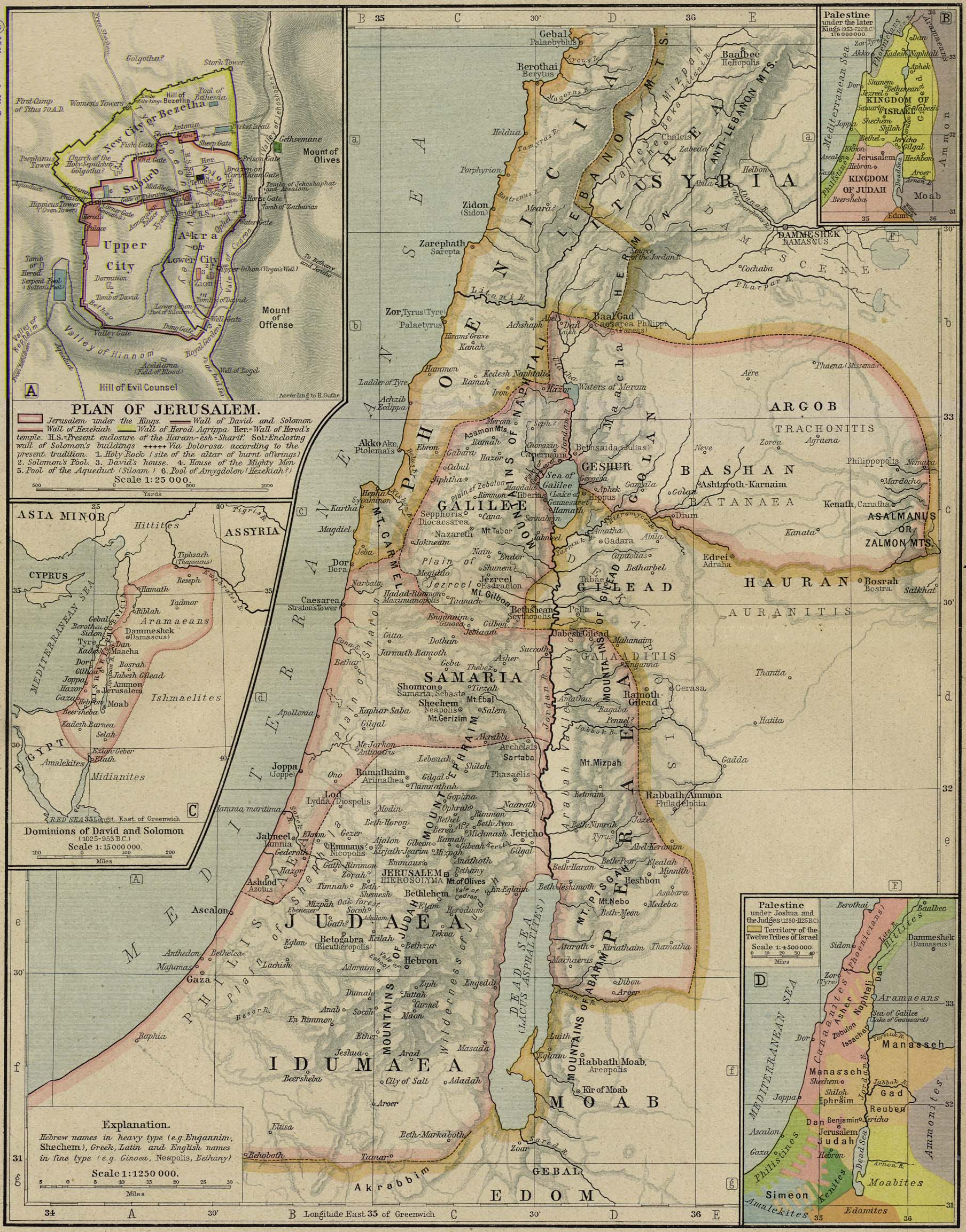
- 1Mount Hermon, The Hivites at its foot answered Jabin's call. Joshua 11:3
- 2Sea of Galilee, Kings came from the Arabah south of Chinnereth. Joshua 11:2
- 3Mount Tabor, Barak gathered ten thousand men there against Sisera. Judges 4:6
- 4Jerusalem, Solomon's forced labour built its wall, and Hazor with it. 1 Kings 9:15
- 5Damascus, Garstang found Hazor at the junction of the road from Egypt to Damascus and the road from Sidon to Beisan. Garstang (1927)
Base map: Reference map of ancient Palestine, Rand McNally reference map (1926), public domain. Each place stands at its place page's coordinates, set on the plate by Jerusalem and Damascus, as the plate prints them.
Each place carries the text or the record that ties it to Hazor.
The City Through Time
The excavators date the city's layers, and the verses place its events from Joshua to Tiglath-pileser.
Hazor was a city from the Early Bronze Age until the Assyrians took it in 732 BC.
- The Early Bronze AgeRemains of the first settlement, found in deep soundings on the tell
- The mid eighteenth century BCThe lower city is first settled and fortified
- The seventeenth and sixteenth centuries BCA settlement in the lower city is razed by fire
- The fifteenth and fourteenth centuries BCHazor is at its height, the largest city in Canaan
- The days of JoshuaJoshua burns Hazor after the battle at the waters of MeromJoshua 11:10 to 13
- Before the end of the thirteenth century BCThe last Late Bronze city falls, and the lower city is not lived in again
- The days of DeborahJabin king of Canaan reigns in Hazor, and Sisera commands his armyJudges 4:2 to 3
- The eleventh century BCAn unfortified Israelite settlement stands on the tell
- The reign of SolomonHazor is built with Megiddo and Gezer by forced labour1 Kings 9:15
- The ninth century BCA citadel and an underground water system are built in the days of the house of Omri
- The eighth century BCAn earthquake destroys the city of stratum VI, possibly the earthquake Amos namesAmos 1:1
- 732 BCTiglath-pileser III takes Hazor and carries the people of Naphtali to Assyria2 Kings 15:29
Twelve events at Hazor in order. Five rows carry the verse that names their event.
Three Things the Text Says Plainly
The text records the chariots burned, the king of Hazor in Joshua's list and the memory of Hazor's army.
JOSHUA BURNED THE CHARIOTS OF THE NORTH
The LORD told Joshua not to fear the northern armies and to hamstring their horses, and Joshua did as he was told after the battle.
THE KING OF HAZOR STANDS IN THE LIST OF KINGS
Joshua 12 counts the king of Hazor as one of the kings Joshua and Israel struck down west of the Jordan.
SAMUEL REMEMBERED THE ARMY OF HAZOR
Samuel reminded Israel that the LORD had sold their fathers into the hand of Sisera, the commander of the army of Hazor.
The Waters of Merom
The camp lay in the Huleh basin, a short march from Hazor.
All these kings joined forces and encamped at the waters of Merom to fight against Israel.The verse names the place of the battle that ended in the burning of Hazor.
Where the waters layBarnes and Gill on Joshua 11:5
Albert Barnes identifies the waters of Merom with the Bahr el Huleh, a lake in a basin some 15 miles long between the hills of Galilee and the lower spurs of Hermon.
John Gill adds that Josephus sets the camp at Beroth, a city of Upper Galilee not far from Kedesh.
The Tell and Its Excavators
Travelers proposed two sites for Hazor before anyone dug, and Garstang, Yadin and Ben-Tor have dug at Tell el-Qedah.
The lower city covered about 175 acres, and the tell about 30.
The 2 area in acres as a table
| Part of the site | Area in acres | What stood there | Verse |
|---|---|---|---|
| The tell | 30 | The upper city, rising about 40 m above the plain | |
| The lower city | 175 | A plateau north of the tell, walled by an earthen rampart and a fosse |
The two parts of the site of Hazor, each drawn by its area in acres.
Robinson's Tell KhuraibehSmith's Dictionary of the Bible, 1863
William Smith's Dictionary of the Bible found no site in the district that answered to Hazor. It accepted Edward Robinson's proposal of Tell Khuraibeh, a rocky height near Kedesh and Lake Huleh, until a better site was found.
Garstang at Tell el-QedahLiverpool Annals of Archaeology and Anthropology, 1927
Garstang described a great enclosure in the Huleh basin, about 1000 m by 400 m, with a mound called Tell el Qedah at one side about 160 m across. He took it for Hazor because Joshua 11 couples Hazor with the waters of Merom and with Sidon, and because the site commands the roads of the north.
The Encyclopaedia Judaica records that J. L. Porter had proposed the same tell in 1875, and that Garstang made soundings there in 1928.
Yadin and Ben-TorEncyclopaedia Judaica
Yigael Yadin led four seasons for the Hebrew University from 1955 to 1958 and a fifth in 1968. They showed that Garstang's enclosure was a lower city with five levels of occupation. Amnon Ben-Tor has led the excavations since 1990.
What the Text Leaves Unsaid
Joshua 11 leaves Hazor burned, and Judges 4 opens with a king reigning there again.
Smith's Dictionary of 1863 notes that Scripture does not tell whether the men of Naphtali or the second Jabin rebuilt the city.
Josephus on the end of JabinAntiquities 5.5.1 and 5.5.4
Josephus sets Hazor over the lake Semechonitis. In his telling Barak fought Jabin at Hazor after Sisera's death, killed him and overthrew the city to its foundation.
Where Scripture Returns to Hazor
Hazor returns in Judges, in the reign of Solomon and in the fall of the north to Assyria.
On that day God subdued Jabin king of Canaan before the Israelites. And the hand of the Israelites grew stronger and stronger against Jabin king of Canaan until they destroyed him.The Jabin of Deborah's day was subdued and destroyed, as the king of Hazor had been in Joshua's.
In the days of Pekah king of Israel, Tiglath-pileser king of Assyria came and captured Ijon, Abel-beth-maacah, Janoah, Kedesh, Hazor, Gilead, and Galilee, including all the land of Naphtali, and he took the people as captives to Assyria.The verse lists Hazor among the towns Tiglath-pileser took into exile.
The Song of DeborahJudges 5:19 to 21
The Encyclopaedia Judaica notes that the prose of Judges 4 names Hazor and the Song of Judges 5 does not, since the Song tells of a battle in the Jezreel Valley.
Kings came and fought; then the kings of Canaan fought at Taanach by the waters of Megiddo, but they took no plunder of silver.The Song names the kings of Canaan and the waters of Megiddo, and leaves Jabin's city unnamed.
Solomon's Hazor1 Kings 9:15
Smith's Dictionary of 1863 reads Hazor, Megiddo and Gezer as Solomon's points of defence for the entrance from Syria and Assyria, for the plain of Esdraelon and for the coastal lowland.
The Encyclopaedia Judaica reports that Yadin dated the six-chambered gate and casemate wall of the upper city to the tenth century, after 1 Kings 9:15.
Three Voices on the Two Jabins
Three commentators of the eighteenth and nineteenth centuries explain how a Jabin reigned in Hazor again in Judges 4.
John Gill holds that the burnt city was built again and held by Canaanites, who had a king of the same name in the days of Deborah.
Adam Clarke makes the second Jabin probably a descendant of the first, who gathered what was left of the army Joshua defeated.
Jamieson, Fausset and Brown read Jabin, which means the Intelligent, as a title the kings of Hazor inherited.
Who Burned the Late Bronze City
Three readings name who destroyed the last Canaanite city of Hazor.
The excavators agree on the physical record. The last Canaanite city ended in fire, and in its palace they found burnt cedar beams, a collapsed ceiling, bricks fused by heat and jars of scorched wheat.
A destruction about 1400 BCGarstang, 1934
In The Heritage of Solomon (1934) Garstang dated Israel's entry into Canaan to about 1400 BC. The Encyclopaedia Judaica reports that from his soundings he dated Hazor's final destruction to the same year, because he found no Mycenaean pottery there.
The objection: Yadin found Mycenaean and local pottery of the thirteenth century in the last city, and that pottery disproved Garstang's date.
The Israelite tribes in the thirteenth centuryYadin; Ben-Tor and Rubiato, 1999
In his article Hazor, printed again in the Encyclopaedia Judaica (second edition, 2008), Yadin ascribed the fall of the last city to the conquering Israelite tribes of the Book of Joshua. Amnon Ben-Tor and Maria Teresa Rubiato, writing in Biblical Archaeology Review in 1999, judged the Israel named on the stele of the pharaoh Merneptah the most likely destroyer.
The objection: Sharon Zuckerman holds that more recent dating places the destruction too early for the Israelites.
A revolt inside the cityZuckerman, 2006
In an article of 2006 in the same magazine, Zuckerman agreed with Ben-Tor in ruling out the Sea Peoples, the Egyptians and the rival cities of Canaan. She judged that a revolt inside the city destroyed it, and that the site then lay empty until the Israelites came.
The objection: Ben-Tor answered in the same magazine in 2013 that the Israelites destroyed the city.
Books on Hazor
Three of these four works can be read free online.
A Dictionary of the Bible, volume 1, the article Hazor
William Smith, editor · 1863
The article sets out the texts on the northern Hazor and records the site proposed for it before the excavations.
Read at archive.orgThe Site of Hazor, in the Liverpool Annals of Archaeology and Anthropology, volume 14
J. Garstang · 1927
The article argues its case from the roads and the texts, before any excavation.
Read at archive.orgThe Heritage of Solomon
J. Garstang · 1934
Garstang sets Hazor at the centre of the Canaanite north and dates Israel's entry to about 1400 BC.
Read at archive.orgHazor: The Rediscovery of a Great Citadel of the Bible
Yigael Yadin · 1975
Yadin wrote this book on the city he excavated.
In print: find it wherever books are sold.
The Land Had Rest from War
So Joshua took the entire land, in keeping with all that the LORD had spoken to Moses. And Joshua gave it as an inheritance to Israel according to the allotments to their tribes. Then the land had rest from war.With Hazor burned and the northern kings struck down, the chapter closes on the land given to the tribes.
Matthew Henry reads the rest of Joshua 11:23 as a promise kept.
“There failed not one word of the promise. Our successes and enjoyments are then doubly sweet and comfortable to us when we see them flowing to us from the promise (this is according to what the Lord said ), as our obedience is then acceptable to God when it has an eye to the precept. And, if we make conscience of our duty, we need not question the performance of the promise.”
Matthew Henry · Commentary on the Whole Bible · on Joshua 11:23Puritan
Keep studying
Read it4
Studies4
Doctrines1
Peoples and groups2